Liu Yong from TaoZ Capital: The Core Calculation Formula for the Success Rate of AI Startups
At the end of September, Liu Yong, Founding Partner of TaoZ Capital, stepped onto the podium for the third session of the *AI Entrepreneurship and Investment* course at Peking University.
In the first two lectures of this course, Wang Xiaochuan from Baichuan Intelligence talked about how entrepreneurs can stand on the side of non-consensus, and Zhu Xiaohu from GSR Ventures discussed the similarities and differences between the internet and AI venture capital logic, both of which are macroscopic overviews.
Liu Yong took the opposite approach and focused on the micro perspective: Split entrepreneurship into an arithmetic problem that can be deduced step by step just like a physics problem.
Liu Yong's own experience exactly spans the three rounds of technology cycles that this course covers.
He graduated from Peking University with a bachelor's degree in Physics, then went to the United States to obtain a Master's degree in Computer Science from UIUC and an MBA from the Kellogg School of Management. In 2003, he co-founded the social networking site Yiyou.com; in 2008, he founded Rekoo, making it one of the largest social game companies in Asia; in 2021, he joined BlueRun Ventures as an Investment Partner, focusing on investing in AI and Web3; in 2026, he founded TaoZ Capital, engaging in early-stage AI investment as an incubator rather than a pure financial investor.
Three points to clarify first:
1. This article is comprehensively sorted out by Surge AI based on the on-site recording transcript of Liu Yong's speech at Peking University and the public course notes, and has not been reviewed by the speaker; it is presented in the first person as an oral record, and some colloquial expressions have been streamlined; all information outside the classroom is marked as "Background Supplement" to be strictly distinguished from the speaker's original words.
2. We have corely included the parts of AI entrepreneurship methodology and business judgment, and released them in the form of viewpoints;
3. Some demonstration details of the courseware and Q&A sessions are not fully included. Readers who want to check the original content can search for other sorted versions on their own.
The core content of this oral transcript: Liu Yong presents his "Battlefield Priority Framework" — a formula about cost (machines plus energy compared to human wages), and points out that the success rate is the real lever in the formula; he uses the multiplication of single-step success rates to explain the widespread confusion of "AI can do everything but can't accomplish anything"; he uses the 87-day window after DeepSeek R1 was open-sourced to illustrate how to quantify timing judgment; finally, it falls on the new basic skill of AI product managers — "evaluation", the two separate accounting systems for China and the US, and the three most common pitfalls in AI entrepreneurship.
The following is the main text of the speech record —
01
Opening: There is also a formula for entrepreneurship
Thirty years ago, I was sitting in the classroom of Peking University like the students in the audience, studying physics, a very hardcore discipline.
Today, I want to follow the spirit of learning physics, use the first principle, and from the perspective of an entrepreneur, take a very hardcore look at how the entrepreneurial process goes step by step. When you really master some basic abilities, you will find that there is also a formula for entrepreneurship, and in some parts you can completely reason step by step just like learning mathematical analysis.
This course only discusses two variables: track and timing.
The track determines whether you are entering a battlefield worth fighting for ten years, and it determines the odds — how much profit you can get from one dollar; the timing determines whether the accounts can be balanced when you enter the market, and it determines the winning rate.
Translated in investment terms, these are two of the three questions VCs love to ask: why this, why now.
Let me start with my core judgment:
For AI entrepreneurship, learn to do the math first before talking about ideals.
Calculate the cost inflection point, accurately estimate the timing window, and correctly account for the scarcity shift.
When these three accounts are figured out, many debates will disappear on their own.
02
Bet on the racetrack, not the jockey
HSG has a book called *Racetrack First*, which can be summed up in one sentence: Bet on the racetrack, not the jockey.
Bet on the racetrack, not the jockey.
HSG will invest in two or three companies in the same racetrack at the same time, betting on the racetrack itself.
Of course, this strategy is a taboo for entrepreneurs. When you choose a VC, you need to think clearly about what the other party is betting on.
My judgment is: A top-tier track with third-tier entrepreneurs will have a significantly higher success rate than a top-tier entrepreneur working on a garbage track. A top-tier track will amplify the capabilities of ordinary people, while a third-tier track will swallow the talent of top players. If a top player is superimposed with a top-tier track, this buff will be even greater.
This is an unwritten rule that I didn't fully figure out when I was starting my own business, but discovered after entering the VC industry. *The Art of War* says "Those who are good at fighting seek victory from the momentum rather than blaming people", and momentum is greater than personal ability.
Choice is more important than effort. This sentence sounds like chicken soup, but it is correct.
03
Fast and Slow: It is worth spending one year on the direction
Entrepreneurship is not afraid of you running slowly. What people fear most is that you run fast, run hard, and run desperately on the wrong battlefield, which is totally counterproductive.
If you plan to build a company in eight to ten years, it is worth spending one-tenth of the time, that is, about a year, to carefully choose the direction.
Choosing the direction is not the end. After the company grows larger, you need to review it every quarter: Is the track still valid? Has the battlefield changed? Many companies die not because they chose the wrong direction at the beginning, but because the world changed after they chose the right direction, yet they failed to keep up with the changes.
Make big decisions slowly, and execute and verify quickly. Use two operating systems for the two phases and do not mix them up.
How to verify a direction? There are three criteria.
First, it conforms to the first principle, and there are real users who are willing to use it and pay for it.
Pay attention to the four words "willing to pay". Many AI products are willing to be used by users but not paid for, which is a signal that the accounts cannot be balanced.
Second, it is quantifiable and falsifiable.
Do not enter a direction where you cannot say "what data will prove that I am wrong".
Third, it still makes sense when placed in the long-term technology and economic cycle.
When I look at a track, I spend roughly half of my time studying history and the other half judging the future.
04
Kondratieff Wave Cycle: Embrace the bubble
Why do cross-century companies like Apple and Microsoft emerge in clusters in the same period? Why are both Bill Gates and Steve Jobs born in 1955? Because they were all born near the inflection point of new technologies: new technologies first change the cost structure, the cost structure breeds new user habits, the organization, channels and pricing of the old giants cannot keep up, and the window opens.
The clustering is not a coincidence, it is that the same window is seen by the same group of people.
To understand the time scale of this process, you need the ruler of the Kondratieff Wave Cycle.
The economy has a 50 to 60-year long wave, including recovery, prosperity, recession and depression, and each round corresponds to a major technological revolution.
When you are in different positions of the cycle, the strategies are completely different: in the introduction period, the competition is for the right to define the technical direction; in the outbreak period, the competition is for financing ability and expansion speed; in the diffusion period, the competition is for cost, efficiency and delivery; in the depression period, the competition is for cash flow, and the survivors will take over the market of those who fall.
The introduction period of AI's current basic capabilities has passed, and it is entering the diffusion period. The protagonist is no longer "who has a stronger model", but "who can turn capabilities into cheap, reliable and scalable delivery".
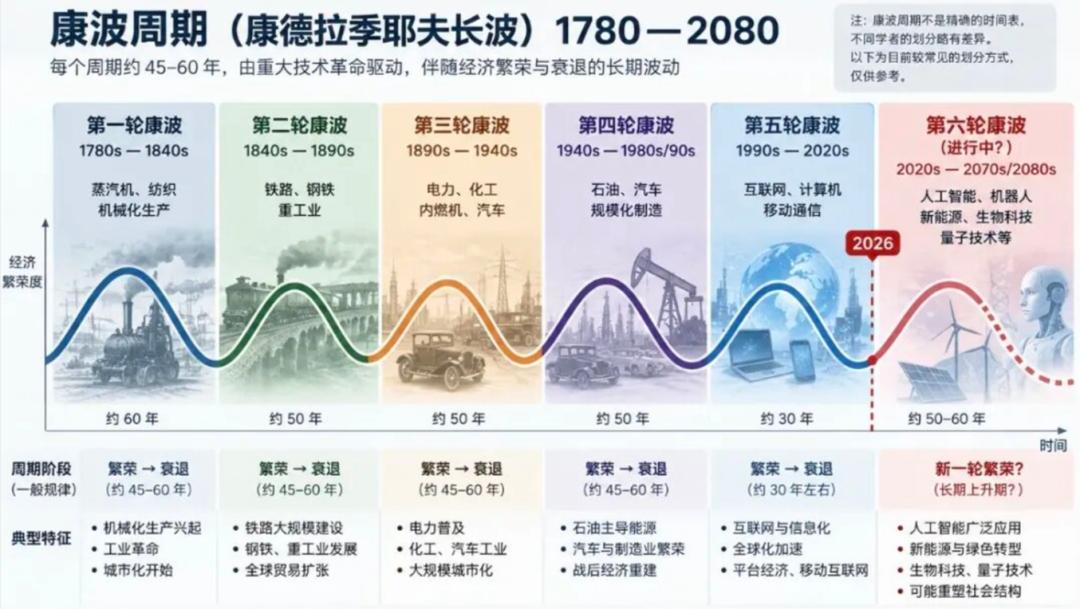
Image source: the Internet
There is another point I want to say to the students of Peking University: You must have a rich imagination, embrace the bubble, never be afraid of the bubble, and only by embracing the bubble can you get rich.
Every technological revolution is a big deal of dealing cards, which gives ordinary people three structural opportunities: a 100-fold increase in productivity brings a brand-new incremental market; the experience of the older generation is cleared, and everyone stands on the same starting line again; the barriers at the factor of production level are generally reduced.
People often only remember to fear the bubble, but the bubble is exactly when new players get to the table.
05
A cost formula: The success rate is the real lever
After talking about the macroscopic cycle, let's move to the most core set of formulas of the whole session.
Demand appears in the form of price: how much do you have to pay someone per hour to get this done — the opportunity cost of people from Peking University is definitely higher than that of the neighboring university.
The supply side consists of two parts: capital (embodied by machines) plus energy.
In the industrial era, energy was coal, oil and electricity. In today's AI era, the machine is the large model, and energy is electricity and computing power.
Only when the cost of new supply is significantly lower than the labor cost, the substitution will really happen, and the entrepreneurial window will open.
But there is an essential difference between AI and past machines: AI is a probabilistic product that will fail, and manual intervention is required after failure.
Therefore, the real cost on the supply side must add the cost of failure intervention and then divide by the success rate.
I have a set of calculations: when the success rate is 90%, the total cost is only 2.2 times higher than the theoretical value; when the success rate is only 20%, the total cost will be 45 times higher.
The success rate is the real lever variable in this formula.
This math can also explain a common confusion: why do large models seem to be omnipotent, but they hit a wall everywhere in practice? A complex task is composed of n simple steps, and the overall success rate is approximately equal to the nth power of the single-step success rate.
For a 50-step task, if the single-step success rate is 95%, the overall success rate is only about 8%; if the single-step success rate is 99%, the overall success rate is about 61%; only when the single-step success rate reaches 99.9%, the overall success rate can reach 95%.
However, the tasks we actually face may have 10,000 or 100,000 steps. This is why there is a huge gap between "amazing in the demo" and "really usable in the production environment".
The engineering implication is: Don't pursue 99.9% success rate for every step. Find 5% to 15% of the key nodes in the process, and arrange manual checks at these nodes.
The machine completes 95% of the process, and people only intervene once at the most error-prone place, then the overall success rate can be raised to a usable level.
06
The 87-day window: Timing can be calculated
How to judge the timing? Find the capability inflection point.
Model capabilities improve continuously, but your opportunities are discontinuous, which is a step function.
In January 2025, DeepSeek open-sourced the reasoning model R1.
After that, two phenomenal general Agent companies emerged in China: Manus was released on March 6, and Jasper, invested by BlueRun, was released on April 8, only two to three months after R1 was open-sourced.
The window period was exactly 87 days.
It is impossible to succeed in making the so-called general Agent later, because the model has already reached that level.
Therefore, at that time, you can only go all out, work 7×20 hours to get it done. You must wait at the tuyere before the inflection point comes.

(Background Supplement: The growth of Manus after its launch confirms the importance of speed in the window period — its ARR exceeded 100 million US dollars 270 days after launch; in December 2025, Meta announced that it would acquire its parent company Butterfly Effect for 2 billion to 3 billion US dollars, but this transaction was stopped by the National Development and Reform Commission in April 2026 on the grounds of national security and the risk of key technology outflow. This is public report, not part of the course content.)
Let's talk about Claude Code next.
For the automated programming, Boris, the project leader, wanted to do it around 2022 and 2023. The product was made in 2024, but it was very difficult to use; it was barely usable in January 2025; until Opus 4 was released on May 22, 2025, its capabilities suddenly jumped to the 60% to 70% usable range.
Even Anthropic itself is essentially "making products for the next generation of models" when developing Claude Code — make the product first, and wait for the model capabilities to catch up.
Let alone our application companies?
Demand is always there, but the opportunity window only opens occasionally.
07
The three-day surfing method: Make products for the next generation of models
I summed up this set of observations into a method called the "three-day surfing method": essentially, all successful AI application companies are making products for the next generation of models.
It can be condensed into three mantras: Make products for the next generation of models, measure today, re-evaluate yesterday, and predict tomorrow.
The specific practice is to add a new basic skill for AI product managers: master evaluation.
Here we need to distinguish the two concepts of benchmark and evaluation: benchmark is a macroscopic and general evaluation set, many of which have been scored full marks today and cannot reflect the real capability gap; evaluation is aimed at your own product scenario, you design more than ten or twenty specific tasks by yourself, such as the complete process of booking a flight ticket, and continuously measure the completion quality, speed, failure rate and rework rate. A 10-point rise in the general ranking does not mean that your users will pay one more cent; a 10-point rise in your own 20 samples is what really matters.
How to select samples? Cover three categories: the tasks that users do most often, the tasks that are most likely to fail in history, and the tasks that the next generation of models may newly unlock.
When you see that the evaluation score of a capability rises from 10% to 20%, suddenly jumps to 40%, then to 60% and 70%, you know that the inf