MiniMax's valuation has plummeted by 80%, and DeepSeek plans to raise 100 billion yuan in financing: Who will take up the offerings amid the large model IPO boom?
The large model industry has two separate price tags across two different markets. Prices in the secondary market dropped for another round last week, while valuations in the primary market are still climbing. The divergence appears to stem from different perceptions on the surface, but the underlying reality is that the group of decision-makers who set valuations has been fully replaced.
On October 8, Hong Kong stock MINIMAX closed down by more than 13%, Zhipu AI fell by over 7%, and the Hang Seng Tech Index closed at 4073 points, hitting its lowest level since September 2024.
In the same week, Bloomberg successively confirmed two primary market transactions. DeepSeek is close to locking in a new round of financing of at least 800 billion yuan, with a maximum amount approaching 1 trillion yuan; Moonshot AI completed the last private placement before its IPO at a valuation of 500 billion US dollars. During the same period, Kuaishou-owned Keling was also reported to be listed in Hong Kong as early as next year, with an estimated valuation of about 122.8 billion yuan calculated based on the capital increase price at the end of August.
The secondary market has given its answer through sell-offs, while the primary market responds with higher bid prices.
The pricing power of large models is changing hands. The secondary market has already priced assets based on revenue structure, while the primary market is still making bids based on scarcity. The coexistence of these two prices relies on the following fact: the primary market price is a negotiated price that takes effect once signed by a few parties, and has not yet undergone public scrutiny.
In a sense, all the players in a rush during this wave of IPOs are seizing the time window before the arrival of that public scrutiny.
Even after losing 80% of value, these assets are still not cheap
The secondary market has already delivered its verdict, and the evidence can be seen in the performance of Zhipu AI and MiniMax over the past nine months.
The two companies went public one after another around January 8 and 9 this year. MiniMax received far more market favor at the time of listing: its issue price was 165 Hong Kong dollars, it rose by 109% on the first trading day, and its market cap reached 105.4 billion Hong Kong dollars, which was exactly twice that of Zhipu AI. At that time, the market only needed one reason to buy: for the first time, investors in the Hong Kong stock market could access pure large model assets, and the rush was driven by scarcity.
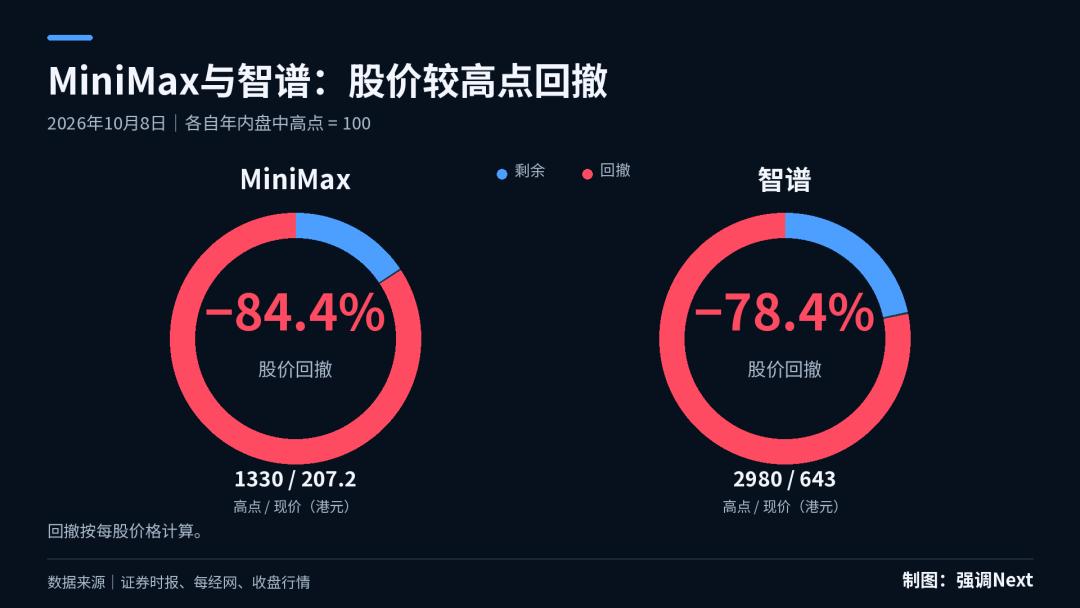
In March, MiniMax's intraday share price hit 1330 Hong Kong dollars, with its market cap once exceeding 400 billion Hong Kong dollars. On June 22, Zhipu AI's intraday share price touched 2980 Hong Kong dollars, giving it a market cap of 1.33 trillion Hong Kong dollars. Calculated based on Zhipu AI's revenue of about 7 billion yuan in 2025, its static price-to-sales ratio at the peak exceeded 1000x.
The divergence started with the shift of pricing power.
In February, Zhipu AI released GLM-5 and raised API prices. In the week of the release, its computing power reserve was fully exhausted, and its core product Coding Plan was temporarily out of sale. After successive price hikes in March, April and September, by the end of August, the token call volume on its MaaS platform had increased by more than 40 times compared with the beginning of the year, API pricing rose by 101% year-on-year, and the gross margin of its open platform and API business climbed to 24.6%. Raising prices without losing customers is the most solid proof of pricing power.
MiniMax presented a completely different situation. Its flagship model M3 was released on June 1, and it announced a permanent 50% price reduction about a week later. JPMorgan immediately downgraded its rating from Overweight to Neutral. With 212 million users and over 70% of revenue coming from overseas, it still failed to get any room for price hikes. The 2025 annual report shows that its annual book net loss reached 1.87 billion US dollars, of which about 1.59 billion US dollars was the book loss from the fair value revaluation of preferred shares before listing, and its operating-level loss was about 280 million US dollars.
The share lock-up expiration in July marked the start of real market voting. On July 9, MiniMax had 153 million shares unlocked for the first time, accounting for about 48.9% of its total share capital. Its share price fell by nearly 18% in a single day, with a closing market cap of 93.3 billion Hong Kong dollars. On the same day, Zhipu AI's market cap was about 906 billion Hong Kong dollars, which was 9.7 times that of MiniMax, while the ratio was only 0.5 on their listing day.
By October 8, the gap had narrowed to 4.3 times: Zhipu AI closed at 643 Hong Kong dollars, with a market cap of about 313.5 billion Hong Kong dollars, down about 78% from its peak in June. MiniMax closed at 207.2 Hong Kong dollars, with a market cap of about 73 billion Hong Kong dollars, erasing about 340 billion Hong Kong dollars from its March peak.
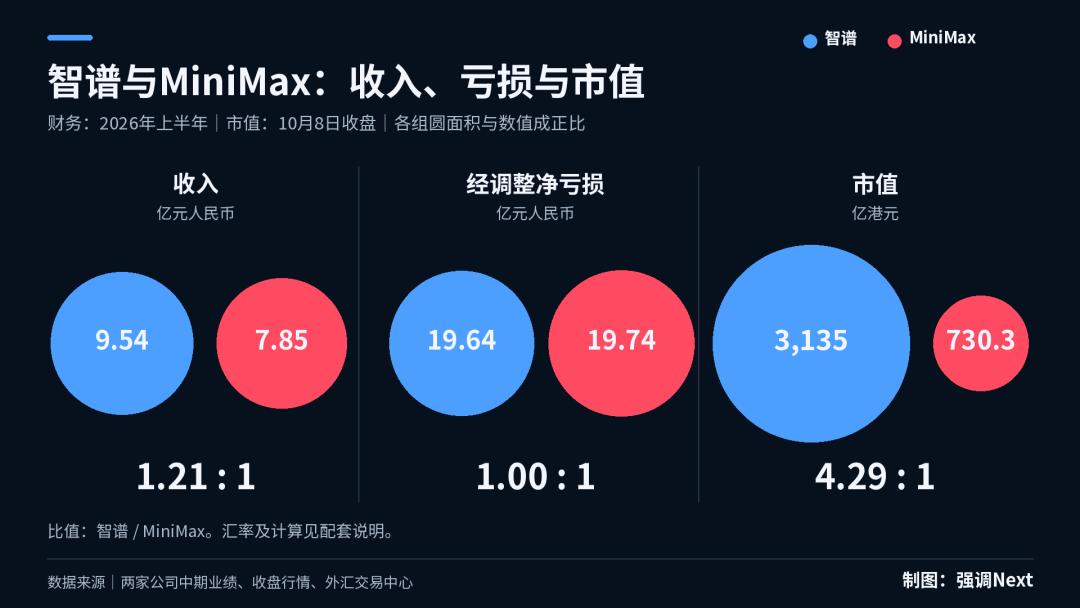
Even after such a sharp drop, neither of the two companies is considered cheap. Calculated based on annualized revenue in the first half of the year and the closing market cap on October 8, MiniMax has a price-to-sales ratio of about 40x, and Zhipu AI's ratio is about 150x.
In the first half of the year, the revenue gap between the two companies was less than 20%, and their adjusted net losses were almost the same, both around 19.6 billion yuan, but their market caps differed by more than four times. This is because while the secondary market has erased most of the peak market value, the prices paid by investors still include a large amount of expectations for future performance.
The "discount" in the primary market is only relative to Zhipu AI
Looking at the primary market for comparison, Keling's valuation of about 122.8 billion yuan corresponds to revenue of about 1.5 billion yuan in the first half of the year, with an annualized price-to-sales ratio of about 41x. Moonshot AI's 500 billion US dollar valuation corresponds to an ARR of about 10 billion US dollars, giving a ratio of about 50x. For DeepSeek, based on the pre-money valuation of about 5 trillion yuan and annualized revenue of about 1 billion US dollars reported earlier, its price-to-sales ratio is about 74x.
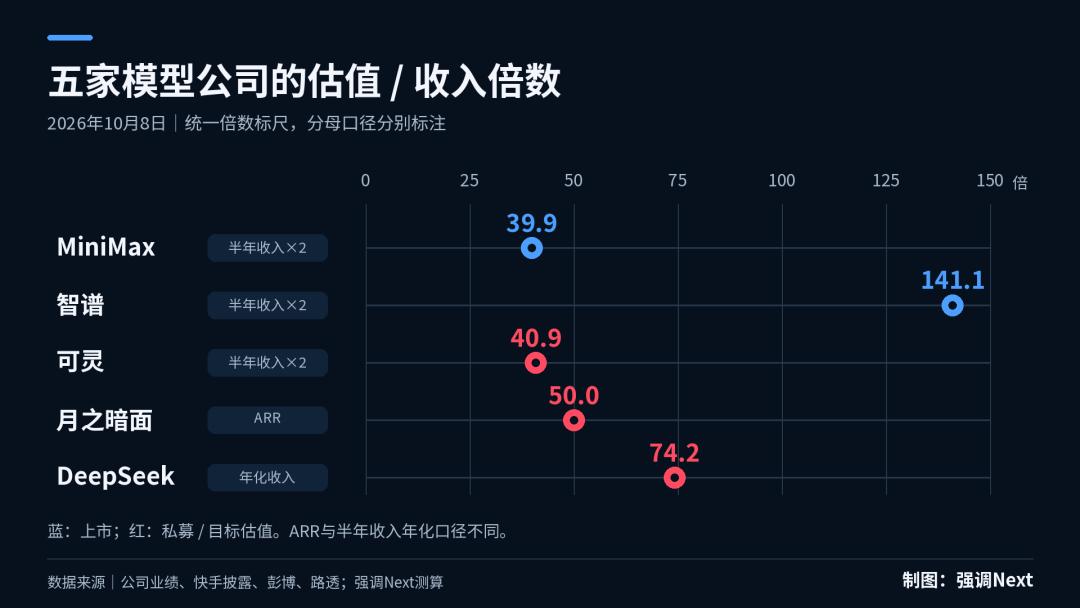
MiniMax at 40x, Keling at 41x, Moonshot AI at 50x, DeepSeek at 74x, and Zhipu AI at 141x. The primary market is sandwiched between the two listed stocks, more expensive than the fully priced MiniMax, and cheaper than the not-yet-fully priced Zhipu AI. The real divergence first emerged inside the secondary market.
However, it should be noted that the multiples calculated based on half-year revenue and current ARR have different levels of validity, and the latter reflects the business pace at the current point in time to a greater extent.
Primary market investors dare to make bids because they have the 141x multiple of Zhipu AI as a reference. The pricing of the last round before IPO always refers to the price that peer companies can fetch after listing, and the most expensive peer happens to be Zhipu AI, which is also the one that may continue to have its valuation bubble squeezed. If its price-to-sales ratio moves further down toward MiniMax's level, the valuation discount in the primary market will disappear completely.
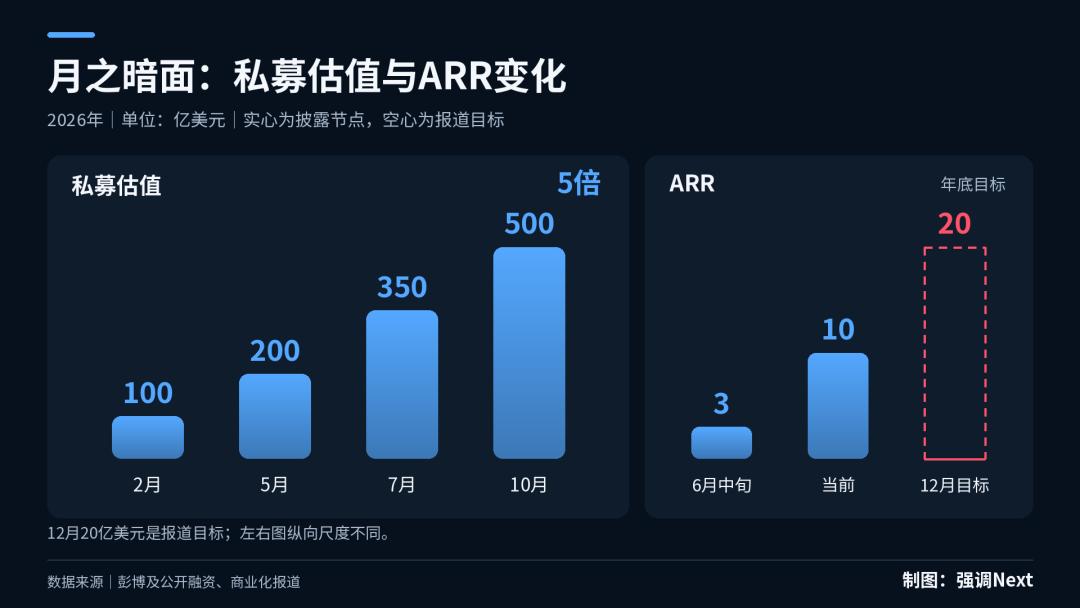
Moonshot AI has the steepest valuation growth curve in the primary market this year: its valuation was 100 billion US dollars in February, 200 billion in May, 350 billion in July, and 500 billion in October, marking a fivefold increase in eight months.
The curve is supported by revenue expectations. Moonshot AI's ARR was 3 billion US dollars in mid-June, and now it is about 10 billion US dollars, and it is reportedly expected to reach 20 billion US dollars in December. Calculated based on the 20 billion US dollars ARR, the 500 billion US dollar valuation corresponds to a multiple of only 25x, which seems sufficiently cheap, but the premise is that it can double its revenue scale again before the IPO roadshow.
Some buyers never refer to secondary market trends
Another reason why primary market prices can deviate from secondary market prices for a long time is that bidders do not only consider financial returns.
The top two investors that pledged the largest capital contribution for DeepSeek's this round of financing are CATL and Tencent. Moonshot AI's Series E round was led by Meituan Longzhu, and its Series F round in July was led by a national-level fund. Keling is backed by Kuaishou.
When industrial capital buys equity in model companies, they never only calculate investment returns.
CATL is buying the entry ticket for the "energy + computing power" narrative, Tencent is buying positions outside its own model system as well as the consumption outlet for its cloud business. Kuaishou values Keling at 120 billion yuan, while solving the issues of spin-off listing and parent company financial statements at the same time. According to reports, on September 30, Yan Yue, former head of Kuaishou's community science line, has taken up the new post of director and CEO of Keling.
The budget of this type of buyer will not fluctuate with secondary market trends.
In addition, there is a special structure in primary market pricing. Keling's capital increase agreement in July gives new investors a put option: if Beijing Keling fails to complete its IPO by the end of October 2031, it must repurchase the shares at the investment principal plus 8% annual simple interest. The negotiated price does not only take effect after signing, it also comes with a built-in guarantee, which is completely different from the prices that are publicly tested every day in the secondary market.
DeepSeek is the most representative case. Its first round of financing was about 500 billion yuan, with Liang Wenfeng personally contributing about 200 billion yuan, and the post-money valuation was between 3.5 trillion yuan and 4 trillion yuan. The latest round targets a valuation of about 5 trillion yuan (pre-money or post-money not disclosed), with the maximum financing amount approaching 1 trillion yuan. The valuation has risen by about 30%, while the financing amount has nearly doubled, and the equity stake taken by new shareholders has risen from about 13% in the first round to 17% to 20%.
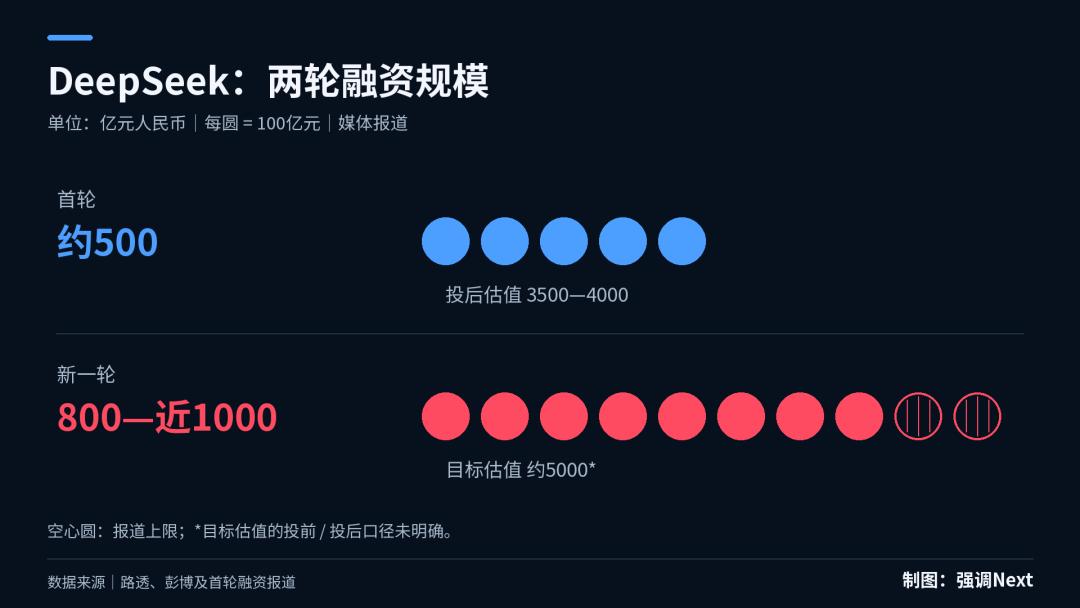
Bloomberg estimates that Liang Wenfeng holds about 78% of the shares and maintains nearly 100% voting rights through a limited partnership structure. So no control rights have been transferred, and all changes are reflected in valuation. For a founder who is not short of money and has firm control, the most reasonable explanation for selling more shares when the valuation growth rate cannot catch up with the financing growth rate is that the gap in computing power is more urgent than the valuation narrative. Sources say DeepSeek is building a data center in Inner Mongolia that plans to deploy at least 160,000 Ascend chips.
In September, Yan Wentao, former partner of GL Ventures, joined the company as its first CFO. According to reports, CITIC Securities is also preparing for its Sci-Tech Innovation Board listing, and the bell to ring the listing is getting closer.
How many more times will shareholders need to contribute capital
The huge losses of large models are being undertaken by capital at different levels in sequence: founders and early institutions contribute capital first, followed by national funds and industrial capital, private placements before IPO close the position, and finally the secondary market takes over.
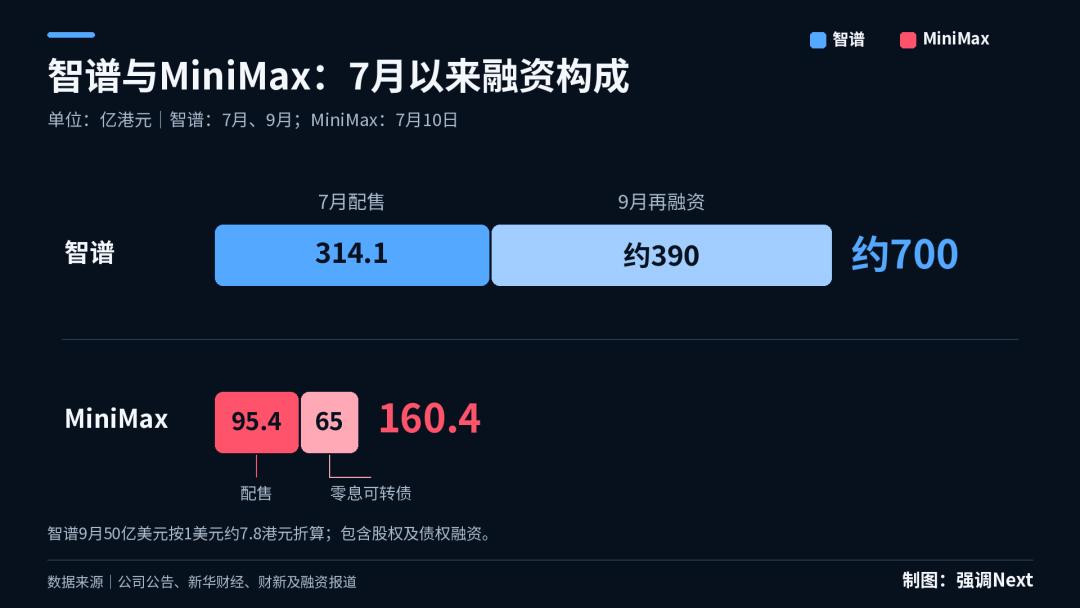
Zhipu AI is the clearest sample on this chain. On July 9, Zhipu AI placed new shares at 1588 Hong Kong dollars per share, raising about 314 billion Hong Kong dollars; in mid-September, Zhipu AI completed another refinancing of about 5 billion US dollars through a "small equity with large debt" structure. In more than two months, it raised about 700 billion Hong Kong dollars from the secondary market, which is more than 80 times its 2025 revenue. Some media estimate that with a daily cash burn of about 224 million Hong Kong dollars, Zhipu AI's capital can sustain its operations until the end of May 2027.
MiniMax also raised more than 20 billion Hong Kong dollars this year. On July 10, the day after its share price plummeted following the share lock-up expiration, it launched a placement plus zero-coupon convertible bond plan: 35.6 million new shares will be placed at 268 Hong Kong dollars per share, with a discount of about 9.9% from the previous closing price, plus 6.5 billion Hong Kong dollars of zero-coupon convertible bonds, totaling about 16 billion Hong Kong dollars. There was strong demand for the deal, which was 7 times oversubscribed, with more than 100 institutions participating, including more than 20 long-term funds and sovereign funds.
<