Yinjia Electronics' Hong Kong IPO Bid: Accumulated Losses of 286 Million Yuan Amid Aggressive Expansion, How to Resolve the Profitability Dilemma?
Recently, Shanghai Yinjia Electronic Technology Co., Ltd. (hereinafter referred to as "Yinjia Electronics") has officially submitted its listing application to the Main Board of the Hong Kong Stock Exchange, with Guotai Junan Financing as its exclusive sponsor. It is the latest "vanguard" joining the wave of smart driving companies listing in Hong Kong since 2025.
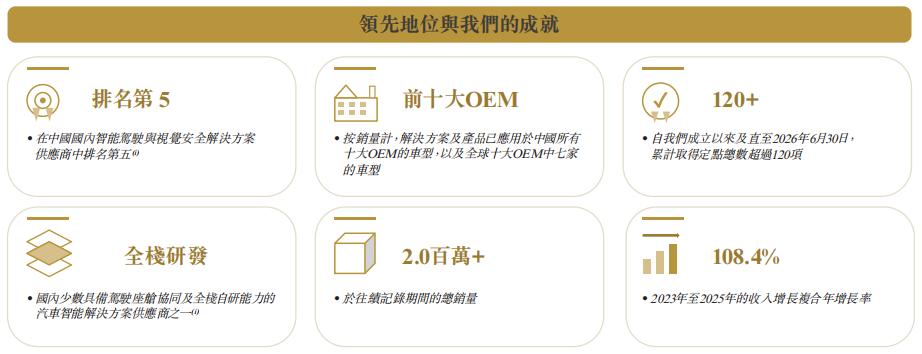
The data disclosed in the prospectus is quite impressive. From 2023 to 2025, Yinjia Electronics' revenue increased from 111 million yuan to 229 million yuan and then to 481 million yuan, representing a compound annual growth rate of 108.4%; its revenue in the first half of 2026 reached 336 million yuan, a year-on-year increase of 164%.
In terms of 2025 revenue, Yinjia Electronics ranks 9th in China's smart driving and visual safety solution market, and 5th among domestic suppliers. It is also the company with the fastest revenue growth rate in the top 10 list in that year, with a growth rate of about 100%.
However, the same prospectus also shows another set of figures: in 2023, 2024 and 2025, the company's net losses stood at 47 million yuan, 108 million yuan and 96 million yuan respectively, and it lost another 35 million yuan in the first half of 2026, with a total accumulated loss of about 286 million yuan in three and a half years. The net cash flow from operating activities has never turned positive during the reporting period, with a net outflow of 110 million yuan only in the first half of 2026, exceeding the full-year outflow in 2025.
Of course, the timing of Yinjia Electronics' listing application coincides with the busiest and most brutal stage of the industry. In February 2025, BYD launched its high-level intelligent driving system "God's Eye" on vehicles priced as low as 70,000 yuan, and the ensuing "intelligent driving equalization" brought more extreme cost squeezing from vehicle manufacturers to the supply chain. In the same year, a number of intelligent driving companies including Saimu Technology and Peetron entered the capital market intensively, and the head effect began to emerge.
On the policy front, the first batch of access permits for L3 conditional autonomous driving models were issued in China at the end of 2025, and the market is still expanding. Frost & Sullivan predicts that the size of China's smart driving solution market will increase from 197.3 billion yuan in 2025 to 553 billion yuan in 2030.
The market cake is getting bigger, but the way to share it is getting tougher. This raises several unavoidable questions: Why can't Yinjia Electronics, whose revenue has doubled for consecutive years, make profits all the time? The adjusted net loss rate has narrowed to 1.1% in the first half of 2026. Has the inflection point of break-even really arrived? With a balance sheet showing net liabilities of 336 million yuan and borrowings of 382 million yuan due within one year, is this IPO an expansion financing or a self-rescue that has to be completed?
I. Yinjia Electronics' business logic and high-quality shareholder background
Yinjia Electronics was founded in Shanghai in 2013. Its founder Chen Yinren has more than 22 years of working experience in the international electronics and automotive industries. The company started with visual perception products for panoramic surround view systems, and became a visual perception supplier for an international high-end automotive brand from 2014 to 2016.
After that, Yinjia Electronics gradually built a technology platform named VT-Navigara, an algorithm-based, software and hardware integrated infrastructure that supports three product lines: smart driving (VT-Pilot), smart cockpit (VT-Cockpit) and robotics (VT-Robotics). In 2024, the company was recognized as a national-level "Little Giant" enterprise specializing in special and new technologies by the Ministry of Industry and Information Technology.
The business logic of Yinjia Electronics is not complicated: it sells integrated software and hardware solutions and products to vehicle manufacturers and tier-1 suppliers, such as AEB automatic emergency braking, adaptive cruise control, automatic parking, in-cabin monitoring DMS, electronic exterior rearview mirror CMS, etc., and some software is charged separately in the form of SDK or license.
The company adopts the cost-plus method for product pricing: the benchmark price is determined by referring to the cost plus a reasonable profit margin, and then adjusted through negotiation with customers according to market competition and order volume. This pricing model determines the profit ceiling of Yinjia Electronics: the pricing power is in the hands of customers.
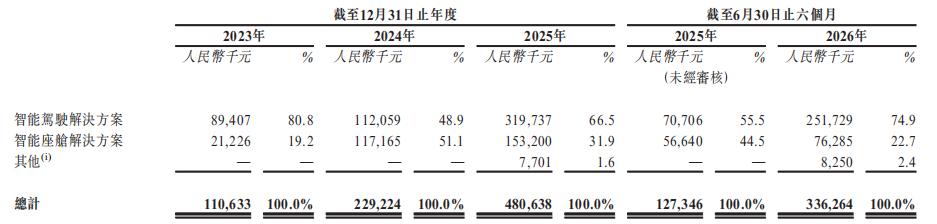
From the perspective of revenue structure, smart driving is its well-deserved core business. The revenue of this sector reached 320 million yuan in 2025, accounting for 66.5% of the total revenue; sales volume increased from 130,400 units in 2023 to 416,200 units, and the average selling price per unit rose from 685.8 yuan all the way to 889.5 yuan in the first half of 2026, with both sales volume and price rising.
According to the prospectus, the company has obtained more than 120 designated projects in total during the reporting period. Models of all top 10 vehicle manufacturers by sales volume in China are equipped with Yinjia Electronics' products, and models of 7 of the top 10 vehicle manufacturers in the world are also using its products.
Smart cockpit is the second business segment, with a revenue of 153 million yuan in 2025, accounting for 31.9% of the total. This business was mainly acquired through the acquisition of 70.11% equity of Shanghai Yuzhou Electric, which was founded in 1981, in April 2024, and its gross profit margin has been at a low level for a long time.
The third business segment is the UAV low-altitude economic solution launched in November 2025, which generated a revenue of 8.25 million yuan in the first half of 2026, accounting for 2.4% of the total, and is still in the initial development stage.
The shareholder list is a distinct feature of Yinjia Electronics. The controlling shareholder is Chen Yinren and his persons acting in concert, who jointly control about 48% of the equity through Wenjie Wuhu, Shanghai Bijie and Wenzheng Zhicheng. The three parties signed a concert party agreement on September 14, 2026, two weeks before the submission of the listing application, to consolidate the control right.
External shareholders are full of state-owned capital elements: the Shenzhen Venture Capital Group system (SCGC, Shanghai Hongtu), Shenzhen High-tech Investment, Oriental Fortune Capital, BOCOM Capital under Bank of Communications, Alibaba-listed company Huitongda Network (9878.HK), A-share listed company Jingxing Paper, as well as a large number of local government industrial funds from Wuhu Fanchang, Suzhou Xiangcheng, Chongqing Rongchang, Sichuan Tianfu, Huaibei, Pinghu, Tongxiang Wuzhen and other regions. This type of shareholder structure is becoming more and more common in current hard technology IPOs: industrial capital provides endorsement, and local state-owned capital offers support.
What is more noteworthy is the climbing rhythm of its valuation. The prospectus discloses that Yinjia Electronics' post-A-round valuation was 200 million yuan in December 2020, 560 million yuan after the B-round in 2023, and about 800 million yuan after the B+ round; its post-C-round valuation reached 1.1 billion yuan in April 2026, and only two months later in June, the post-Pre-IPO round valuation jumped directly to 2.78 billion yuan, more than doubling.
II. Mixed operating fundamentals: where is the problem?
The most glaring problem of Yinjia Electronics is not the loss itself, but the deviation between loss and revenue.
The year 2024 is a key to understanding Yinjia Electronics. Its revenue doubled to 229 million yuan that year, but the net loss expanded from 47 million yuan in the previous year to 108 million yuan, and the loss increase far exceeded the revenue growth.
Breaking down the data, the drag comes from three aspects: first, the amortization of customer relationship brought by the acquisition of Shanghai Yuzhou ate up 14 million yuan and 18 million yuan of profits in 2024 and 2025 respectively, and this amortization will continue for several years in the future; second, the administrative team expanded after the acquisition, and administrative expenses surged from 21 million yuan to 46 million yuan; third, the company borrowed money for working capital, and the financial cost doubled to 14 million yuan.
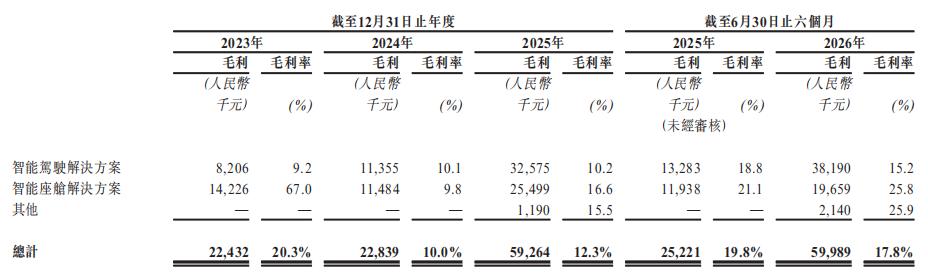
What really erodes the profit foundation is the gross profit margin. During the reporting period, the company's overall gross profit margin was 20.3%, 10.0%, 12.3% and 17.8% (first half of 2026) respectively. Among them, the 20.3% in 2023 was not real - the 67% gross profit margin of the cockpit business in that year came from a one-time large-scale software solution, which was not the normal state.
After excluding this disturbance, the company's true performance is clear: the smart driving business, which accounts for two-thirds of the revenue, has a gross profit margin hovering around 10% for a long time, which was 10.2% in 2025, and only 15.2% after improvement in the first half of 2026.
What does a 10% gross profit margin mean? Under the cost-plus pricing model, the annual "price reduction" convention of vehicle manufacturers will directly swallow the already meager profits, while the upstream automotive-grade chips account for about 40% of the cost, so the space for cost reduction is constrained by the supply chain.
Taking Desay SV, the leading intelligent driving company in the A-share market, as a reference: its comprehensive gross profit margin in 2025 was 19.07%, and the gross profit margin of its intelligent driving business was 16.36%. Its scale is dozens of times that of Yinjia Electronics, but its gross profit margin has declined for four consecutive years from 24.60% in 2021 to 19.07% at the end of 2025 due to the cost reduction demand of OEMs, with a total decline of 5.53 percentage points during the period.
Even the leading company is in such a situation, Yinjia Electronics' situation is the epitome of mid-tier suppliers in the industry: it has technology, designated projects and sales volume, but it is only a cost item in the bargaining system of vehicle manufacturers.
To make matters worse, there is the capital cost. In 2025, the company's financial cost was 16 million yuan, plus the 19 million yuan financial cost of the redeemable financial liabilities generated by the redemption right of Pre-IPO investors, the two items totaled 35 million yuan, equivalent to 60% of the gross profit of 59 million yuan in that year. Most of the gross profit earned after a year of hard work has to be used to fill the capital chain first.
There is also an easily overlooked signal on the expense side. The absolute amount of its R&D expenditure increased from 28 million yuan in 2023 to 49 million yuan in 2025, but its proportion in revenue dropped all the way from 25.2% to 10.1%, and further decreased to 7.4% in the first half of 2026.
The company explained that this was because early R&D investment had entered the harvest period and the scale effect was released. This statement is valid, but the flip side of the coin is that in the smart driving industry where technology iteration is counted by month, its R&D investment intensity continues to decline, which is inconsistent with the "full-stack self-development" narrative.
What is more tense than the income statement is the cash flow statement. During the reporting period, the company's net cash flow from operating activities was -89 million yuan, -126 million yuan, -78 million yuan and -110 million yuan respectively.
What is particularly alarming is the first half of 2026: the company's adjusted net loss has narrowed to 3.749 million yuan, close to book break-even, but the operating cash outflow reached 110 million yuan, 40% more than the full-year outflow in 2025.
Further analysis shows that the deviation between Yinjia Electronics' profit and cash flow actually lies in working capital.
The main crux is accounts receivable. Yinjia Electronics' trade receivables and notes receivable increased from 72 million yuan at the end of 2023 to 262 million yuan at the end of 2025 and 312 million yuan at the end of June 2026 - equivalent to 54% of the full-year revenue in 2025.
At the same time, its receivable turnover days decreased from 204.1 days in 2023 to 142.8 days in 2025, and then rose back to 154.3 days in the first half of 2026. The prospectus explained this as "several tier-1 suppliers delayed payment".
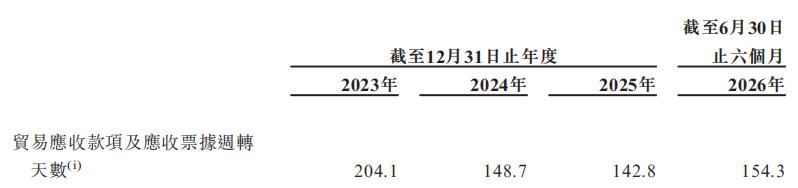
Yinjia Electronics only gives its main customers a credit period of 1 to 3 months, but the actual payment collection cycle is close to 5 months, which may indicate that a considerable part of its high revenue growth is achieved by advancing funds for customers.
To be fair, Yinjia Electronics is not without merits. Its inventory management is the most thoroughly improved item during the reporting period: inventory turnover days were compressed from 205.8 days in 2023 to 64.1 days in the first half of 2026, and the cash conversion cycle was shortened from 86.3 days to 47.2 days in 2025, and rebounded to 61.1 days in the first half of 2026.
In terms of supply chain, the company's procurement proportion from the top five suppliers decreased from 54.4% to 42.3%, and the chip procurement adopts a dual-platform strategy of domestic and imported chips; the gross profit margin of the cockpit business recovered from 9.8% in 2025 to 16.6%, and further increased to a high level of 25.8% in the first half of this year, which is mainly benefited from the company's supply chain integration after the acquisition.
The customer structure is also being optimized. The revenue proportion from the top five customers of the company decreased from 93.2% in 2023 to 51.7% in 2025, and rebounded slightly to 54.7% in the first half of 2026; the dependence on the largest customer decreased from 47.5% to 14.8%, and the fragile structure where one customer contributed half of the revenue in 2