Proposes to launch another HKD 4 billion share placement, with its share price tumbling nearly 12%: the capital challenge facing Biren Technology
Biren Technology, a domestic Chinese AI chip company, has once again stepped into the spotlight of the capital market.
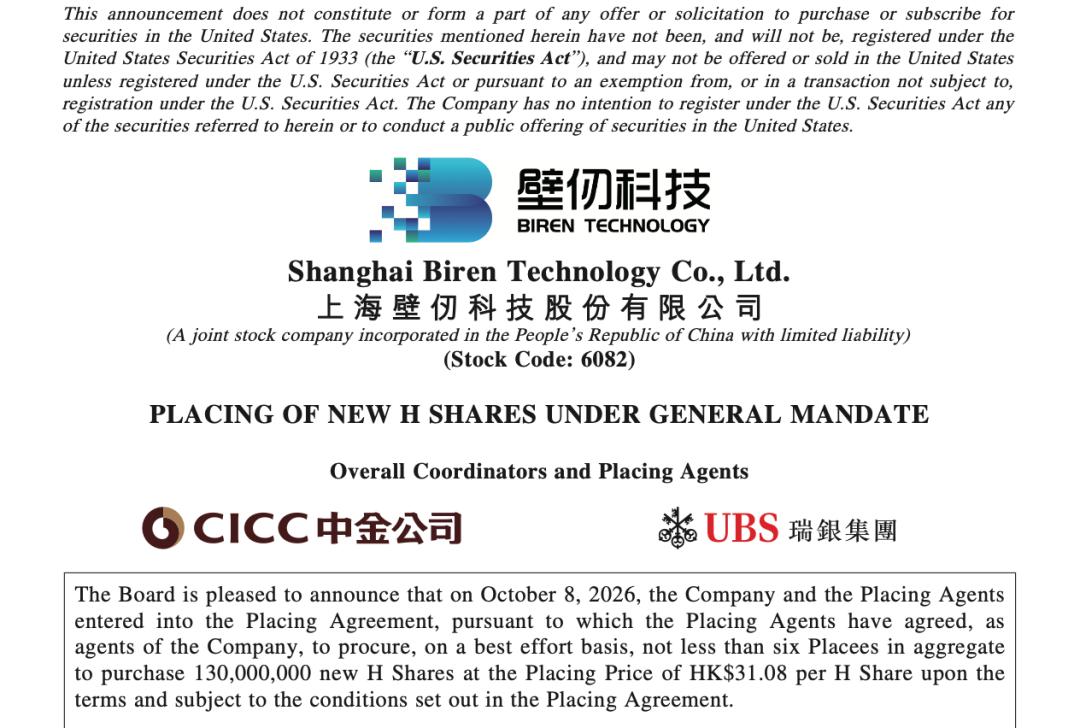
On October 8, Biren Technology announced that it plans to place 130 million new H shares at a price of HK$31.08 per share. Assuming all shares are fully subscribed, the estimated net proceeds will be approximately HK$4.0197 billion. The placing price represents a discount of about 9.76% to the closing price on the previous trading day.
On the same day, Biren Technology's share price fell by 11.9%.
This financing comes right after Biren Technology completed a placing of approximately HK$7 billion in July.
Looking at the overall capital utilization rate of the last round of placing alone, it was about 14% as of September 30; but the company also released another set of key information in its latest announcement: the funds allocated for the commercialization of new-generation products and production preparation are expected to be used up faster than originally planned.
Therefore, the core issue of this financing is not just "whether the company is short of money", but why Biren Technology chooses to invest more funds in advance before its new-generation chips complete verification, customer certification and mass production, and whether these funds can be converted into stable delivery and commercial revenue as planned.
I
HK$4 Billion Placing:
Amount, Discount and Dilution
According to the Hong Kong Stock Exchange announcement, Biren Technology plans to place 130 million new H shares, and the placing agent will seek no less than six subscribers on a "best-effort basis".
If all shares are placed, the total gross proceeds are estimated to be HK$4.0404 billion, and the net proceeds after deducting placing commission and relevant expenses will be approximately HK$4.0197 billion.
The placing price of HK$31.08 represents a discount of approximately 9.76% to the closing price of HK$34.44 on October 7; and a discount of about 13.73% to the average closing price of approximately HK$36.03 in the previous five trading days. The placed shares account for approximately 4.76% of the enlarged total share capital.
It should be noted that this is a conditional placing arrangement, which does not mean that the funds have been received at the time of the announcement. The placing still needs to meet conditions such as the approval of the Hong Kong Stock Exchange for listing and trading, and the completion of relevant regulatory documents; the announcement clearly states that the placing may be completed or may not proceed at all.
The placing price discount and new additional shares will bring short-term dilution pressure. On October 8, Biren Technology's share price fell by 11.9%.
However, the one-day share price change cannot be simply attributed to the placing alone, nor does it mean that the market has denied the company's long-term prospects. More accurately, the market is simultaneously weighing the financing discount, share dilution and whether the new funds can drive subsequent growth.
II:
Last Round of Funds Are Not Idle
Company States Production Schedule Is Advanced
Biren Technology was listed on the Hong Kong Stock Exchange in January this year, and completed the placing of 153 million new H shares on July 8, with net proceeds of approximately HK$7.0376 billion.
As of September 30, the company has used approximately HK$982.8 million of the funds, accounting for about 14% of the net proceeds from the last placing. If only looking at this proportion, it is easy to draw the conclusion that "the newly raised money has not been used up yet, why raise funds again". But the announcement further breaks down the use of funds:
As of September 30, in the last round of placing, approximately HK$814.8 million of the funds allocated to accelerate the commercialization and production of new-generation products have been used, accounting for about 19% of the funds allocated for this purpose; the remaining approximately HK$3.4077 billion, the company expects most or even all of it to be used up by the end of 2026, earlier than the originally scheduled end of 2027.
The company stated that the progress of new-generation products is faster than expected at the time of the last round of financing, the demand for AI chips continues to rise, the upstream supply is tightening, the prices of key materials, components and production capacity are rising, and the procurement cycle is extended; large customers also put forward higher requirements for inventory preparation, delivery volume and delivery time of large-scale orders. Therefore, the company plans to make advance procurement, reserve production capacity, and prepare inventory buffers.
The announcement also specifically explained that part of the funds raised from the listing for "commercialization" was originally mainly used for sales and marketing, exhibition facilities, customer technical support, etc., and did not cover the supply chain procurement and production ramp-up mentioned this time. The company stated that the expenditures required for the updated production and procurement plans have exceeded the funds allocated for similar purposes in the IPO and the last round of placing.
This provides the company's own explanation for "why refinancing": it is not simply to raise more funds after the last sum of money is spent, but the pace of product and supply preparation has been advanced, and capital demand has increased accordingly.
However, this explanation also raises the execution requirements. Advance procurement and production capacity reservation can reduce the risk of insufficient supply and delayed delivery, but it also means that the company has to bear more capital occupation and inventory pressure before customer verification and order scale are fully realized.
III:
Where Exactly Will the Funds Be Invested?
Of the net proceeds from this placing, approximately 70% is planned to be used for strategic supply chain procurement, production preparation and commercialization of new-generation products, amounting to about HK$2.8138 billion; approximately 20% will be used for R&D capabilities and software ecosystem, amounting to about HK$803.9 million; the remaining approximately 10% will be used for working capital and general corporate purposes, amounting to about HK$402 million.
The company expects that funds related to supply chain and production preparation will be used up by the end of 2027, funds for R&D and software ecosystem will be used up by the end of 2029, and the working capital part is expected to be used up by the end of 2028.
The direction of capital investment itself reflects Biren Technology's current industrial stage: it not only needs to continue to develop chips, but also needs to procure materials and components for mass production, guarantee production capacity, prepare inventory, and improve software platforms, toolchains and compatibility with mainstream models and frameworks.
This is not an asset-light software business. From chip design to customer deployment, it involves R&D, supply chain, server and cluster solution adaptation. Funds usually need to be invested first, and revenue can only be gradually confirmed after product verification and customer delivery.
Therefore, financing can help the company gain time and production capacity, but it cannot replace customer certification, product stability and large-scale orders.
IV:
Revenue Is Rising, Losses Remain
Growth Quality Remains to Be Observed
Biren Technology recorded operating revenue of approximately RMB 1.236 billion in the first half of 2026, a year-on-year increase of about 1997.6%; gross profit was approximately RMB 527 million, with a gross profit margin of about 42.7%.
In the same period, the net loss was approximately RMB 377 million, narrowing by 76.4% year-on-year; the adjusted loss was approximately RMB 337 million, narrowing by 38.9% year-on-year. R&D expenditure was approximately RMB 804 million, up 40.7% year-on-year. These are the company's interim performance data, not the financial data in the placing announcement released on October 8.
The revenue in the first half of the year has exceeded the full-year revenue of approximately RMB 1.035 billion in 2025, indicating that there has been a significant growth in product sales and project delivery. However, the nearly 20-fold year-on-year increase is also affected by the low base: the revenue in the first half of 2025 was approximately RMB 58.9 million. High growth is an important progress, but it alone cannot prove that Biren has established a stable and replicable revenue curve.
The narrowing of losses also needs to be analyzed separately. The losses in the first half of 2025 included large financial costs such as book value changes of redemption liabilities. After the listing, the relevant investor redemption rights were terminated, and this part of the cost no longer appears in the same way. Therefore, the 76.4% year-on-year narrowing of net loss cannot be fully interpreted as a 76.4% improvement in the efficiency of the main business; the 38.9% narrowing of adjusted loss is more suitable to be observed side by side with the net loss indicator.
R&D expenditure accounts for about 65% of the revenue in the first half of the year, which also indicates that the company is still in a stage of high investment. Chip companies must continue to iterate their products, but whether R&D investment can be converted into product performance, software ecosystem, customer procurement and subsequent gross profit is the key to long-term operation.
V:
New-Generation Products Have Entered the Verification Stage
Mass Production Still Faces Certain Conditions
In the placing announcement on October 8, Biren Technology described its new-generation products as having completed bring-up and entered the post-tapeout verification stage; the company is communicating with existing and potential customers about deployment and has formulated a large-scale production plan.
The announcement predicts that customer sampling and mass production will be promoted in the next few quarters, on the premise that verification and customer certification are successfully completed.
This official announcement does not mention the product model. Some media reports refer to this new-generation product as BR20X.
"Completing bring-up and entering verification" is an important milestone in the R&D process, but there is still one or even more steps before passing customer certification and mass delivery. Chips need to go through stability, performance, power consumption, software adaptation and system-level verification; large-scale customers also need to confirm whether cluster operation, supply guarantee and after-sales support are reliable.
In addition, relevant entities of Biren Technology were once included in the Entity List by the U.S. Department of Commerce, and external export control and supply chain restrictions are also risk variables that the company must face. This makes locking the supply chain in advance practically meaningful, but it also requires the company to prove that the existing supply system is sufficient to support product iteration and large-scale delivery.
NewMang xAI Comment
Biren Technology's planned net proceeds of approximately HK$4.02 billion from the placing does not necessarily mean that its cash is already in urgent shortage. The company's revenue grew rapidly in the first half of the year, and a large proportion of the funds from the last round of placing are still unused; the core reason given in the official announcement is that the progress of new-generation products has been advanced, the production plan has been accelerated, and the demand for supply chain procurement and production capacity reservation has increased.
However, the more the financing logic relies on "imminent mass production", the more specific the market's requirements for subsequent fulfillment will be. Investors need to observe in the next step: whether the placing is successfully completed, how the supply chain funds are used, when the new-generation products complete customer verification and form mass shipments, and whether revenue growth can further bring loss narrowing and cash recovery.
The competition of domestic Chinese AI chips is no longer only about whether products can be developed. It also includes whether they can obtain production capacity in time, complete system adaptation, achieve stable delivery, and enable customers to make continuous repeat purchases.
What Biren Technology has obtained is the funds to keep running forward; what really determines whether this sum of money is worthwhile is whether it can be converted into orders and operating results.
Note on Materials:
The placing and use of funds are subject to the announcement released by Biren Technology on the Hong Kong Stock Exchange on October 8, 2026; financial data refers to the company's 2026 interim performance announcement.
The analysis in the article is an observation at the industrial and operational level, and does not constitute investment advice.
This article is from the WeChat official account "NewMang xAI", authors: Ge Lin, Dong Yizhen, published by 36Kr with authorization.