Manus in the cracks between major tech giants
Butterfly Effect, the parent company of Manus, is on a massive hiring spree in Beijing. Just one day after the job postings were released, founder Xiao Hong received thousands of resumes.
All 17 positions are based in Beijing, ranging from Agent Harness engineers to evaluation and research interns, virtualization engineers to business analysts, covering the full chain from the agent operation control layer to user growth and paid conversion.

Image source: Butterfly Effect
Nearly in lockstep with the hiring drive came the financing news. Butterfly Effect announced the completion of a new round of financing of over 500 million US dollars, led by Boyu Capital and IDG Capital, with continued support from existing shareholders Tencent, HSG, and ZhenFund. The corresponding valuation is approximately 4 billion US dollars, double the 2 billion US dollar price tag at the time of Meta's acquisition. This is by far the largest single financing obtained by a domestic native Agent startup.
Prior to the financing announcement, the product was already on the table. On September 28, Manus released its 2.0 version, replacing the underlying Agent execution framework with self-developed Cascade, launching cloud PCs that can run 24/7 and automated workflows triggered by external events, and upgrading the desktop application to Manus Studio which covers video editing and game development.
The independently launched standalone app Cue equips each Agent with a dedicated email address, phone number, wallet and computer.
Counting from the official announcement of resuming independent operation on September 1, Manus has completed a 500 million US dollar round of financing, a major version product release, and launched the formation of a domestic team in no more than five weeks.
However, just over a year ago, the situation of Manus was completely different. In 2025, Manus moved its headquarters to Singapore, then drastically downsized its China team, shifted its business focus to overseas markets, followed by Meta's lightning acquisition, the regulatory decision to ban investment, the original price repurchase by old shareholders, and seven months of user data deletion and recovery.
Today, this story that has lasted for more than a year has brought Manus back to the place where it started.
The returning Manus is facing an Agent track whose development landscape has completely reshuffled. When it left, "general-purpose AI agent" was still a new category defined by startups; after its return, Meta's Muse has exceeded 5 million downloads in less than a month after launch, Tencent's WorkBuddy has surpassed 20 million monthly visits for AI office agents on domestic PC terminals, and OpenAI and Anthropic have integrated Agent capabilities into their core products.
So, is Manus's 4 billion US dollar valuation too high? Can its annualized revenue of 400-500 million US dollars continue to grow after breaking away from Meta's channels? As a company that does not train foundational models and started by calling Claude, returning to a market squeezed by both big tech ecosystems and open-source Agents, where is its living space?
I. Selling Agents Just Like Selling Computers
Putting aside all those dramatic events including explosive growth, acquisition, suspension and repurchase, what Manus does is not complicated: users set a target, Manus pulls up a virtual machine in the cloud, calls tools such as browsers, code editors and file systems, and completes the task from start to final delivery.
In essence, Manus is a company that sells execution services, that is, users pay for the ability of Agents to handle affairs on their behalf. The core demand is to get things done, and make it more convenient than users doing it themselves. Users do not care whether Claude or GPT is called behind the scenes.
Manus adopts a subscription billing model, which means its revenue model is very simple: users pay on a monthly basis, and Manus provides services on a monthly basis.
Under this business model, revenue growth depends on two things: whether users are willing to keep paying, and whether the cost of a single execution can be kept low enough.
Based on this, Manus's founding team has a clear understanding. Xiao Hong uses "selling computers" as a metaphor for the company's business: people buy computers mainly for work, but a computer that cannot play videos or run games will make people feel boring.
This metaphor is a natural extension of the business logic of "execution services", with two layers of meaning.
The first layer is product logic. The same set of computing power can carry different needs such as office work, creation and entertainment. You can use it to write documents today, edit videos tomorrow, and play games the day after tomorrow, so the product has a wider range of usage scenarios.
The second layer is business logic. If Manus only sells one task execution, it will be no different from outsourcing. Users will leave after finishing one task and have no reason to keep paying. But what Manus sells is a "computer", including computing resources, software environment and continuous running time, so users will pay for long-term use just like buying a physical computer.
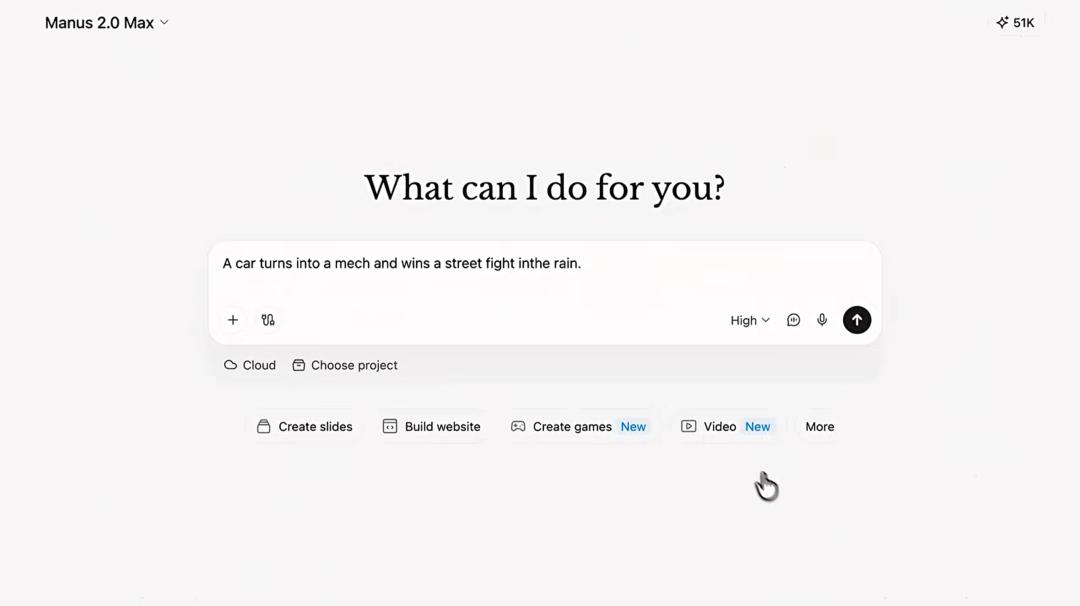
Image source: Butterfly Effect
This positioning explains a series of product decisions of Manus 2.0: the cloud PC is a resident Ubuntu virtual machine in the cloud, files, installed software, and running processes all remain on it. Even if the user's local computer is shut down and disconnected from the network, the Agent can continue working as usual.
Manus Studio upgrades the desktop application to a shared workspace for humans and AI, covering documents, spreadsheets, PDFs, slideshows, websites, codes, videos and games. For example, after users get the AI-generated draft, they can edit it directly on the timeline, or send it back to AI for further processing.
Cue extends this route to personal life scenarios, equipping each Agent with an independent email address, phone number, wallet and computer. Agents can send messages, answer calls, make payments within the budget on their own, and multiple Agents can be invited into the same group chat for division of labor and collaboration.
II. Manus's Independent Survival Test
From the perspective of revenue structure, Manus's ARR (Annual Recurring Revenue) has grown from 100 million US dollars in December 2025 to the range of 400-500 million US dollars by the end of June 2026. This growth curve is rare in the SaaS industry. In comparison, traditional SaaS companies usually take 5 to 7 years to achieve ARR from zero to 100 million US dollars, while Manus only took 8 months.
This growth curve has an unavoidable problem: it occurred in the seven months after Meta's acquisition. Less than two months after Meta completed the acquisition, it connected Manus to Ads Manager, opening it up to more than 10 million advertisers, and then expanded to the WhatsApp Business and Instagram ecosystems.
The seven months when Manus's revenue grew the fastest were exactly the seven months when it operated as part of Meta. This leaves a core problem for the newly independent Manus: how much of the past growth came from the Agent itself, and how much came from the traffic and distribution provided by Meta?
Guo Tao, an expert consultant at Wuhan Municipal Bureau of Commerce, said in an interview that Manus's explosive growth in this round took place during the Meta acquisition window, with obvious "event-driven" characteristics. How much the endogenous growth is needs to be carefully distinguished.
And he judged that if the revenue is highly concentrated in Meta as a single source, the original high-speed growth curve will most likely slow down significantly after the merger and acquisition is terminated, and Manus needs to re-verify its commercial hematopoietic capacity.
The independent Manus needs to prove how much of the 400-500 million US dollars ARR is endogenous growth and how much is channel inflow. If the ARR drops significantly after excluding the impact of Meta's pipeline, the 4 billion US dollar valuation will lose its support.
In addition, "shell wrapping" is the most long-standing label on Manus.
Since Manus does not have self-developed underlying large models, and its core capabilities rely on calling the API of Anthropic's Claude model, an open-source community once reproduced OpenManus with similar functions 3 hours after Manus became popular, adopting the MIT license. Anyone can use and modify its code for free, even directly use it for commercial products, no need to pay any fees to the original author, and no need to open source their own modifications, which further intensified the outside world's doubts about its technical barriers.
This label is too simplistic. An easily overlooked fact is that during the seven months of being acquired, investigated and required to be split, Manus did not stop product iteration, and its internal order did not collapse.
From the perspective of financial data, Manus's gross profit margin is about 50%. The Information reported that when Manus uses Anthropic's Claude, it needs to pay Anthropic 2 US dollars on average for completing each task.
This level of gross profit margin means that for every 100 US dollars of Manus's revenue, about half is used to cover costs dominated by computing power. The gross profit margin of traditional SaaS can usually reach 75%-80%. The cost structure of Agents is changing this paradigm: the more users there are and the more complex the tasks are, the revenue may increase, and the model and computing costs will also increase accordingly.
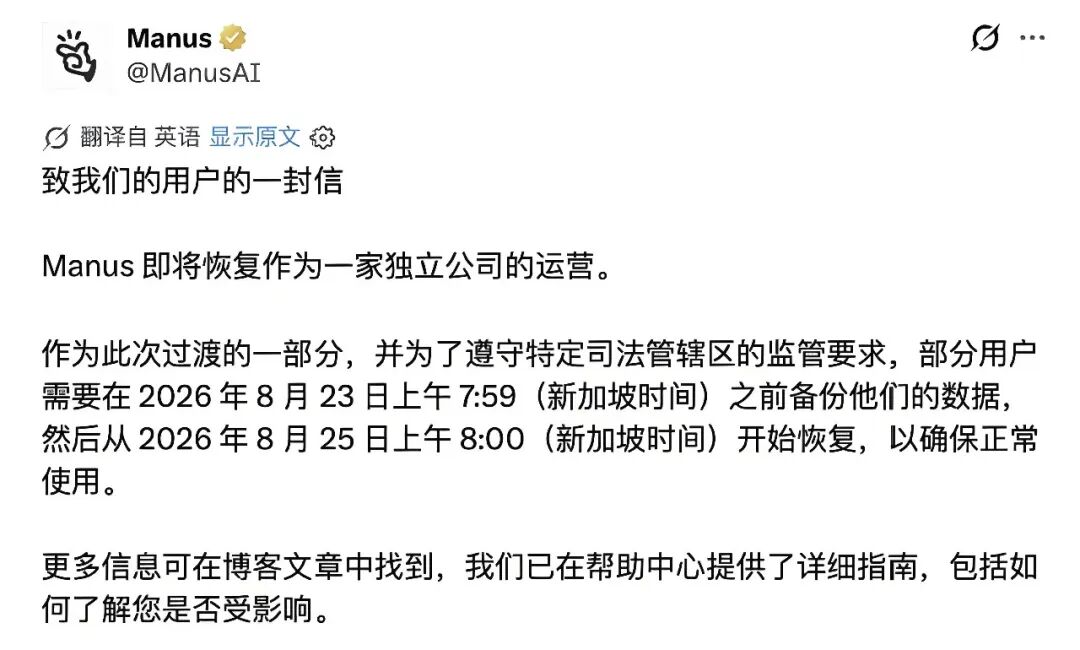
Image source: Jike
Next, let's look at the valuation. Looking at the number alone, Manus is indeed twice as expensive, but when revenue is taken into account, the situation changes, and Manus is even cheaper than when Meta acquired it.
Before Meta's acquisition, Manus's ARR was about 100 million US dollars, and the 2 billion US dollar acquisition price corresponded to about 20 times ARR. By the end of June 2026, Manus's ARR has risen to 400-500 million US dollars, and the 4 billion US dollar valuation corresponds to a revenue multiple of about 8-10 times. From the perspective of revenue multiple, the valuation is half cheaper relative to revenue.
Of course, the premise of being cheap is that the ARR of about 500 million US dollars can be sustained. If a considerable proportion of it comes from the diversion of Meta's channels, the actual revenue base after independence may be significantly lower than the book figure.
Therefore, Manus needs to prove two things next.
First, whether the annualized revenue of 400-500 million US dollars can continue to grow. It depends on two things: whether users are willing to continue paying for "execution services", and whether Manus can independently acquire customers after breaking away from Meta's channels.
Second, as the number of users and tasks increases, whether the cost can be reduced to a level sufficient to support profits. The Cascade framework has reduced the operating cost by 32%, but whether the cost growth brought by the expansion of user scale can be offset by continuous optimization still needs to be verified.
From the announcement of resuming independent operation on September 1 to the completion of financing of over 500 million US dollars on October 8, it took only five weeks. The attitude of the capital market is clear. How long the capital's patience can last depends on whether Manus's data after independence can continue to tell a growth story.
III. Writing the Next Chapter: The Third Pole in a Crowded Track
When Manus set off again, differences have emerged in the commercial judgments surrounding it.
One kind of questioning believes that the company has missed the key window for Agent development amid all these twists and turns. As model vendors and application companies have successively incorporated task execution capabilities into their products, general-purpose Agents have become a common direction, and opportunities for independent startups will narrow accordingly.
Since the beginning of this year, Tencent, Alibaba and ByteDance have successively integrated the Agent products developed by multiple internal teams respectively under the three brands of WorkBuddy, Qwen Office and Doubao Work. Data shows that in June this year, WorkBuddy's monthly visits on domestic PC-side AI-native office agents have exceeded 20 million times. Overseas, Meta also launched its personal Agent product Muse in September.
The competition of Agents is gradually becoming a war among big tech companies. From the perspective of product life cycle rather than company life cycle, the challenge Manus faces is not "whether it has missed the window", but "how to find its own position in an already crowded track".
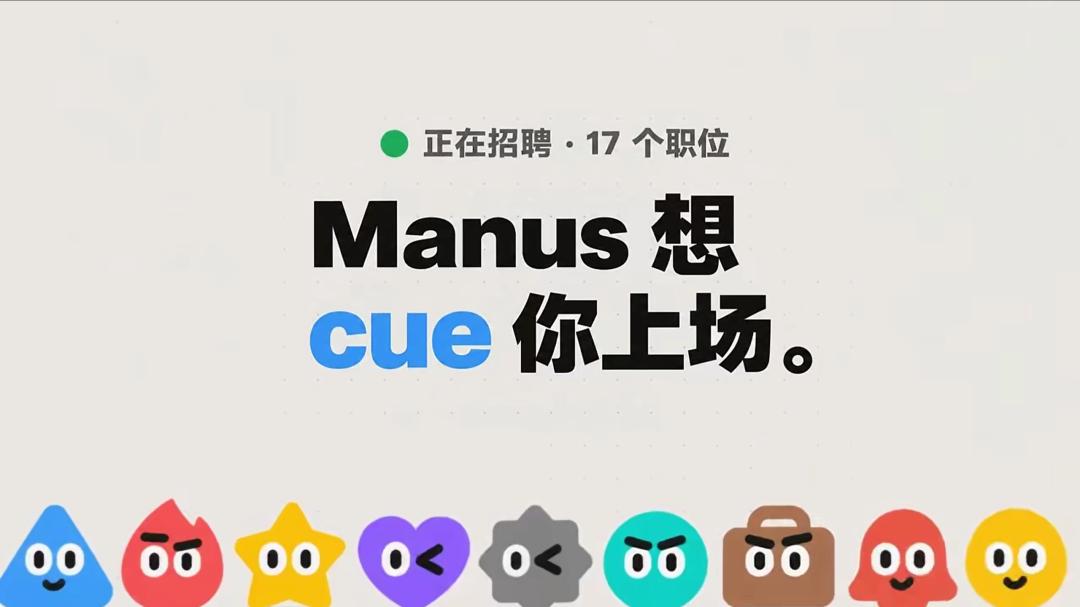
Image source: Butterfly Effect
Judging from the 17 positions announced by Manus, covering product, R&D, operation and growth, this team needs to participate in the complete process from product development to user operation, and some of the positions also undertake global business.
The roadmap revealed by these 17 positions is clear: Manus tries to build a complete chain from the Agent operation control layer to user growth and paid conversion. It not only wants to bring Manus 2.0 and Cue to the domestic market, but also wants to find a sustainable business model in a market with weak willingness to pay.
However, data from the domestic market has repeatedly proved that the willingness of C-end users to pay is weak, and the B-end is the main position for the commercialization of agents. IDC data shows that the scale of the domestic enterprise-level AI Agent market is expected to reach 44.9 billion yuan in 2026, while the C-end agent market space is only a few billion yuan.
If Manus wants to achieve commercialization in China, it may need a completely different product logic from overseas, shifting from individual-oriented to organization-oriented Agents for enterprises, which is precisely the place where the domestic big tech ecosystem has the deepest barriers. This is also the first practical problem Manus faces after returning to China: big tech Agents have entrances, ecosystems and models. What does Manus have?
The core of Tencent's WorkBuddy comes from Tencent's programming tool CodeBuddy, while Qwen Office and Doubao Work are closely combined with DingTalk and Feishu respectively. The common feature and advantage of these products lie in entrance and distribution.
Startups like Manus are very different from products with big tech backgrounds in terms of product design, understanding of user experience and technology application.
Therefore, the position Manus may strive for is an independent execution entrance that is cross-model and cross-service. It is not bound to any large model vendor, can dynamically schedule between multiple open-source and closed-source models, and does not depend on the ecosystem of any internet platform, and can connect to various services that users actually use. Independence itself is a kind of differentiation.
But this position also means that Manus needs to solve the connection problems that big tech Agents naturally have one by one. Behind the shopping Agent are commodities, merchants and payments, and behind the office Agent are files, communication records and organizational permissions.
Big tech companies only need to convert their original business relationships into the execution capabilities of Agents, while Manus needs to build these connections from scratch.
