Terence Tao reposted the boycott statement, and the mathematics community has completely broken ties with OpenAI.
Releasing more than 700 documents at one go is not a demonstration of academic achievement, but a display of power.
We urge mathematicians to stop cooperating with OpenAI and return to the scientific concept centered on human understanding.
This is a special statement released by the Human Mathematics Association in response to OpenAI's massive release of mathematical research results. The association commented in the statement that OpenAI did this because "mathematicians did not ask for this work to be done", and called on all mathematicians to boycott OpenAI from now on.
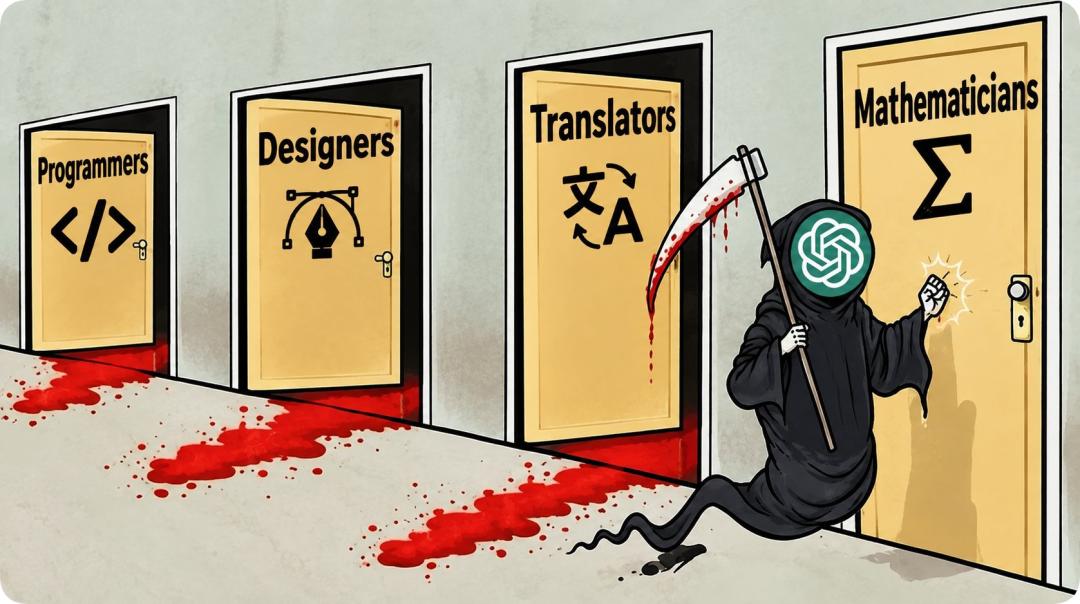
Once the statement was released, the disagreement between the AI community and the mathematics community sparked heated debates on X again.
Terence Tao, a Chinese mathematician and Fields Medal winner, reposted this statement on his personal blog. It was soon reposted by netizens as a statement led by Terence Tao, but the fact is that even Terence Tao himself does not appear in the member list of the Human Mathematics Association.
Then some people began to dig into the background of the Human Mathematics Association. Netizens accused the association of being as irresponsible as OpenAI, especially the so-called remark that "mathematicians did not ask for this work to be done", which was considered "the most ridiculous and absurd statement I have read recently."
We also found that what is more interesting than this statement is the membership commitment of the Human Mathematics Association.
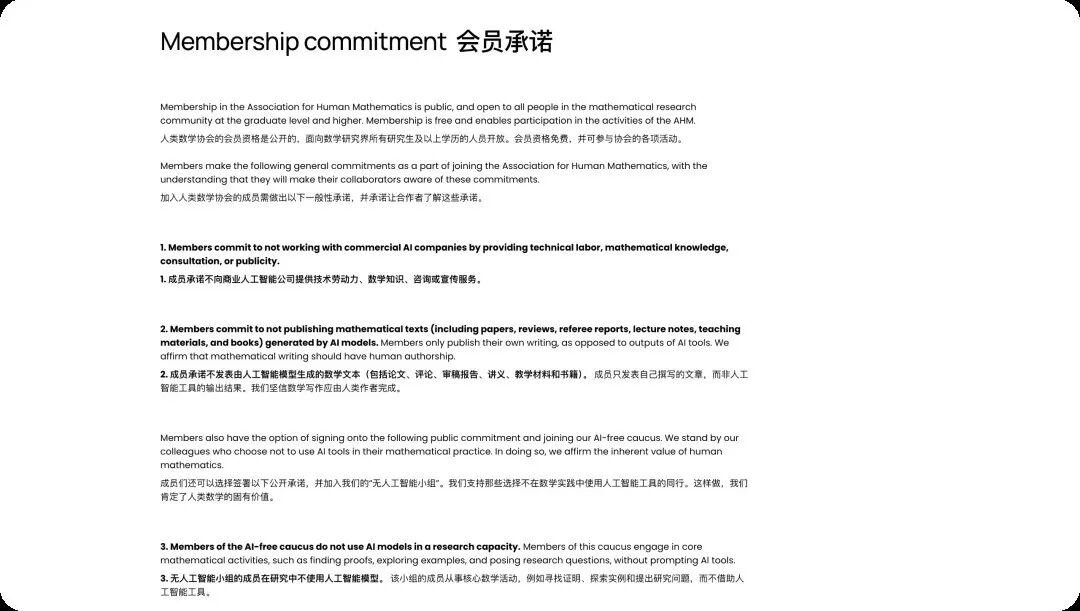
To become a member of the Human Mathematics Association, you must make three commitments:
1. Members commit not to provide technical labor, mathematical knowledge, consulting or publicity services to commercial artificial intelligence companies.
2. Members commit not to publish mathematical texts generated by artificial intelligence models (including papers, comments, peer review reports, lecture notes, teaching materials and books).
3. Members of the anti-artificial intelligence group will not use artificial intelligence models in their research work.
In short, if you want to join the Human Mathematics Association, you have to give up AI.
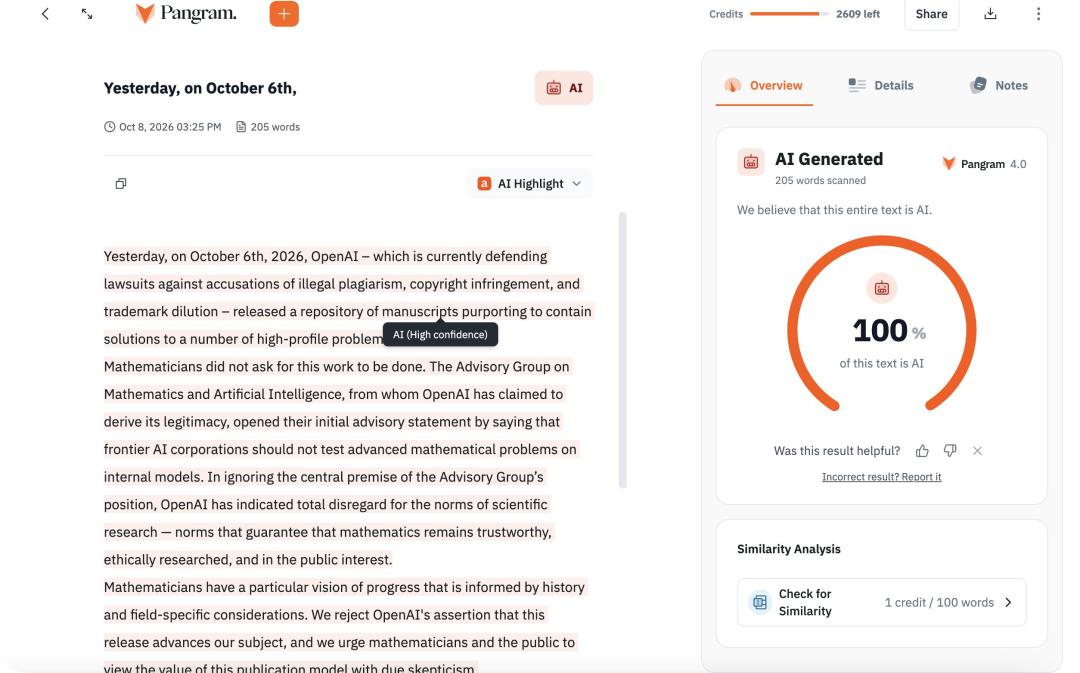
But what is even more ridiculous is that someone threw this statement to the AI detection tool Pangram and found that the test result showed it was 100% generated by AI.
On the other side, the criticism against OpenAI has not stopped. Among the so-called 722 papers, only the main results of 162 papers have been verified by computers.
The next day after the release, OpenAI also removed 3 manuscripts: a symbol error invalidated a core argument, which in turn affected two papers that relied on it; another 14 papers were revised, and 13 papers had their citation relationships updated.
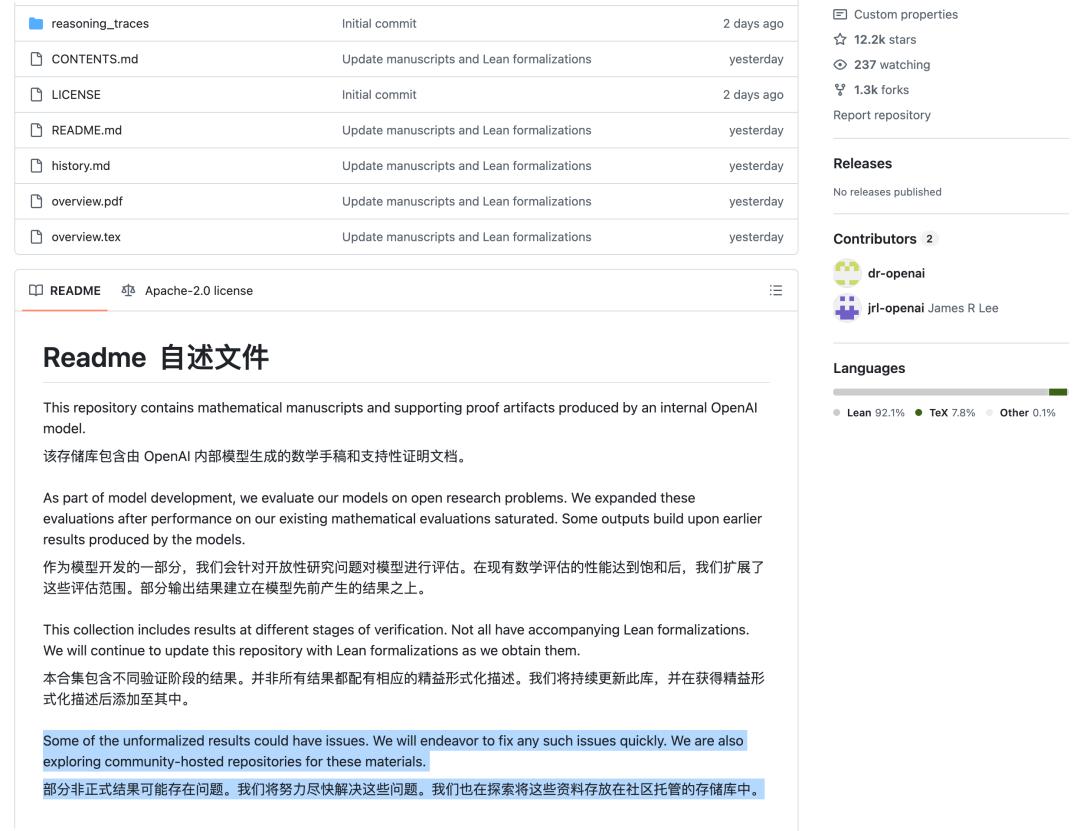
OpenAI itself also admitted that not all papers adopted the Lean formalization method. It was mentioned in the README document of their public GitHub repository that "some unformalized results may have problems. We will strive to fix any such problems as soon as possible."
In other words, a lot of the content they published may be wrong.
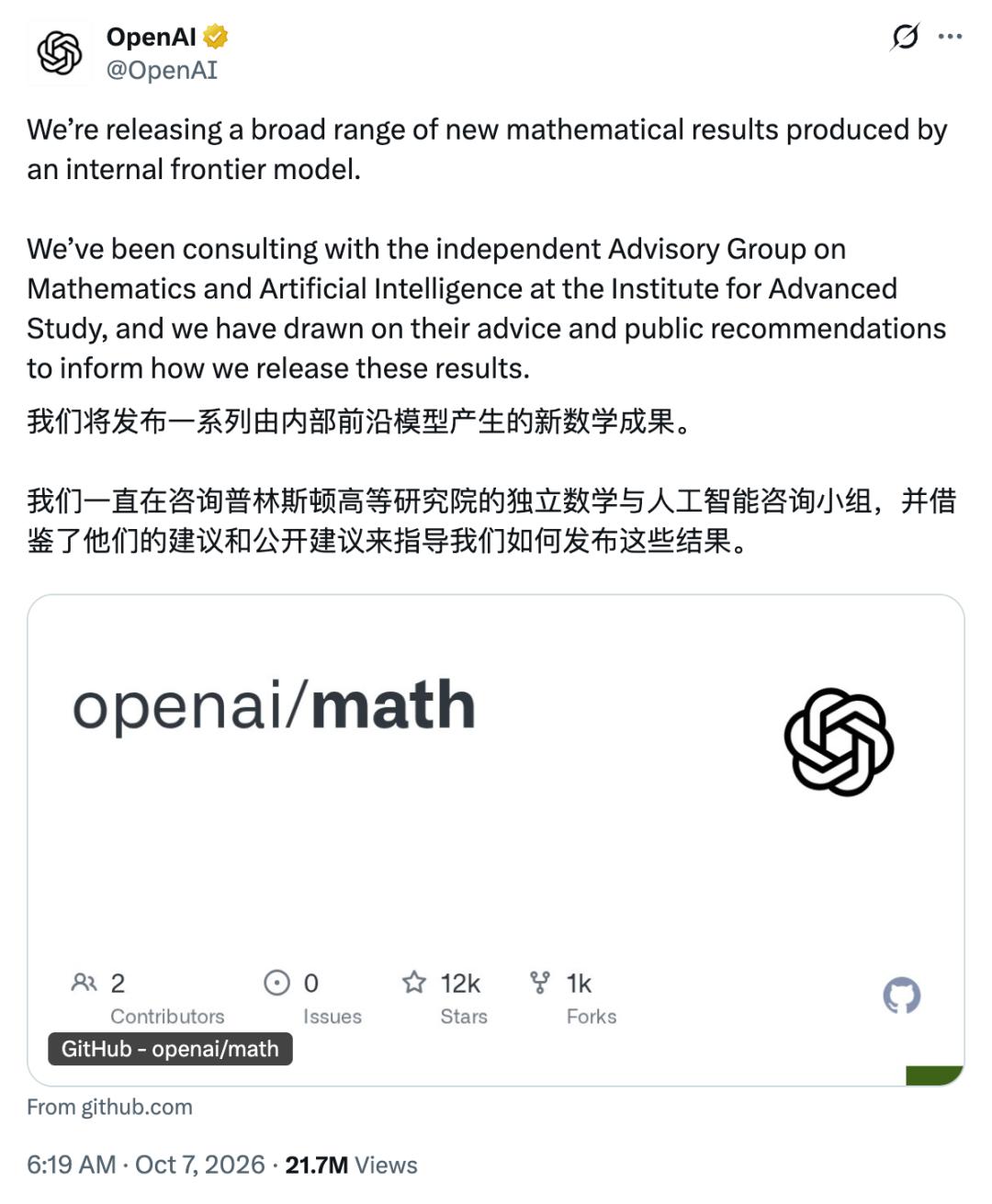
So, who on earth should we listen to? Should we follow the mathematics community to call on all mathematicians to stop using OpenAI, or work with OpenAI to embrace the changes brought by AI, and accept the reality that AI can produce a Fields Medal-level achievement in just ten minutes?
A Mathematician Alliance That Boycotts OpenAI
In this complete statement, in addition to mentioning "stopping cooperation with OpenAI" and "mathematicians did not ask OpenAI to do this work", it also discussed the basic rules of mathematical research through this incident, that is, whether the author understands the proof, whether they verified it personally, who takes responsibility, how papers are cited and peer reviewed.
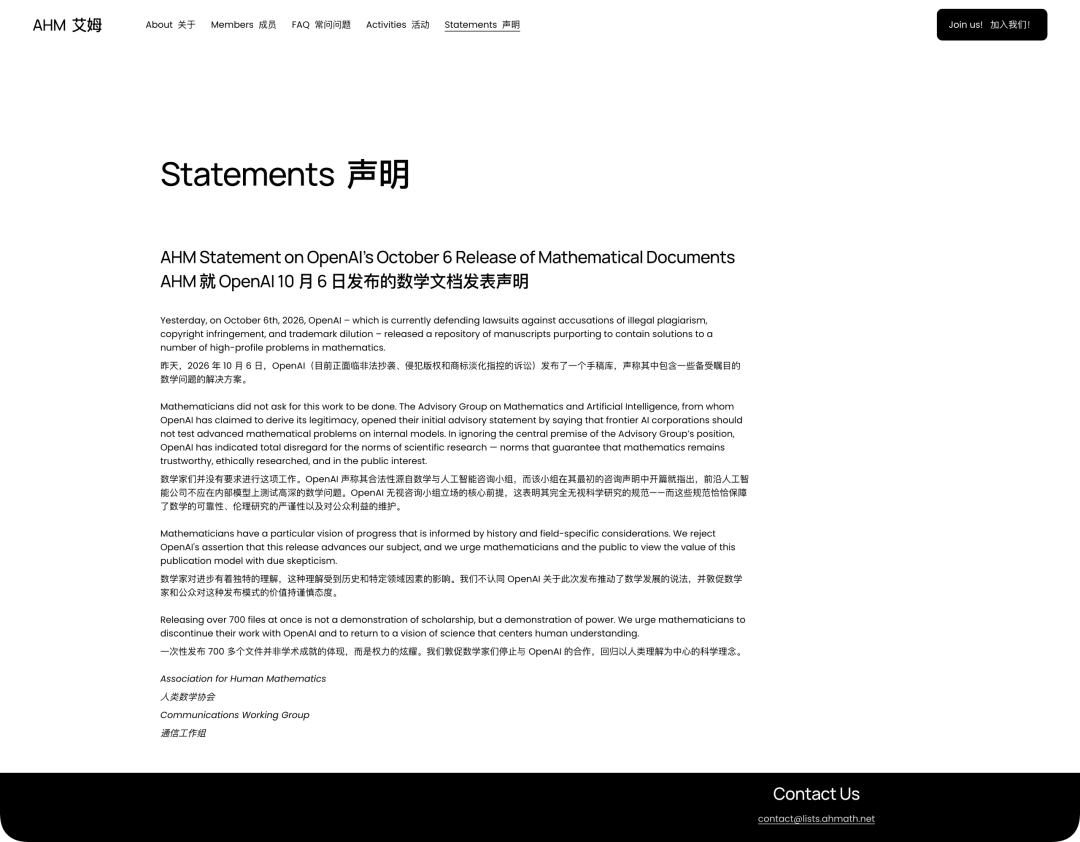
This is also the most discussed controversy among the voices opposing OpenAI.
In the eyes of critics, OpenAI does not understand what they have released, and even they themselves cannot understand the papers and reports written by AI. They just see that AI has reached a certain conclusion, make it public, and then claim that they have solved certain mathematical problems.
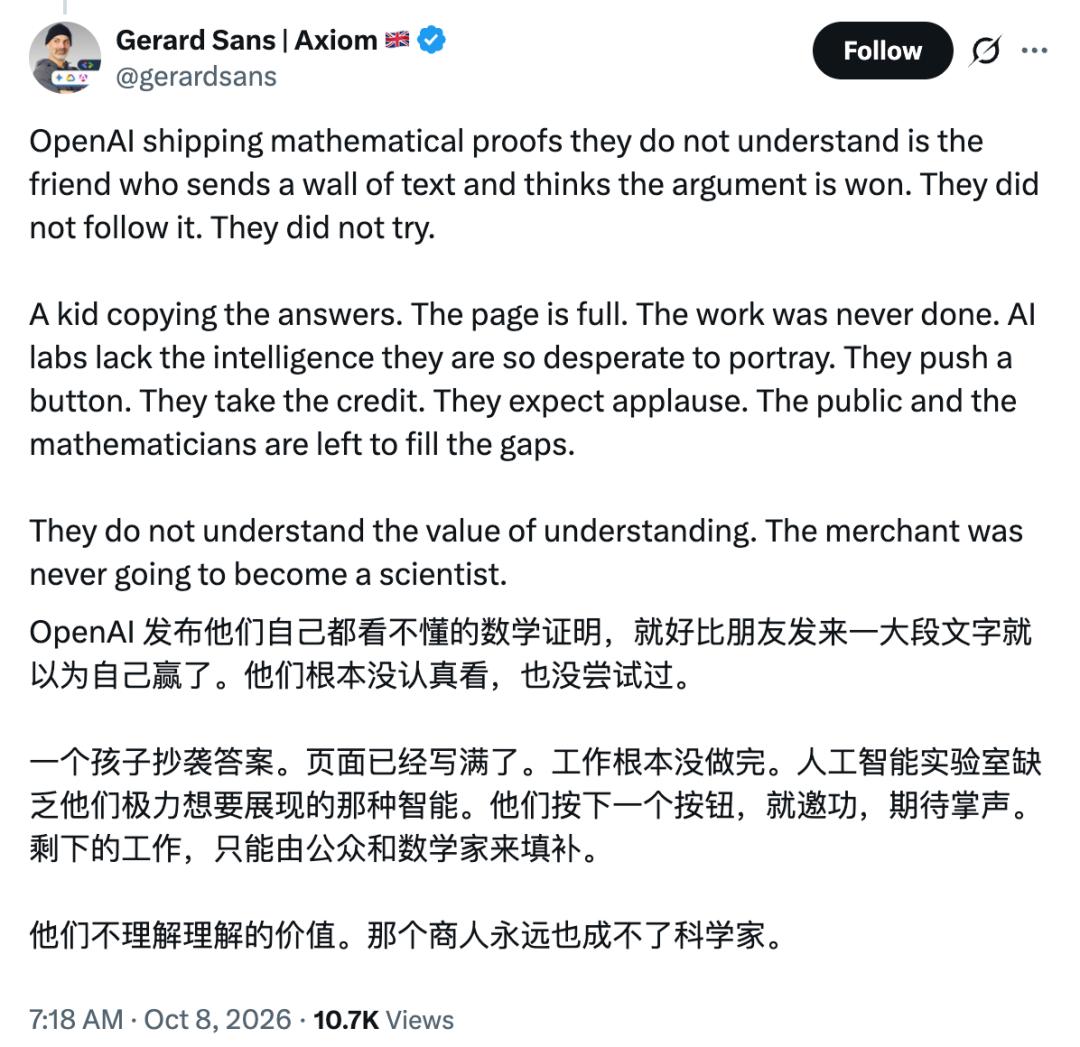
On the other hand, the statement also mentioned the issue of OpenAI's power: a company uses an internal model that the public cannot access to generate research results in batches, and then decides when to release, what to release, and whether it will give the company the power to set the agenda for mathematical research.
Some netizens said that this statement will likely be included as a primary source in future university courses that teach the early history of "AI entering knowledge production".
Behind the statement, information about this association was also dug up by netizens: it was established in August 2026, currently has only 809 members, most of whom are just graduate students, not mathematicians who have made important mathematical research achievements.
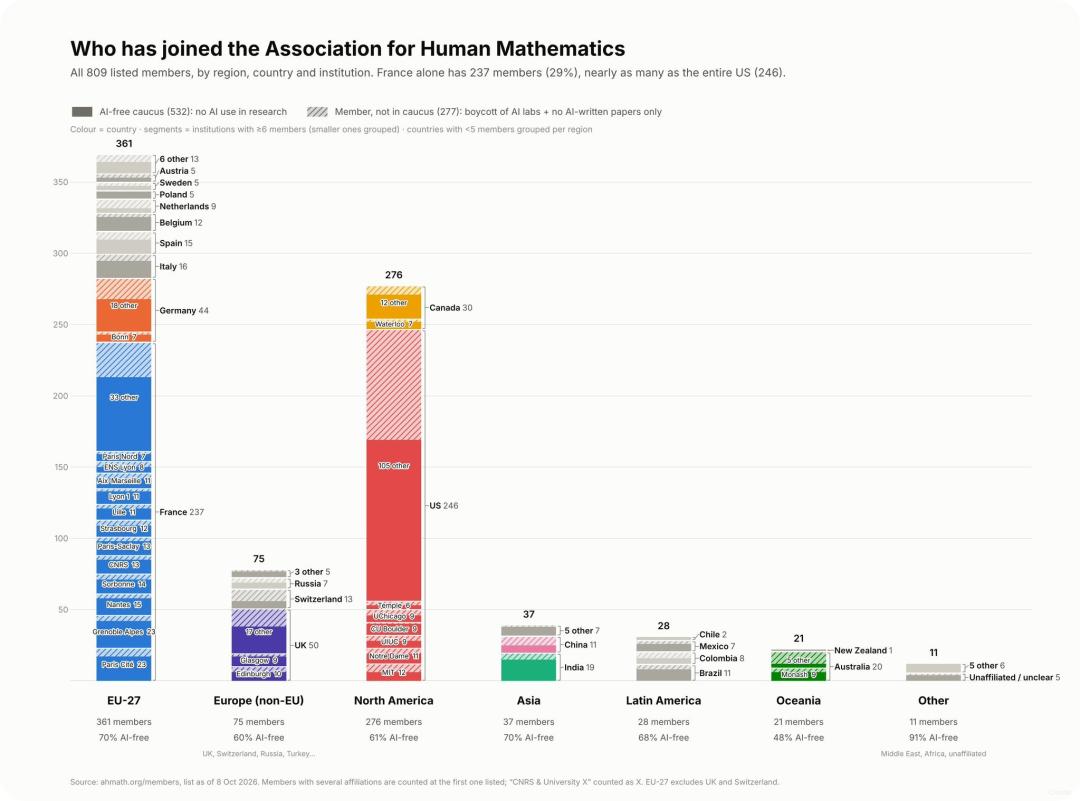
Nearly one-third of the 809 members are French, another third are Americans, and 11 of them are from China.
The Human Mathematics Association is similar to the AI Welfare Association, AI Safety Association, AI Human Association and other organizations that emerged in the early days of AI. In addition to this 809-member Human Mathematics Association, there is also the Mathematics and Artificial Intelligence Advisory Group composed of 9 senior mathematicians, and the Mathematics Declaration signed by 28 Fields Medal winners.
mathandai.org - the "Declaration on Serious Imbalance of Artificial Intelligence in the Field of Mathematics" signed by 28 Fields Medal winners and supported by more than 8000 people.
agmai.org - the Mathematics and Artificial Intelligence Advisory Group, hosted by the Institute for Advanced Study (IAS): 9 senior mathematicians, independent and unpaid, mainly commenting and making suggestions on how laboratories should release results generated by artificial intelligence.
ahmath.org - the Human Mathematics Association, with about 800 members. All members commit not to cooperate with commercial artificial intelligence companies, nor to publish mathematical texts generated by artificial intelligence; most of its members (non-AI group) also refuse to use artificial intelligence in their research.
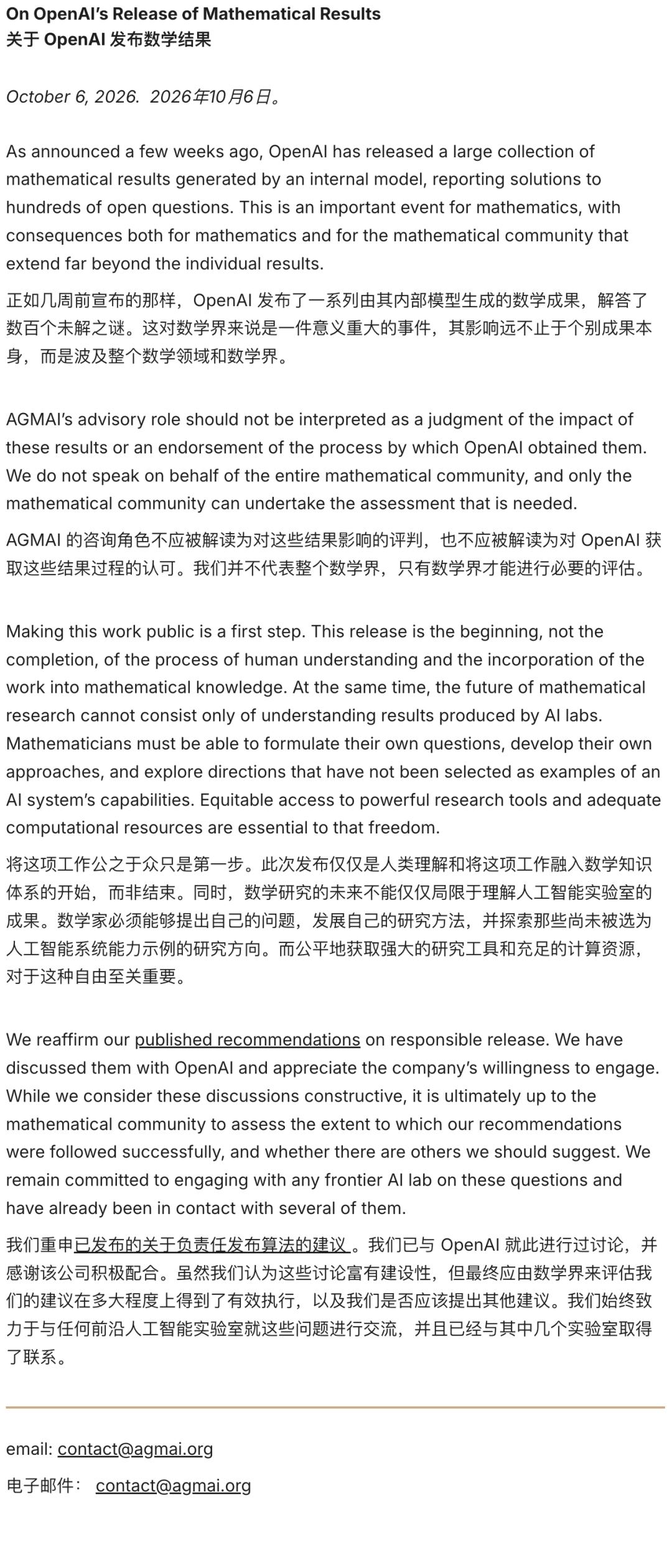
These mathematicians hold different views, but most of them believe that mathematics has indeed been impacted by OpenAI at the moment, and the mathematics community is facing new confusion and bewilderment.
On social media, some people say that OpenAI released these paper manuscripts entirely for its own economic interests, completely ignoring the existing structure of the mathematics community, that is, the standardized mathematical processes such as naming paper authors, submitting to journals, and going through peer review.
If OpenAI wants to destroy the mathematics community, this is undoubtedly an excellent way.
Unsolved problems are precious resources accumulated by the mathematics community over decades or even hundreds of years. Their value comes from the meaning we give them. They provide structure for the mathematics community and a yardstick for measuring progress and long-term goals.
The emergence of artificial intelligence is destined to bring a huge impact, but such a large number of papers are coming like a tsunami, and we have no time to prepare at all.
Obviously, OpenAI will not hesitate to destroy the existing structure of our mathematics community for its own economic interests.
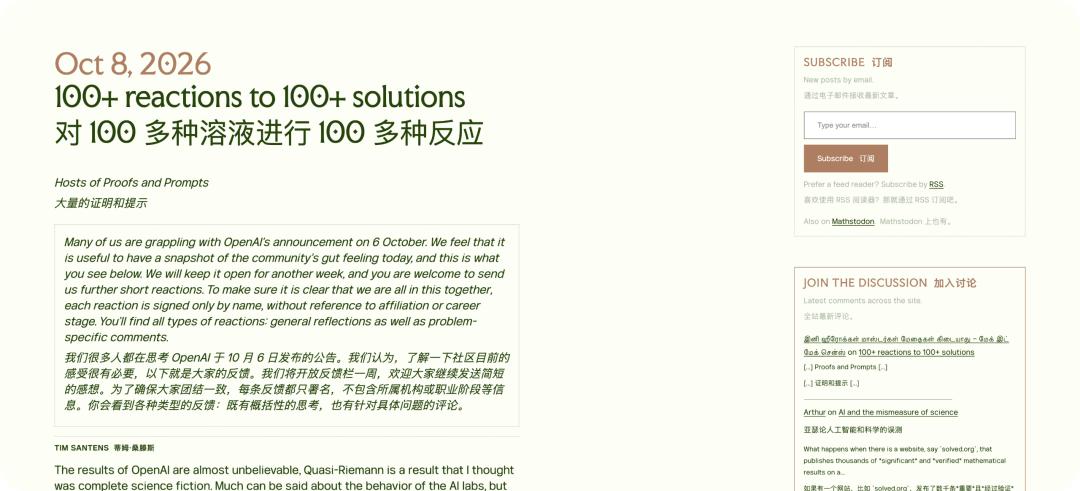
Figure | Summary of community discussions https://proofsandprompts.com/2026/10/08/100-reactions-to-100-solutions/
722 Drafts, Who Will Verify Them
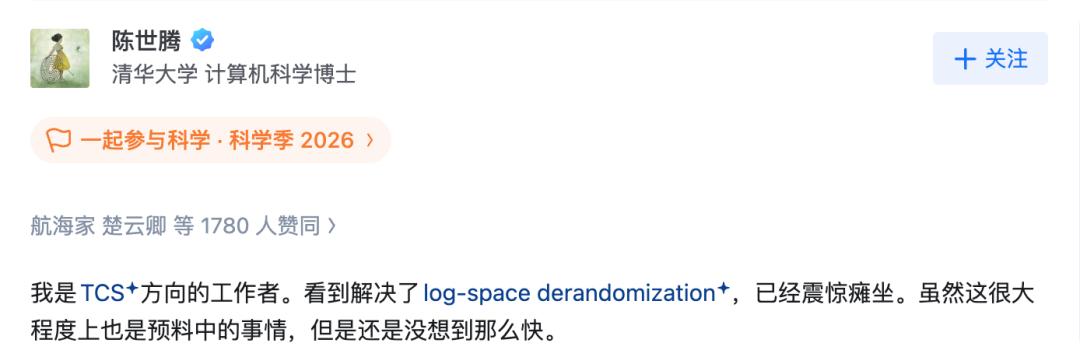
On the side that supports OpenAI, people believe that these more than 700 mathematical manuscripts have pushed mathematical research to a stage where the working method must be redefined; some people hope to read these proofs with students and postdocs to find new connections among them.
In OpenAI's own developer community, relatively specific preliminary verification has also appeared: someone re-ran the Lean check for the quasi-Riemannian results and reported that the code passed; another person extended a matrix multiplication result to a more general field, which also passed the Lean check.
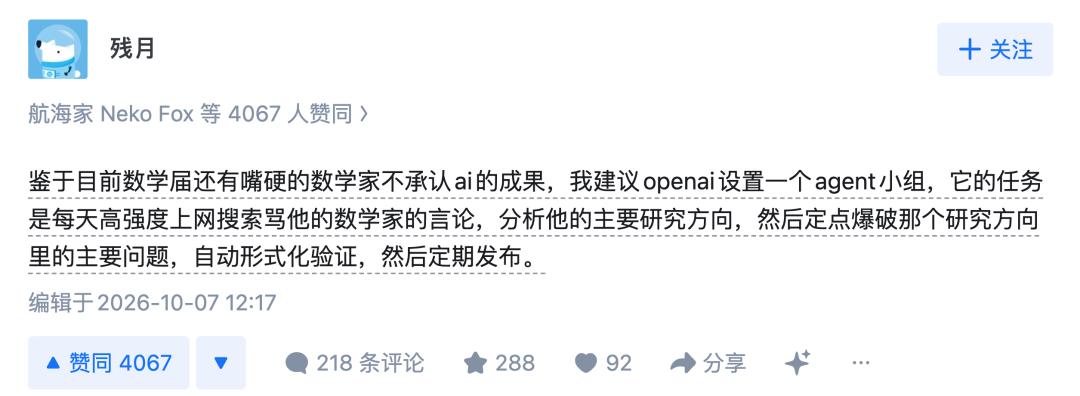
In previous statements by Terence Tao and others, they did not deny that AI can help mathematics. The focus of their argument is only that AI companies using "solving open problems" as a capability indicator will damage the understanding, insight, problem posing and intergenerational inheritance that mathematics truly values.
The statement of the Human Mathematics Association this time urges all mathematicians to refuse to cooperate with OpenAI, making the discussion triggered by this incident go beyond "whether AI can do mathematics".
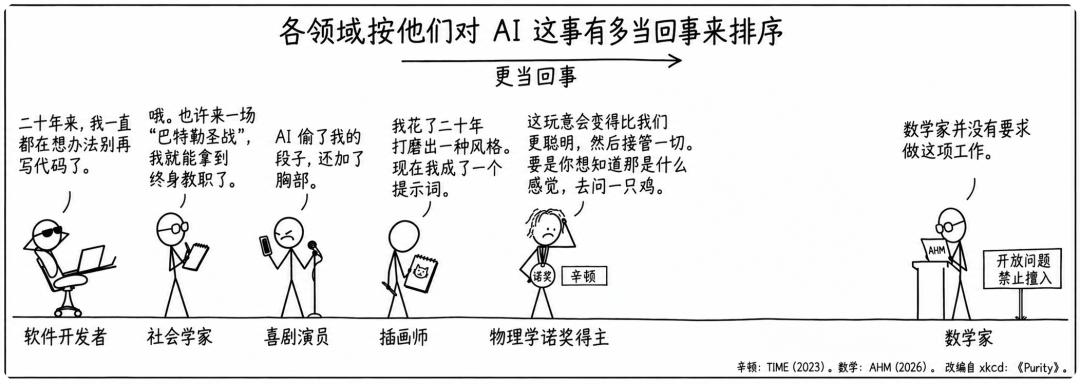
Perhaps both sides of the argument make sense, but as the argument develops to now, it has a familiar flavor.
This reminds me of a classic plot in the American TV series Silicon Valley. In the show, Gavin Belson, the CEO of the tech giant Hooli, always likes to talk about "making the world a better place". But compared to whether the world has really become better, he seems to care more about another thing: the person who changes the world must be himself.
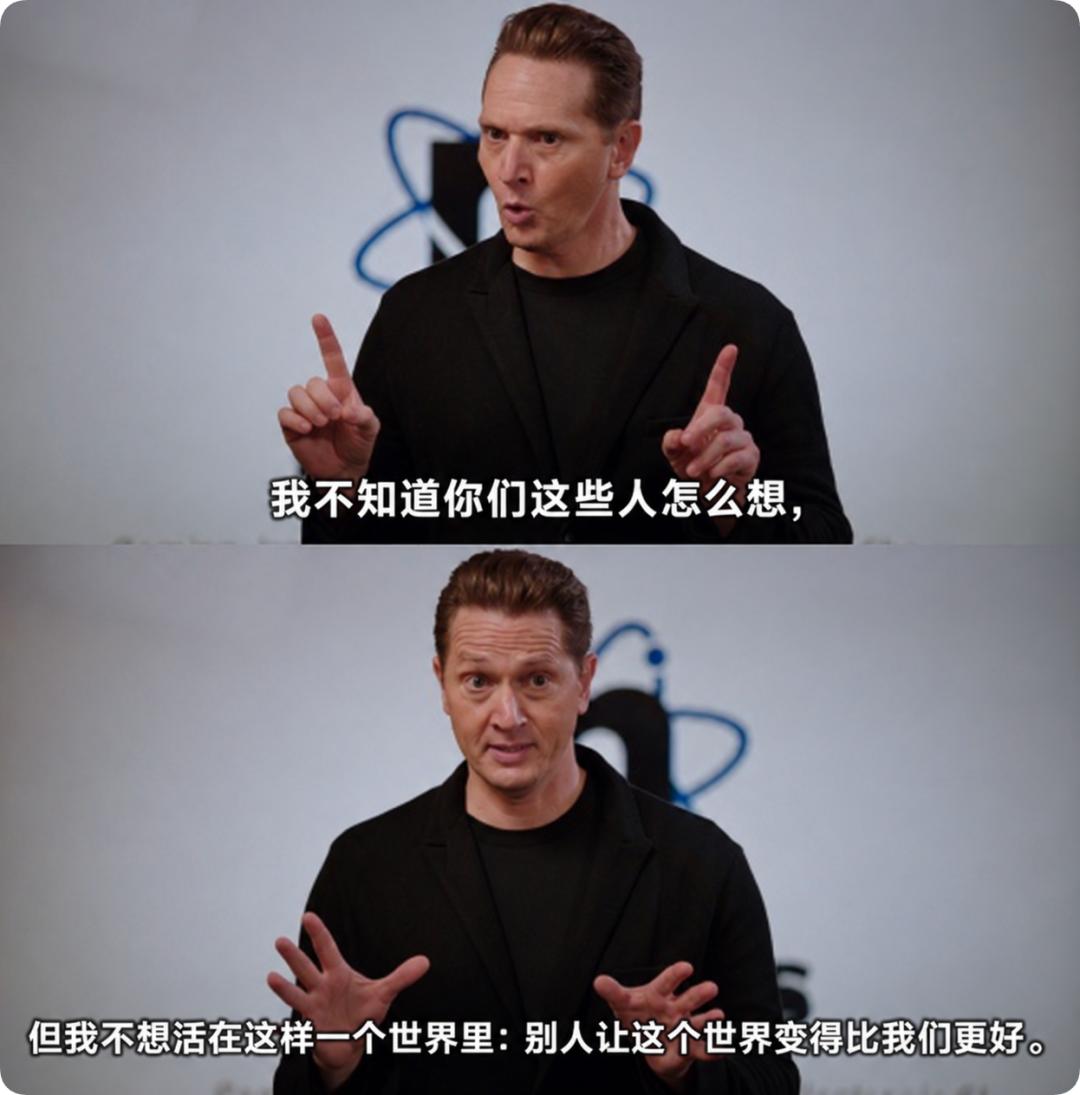
Figure | The CEO said when criticizing the company team "
This joke suddenly has a sense of reality in today's mathematics community.
OpenAI wants to prove that AI has been able to solve a large number of problems that have plagued mathematicians for many years on a large scale; while opponents worry that a commercial company is relying on technological advantages to re-determine the rhythm, rules of mathematical research, and even what kind of achievements are worthy of being called mathematical progress.