Huawei and Xiaomi have launched a new round of price increases.
Smartphones are witnessing a new wave of price hikes. On October 9, Huawei and Xiaomi raised the prices of some of their products again.
Starting from zero o'clock on October 9, the suggested retail prices of Huawei's mid-range high-volume models nova 16 and nova 16 Pro have been raised by 400 yuan, nova 16 SE by 200 yuan, while the prices of nova 16z and nova 16 Ultra remain unchanged.
The Huawei nova 16 series was released on June 1 this year. At that time, the starting price was 300 to 500 yuan higher than that of the nova 15 series.
According to observations and leaks from digital blogger @RD, as of the 36th week of 2026 (August 31 to September 6), the cumulative sales of the Huawei nova 16 series reached approximately 2.2029 million units. It takes a leading position among domestic mid-range smartphones and serves as a key support for Huawei's shipment volume in the second half of the year.
In Huawei's mobile product portfolio, the Mate and Pura series target the high-end market, the nova series is positioned as mid-range trendy phones for young users, and the Enjoy series focuses on the entry-level practical market.
It should be noted that users in the low and mid-end market are price-sensitive, and price hikes are likely to drive away some potential customers, with some manufacturers even actively phasing out their low-end product lines. After Huawei raised the prices of the Mate 80 series on September 1, the nova 16 series followed suit, which indicates that the cost pressure is indeed extremely high.
Prior to this industry-wide price hike wave, almost no generation of nova series models could maintain its market position for a long time at the official guide price. Coupled with preferential activities such as manufacturer subsidies, e-commerce festival promotions, and trade-in programs, there was a gap between the actual transaction price and the official guide price of the nova series for most of the time. Under normal circumstances, the "high marked price, low transaction price" model can also be regarded as a means for the nova series to attract its target customer group.
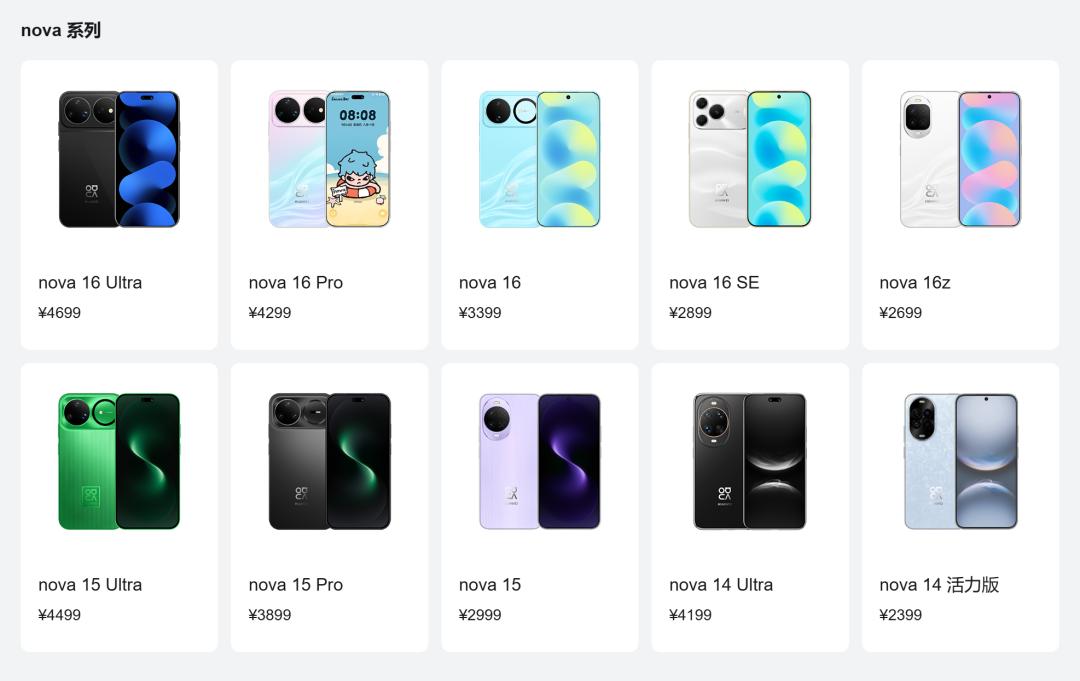
▲ Figure / Huawei Mall
Since the beginning of this year, Yu Chengdong, Executive Director of Huawei, Director of the Product Investment Review Committee, and Chairman of the Terminal BG, has talked about the huge pressure brought by memory price hikes on many public occasions.
At the end of September, Yu Chengdong said in an interview with the media that the sharp rise in storage prices has added an extra hardware cost of more than 200 US dollars per unit of mobile phone. Huawei's mobile phones have higher memory configurations than other models, so the cost pressure is even greater. "Our overall profit margin has dropped significantly, and we have no choice but to raise product prices later."
In fact, compared with its competitors, Huawei is a manufacturer with a relatively slow pace of price adjustment. On the same day when the nova 16 series raised prices, the entire Xiaomi 17 Ultra line also raised its selling price by 1000 yuan. This is the third price adjustment of the Xiaomi 17 series following two rounds of price hikes in August and September, and also the fifth price adjustment of Xiaomi since the beginning of this year. Before Xiaomi, OPPO and vivo had already taken the lead in raising prices.
Judging from the price adjustment pattern of various manufacturers, the price hike wave of smartphones is almost always initiated by high-end flagship models first, followed by mid-range models, spreading from high to low across all price segments.
Driven by the explosive demand for AI computing power, the supply of standard DRAM and NAND for general data centers and ordinary consumer electronics has shrunk sharply, directly pushing up the costs of the 3C industry. A latest memory industry research report released by Simon Woo, an analyst at Bank of America Securities, shows that in the third quarter of 2026, the average contract price of DRAM rose by 20% to 30% month-on-month, and NAND flash prices rose by more than 15% month-on-month. The duration of the price hike far exceeded the market's expectations at the beginning of the year.
In the field of smartphones, the proportion of DRAM and NAND in total cost has increased from 10% to 15% in 2024 to 30% to 40%. For some entry-level phones priced at around 1000 yuan, the storage cost even accounts for more than 1/3 of the total selling price of the device.
Entering the fourth quarter of 2026, the storage price hike wave is still continuing. According to the latest memory industry research from TrendForce, it is estimated that the price of general DRAM will increase by 10% to 15% quarter-on-quarter in the fourth quarter of 2026; the overall contract price of NAND will increase by 15% to 20% quarter-on-quarter.
There are different voices in the industry about when this storage price hike cycle will end. Almost all new production capacity of the three major original manufacturers Samsung, SK Hynix and Micron has shifted to AI, and the supply gap of consumer-grade storage cannot be filled in the short term. Therefore, UBS predicts that the shortage of DRAM supply will last at least until the second quarter of 2028, and the NAND market boom will continue until the fourth quarter of 2027.
Sanjay Mehrotra, Chairman and CEO of Micron Technology, said at the earnings call a few days ago that the inflection point where supply and demand return to balance is still not visible at present.
There is also an optimistic judgment. The blogger Dingjiao Digital believes that based on the overall trend of the storage market, the price of memory chips is expected to stabilize in the second half of 2027, and by then consumers may be able to buy digital products that no longer see price hikes.
As the storage cycle becomes less predictable, smart terminal manufacturers and users are absorbing the cost brought by the memory chip cycle in different ways: the former adjust prices and change product portfolios, while the latter can only delay upgrades by extending the mobile phone replacement cycle.
This article is from the WeChat Official Account "Caitian COVER", the author is Caitian COVER, and it is published by 36Kr with authorization.