Can the US stock bull market still continue?
The S&P 500 Index hit a new high on October 6. However, the long-term U.S. interest rate once rose to 5.36% on October 7, marking the highest level since 2002. Rising interest rates will increase corporate borrowing costs and squeeze profits. The market's views on the future trend of the stock market have diverged...
Faced with the continuously strengthening U.S. stock market, cautious views have begun to emerge in the market. The long-term U.S. interest rate, which has already reached a high level, continues to rise, and the market has realized that it will become a heavy pressure on stock prices. At present, the market's views on the future trend have diverged, showing strong uncertainty.
In mid-September, Edward Yardeni of Yardeni Research, a U.S. research firm known for its optimism, lowered its S&P 500 Index target for the end of 2026 from the previously set 8,400 points to 7,900 points. Due to the rise in bond yields, Edward Yardeni lowered the price-to-earnings ratio (PER) level, which reflects future growth expectations and investor sentiment, from the original 19.8 times to 18.6 times.
Bank of America (BofA), which maintains a cautious attitude, raised its 2026-end forecast from 7,100 points to 7,400 points in September, but it is still about 5% lower than the current level. Bank of America warned that against the backdrop of rising inflation, the current price-to-earnings ratio still has room for further decline.
The long-term U.S. interest rate once rose to 5.36% on October 7, reaching a new high since 2002 (bond prices fell). As the market is generally worried that rising crude oil prices will lead to prolonged inflation, vigilance against further interest rate hikes by the Federal Reserve (FRB) is spreading. Yardeni pointed out that "the surge in crude oil prices may be the reason for the Fed to raise interest rates multiple times".
The S&P 500 Index hit an all-time high on October 6, but fell slightly on the 7th. Vigilance against rising interest rates continues to hang over the market. Rising interest rates will increase corporate borrowing costs and squeeze profits. For investors, rising bond yields will weaken the relative attractiveness of stocks, thus adversely affecting the stock market.
Market participants hold widely divergent views. HSBC in the UK raised its end-of-year forecast for the S&P 500 Index from 7,650 points to 8,100 points in early September. Nicole Inui of HSBC pointed out that if long-term interest rates continue to rise, it will suppress investment valuations, but also noted that "the trend of the U.S. stock market is more sensitive to corporate earnings than to interest rate changes".
Nicole Inui believes that driven by huge capital investment in the artificial intelligence (AI) sector, a wide range of stocks such as semiconductors are expected to receive support in the short term.
In fact, the outlook for corporate performance is steadily improving. According to data from QUICK FactSet, if the S&P 500 Index is regarded as a single enterprise, its earnings per share (EPS) has increased by 10% compared with the end of June. Although stock prices are moving sideways, the market's confidence in sustained earnings growth is continuously strengthening.
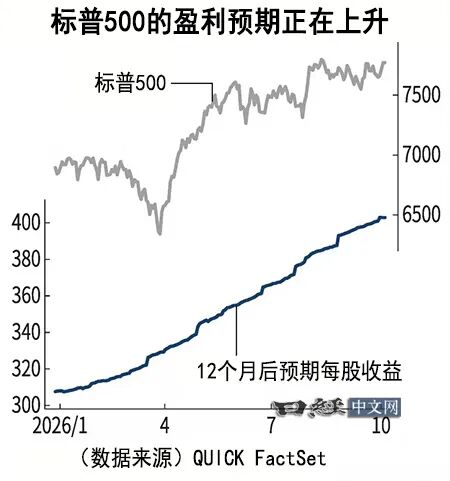
The market's focus has shifted to whether enterprises can achieve profit growth that outpaces the rise in interest rates.
JPMorgan Chase of the United States raised its year-end target for the S&P 500 Index from 7,800 points to 8,000 points in August. Dubravko Lakos-Bujas and others pointed out that "considering the support brought by strong earnings growth, the current interest rate environment is unlikely to weaken the upward trend of the stock market". They remain optimistic against the backdrop of solid corporate performance.
Following the long-term interest rate, the market's focus has shifted to the U.S. midterm elections to be held in November. Among them, data center construction has become one of the controversial focuses. Such facilities consume huge amounts of power, and their negative impact on the environment is a cause for concern. The Democratic Party advocates strengthening supervision on AI investment that drives up electricity prices, and the election results may affect the AI market trend.
During the period when U.S. stocks rose sharply around June driven by growth expectations in fields such as AI, multiple U.S. institutions successively raised their year-end target levels for the S&P 500 Index. As uncertainties such as rising interest rates and the U.S. midterm elections emerge, investors are being forced to pay more attention to risk factors.
This article is from the WeChat Official Account "Nikkei Chinese Net" (ID: rijingzhongwenwang), written by Tetsuji Fujita and Junhei Kuchibuchi, authorized for release by 36Kr.