The fighting competition that pits real people against robots, where tickets are extremely difficult to come by, has been halted.
A real person steps into a steel cage to fight head-to-head against a humanoid robot. This sci-fi movie-style performance has landed its organizer a regulatory cease-and-desist letter.
Local time on October 8, *The Verge* followed up with a report that the California State Athletic Commission has required REK, the organizer of the robot combat event, to stop unauthorized boxing or mixed martial arts activities with human participants. The scope of this regulatory action needs to be clarified: it targets unlicensed real-person combat events, and does not mean that California has fully banned competitions between robots.
The controversial match took place on September 18 in San Francisco. Social media content creator Frankie LaPenna stepped into the ring to fight against the humanoid robot. The competing robot was remotely controlled by a human operator, and behind the robot's punches and kicks, there was still a human manipulating the entire showdown.
On September 30, Cix Liv, founder and CEO of REK, publicly released the received cease-and-desist letter on social platforms. The publicly reposted content of the letter shows that the regulatory authority requires REK to stop organizing, promoting or advertising boxing, mixed martial arts matches and performances involving real people in California without the approval of the Commission, and issues a warning against carrying out such activities without corresponding licenses.
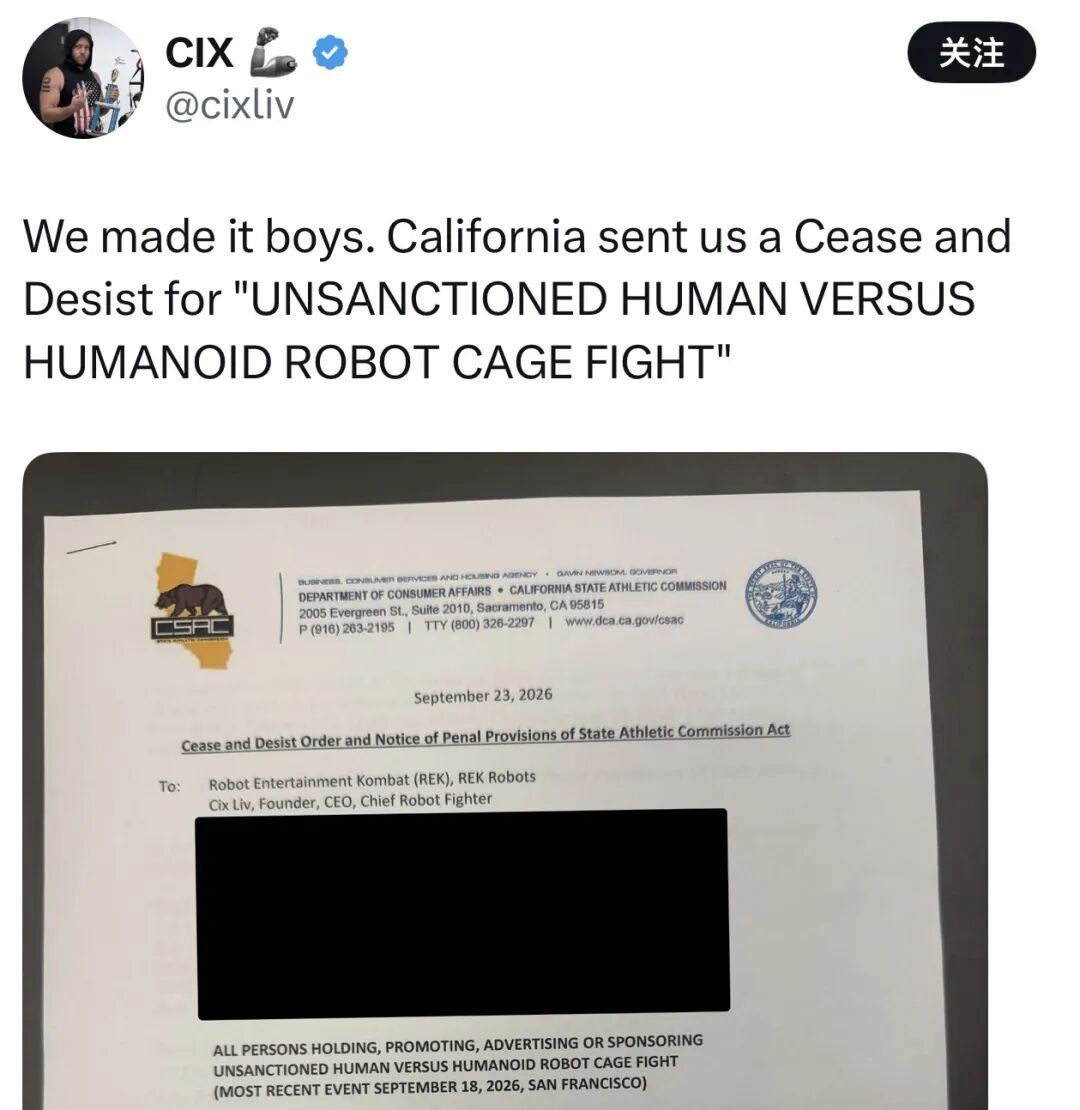
However, this cease-and-desist letter did not prompt REK to remove all its event schedules. As of press time, its official website still lists the "REK Deathmatch" to be held in San Francisco on local time October 9, including three matches such as G1 weapon combat and T800 vs. battles, and the page shows that tickets have been sold out.
REK is trying to build robot combat into a business that connects games and live performances. Its official introduction links simulators with physical robot events: players compete first in the simulator, and outstanding operators get the opportunity to control real robots to participate in offline events. In this way, audiences, players and robot operators can all be attracted to the same set of events.
In fact, robots stepping into combat arenas has a history of several decades. In 1994, designer Marc Thorpe held the first *Robot Wars* in San Francisco, USA, inviting contestants to build their own combat machines. The appeal back then was already very clear: combining mechanical design, on-site operation and fierce confrontation to let audiences witness the duels between machines.
Television later amplified the influence of such events. In 1998, *Robot Wars* was broadcast on BBC Two in the UK; in 1999, *BattleBots* held competitions in the United States, and entered the TV program schedule of Comedy Central in 2000. Robot combat gradually developed from a niche live event for enthusiasts to a competitive entertainment that can be broadcast to the general public.
Exploration of humanoid robot combat also started quite early. Japan's ROBO-ONE event, which began in 2002, lets bipedal robots compete through boxing, throws and knockouts. Later, the event also set up remote control and autonomous control categories respectively. It can be seen that whether a robot adopts a humanoid structure and whether it can independently judge and choose attack moves are two separate issues.
Domestic audiences' understanding of robot combat has also undergone changes from "ironclad collisions" to "humanoid duels".
In 2018, programs such as *Iron Hero* and *This Is Fighting Robots* brought robot combat into the view of more people. In August of the same year, the KOB Global Robot Combat Tournament kicked off during the World Robot Conference held in Yizhuang, Beijing, attracting more than 60 teams to participate. The machines collided and flipped their opponents in a closed combat cabin, with operators controlling outside the arena. This competition at that time had a weight limit of less than 13.6 kg, and a side was judged to lose if it lost the ability to act for 10 seconds. Clear rules for site isolation, weight classification and victory/defeat have already been formed.
By May 25, 2025, the mech combat arena match of the *CMG World Robotics Contest Series* was held in Hangzhou, where humanoid robots began to fight with moves such as punching, kicking and dodging. The robot getting knocked down, standing back up, adjusting its posture and continuing to compete has also become an important highlight of the event.
This competition still adopted the human-machine collaboration mode. A pre-match visit by China Central Television clearly introduced that the operator controls the movement direction via a joystick, and triggers moves through combination key presses. The robot's motion control system is responsible for completing the moves and maintaining balance, while the on-site operator needs to judge the position and the timing of launching attacks. Therefore, this type of competition demonstrates the ability of the operator and the robot to complete the confrontation together, which cannot be simply summarized as fully autonomous combat by robots.
Domestic events are also continuing to explore higher levels of autonomous control. On September 19, 2026, the URKL Robot Combat City Tour of the Global Humanoid Robot Free Combat League was held in Baoshan, Shanghai, where two T800s fought on the arena. According to reports from Xinhua News Agency, this event demonstrated the robots' capabilities of autonomously entering the octagonal cage, identifying the opponent's posture and movement trend, and selecting moves and adjusting strategies based on the status of both sides. This is an autonomous confrontation demonstration in a specific event, and its performance still needs to be understood in the context of the competition conditions.
It can be seen from these events that robot combat is currently playing the dual roles of competitive entertainment and technology demonstration. For bipedal robots, throwing punches, kicking legs and withstanding collisions pose challenges to balance control, joints and structural components. However, excellent performance in the arena only means that it has completed these actions under corresponding conditions, and there are still other capabilities that need to be verified before it can stably perform tasks in factories or households.
REK's current attention from regulators has pushed the topic to another level: when a real person also steps into the ring and directly bears the blows from the machine, the event will involve the personal safety of human participants and the licensing of combat activities. Who controls the robot, how to perform emergency stops, which moves are allowed, and who is responsible in case of injury, have all become issues that the organizer needs to address.
Robot combat can continue to develop, but putting a real person face to face against a robot requires assuming clearer responsibilities. The boundary drawn by this California cease-and-desist letter is exactly here: any combat activities involving real participants cannot omit the required approval and licensing just under the name of "robot performance".
This article is from the WeChat official account "Core Intelligent Headline", author: Mian Mian, editor: Mark, published with authorization from 36Kr.