Manned eVTOL Receives TC Acceptance, Qifei Aviation Completes Strategic Financing of Nearly 100 Million Yuan | 36Kr Exclusive
Text | A Zhi
Cover source | Provided by the enterprise
The capital narrative of the low-altitude economy is heading towards differentiation.
In the first half of 2026, large-scale financings in this sector occurred frequently, with capital highly concentrated in a small number of leading companies, and eVTOL complete machine R&D and manufacturing occupies an absolute dominant position. Entering the third quarter, negative public opinions about the industry accompanied market tightening, and institutions generally turned cautious towards the low-altitude track.
Many practitioners have expressed similar feelings: the market is not cooling down, but the investment direction is narrowing. Apart from the first echelon that is sprinting for certification, capital is only willing to flow to "visible progress". For latecomer players, speed and efficiency are more critical propositions.
We have learned that Qifei Aviation Technology (Suzhou) Co., Ltd. (hereinafter referred to as "Qifei Aviation"), an eVTOL original equipment manufacturer, has completed a strategic financing round of nearly 100 million RMB, led by Suzhou Innovation Investment Group, with joint capital injection from Jiangsu Provincial Strategic Emerging Future Angel Fund and Xiangcheng Urban Investment Holding Group, and continued additional investment from old shareholders InnoVision Capital and Linear Capital. The funds will be mainly used for product R&D, test flight and airworthiness certification.
After the completion of this round of financing, Qifei Aviation has formed a shareholder structure jointly supported by provincial, municipal and district state-owned capitals, which can obtain more support in industrial resources, policy coordination and regional ecological integration.
Since its establishment in May 2022, Qifei Aviation has moved from scaled verification to normal test flights of full-size real aircraft at the speed of "three aircraft in three years". The founder mentioned that Qifei Aviation's manned model W280 has obtained the type certificate (TC) acceptance from the East China Regional Administration of Civil Aviation Administration of China on September 1, which only took one year from final assembly rollout, first flight, conversion flight to obtaining airworthiness acceptance.
A team that "has built aircraft" and the path they believe in
The founder of Qifei Aviation has been deeply engaged in the aviation field for nearly 20 years, with experience spanning aircraft design, engineering, testing, certification, manufacturing and operation. Core team members have participated in the Gulfstream G500, G650, G600, G700, G800 large business jets, Bombardier C series, Global series, Airbus A350, A400, Boeing 787, 777X, as well as COMAC C919/ARJ21 projects. This is a team where every link from design, manufacturing, test flight, airworthiness certification to operation has relevant experienced personnel.
Different from the tilt-rotor route that was more sought-after in the early years, Qifei Aviation chose to enter the field with a compound wing model, focusing on high-payload pure electric eVTOL.
The choice of technical route comes from the judgment of actual application demands. In the view of the founding team, eVTOL, as the extension of the new energy power revolution in the air, has its largest application scenario in the point-to-point travel within cities and among urban agglomerations at a distance of 30-150 kilometers. This distance range basically covers the travel distance from CBD to transportation hubs, as well as inter-city travel in the Pearl River Delta and Yangtze River Delta.
Within this distance range, the endurance of multi-rotor aircraft is difficult to support. Although the tilt-rotor route has a faster cruising speed (mainstream models are usually 250-300km/h), compared with the compound wing (about 160-200km/h), the minute-level time difference has little impact on passenger experience, but it faces multiple challenges such as low technical maturity, high difficulty in airworthiness certification and supply chain constraints.
"For example, from Lujiazui to Pudong Airport, the tilt-rotor takes about 9 minutes, and the compound wing takes 12 minutes. What users care about is the time reduced from one hour to ten minutes, not the difference of three minutes." The founder of Qifei mentioned that this is a route that reversely promotes technical iteration starting from application demands. Startups have few opportunities for trial and error, and the competition lies in who can quickly bring technology to the market.
Application scenarios determine the configuration route, and product strategy must follow the objective evolution law of complex system engineering that prioritizes high fault tolerance first and then low fault tolerance.
Qifei Aviation advocates a platform-based approach: integrating manned and cargo transportation, one platform with two aircraft.
Specifically, based on the underlying flight platform of W280, two models, W280 (manned) and W280F (cargo), are defined at the same time. The two share the aerodynamic shape, overall layout, three-electric system, flight control and suppliers, and adopt a modular design, with the difference mainly concentrated in the system redundancy level.
Its flagship product W280 is a full-size eVTOL with compound wing configuration and pure electric drive, designed strictly in accordance with passenger-carrying standards, with a maximum take-off weight of 3.18 tons, a 5-6 seat layout, a maximum speed of 280km/h, and a maximum range of 300 kilometers. The maximum payload of the cargo version is 1 ton.
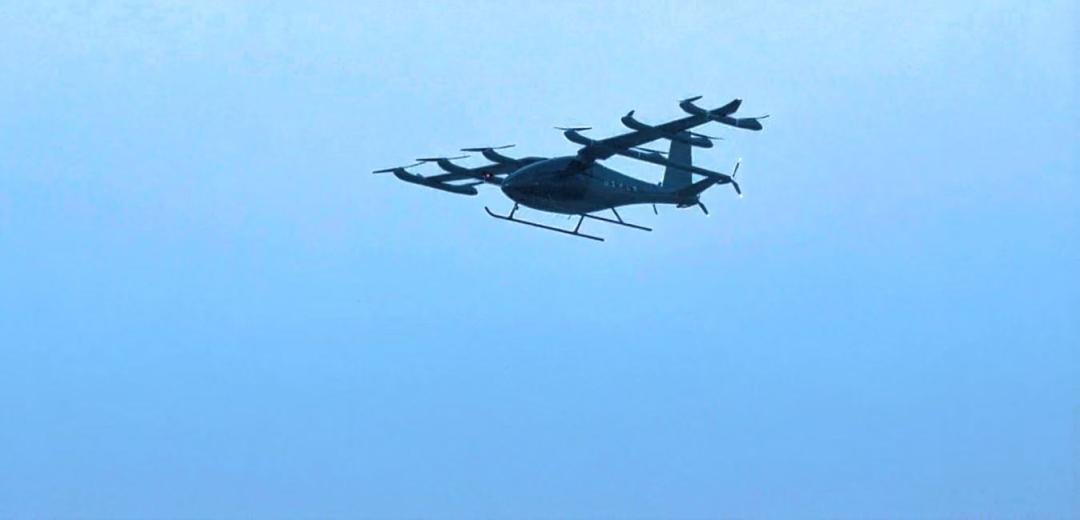
Qifei Aviation W280 full-size engineering verification aircraft
"This is not a detour, but to commercialize the intermediate products of R&D in advance." In the view of the founder, the core value of this solution is to convert the inevitable weight and time cost in the eVTOL R&D process from sunk cost into reusable experience and monetizable assets: first, let the cargo configuration pass airworthiness certification and real operation to generate revenue, and at the same time continuously accumulate data such as flight hours, maintenance records and supply chain stability for the manned configuration, to accelerate the certification of the manned model.
This path from cargo to passenger, from special use to full scenario, has been proven effective in history.
As a reference, the Cessna 208 Caravan started with a multi-purpose design. It began to deliver basic cargo models to FedEx in 1985. In 1990, it keenly sensed the gap in the commuter market, restored the porthole design, optimized the interior, and launched the extended 208B Grand Caravan. Finally, more than 3,000 units have been delivered worldwide, making it one of the most successful and best-selling aircraft in the global general aviation field.
Of course, for a late-entry team, a more realistic development basis also comes from the judgment of timing and competition. Optimistically estimated, the real commercialization of the manned eVTOL will take at least another 3-5 years, but the cargo demand in rigid scenarios such as offshore oil and gas platforms and island transportation already exists. Instead of directly betting the survival opportunity on the realization of the long-term market, the collaboration and progressive development of the two aircraft can better improve the winning rate of startups.
In the final analysis, it is to identify a path that you believe in, and then fight an efficiency battle.
In May last year, the full-size engineering verification aircraft of Qifei Aviation W280 rolled off the production line, and two months later, it completed its maiden flight at the Suzhou Shengze Lake All-space Unmanned System Demonstration Island. In the first half of this year, W280 entered the normal conversion transition phase of test flight, and obtained TC acceptance on September 1, and the manned model entered the airworthiness certification phase.
The intensive fulfillment of key milestones has also brought this team, which rarely spoke out in the past few years, back to the industry's discussion scope.
Hold the "brain" in hand and make the most of the Chinese supply chain
From the perspective of engineering progress, Qifei Aviation is moving very fast. Behind the efficiency is the combined force of three dimensions: the experience of the founding team, independent R&D of core technology, and 100% domestic supply chain.
Qifei Aviation has proposed the R&D method of "software-defined aircraft", behind which is the judgment: future aircraft will be highly electronic and integrated like today's cars, function iteration and system integration will be more driven by software, and hardware will tend to be standardized and generalized.
"We originally adopted a platform-based idea, independently developed flight control and operating system, connected all on-board hardware to the integrated computing platform, and the software platform completes data collection, integration, judgment and intelligent processing." In the founder's view, eVTOL is a natural fly-by-wire aircraft, whose control logic is highly dependent on software and algorithms, and the platform-based direction is inevitable. In the future, when pilots fly aircraft, they give instructions rather than actions, and the aircraft can calculate the optimal path according to real-time traffic and airspace, and human intervention is only required in case of accident or forced landing.
At the hardware level, Qifei chooses to hand over the "experience-dependent work" to more professional partners.
For example, in the flight control link, Qifei Aviation has reached an exclusive strategic cooperation of "from stick to rudder" with AVIC Automatic Control Research Institute. In the fields of airframe structure, power and energy, Qifei Aviation has also jointly cooperated with many central enterprises and leading listed companies to develop key systems such as material systems, airframe structures, motors and batteries, and overcome the vibration problem of compound wing through forward adaptation design, so as to continuously optimize weight and performance.
"AVIC Automatic Control Research Institute is the main domestic supplier of civil aircraft flight control. They are responsible for the hardware platform and flight control computer, which is their strength. The core software and control laws are written by ourselves to ensure independent and controllable. The two sides jointly tackle key problems and complement each other's capabilities to ensure flight safety." The founder of Qifei mentioned that many eVTOL manufacturers will outsource the entire software and hardware architecture of flight control, and Qifei is one of the few OEMs that have developed manned-level flight control by themselves and mastered the control laws and core software.
According to the introduction, Qifei Aviation has now achieved 100% localization of the supply chain, with the AVIC system accounting for more than 50%.
Qifei Aviation summarizes it as the collaboration mode of "OEM + national team + industry leader". For startups, relying on the strongest local supply chain system with central and state-owned enterprises as the core can not only provide engineering support and independent and controllable guarantee for subsequent airworthiness certification and large-scale mass production of aircraft, but also help the team improve R&D investment efficiency and optimize cost structure.
The founder mentioned that for three years and three aircraft, Qifei Aviation only used a team of less than 50 people, about one third of the R&D cost of its peers, to achieve the same engineering progress. "In the verification machine stage, we actually don't need that much capital. We independently develop core technologies, do not expand the team blindly, and make the most of the supply chain based on the advantages of China's manufacturing industry."
This kind of accumulation is also gradually translating into market recognition. Previously, Qifei Aviation has established an airworthiness guarantee alliance with many units under AVIC, and reached cooperation with China Telecom Suzhou, Rnaviation and other enterprises to jointly build an urban low-altitude service ecosystem.
In November last year, Qifei Aviation signed a letter of intent for the procurement of 105 eVTOLs with three enterprises in the Guangdong-Hong Kong-Macao Greater Bay Area to promote the construction of a three-dimensional logistics network in urban agglomerations.
All companies are locking in market demands in advance, and the next competition is whether the product can fly and who can fly first.
For Qifei Aviation, obtaining TC acceptance is an important milestone on the R&D path of W280 product, but it is far from the end. The team judges that this track is a long-term and protracted war -- the elimination has not yet begun, and rhythm is more important than ranking. Manned eVTOL will not enter commercial operation until at least 2028. Before that, continuously polishing the product and surviving is the most important thing.