Short-seller report targets Anthropic: its $2 trillion valuation is only worth $150 billion
"The most absurd IPO of 2026."
Independent research institution New Constructs used this sentence to set the tone for Anthropic's listing. This AI company is sprinting towards Nasdaq with a target valuation of 2 trillion US dollars, which is expected to surpass SpaceX and become the largest IPO in global history.
However, New Constructs only gave a valuation of 150 billion US dollars, 13 times lower than the target valuation.
There is an even more weighty statement in the short-selling report — Wall Street is about to face an unprecedented test, which will show how gullible investors are.
David Trainer, founder of New Constructs, has been engaged in IPO bearish businesses on Wall Street for many times. In 2019, he called WeWork "the most absurd IPO of the year". Six weeks later, WeWork withdrew its listing application, and filed for bankruptcy protection four years later.
Coincidentally, "Big Short" Michael Burry also spoke out. He posted that for the benefit of humanity, the market should fall sharply to stop the IPO of OpenAI and Anthropic. The reason is that the two companies will absorb trillions of dollars in funds and eventually destroy all that money — and that is only the minimum damage they may cause.
On one side is the largest $2 trillion IPO in history, and on the other side are fierce accusations of "the most absurd", "scam" and "block listing". The gap between the two sides is so huge that it does not seem to be talking about the same company.
How much is Anthropic really worth?
There may be no standard answer to this question, but before its official listing in November, we can first lay out the books for a check.
Why Some People Are Willing to Pay High Prices
The $2 trillion valuation is first supported by an extremely steep growth curve.
In 2024, Anthropic's full-year revenue was 386 million US dollars. In 2025, this figure rose to 4.59 billion US dollars, surging 12 times in one year.
In 2026, the growth rate is still accelerating. By the end of July, the annualized revenue has rushed to 650 billion US dollars. The company expects that the annualized revenue will exceed 1 trillion US dollars by the end of this year, and reach 1.9 trillion to 2 trillion US dollars in 2028.
From 46 billion to 2 trillion, it is more than 40 times growth in three years.
Calculated based on the forecasted revenue in 2028, the $2 trillion valuation corresponds to a price-to-sales ratio of about 10 times, which is not an outrageous number for a high-growth technology company. But if calculated based on the actual revenue of 4.6 billion in 2025, the price-to-sales ratio is 436 times.
This is the core bet of the $2 trillion valuation: do you believe Anthropic can increase its revenue by 40 times in three years?
The bulls have their reasons.
The first is customer growth. The number of enterprise customers with annual consumption of more than 1 million US dollars has doubled from more than 500 to more than 1,000 in two months. Claude is penetrating rapidly in high-frequency scenarios such as programming, knowledge retrieval and data analysis. Once integrated into the enterprise workflow, the call volume will continue to grow as the business expands.
Then there is the channel advantage. Anthropic provides services to enterprises through the three major cloud platforms of Amazon AWS, Google Cloud and Microsoft Azure, which is equivalent to leveraging the sales channels of the three clouds. The customer reach efficiency is much higher than building a sales team from scratch.
There is also capital endorsement. From its establishment in 2021 to now, Anthropic has completed 13 rounds of financing in five years. The Series A was only 124 million US dollars, the valuation was 615 billion in March 2025, rose to 1.83 trillion in September, and reached 9.65 trillion after the financing in May 2026 — if the IPO hits 2 trillion, it means the valuation of the last round will more than double.
In five years, the valuation has increased by 20,000 times from 100 million to 2 trillion. But the higher you fly, the more fuel you need. And Anthropic's fuel bill has reached a staggering level.
Real Risks: Losses, Computing Power Bills and Customer Concentration
$42 billion is Anthropic's net loss in 2025. A company that has been established for four years lost 42 billion in one year, which sounds exaggerated.
But this number needs to be broken down. About 34 billion of it is non-cash accounting expense generated from the revaluation of convertible financing instruments. To put it plainly, it is just a bookkeeping number game, not that so much cash has been actually burned.
After deducting this part, the actual operating loss is 8.06 billion US dollars.
8 billion is not a small number, and it is still expanding compared with 2.98 billion of the previous year. The source of the loss is very clear — computing power.
In 2025, Anthropic spent 7.33 billion US dollars on computing and infrastructure, accounting for 58% of total operating expenses, equivalent to 1.6 times of the annual revenue. For every 1 dollar of revenue earned, 1.6 dollars have to be spent on computing power fees.
The good news is that this proportion is declining. In 2024, computing power expenditure was 6.6 times of revenue, and it dropped to 1.6 times in 2025. The growth rate of revenue exceeds the growth rate of computing power expenditure, and the scale effect is emerging.
The bad news is that even larger bills are yet to come.
The prospectus discloses that Anthropic's total contractual obligations for cloud computing and infrastructure in the next few years are about 5.18 trillion US dollars.
What is the concept of 5.18 trillion? It is equivalent to more than 100 times of the company's 2025 revenue. And a large number of these contracts adopt the take-or-pay model — in short, whether you use the computing power or not, the money has to be paid in full.
In the past 11 months, on the basis of the original 1 to 2 GW, Anthropic has locked in at least 14.8 GW of computing power. What is the concept of 14.8 GW? Calculated based on 1 GW corresponding to the electricity consumption of about 750,000 American households, this is equivalent to the electricity consumption scale of more than 10 million households.
Why sign such a large long-term contract? Because Anthropic is betting — betting that the demand for models will continue to grow in the future, locking in computing power resources in advance in exchange for space for future expansion. But if the demand growth cannot keep up, these contracts will become a heavy burden.
Customer concentration is also a rather serious problem. Nearly a quarter of Anthropic's revenue comes from two customers. Two customers support a quarter of its business, and the concentration is quite high. Moreover, many large customers have not signed long-term lock-in contracts, which means they can reduce expenditure or even stop procurement at any time.
For a To B company, customer concentration is not a sin in itself — it is normal for large customers to drive growth in the early stage. But combined with the premise of "no long-term contract", the risk is amplified. Today's big customer may not be there tomorrow.
There is also a deeper structural problem: the shareholder revolving door.
Amazon and Google are not only important investors of Anthropic, but also its cloud infrastructure suppliers. This relationship helps Anthropic quickly obtain capital, computing power and sales channels, but it also means that the company's cost structure and cooperation terms are deeply bound with related parties. Are investors buying stocks of an independent company, or a part of an ecosystem? This needs to be figured out clearly.
By the end of 2025, Anthropic still had 202.8 billion US dollars in cash on hand. It sounds like a lot, but compared with the 5.18 trillion computing power contractual obligations, it is just a drop in the bucket.
This is also why Anthropic has to go public. Without listing, there is not enough money to burn.
The Logic of the Bears
Why does New Constructs dare to say that it is only worth 150 billion?
Their core argument is not losses, nor customer concentration — these are all tactical issues. Their point of attack is at the strategic level: the closed-source model cannot make money at all.
"Since the emergence of the open-source model, it is obvious that the closed model is very difficult to generate profits," New Constructs wrote in the report.
This logic is actually not complicated.
In the past few years, open-source large models have made rapid progress. Meta's Llama series, Mistral's models of various sizes, and a large number of fine-tuned versions from the open-source community are getting more and more capable with lower and lower prices. Many enterprise customers find that an 80-point open-source model can meet their needs, so there is no need to pay 10 times the price for a 95-point closed-source model.
For Anthropic, this means two pressures: first, it is difficult to raise prices, and second, the profit is thin. If customers can switch to cheaper open-source solutions at any time, the pricing power of closed-source models is very limited. The computing power cost is rigid, but the revenue has a ceiling. How large can the profit margin in between be?
New Constructs also did the math: to support a $2 trillion valuation, Anthropic's profit needs to reach twice the profit of NVIDIA in the previous year. NVIDIA's net profit in the past four quarters exceeded 190 billion US dollars.
But Anthropic is still losing 8 billion a year now.
How big is this gap? From losing 8 billion to making 380 billion, there is a huge gap of 460 billion. Even if the revenue reaches the predicted 2 trillion, the profit margin has to be close to 200%, which has never been heard of in any industry.
Of course, the bears are not right every time.
New Constructs' track record includes the amazing prediction of WeWork, as well as the accurate bearish view on Allbirds — this shoe company was valued at 4.1 billion US dollars when it went public, and sold its assets for 39 million US dollars a few years later.
But they also made misjudgments. In 2020, they called DoorDash the most absurd IPO of the year, comparing it to the next WeWork. As a result, DoorDash's stock price rose all the way after listing, and its market value rose from 600 billion to 830 billion.
Trainer himself also admitted: "Crazy things will happen, and we are not always right. But I have to stick to what I think is right."
More extreme than New Constructs is the "Big Short" Michael Burry.
This investor, who was played by Brad Pitt in the movie *The Big Short*, directly called for the market to fall to stop the IPO of Anthropic and OpenAI. He said the two companies will absorb trillions of dollars in funds and eventually destroy all that money — "and that is only the minimum damage they may cause".
Burry's words are a bit extreme, but he represents a deep concern: will the AI bubble drag the entire market down?
There is also a very ironic point that New Constructs also pointed out — Anthropic itself said that AI may bring "catastrophic or existential risks". The 80-page risk factors section in the prospectus lists potential scenarios such as models resisting shutdown, hiding manipulated information, and committing extortion acts.
The company itself is warning of risks, so shouldn't investors discount the valuation for these risks?
Historical Reference: WeWork or Microsoft?
Every time there is a super IPO, the market will ask the same question: Is this the next Microsoft, or the next WeWork?
However, it is really unfair to compare WeWork with Anthropic.
WeWork is essentially a sublessor business: renting offices, decorating them and then subletting them, with no technical barriers, relying only on storytelling and burning money for expansion. Anthropic has real technical barriers, real products, real revenue growth, and the outbreak of enterprise AI demand is also real.
But the similarities between the two are also disturbing.
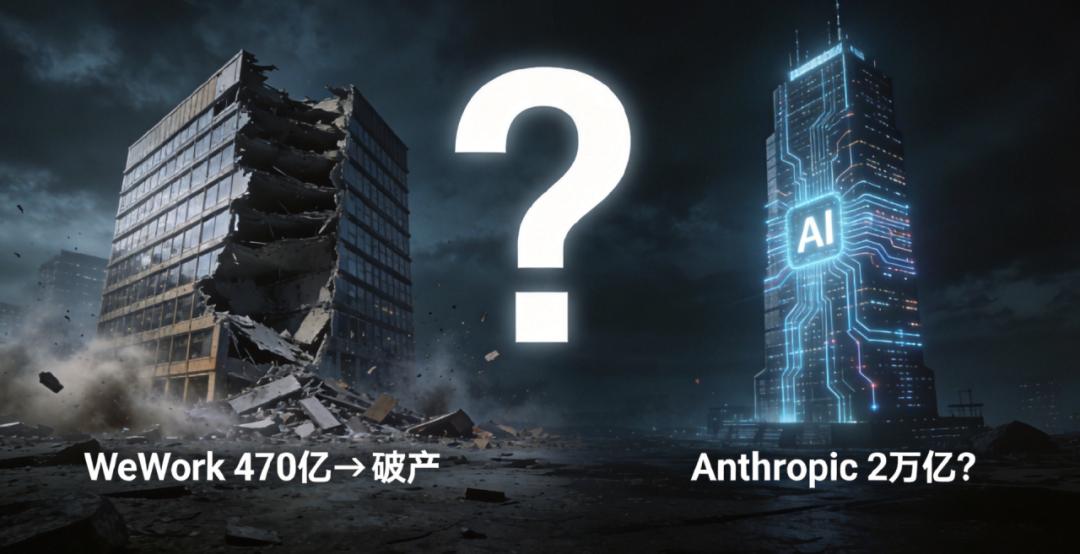
The same ultra-high valuation, the same loss-making expansion, the same founder aura, and the same sprint for IPO at the hottest time of the market. WeWork's peak valuation was 47 billion, and it went bankrupt to zero in the end. If Anthropic really goes public at 2 trillion, even if it only falls by half, 1 trillion of market value will evaporate — which is not a small number.
A more appropriate historical reference may be the dot-com bubble in 2000.
At that time, the stock prices of really good companies such as Amazon, Google and eBay were also speculated to outrageous heights, and fell by 80% and 90% after the bubble burst. But they survived and became the greatest companies of this era. And most other companies disappeared completely after their bubbles burst.
So the question is not "whether AI is the future" — AI is certainly the future. The question is at what price to buy the future.
Buying Anthropic for 2 trillion means betting that it can become Microsoft or Google in the AI era — a trillion-dollar software empire. No one knows how likely that is. But you have to admit that from the current state of 46 billion revenue and 8 billion losses to a software empire with trillions in profits, there are too many hurdles to cross.
Will open source continue to erode profits? Can customer growth continue? Can the 5.18 trillion computing power contracts be converted into sufficient revenue and profits? How much impact will regulatory and security risks have? How will competitors such as OpenAI, Google and Meta fight back?
If you get any of these questions wrong, the valuation has to be discounted. After a dozen questions, the gap between 2 trillion and 150 billion may not be that big.
Of course, the reverse is also true. If you get every question right, 2 trillion may even be cheap — just like when Google went public in 2004, many people thought the $800 billion valuation was crazy.
What Exactly Is the $2 Trillion Bet On
Anthropic's $2 trillion IPO is ultimately a question about belief.
The bulls are betting that this growth curve can continue to extend: enterprise AI demand continues to explode → revenue grows exponentially → scale effect emerges → turn losses into profits → become an infrastructure-level company in the AI era.
The bears are betting that growth will eventually come to an end: open-source models pull down the price ceiling → large customer budgets fluctuate → the 5.18 trillion computing power bill becomes a heavy burden → the high valuation collapses.
Both sides make sense, and both sides have risks.
New Constructs' 150 billion valuation may be too conservative. After all, Anthropic has real products, real customers and real growth, and 150 billion is equivalent to denying all the value of these.
But 2 trillion may also be too optimistic. A historical price-to-sales ratio of 436 times, an operating loss of 8 billion, and 5.18 trillion in contractual obligations — these figures on any company should make investors stop and think.
The IPO in November will be the beginning of market voting. Roadshows, inquiry, listing, first-day performance — every link is a pricing calibration.
Is it the largest IPO in history, or the largest bubble? The answer to this question may not be truly revealed until three to five years later.
Until then, the only thing investors can do is to see clearly what they are betting on.
If you bet on a technological revolution, you have to bear the volatility. If you bet on valuation regression, you have to endure the pain of the bubble continuing to expand.
History has proved over and over again that the market can be crazier than you, and more rational than you can imagine. The only thing is that these two things never happen at the same time.