"De-Ningdeization" is a misunderstanding.
In September this year, a woman in Zhengzhou planned to spend more than 500,000 yuan on a Li Auto MEGA, and had already paid a 5,000-yuan deposit. Later, she found that the battery of the car she ordered was not supplied by CATL. Upon learning the news, she chose to cancel the order.
According to the adjustment plan previously released by Li Auto, for the new MEGA with locked orders after 15:00 on September 7, the battery will be switched from CATL's 5C ternary lithium battery to the 5C ternary lithium battery independently developed by Li Auto.
In response to the user's order cancellation, the staff at the Li Auto store responded: "The battery brand is not a core selling point, and we didn't expect users to care about it."
In the era of fuel vehicles, few people would ask which part comes from which supplier before buying a car. But in the era of smart electric vehicles, the names of several suppliers have begun to appear frequently in crowded airports and railway stations, trying to influence the car purchase decisions of this generation of consumers.
For these super Tier 1 suppliers, this is of course a huge success, but for car companies, it may not necessarily be entirely good news.
If the most core performance of a car, the most important sense of security, and even whether consumers are willing to place an order are increasingly determined by the names of several suppliers, then who exactly defines this car, and who is ultimately responsible for it?
Just at this time, Li Auto began to introduce self-developed batteries on a large scale, and increased its capital in Sunwoda Power to become its second largest shareholder. Leapmotor also began to produce part of the cells on its own. Xiaomi has also reached strategic cooperation with Sunwoda and CALB, and NIO is also moving deeper into the upstream of the battery industry in different ways.
A term that had been silent for several years was pushed to the forefront again: "De-CATLization".
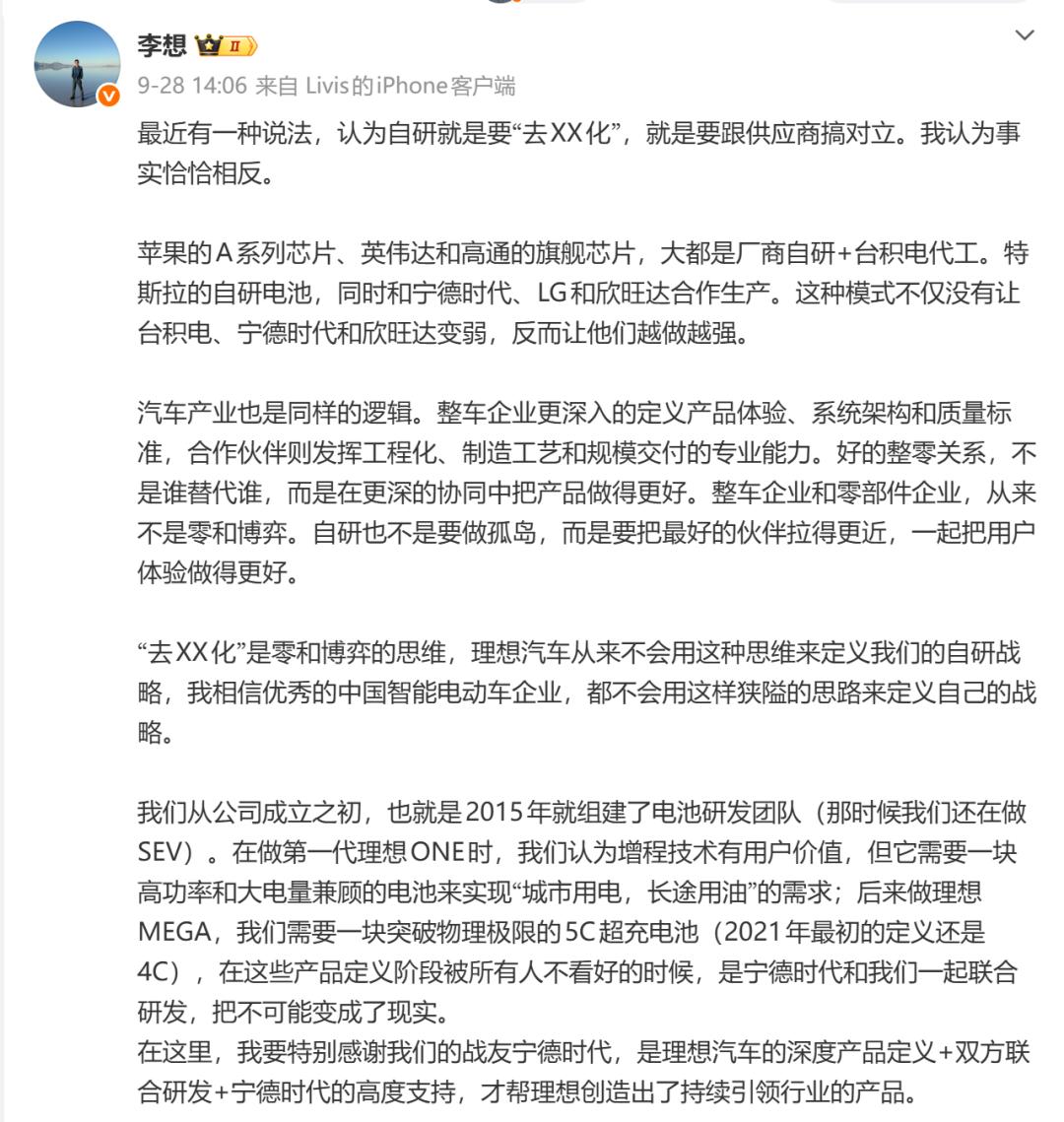
Li Xiang responded to "De-CATLization" on Weibo
Many people think this is because CATL has made too much profit, set too high prices, and held too much discourse power in recent years. After enduring for many years, car companies have finally begun to "rebel".
This inference is very consistent with empirical intuition, but it may not explain everything that is happening. The so-called "De-CATLization" movement is backed by an industrial transformation far more complex than simply changing suppliers.
01
The Truth of the "Ning Tax"
If you only look at the income statement, "De-CATLization" can easily be understood as a long-overdue resistance.
In the first half of this year, CATL's revenue reached 276.9 billion yuan, its net profit attributable to shareholders was 43.3 billion yuan, and its gross profit margin reached 23.93%. On the other hand, Chinese car companies are still fighting fiercely in the price war, and none of Li Auto, NIO and XPENG can stably cross the break-even line.
As a result, the outside world often uses financial reports to question CATL: Others make almost no profit selling cars, why are you, the battery seller, making so much money?
But "CATL is very profitable" and "CATL makes huge profits at the expense of Chinese car companies" are actually two completely different issues.
Let's first break down CATL's revenue.
In the first half of this year, power battery revenue was 192.1 billion yuan, accounting for about 69% of total revenue, with a gross profit margin of 20.63%, a year-on-year decrease of 1.68%; energy storage battery revenue was 53.3 billion yuan, with a gross profit margin of 23.96%, a year-on-year decrease of 1.56%; revenue from materials, recycling, mining and other businesses was about 18.8 billion yuan, with a gross profit margin of 27.04%.
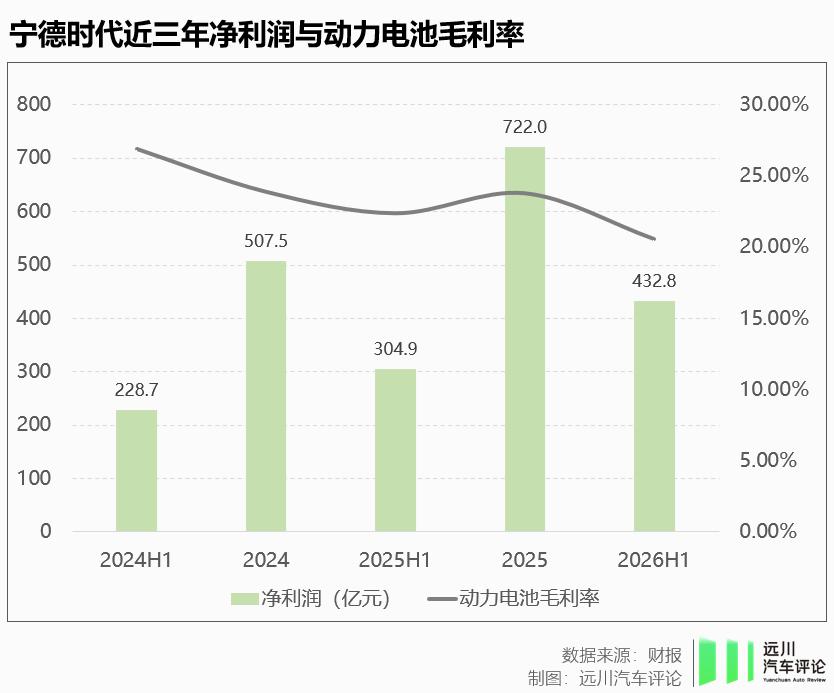
The gross profit margin of power batteries is on a downward trend
In other words, although power batteries are the fundamental business of CATL, they are not the most profitable business, and their gross profit margin is also in a downward trend.
Regional differences are even more obvious.
In the first half of the year, CATL's domestic revenue was 189.8 billion yuan, with a gross profit margin of 21.16%; its overseas revenue was 87.1 billion yuan, but the gross profit margin reached 29.97%, nearly 9 percentage points higher. Overseas revenue accounts for more than 30% of total revenue, but contributes nearly 40% of gross profit.
It can be said that CATL's current profitability is not built on "exploiting" car companies, but on globalization, scale and business diversification. Directly equating the group's gross profit margin of about 24% to "for every 100 yuan car companies spend on batteries, CATL takes 24 yuan" somewhat overestimates the power of the "Ning Tax".
If you break down the data further, the result will be more counterintuitive.
In the first half of this year, CATL's global power battery installed capacity was about 242.7GWh, of which about 152.2GWh was in China and about 90.5GWh was overseas. Calculated by electricity volume, the domestic market still accounts for more than 60%.
However, the overseas power battery price is significantly higher than the domestic price. According to the estimate of the price difference at home and abroad by third-party institutions [1], the proportion of CATL's domestic power battery revenue in the entire power battery sector will drop to about 53%, corresponding to a revenue of just over 100 billion yuan.
Combined with the structure of passenger and commercial vehicles in the domestic power battery market, CATL's revenue from Chinese passenger vehicle power batteries is about 76 billion yuan, accounting for less than 30% of the group's total revenue.
The same logic applies to gross profit margin.
Although CATL does not separately disclose the gross profit margin of "domestic power batteries in China", according to reasonable estimates [2], if most of the materials, recycling, mining and other businesses are excluded from domestic revenue, the gross profit margin of the remaining "power battery + energy storage battery" is about 16.6%, which is not significantly higher than that of second-tier manufacturers such as Sunwoda, CALB and Gotion High-Tech.
Moreover, high gross profit margin never equals huge profit. Especially for the heavy asset manufacturing industry such as power batteries, it is impossible to simply draw a line that 16% is reasonable and 20% is huge profit. More importantly, we need to see where these profits come from.
In the first half of this year, CATL's existing production capacity of battery systems was 525GWh, with an output of 498GWh, and the capacity utilization rate was close to 95%, which is an absolute leading level far ahead of others.
For the heavy asset manufacturing industry, the more fully the production line runs, the lower the depreciation and fixed cost allocated to each cell. Coupled with a larger raw material procurement scale, more mature processes, higher yield rates, and long-term accumulated supply chain and quality management capabilities, CATL can easily earn a few more percentage points of profit even at similar selling prices, simply because its costs are lower than others.
Therefore, the premium factor of CATL includes not only its leading position and brand endorsement, but also excess returns brought by scale effect, manufacturing efficiency and technical capabilities.
Of course, for car companies, this does not mean that battery prices are already low enough to leave no room for reduction. Power batteries are still the largest cost item of a new energy vehicle. Even if the procurement cost can only be reduced by another 2 to 3 percentage points, multiplied by hundreds of thousands or even millions of cars, it is also a very considerable profit.
But if the sole purpose is to reduce costs, car companies can actually adopt a simpler and cruder method: introduce more suppliers and let them compete to lower prices. But what car companies have done in this round is far more than that. They began to define cells on their own, research materials, master manufacturing data, and even go into production in person.
02
Why Now?
Song Yining, head of battery business at Leapmotor, said in a recent interview with 36Kr that because power batteries have become commoditized, it is the right time for car companies to enter this field [3].
Before 2020, the material system of lithium batteries iterated rapidly, equipment and processes were not mature, and a large amount of know-how was mastered by a few enterprises. At that stage, if car companies researched cells from scratch, it was equivalent to re-learning electrochemistry, material science and mechanical manufacturing on a fast-evolving track. It was very likely that before their own products were mass-produced, the industry route had already changed.
But in the past three to five years, especially in the LFP battery field, the situation has changed.
Material supply is becoming more and more concentrated, equipment enterprises are getting more and more mature, and production environment, process control and quality system are gradually standardized. Song Yining said that for today's LFP batteries, the gap in basic manufacturing capabilities between leading enterprises is not as huge as it used to be.
The reason why Leapmotor and Li Auto dare to enter this field now is not that they suddenly feel that they understand electrochemistry better than CATL. The premise is that the lithium battery industry chain can provide mature equipment, materials and talent foundation.
In a sense, this is a somewhat ironic result: CATL spent more than ten years turning power batteries from luxury products with unstable performance into mature industrial products, but it also lowered the threshold for automakers to go deeper into the upstream industry.
But technological maturity is only a necessary condition. What is more important is scale.
If an automaker only sells 100,000 vehicles a year, there is no economic sense to build a complete set of independent battery R&D and manufacturing system. But in the era of annual sales of millions of vehicles, the situation is completely different.
According to Leapmotor, if they sell 1 million cars this year, they need nearly 70GWh of cells. If they can sell 1.6 to 1.7 million cars next year, the demand may exceed 100GWh, and 70GWh is equivalent to the annual shipment volume of a large power battery company.
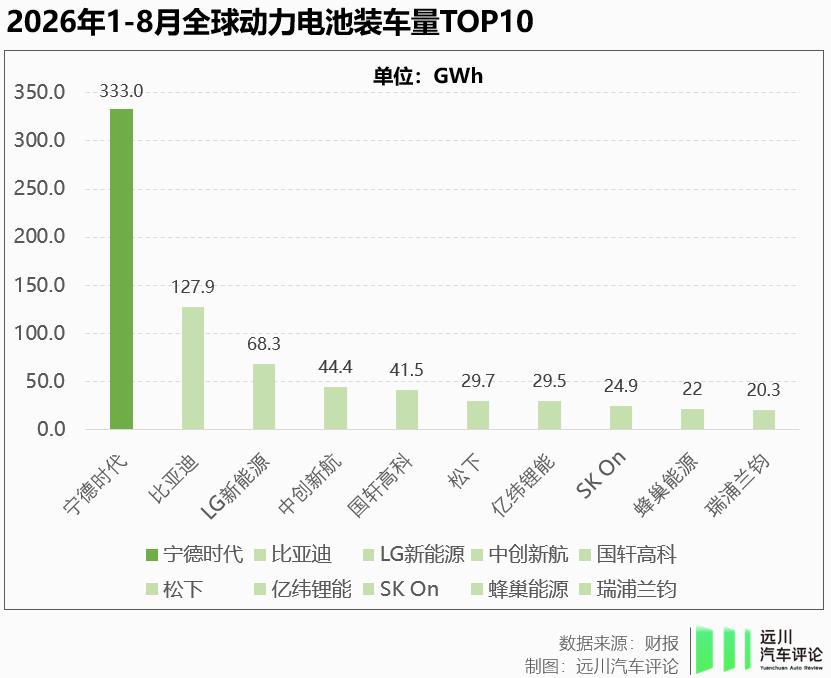
Rather than dispersing such a large demand to different suppliers, it is better to independently develop and produce part of the cells, which can not only hedge upstream risks, but also shorten the production process.
For example, Leapmotor's integrated battery park puts cells, modules PACK, boxes, liquid cooling plates, CCS (cell connection system) in the same park, eliminating packaging, transportation, loading and unloading, and intermediate inventory. According to Song Yining's estimate, the cost of logistics and packaging per vehicle can be reduced by about 200 yuan.
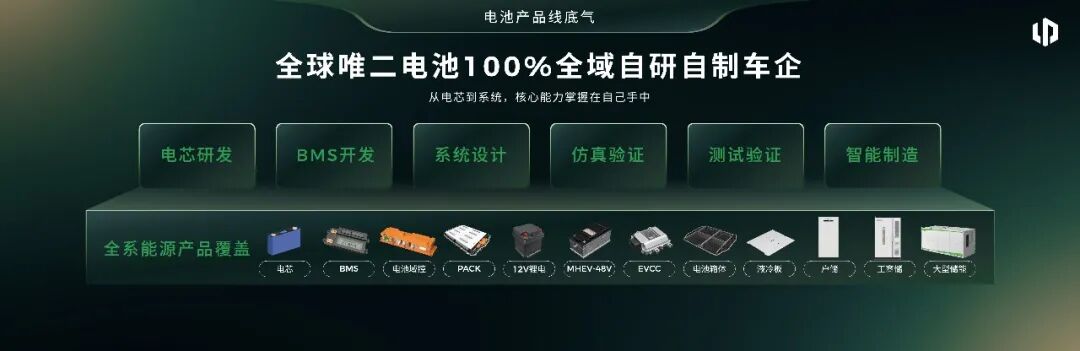
In the battery field, Leapmoon implements full-domain self-development and self-production thoroughly
To put it bluntly, every car company has considered developing and producing batteries on its own. It was just unaffordable before, and now it is more reasonable to do so.
Another time variable that cannot be ignored is the relationship between supply and demand.
Around 2022, the domestic power battery supply was in short supply, and the price of upstream lithium carbonate soared all the way to nearly 600,000 yuan per ton. In order to grab batteries, car companies needed to lock in production capacity in advance.
In early 2023, CATL launched the "Lithium Mine Rebate" program for some strategic customers, using the settlement price of 200,000 yuan per ton of lithium carbonate to reduce part of the battery cost, but required cooperative car companies to hand over about 80% of their battery procurement volume to CATL in the next three years [4]. In essence, it is a transaction of "exchanging price certainty for order certainty".
Three years later, the chips on the negotiating table are completely different.
The price of lithium carbonate has dropped to more than 100,000 yuan per ton, and the power battery production capacity is more abundant than before. The product capabilities and delivery scales of BYD, Sunwoda, CALB, Gotion High-Tech and EVE Energy are constantly improving. At the same time, the round of long-term procurement arrangements in 2023 has also entered the window of renegotiation and renewal one after another.
Therefore, this round of car companies going deep into the battery business is not because a certain variable has changed suddenly, but because technology, scale and supply-demand relationship have all crossed the critical point at the same time.
03
Not Devoured by Complexity
The more customers a battery company serves, the more complex the cell SKUs will inevitably be.
Different cells mean different sizes, different capacities, different rates, even different material systems and cycle lives. Moreover, when a vehicle model is updated, the cell specifications may be adjusted accordingly. Song Yining revealed that he asked some leading cell companies, and their battery SKUs can reach thousands of types.
But this is obviously not what car companies want. Otherwise, the cost advantage brought by vertical integration will be completely devoured by complexity.
Take Leapmotor, which adheres to full-domain self-development, as an example. It has been promoting cell standardization since 2018. The 148 model has been iterated for 8 years, and the 208 model has also been iterated for 5 years. Li Auto follows the same idea. It currently provides two types of solutions: 5C ternary lithium and 5C LFP, with a maximum of two cells for each type, so as to improve the versatility and manufacturing flexibility of the production line.
The logic behind this is not complicated.
Cells are products manufactured in a highly continuous way. A large number of equipment and process parameters are deposited on one production line. To switch to another type of cell, it is not only necessary to replace the equipment, but also to adjust the process, verify the parameters, and then go through a round of yield rate climbing.
According to Song Yining, some domestic battery factories change the model of one production line for less than 5 times a year, and some production lines change models more than 10 times a year. The model change itself plus the re-climbing process may lose weeks or even months of effective production capacity.
Moreover, there is a big difference in the final maturity and cost between a cell produced only for a few months and a cell produced continuously for several years. This is also the key reason why many car companies are pursuing