Why is Huawei pushing HarmonyOS to go global at this moment?
Huawei Devices is venturing into overseas markets again with a brand-new approach.
On October 6, Huawei's official overseas account released an interview transcript. Yu Chengdong (Richard Yu), Executive Director of Huawei and Chairman of Huawei Devices BG, talked to international media about Huawei's latest progress in chips, HarmonyOS, AI, foldable screens and overseas markets.
He stated that the long-term strategy of Huawei's Devices business in the next decade will center on five major scenarios: Harmony Intelligent Mobility, Harmony Office, Smart Home, Sports & Health, and Audio-Visual Entertainment, to deliver a seamless AI life experience for all consumers.
Among all the updates, two points stand out: first, Huawei is considering gradually rolling out the HarmonyOS operating system to the global market, but this is only an initial plan that will be advanced step by step; second, the price of storage components has risen sharply, pushing up the cost of each mobile phone by more than 200 US dollars. Huawei has been trying to absorb the extra cost on its own, but its overall profit margin has dropped significantly, leaving the company no choice but to raise product prices in the future.
The fact that these two points were actively disclosed by the official itself sends a clear signal: Huawei's Devices business will take HarmonyOS as its core driver to expand into overseas markets on a large scale once again.
More importantly, Yu Chengdong made these remarks specifically for the overseas market audience.
Statistics show that HarmonyOS has already built a solid foundation.
Yu Chengdong revealed that at present, more than 90 million devices are running HarmonyOS 6 and HarmonyOS 7, covering smartphones, PCs and tablets. The figure is expected to reach 100 million by the end of 2026, marking that the HarmonyOS ecosystem has moved past the introduction phase and entered the growth phase.
In terms of the application ecosystem, the number of applications and services on HarmonyOS has exceeded 450,000, the number of registered global developers has reached 11 million, and the number of application innovation partners has surpassed 23,000.
In the first quarter of 2026, HarmonyOS overtook iOS for 7 consecutive quarters with a 19% market share, ranking second in China; its share rose to 24% in the second quarter, while iOS took 18% of the market. The Ministry of Industry and Information Technology of China also confirmed that HarmonyOS has become the world's third largest mobile operating system after Android and iOS, with a 5% global market share in the first quarter.
However, the ranking of second in China and third in the world does not mean that HarmonyOS is in a safe position. Yu Chengdong pointed out that the biggest challenges for operating systems lie in application development and ecosystem construction, which is the exact step where Microsoft's Windows Phone, Samsung's bada and Nokia's Symbian all failed completely.
At the moment, there are only two paths left for Huawei's Devices business to continue growing stronger: move up the value chain, or expand outward to overseas markets.
For the upward path, Huawei remains the only domestic Chinese brand that can compete head-to-head with Apple in the high-end market. Over the past 7 years, Huawei's mobile phone business has not only survived, but also captured almost all the domestic market share it could secure. In the second quarter of 2026, Huawei ranked first in China's smartphone market with a 23% share, while Apple ranked second with 18%.
This leaves only one viable path: to expand outward to overseas markets.
Selling mobile phones is a one-off transaction, while running an operating system is a recurring revenue business. Apple's App Store commission and Google's licensing fees are proven successful examples. If HarmonyOS is fully rolled out globally, Huawei's mobile phone business model will shift from selling hardware to the Apple-style integrated hardware and software model.
This is the most thorough strategic reassessment of Huawei's mobile phone business in the seven years since it was hit by supply restrictions.
Huawei has also prepared two new trump cards for this goal: an independent supply chain system and self-developed operating system. As Yu Chengdong put it, Huawei resumed localized supply of core mobile phone chips in 2023, and has basically got rid of its dependence on external technologies.
With all these conditions in place, HarmonyOS can officially put the "overseas expansion" plan on the table.
However, Yu Chengdong did not give a specific timetable for this new overseas expansion, and this public statement is more like a test of market response. Even so, the significance of HarmonyOS going global is far greater than the outside world expects.
Over the past two decades, Chinese technology companies' overseas expansion has gone through two phases. The first phase is product export, where hardware products are sold to all over the world; the second phase is model export, where platforms like TikTok and SHEIN replicate Chinese business models across the globe.
These two phases of overseas expansion share one common point: they are all built on underlying infrastructure owned by other parties. For example, Android, iOS and Windows, whose distribution rules, commission rates and review mechanisms are all set by others. The crisis Huawei faced in 2019 was exactly that its underlying support was taken away.
From my perspective, if HarmonyOS successfully goes global, it will very likely kick off the 3.0 phase of Chinese technology companies' overseas expansion: exporting the underlying digital infrastructure itself. Because operating systems are the "land" of the digital world, whoever owns an operating system is qualified to participate in the formulation of industry rules.
Huawei has accumulated sufficient resources for this goal for a very long time. On the one hand, it has achieved technological self-reliance: nearly half of Huawei's more than 200,000 employees are engaged in R&D, and the company's total R&D investment from 2007 to the end of 2025 exceeded 1.8 trillion yuan, with the R&D-to-revenue ratio rising from around 10% to over 20%.
The HarmonyOS ecosystem has also entered a positive cycle. HarmonyOS now has access to more than 400,000 applications and services, with over 100,000 native applications, a 97% adaptation rate for the top 100 mobile applications, and all high-frequency applications such as WeChat, Alipay, Douyin and Meituan are fully supported. Among them, the installed volume of the WeChat HarmonyOS version has exceeded 80 million.
On the other hand, Huawei has made efforts to adapt to international rules. On October 5, Huawei and Qualcomm just announced a multi-year patent cross-licensing agreement covering 5G, computing, AI, networking and other fields. Qualcomm will also acquire several of Huawei's US patents in the fields of computing, AI and networking, and the transaction is still pending regulatory approval.
This is the first 5G-covered cross-licensing agreement between the two parties, and it is the first time Qualcomm has paid patent royalties to Huawei. The total amount of Huawei's cumulative patent licensing agreements is expected to exceed 6.9 billion US dollars. The agreement repeatedly emphasizes the FRAND principle (Fair, Reasonable and Non-Discriminatory), which is equivalent to Huawei submitting a letter of commitment to comply with the international intellectual property rule system.
Among all Chinese technology companies, Huawei is currently the only one that can exchange standard essential patents with Qualcomm.
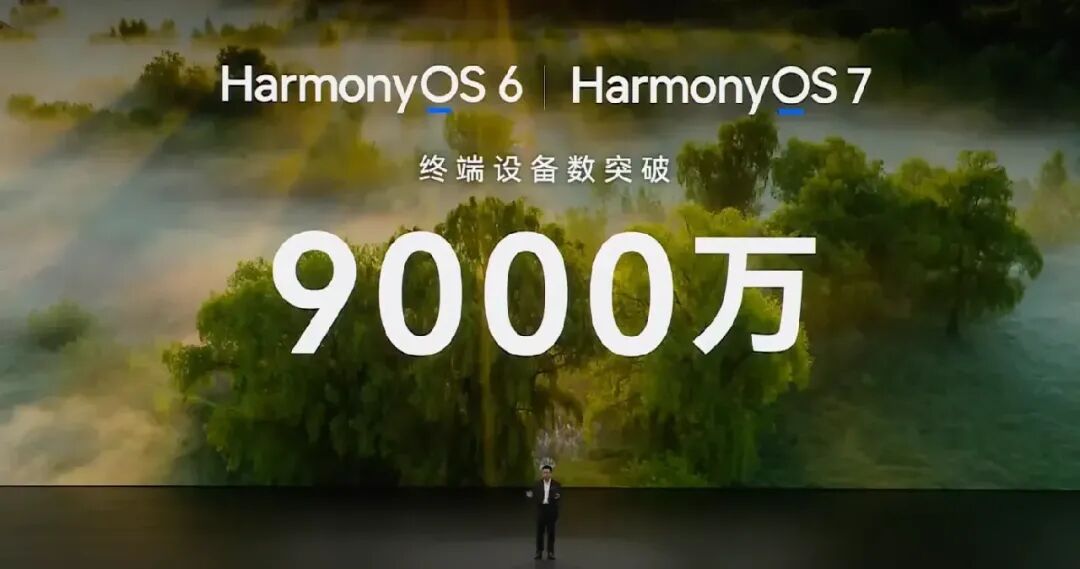
HarmonyOS Ecosystem Source: Screenshot from Huawei press conference
To a certain extent, HarmonyOS going global is equivalent to a corporate asset restructuring for Huawei. In the past, its Devices business followed the logic of the manufacturing industry, earning profit from each unit sold; now it shifts to the platform logic, where the sales volume of hardware such as mobile phones can be lower, but every HarmonyOS device acts as an access point to the ecosystem.
It can even be said that Huawei is currently following the successful path that Apple has taken. However, Yu Chengdong holds a very cautious attitude towards this overseas expansion. He said that Huawei's smartphone business has been severely affected since 2019: it once ranked first in the global market share, but now only sells several million units outside China every year.
This requires Huawei to rebuild its distribution channels, nurture the ecosystem, and refresh its brand recognition in overseas markets. The hardest part is trust building: operating systems hold users' data, payment channels and application distribution rights, so why would overseas users and developers hand over their digital lives to a Chinese operating system?
Fortunately, the foundation Huawei laid in the past is still solid. For example, its wearable devices rank first in market share both in China and across the globe, and its TWS earphones top the sales charts in many countries. Watches, earphones, tablets and vehicle infotainment systems rely far less on the application ecosystem than smartphones, and users who buy a Huawei watch do not care if it can install Instagram.
When expanding HarmonyOS to overseas markets, Huawei can temporarily put aside the mobile phone priority strategy, and first roll out a batch of devices that do not rely on Google's GMS suite, to gradually nurture the account system and developer ecosystem.
Emerging markets are another key entry point. Southeast Asia, the Middle East, Latin America and Africa are far less dependent on Google services than Europe and the United States, and their consumers are more price-sensitive. Users in these markets demand products that work well and are affordable, and do not insist on using Google services. Android captured these markets in its early days by securing the incremental market first before moving to compete for the stock market, and HarmonyOS can replicate this exact path.
AI also provides Huawei with a valuable window of opportunity. Compared with Apple's AI which is still delayed, Huawei's AI has already taken the lead in development. For example, HarmonyOS 7 for the first time integrates a large performance model into the performance optimization engine, adopts hyper-space storage technology, and proposes an agent-friendly system architecture, which enables the operating system to support agent operation at the kernel level, realizing the transition from "users finding applications" to "intent as service".
In the past, Windows Phone, bada and Symbian all failed in the paradox of "prioritizing users or applications first", and AI gives all mobile phone manufacturers a new level playing field.
If users can complete their tasks without opening a specific App, and the system directly calls out the corresponding service, then the problem of "not having a native version of a certain application" will no longer be a fatal flaw.
Nowadays, Huawei's Devices business is standing at a critical juncture. But the pace of HarmonyOS's overseas expansion fundamentally depends on how much gross profit Huawei's mobile phone business can continue to generate.
On this matter, Huawei can neither afford to go too slow, nor rush ahead recklessly.
This article is from the WeChat Official Account "Tang Chen's Notes", written by Tang Chen, and published with authorization from 36Kr.