For 140 years, the automotive industry has only answered one question.
Let's start with three scenarios.
Scenario 1: 1886, Stuttgart. Robert Bosch opened a precision mechanical workshop, with its initial business focusing on internal combustion engine ignition devices, and its earliest customers were Daimler and Benz, a group of people who had just invented the automobile. For the following 140 years, this company made almost all the right choices in the history of the automotive industry.
Scenario 2: 1999, Detroit. General Motors' shareholders approved one of the largest spin-offs in the history of American industry: divesting its huge parts empire to form an independent company called Delphi. On the day of the spin-off, Wall Street applauded and the management breathed a sigh of relief. No one expected that six years later, the company would end up in bankruptcy court.
Scenario 3: Today, China. Technology companies are flooding into the automotive industry with intelligent capabilities, and a never-before-seen complex relationship is evolving between automakers and suppliers, leaders and supporting partners, with in-depth cooperation, cross-shareholding, platform binding, sovereignty transfer and sovereignty recovery happening simultaneously every day.
The three scenarios, spanning 140 years, are essentially three inquiries about the same question: Who is qualified to sit in the driver's seat in the automotive industry?
We reorganized the history of suppliers in the global automotive industry over the past 140 years and found that this boundary was not designed by anyone, but drawn through the life and death of countless companies — Bosch proved one side with 140 years of operation, and Delphi proved the other side with bankruptcy.
This article is divided into three parts:
History: How the Tier 1 pattern was formed and how the boundary was drawn.
Rite of Passage: The position of Chinese automakers on this boundary and the mandatory exams they must take.
Ecosystem: The industrial power structure in the layered era and the future of industrial belts.
01
A Century of History: The Boundary Is Drawn at the Cost of Life and Death
1. The Family Precept of 1886: Not Making Cars Is a Belief, Not a Lack of Capability
First, let's explain a term that is unfamiliar to ordinary consumers but revered by everyone in the industry: Tier 1, the first-tier supplier, which refers to a supplier that directly delivers a complete system assembly to the automaker.
Bosch, Continental, ZF, Denso, Magna — names that most consumers cannot name, constitute the real middle layer of power in the global automotive industry. A fuel vehicle has more than 20,000 parts, and in an era when the proportion of parts manufactured by automakers themselves is getting lower and lower, Tier 1 determines what the brakes, steering, transmission, and electronic control systems of a car look like.
The starting point of this pattern is exactly that Stuttgart workshop. Over the next 140 years, Bosch made almost all the right choices, but the only truly foundational one is: never compete with customers.
Bosch can supply ESP body stability systems to Mercedes-Benz, and also supply the same set of ESP to BMW, Volkswagen, and Toyota — because it does not make cars itself, it can take every order with a clear conscience. The R&D cost of the same technology is spread across the scale of the entire industry, which is the secret of Tier 1's profit and the dividend of its neutrality.
It is worth noting that not making cars has never been a "capability issue" for Bosch — with Bosch's technical depth and financial strength, making a car is by no means an impossible task. It is a matter of belief: precisely because it has personally closed the door to becoming an automaker, it can stand at the table of all automakers at the same time.
The weight of this family precept is measured by the failure of its competitors.

2. The Fiasco of Detroit: Seventy Years of the Vertical Integration Empire
The United States in the early 20th century took a different path.
General Motors made large-scale acquisitions of parts manufacturers during its expansion period, bringing transmissions, spark plugs, and radiators all into its own system; Ford was even more extreme, wanting to control everything from iron ore to rubber plantations — the integrated steel, glass, and tire production at the River Rouge Complex was the peak totem of the "vertical integration" belief. The logic sounded impeccable: making parts in-house means controllable costs and secure supply.
What was the result? Captive suppliers became cost black holes: they only supplied to their parent company, failed to achieve sufficient scale, lagged in technical iteration, could not reduce costs, and had to give in unconditionally when the parent company cut prices. By the end of the century, the two automakers had to dismantle the empires they had built: General Motors spun off its parts system into Delphi in 1999, and Ford followed suit by splitting its system into Visteon in 2000.
Was it over after the spin-off? No. Delphi filed for bankruptcy protection in 2005, and Visteon followed into bankruptcy proceedings in 2009. The legacy of a generation of vertical integration ended up in bankruptcy court. Meanwhile, the independent Tier 1 suppliers, Bosch, Continental and ZF, grew into the mainstays of the automotive industry. ZF even spent tens of billions of dollars to acquire TRW in 2015, and then took over Wabco in 2020, growing stronger and stronger.
Detroit spent seventy years proving one thing: automakers can own parts factories, but they cannot own efficiency; suppliers can be supported by the parent company, but they cannot be supported to be competitive. What captive departments lack is never investment, but the test of market competition. A department that has no clients to lose has no reason to cut costs and pursue innovation.
(Later, some people tried to overturn this conclusion: Isn't BYD's vertical integration very successful? Note the key difference — BYD's FinDreams Battery sells to external parties, and its semiconductor business also supplies outside, so its internal departments are always exposed to market competition. The success or failure of vertical integration does not lie in "how much you do in-house", but in "whether the internal workshop needs to undergo market testing". A closed empire dies of arrogance, and open integration wins by staying sober.)
3. Toyota's Sense of Proportion: Deep Blood Ties, Separate Accounting
The Japanese route provides a more sophisticated version.
In 1949, Toyota spun off its electrical department to establish Nippon Denso, which is today's Denso. Toyota holds about 20% of the shares, and the two sides have extremely deep blood ties; but Denso has operated independently and acquired customers independently since the day of the spin-off, with General Motors, Ford and a number of European and American automakers long on its customer list. Aisin, another supplier of the Toyota group, follows the same structure: related by shareholding, but operating independently.
This "sense of proportion" was later written into all supply chain textbooks: shareholding can be connected, but brand and operation must be independent. Connection brings deep synergy, and independence brings industry-wide scale. Toyota's supplier system was once criticized as "closed", but even in the years of the most severe criticism, Denso never fell into the situation of only serving Toyota. It is precisely this independence that allowed it to survive the appreciation of the yen and the burst of the bubble, and grow into one of the world's leading component giants.
4. The Preview of CATL: The Reward of Restraint
Some people may ask: Has this rule been verified in China?
Yes, and it was only a few years ago, with CATL as the protagonist.
In 2022, when power batteries accounted for 30% to 40% of the total vehicle cost, the chairman of a leading automaker publicly complained at the World Power Battery Conference that automakers were working for battery factories. Public opinion was in an uproar, and the voice of "breaking away from CATL" in the industrial chain lasted for a long time. With CATL's bargaining power at that time, it had countless ways to extend its reach downstream — taking shares in automakers, binding channels, and using supply priority to exchange for discourse power.
It did none of these things. CATL continued to supply all automakers — including competitors that were fighting fiercely with each other. A few years later, the "working for battery factories" theory gradually faded out of sight, CATL became the absolute number one in the global power battery market (today, more than one out of every three power batteries in the world is produced by it), and Chinese automakers, based on its neutral supply, have occupied half of the global new energy vehicle market.
China's industry won the battery battle: it won because the supplier held its position as a supplier. This is the first large-scale verification of this century-old iron law in the Chinese context — restraint is not weakness, restraint is the most valuable asset.
5. Three Iron Laws
To condense 140 years of experience, the global automotive industry has drawn three iron laws through blood and tears:
First, suppliers do not compete for benefits with their customers. Once a supplier reaches out to make complete vehicles, it becomes a threat to every one of its customers, and orders from the entire industry will leave it.
Second, brands must belong to automakers. What consumers remember is the logo on the front of the car. Whoever holds the logo is the owner of the car. Cooperation where the brand is in the hands of suppliers hides risks from the very beginning of property rights.
Third, deep synergy and operational independence must coexist. Shareholding can be connected and technology can be shared, but product definition, brand operation, and channel system must be the automaker's own — otherwise, it is not an automaker, but an OEM factory with a license.
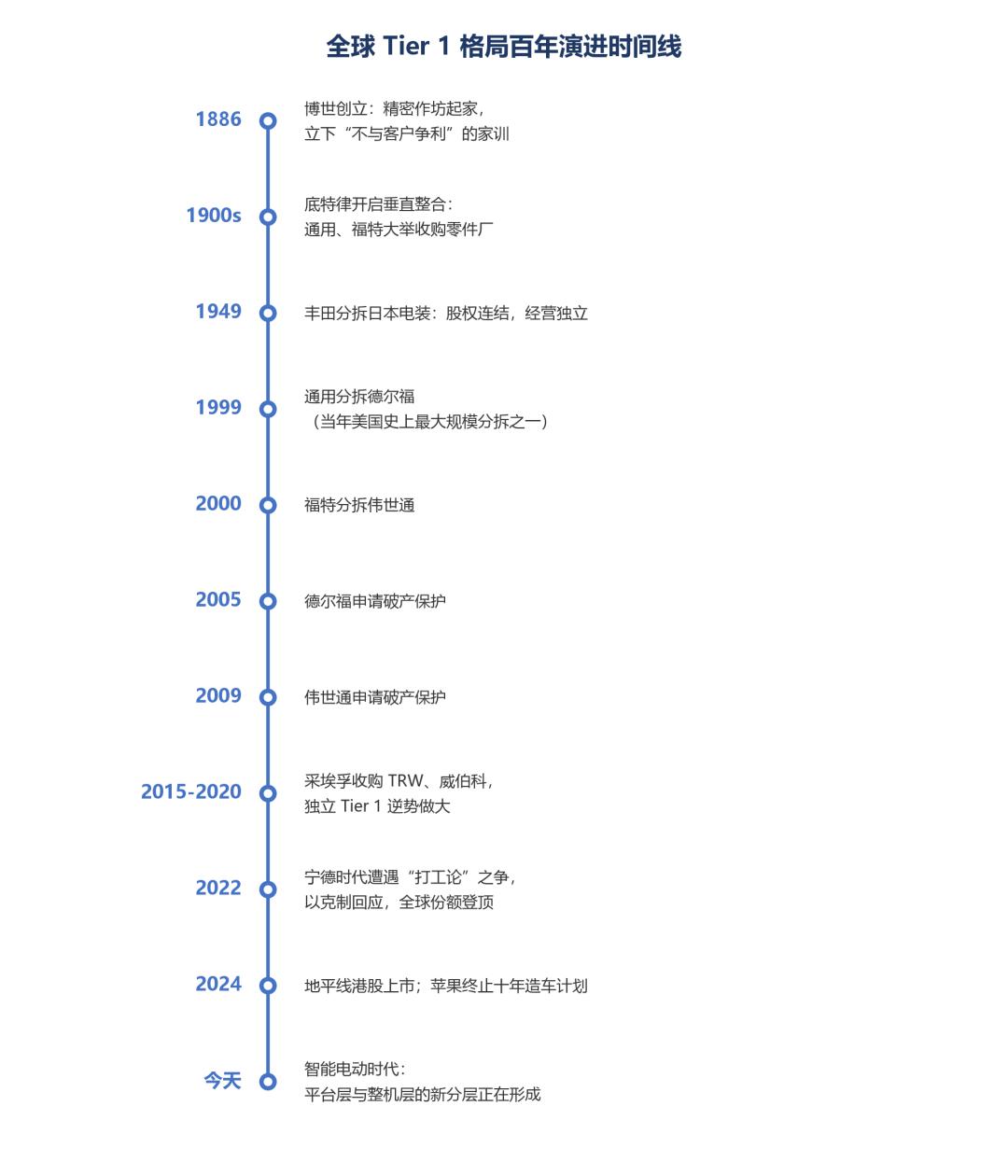
Figure: Timeline of the century-long evolution of the global Tier 1 pattern
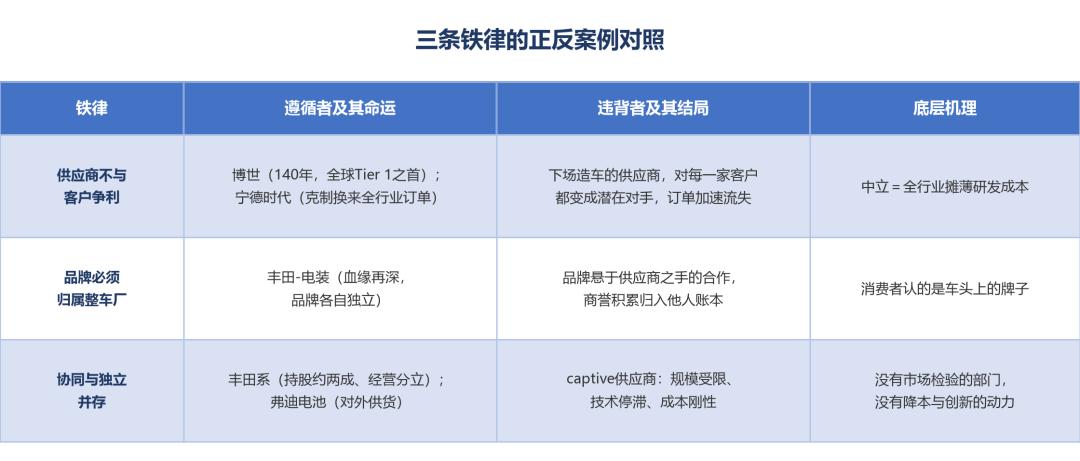
Figure: Comparison of positive and negative cases of the three iron laws, click to view the large image
With these three iron laws in mind, let's look at what Chinese automakers are going through.
02
Rite of Passage: Three Major Exams for Chinese Automakers
Putting the 30-year history of China's automotive industry into this framework, we will see a complete growth narrative: school days, adolescence, and rite of passage. The three exams are essentially testing the same question.
1. The Trap of Adolescence: Why the Intermediate State Is Dangerous
Chinese automakers are no strangers to the taste of "incomplete sovereignty". The first time they experienced it was in the joint venture era.
The wave of joint ventures around 1984 was based on the framework of "exchanging market for technology": foreign parties provided brands, product definitions, and core technologies, while Chinese parties provided factories, labor, and markets. Thirty years later, the manufacturing capability has indeed reached world-class level; but reviewing the property right structure: the brand is in the hands of the foreign party, the product definition is in the hands of the foreign party, and most of the channel profit flows to the foreign parent country through the joint venture agreement. The Santana has been sold for decades and has become a national memory of a generation, but it goes without saying who owns the goodwill. The tuition paid in the school days is the long-term absence of these three kinds of sovereignty.
In the ten years of new energy development, the script has turned over, but the same structural temptation has reappeared in a new guise: technology companies enter the market with intelligent capabilities, and provide automakers with "deeply packaged" solutions from product definition, brand co-governance to channel sales. In a boom cycle, this is called complementary advantages — technology companies provide the "soul" of intelligence, and automakers provide the "body" of manufacturing. But when we measure it against the iron laws of a century of history, we can see the structural risks of this "intermediate state":
Each party only holds part of the property right, so each party only assumes part of the responsibility. Brand and product definition belong to one party, manufacturing and qualifications belong to the other, and capital and final decision-making power belong to the shareholders' meeting — when the industry enters a downward cycle, each party can calculate the stop-loss cost, but no one can find a reason to "rescue". An automaker with complete sovereignty dies slowly: it can sell assets, raise funds, or switch tracks, and the struggle itself is a right. An "automaker" with incomplete sovereignty dies instantly: its fate depends on whether someone in the shareholders' meeting thousands of miles away is willing to continue voting for its survival.
This is not a judgment for a specific company, but a judgment for a type of structure. History has taught this lesson twice through the fiasco of Detroit and the 30 years of the joint venture era.
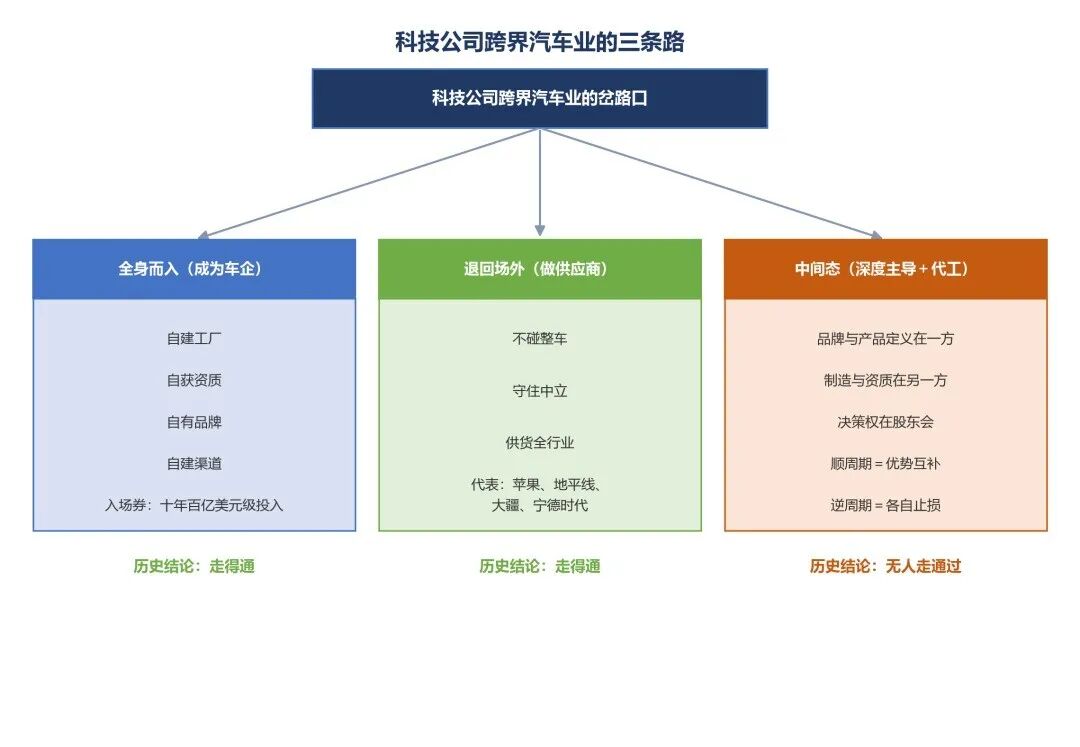
Figure: Three paths for technology companies to cross-border into the automotive industry
2. Two Verified Paths: Xiaomi's 10 Billion USD, Apple's Turnaround
In the same era, technology companies have voted with real money among these three paths.
The representative of the "fully enter the market" path is Xiaomi. When it officially announced its car-making plan in 2021, it had two "lightweight" options: find an automaker to do OEM production, or become a solution supplier. It rejected both — it built its own factory, obtained its own qualification, owned its own brand, built its own channels, and defined products itself. Lei Jun called it "the last major entrepreneurship in my life", planning to invest 10 billion USD in ten years. Its first car was launched in March 2024, with deliveries exceeding 100,000 units in the first year, and its second car launched in 2025 continued to sell well.
Xiaomi used a check worth tens of billions of dollars to confirm one thing, which is the mirror of Bosch's family precept a century ago: there is no asset-light shortcut in car making. Either enter the market fully and become a real automaker; or stay outside the field and become a real supplier.
The representative of the "retreat from the field" path is Apple. In February 2024, Apple gave up its car-making plan that it had worked on for ten years — it was the richest and most patient team in the consumer electronics history. After ten years and tens of billions of dollars of investment, the conclusion it finally reached is still: for the automotive business, you have to devote all your resources to enter the field, half-hearted efforts will not work. After turning around, Apple refocused its automotive business on the role of a "supplier".
More Chinese technology companies have already figured this out: the drone giant spun off its automotive business into an independent intelligent driving solution company that supplies the whole industry; the intelligent driving algorithm company has customers covering central state-owned enterprises, new car-making forces and multinational giants; Horizon went public on the Hong Kong Stock Exchange in October 2024, becoming the "first share of intelligent driving chips", and Volkswagen even invested about 2.4 billion USD to form a joint venture with it.
Both paths are feasible. The only one that has been repeatedly falsified by history is the intermediate state. Bosch closed the door to car making from the outside, Xiaomi pushed the door open from the inside and moved itself in completely. The two paths lead to the same goal, both rejecting the