Super El Niño is coming. Will the prices of our daily necessities really rise due to it?
This summer, multiple meteorological agencies across the globe have sounded the same alarm: an unprecedented super El Niño is unfolding, and it will most likely persist until February next year.
Economists from JPMorgan Chase estimate that global food inflation will rise to 5% in the first half of 2027, significantly higher than the 2.8% recorded in the same period this year. This is partly driven by the blockade of the Strait of Hormuz and the conflict in the Black Sea, and also partially attributed to this extremely rare super El Niño that has not been seen in 50 years, which we are currently in the middle of.
Affected by the super El Niño, the entire Pacific region will present a pattern of "floods in the east and drought in the west"; for China, the year following an El Niño event tends to more easily bring about the pattern of "floods in the south and drought in the north", with a more prominent impact on areas south of the Yangtze River. This climate anomaly is very likely to hit the critical growth period of some crops, and transmit through the supply chain layer by layer, affecting the prices of bulk commodities and end consumer goods, and ultimately reflecting on the wallets of ordinary people.

In this episode of the Silicon Valley 101 podcast, we invite Zhang Siqi, a senior bulk commodity futures trader, to talk about how exactly the super El Niño will affect global supply? Is the harm it brings really as severe as the media reports? What preparations have people made to cope with El Niño in repeated fights against extreme climate change?
Interview: Ma Hua
Text and Graphics: Zhu Jie
The following are selected highlights of this conversation:
01
El Niño is not a "price hike button"
How exactly does it affect agriculture?
Ma Hua: Many people have been discussing this year's super El Niño recently, which may lead to tight supply of bulk commodities in the future, further exacerbating the inflation that already exists in the past two years. I saw that Goldman Sachs released a report on September 7, stating that the Bloomberg Agriculture Spot Index has risen by 24% year-on-year, among which wheat has the largest increase of 41%; soybean oil, corn, cotton and sugar are also rising in price; the futures prices of palm oil and rubber are also soaring all the way.
Before we discuss El Niño, I would like to ask you first, what are the main factors affecting the supply and price of bulk agricultural products? What percentage of the impact does climate actually account for?
Siqi: Simply put, El Niño is not a button that will make all commodities rise in price. What it changes are rainfall, temperature, marine environment and water resources in different regions. Only when such changes exactly hit the critical growth period of a certain commodity, and coincidentally the variety has low inventory, concentrated exporting countries, blocked logistics or tightened policies, will it truly transmit to price fluctuations.
Therefore, the key to understanding it is not to memorize what El Niño is bullish on, but to connect the climate, producing areas, crop calendars and the entire supply chain as a whole. Back to the situation of agricultural products, the factors affecting agricultural product prices can be roughly divided into five groups:
1. Supply, that is, how much we have planted, how well the crops are growing, whether they can be harvested smoothly, and whether they can be transported out smoothly.
2. Demand, such as demand for feed, food, oil pressing, ethanol, biodiesel, and textiles.
3. Inventory, which we can regard as a buffer pad.
4. Policies and logistics, including export restrictions, tariff policies, ports and canals, war and freight charges.
5. Financial conditions, all our financial assets are related to business cycles, the US dollar, interest rates, energy prices and fund positions.
Ma Hua: So extreme climate does not necessarily lead to tight supply, or rising prices?
Siqi: Yes, weather is one of the most important factors on the supply side, but there is no fixed proportion when asking what percentage of the price it accounts for. When inventory is relatively sufficient, even if production is reduced in one region, other regions can replenish the supply, and the price may not rise sharply. When inventory is low and exports are concentrated in a few countries, even if the global output is only 1 or 2 percentage points less, the market may push the risk premium to a very high level.
When we study El Niño, we focus on three types of issues. First, as mentioned earlier, what is the approximate weight of the affected producing areas in the global trade proportion. Second, which specific link the weather hits, whether it is the sowing period, flowering period, fruiting period, or harvesting stage, the impact of each link is different. The third point is whether the overall situation of global inventory and substitutes is tight at that time.
If we only talk about abnormal weather without considering these three things, it is easy to turn the problem into a narrative, and treat the narrative as market trend.
For agriculture, what we usually pay attention to is not the annual average temperature, but whether the rainy season is delayed, whether there is continuous high temperature in the critical growth period, whether there is enough water in soil moisture or reservoirs, and whether this extreme heavy rain will damage farmland cultivation or roads.
Ma Hua: Damaged roads are also a huge impact.
Siqi: Yes, the main impact is on logistics. It does not affect how much supply is produced, but affects how much can be transported.
Ma Hua: Let me popularize the definition of El Niño first. The criteria for judging El Niño are: the surface sea temperature in a specific area of the eastern and central equatorial Pacific (170°W - 120°W, 5°S - 5°N) is 0.5℃ higher than the perennial average for 3 consecutive months, which is defined as El Niño; if it is more than 2℃ higher, it is a strong El Niño. In September this year, the sea surface temperature index in the El Niño monitoring area has exceeded 2.5, which means it has reached the level of super El Niño.
In fact, ordinary El Niño events occur roughly every 2 to 7 years, but according to records, super El Niño events are still relatively rare. According to the ONI index standard of NOAA, since 1950, only a few super El Niño events have occurred, namely 1972 to 1973, 1982 to 1983, 1997, and 2016.
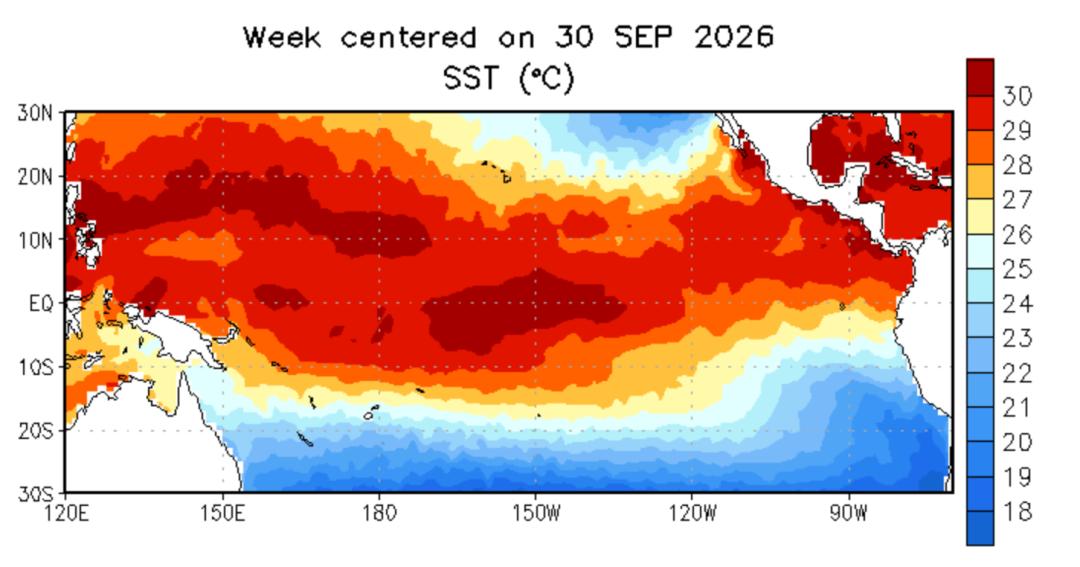
The wide range of higher-than-normal sea surface temperatures in the central and eastern equatorial Pacific (dark red area) is a direct signal of the formation of El Niño. Image source: NOAA Climate Prediction Center (CPC)
The impact brought by El Niño is that the eastern Pacific region, such as the western United States and Chile, will have more precipitation, which will trigger floods. But in places like Central America, Southeast Asia and Australia, precipitation will be less and drought will occur. To put it simply, the entire Pacific region will face the situation of "floods in the east and drought in the west".
Specifically for China, it is more likely to form a pattern of "floods in the south and drought in the north" in the second year after El Niño, and the areas south of the Yangtze River will be particularly significantly affected.
I would like to ask Siqi, based on the impact of "floods in the east and drought in the west" in the Pacific, which crops in which regions around the world will be more significantly affected?
Siqi: According to the global supply weight of all commodities, there are several regions worth our attention.
The first is the maritime Southeast Asia, that is, the areas around Indonesia, Malaysia and the Philippines. During El Niño, this area will become drier and hotter, and the palm oil, rice, Robusta coffee and some cocoa producing areas planted here are relatively sensitive. Especially palm oil, because its global supply concentration is very high, mainly concentrated in Indonesia and Malaysia, so the impact on its supply will be more significant. The impact caused by drought usually does not appear immediately in the current month, but may be reflected in fresh fruit, yield per unit and oil yield after a few months.
The second is South Asia and continental Southeast Asia, including India, Thailand and surrounding areas. The key here is the monsoon. Insufficient rainfall or too late arrival of the monsoon will affect crops such as sugarcane, rice, cotton and corn, or insufficient water storage in reservoirs, which will affect the next growth cycle. For sugarcane, which is the underlying asset of "sugar" in futures, many people may intuitively think that Brazil is more important, but ignore the importance of Thailand and India. In fact, the export proportion of these two regions is also quite high, and their weather and policies can often change the surplus of sugar exports.
The third is the eastern and southeastern parts of Australia. This area mainly produces wheat, rapeseed, cotton and part of sugarcane. Among them, Australian wheat is a marginal variety of global exports, which is also very worthy of attention. We are not saying that the reduction of Australian wheat production will definitely lead to a sharp rise in global wheat, because it is not a country with very large output, but why is it so important? First, it is the marginal decline in output, and second, it will reflect whether this pressure is fulfilled through regional premiums and discounts (referring to the difference between futures prices and spot prices), so we will take it as a pressure indicator for Australia.
The fourth region is South America, but South America needs to be discussed by sub-regions, and cannot be generalized. For example, Argentina and the southern part of Brazil tend to be wetter in El Niño years. That is to say, these places themselves may instead relieve drought and increase yield per unit, and sometimes excessive rainfall will cause flood and diseases. The central-western part of Brazil is the main producing area of soybeans and corn. Whether the rainy season for soybeans can start smoothly, or whether it can be harvested smoothly, directly determines not only the single variety of soybeans. If it is delayed, it will actually affect the subsequent sowing on the same land, that is, the sowing situation of the second crop of corn.
The United States is not completely unaffected, but it is not a region directly exposed to El Niño. Due to the existence of El Niño, the winter wheat in the southern plains of the United States may get relatively good moisture conditions. So this example just shows that the same climate event can have completely different directions for different crops and different crop calendars in different regions.
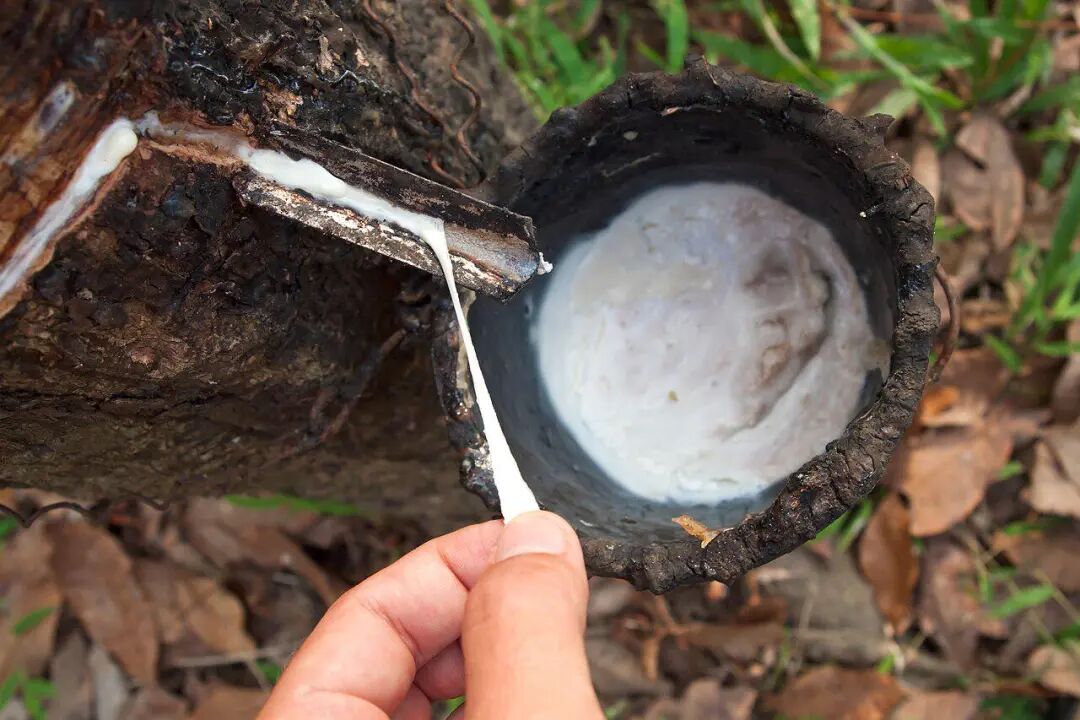
Rubber plantation in Koh Chang, Thailand, latex is flowing into the collection cup Image source: Wikimedia Commons
Ma Hua: It is quite interesting to learn how El Niño affects the yield of these crops.
For example, palm oil comes from oil palm. Since oil palm is a monoecious plant, its sex ratio is affected by both genetics and the environment, and moisture is a very critical environmental factor. If drought increases, it will make oil palms produce more male flowers and reduce the number of female flowers, thus reducing the number of fruit bunches. So it will have a very large impact on palm oil production in Indonesia and Malaysia. Historically, during El Niño periods, palm oil prices were affected by drought, with an increase of about 10% to 20%.
El Niño also has a great impact on rubber. Thailand and Malaysia account for 70-80% of the world's natural rubber production, but this is not entirely the fault of El Niño, because 40% of the rubber trees in Thailand are over 35 years old, which are old trees that may not produce much rubber in the first place. What will the drought of El Niño bring? On the one hand, it will slow down the photosynthesis of rubber trees and reduce their rubber yield; on the other hand, the water in the trees will be insufficient, they used to flow latex for 3 to 4 hours a day, but now they may only flow for 1 hour, so their output will also drop.
Siqi: Right. What we talked about earlier is still at the level of crops. But for oil palms and rubber trees, their growth cycles are different from those of soybeans and corn — soybeans and corn are herbaceous, while oil palms and rubber trees are woody, their respective critical growth cycles, which I referred to as crop calendars earlier, are very different. In the window from November this year to March next year, we need to keep an eye on whether abnormal weather will appear at their respective critical growth nodes.
02
From instant noodles to cat food
Which end products will rise in price?
Ma Hua: These bulk commodities affected by El Niño will lead to a high possibility of price increases for which end products?
Siqi: For example, the palm oil we have repeatedly mentioned earlier, we know that it not only exists on the edible oil shelf, but more importantly, it enters processed foods, instant noodles, snacks, baking shortening, and it is also used in daily necessities, including laundry detergent, soap, and cosmetics. In addition, in many countries, it is now an important raw material for biodiesel. Therefore, when the supply of palm oil is tight, the first areas usually affected are the oil and fat industry chain, food processing, and biofuels.
Ma Hua: I see that palm oil accounts for 15% to 20% of the cost of instant noodles. Is it a foregone conclusion that instant noodles will rise in price?
Siqi: Not necessarily. In fact, there are many brand promotion channels for consumer goods, including the allocation of their inventory. And as far as I know, many traders or large processing brand owners also have futures traders like us to help them hedge the risk of rising or falling raw material prices.
Ma Hua: But for drinks, for example, since sugar is a very important part of the cost of drinks, will the super El Niño also have an impact on the beverage industry?
Siqi: We can look at sugar from two perspectives. I don't know if you have paid attention to the ingredient lists of drinks in supermarkets now. In fact, few drinks use white sugar completely now, and most use high fructose corn syrup and sugar substitutes. High fructose corn syrup is not produced from sugarcane, so these two aspects have greatly reduced the impact of sugar prices on beverage prices.
If we find some traditional herbal drinks that insist on using white sugar because their taste is different, it will indeed have a certain impact on their raw material costs. If the price of raw materials rises sharply, they must judge in advance and make hedges, such as locking in some raw material cost prices in advance, signing some long-term contracts, or doing some hedges on options.
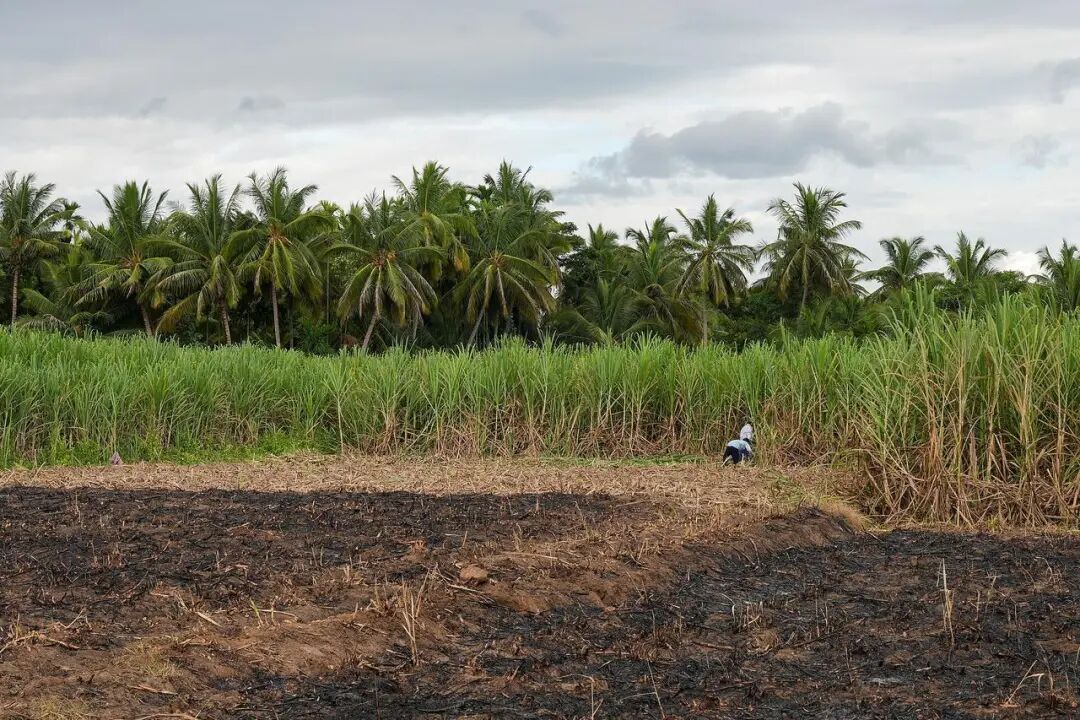
Harvesting sugarcane fields in Karnataka, India Image source: Wikimedia Commons