The unmanned delivery company backed by SF Express has raised another 100 million US dollars.
White Rhino has secured new financing again.
On October 8, this L4 autonomous delivery company announced the completion of its Series C2 financing, bringing the total amount of Series C round to 100 million US dollars. This round is led by Hidden Hill Capital, with Xiangtan State-owned Assets, Shenzhen Major Investment, Hunan Caixin, Woori Financial Group of South Korea, and Bozheng Capital as follow-on investors.
It has only been about 5 months since White Rhino announced the completion of its Series C1 financing in May this year.
Founded in 2019, White Rhino is an L4 autonomous driving solution provider that starts with unmanned delivery, and mainly focuses on autonomous driving products and services on urban public roads.
As a startup, how has it made it this far on a track with brutal technological iteration and fierce competition from industry giants? What challenges will it need to overcome in the future?
01
Who is investing, and where will the capital go
First of all, the highlight of this round of financing does not lie in the amount itself. 100 million US dollars is not an astronomical figure in the current unmanned delivery track, and what is more noteworthy is the "composition" of the investors.
Hidden Hill Capital is a private equity investment platform under GLP, with an AUM of over 300 billion yuan. It has long focused on logistics technology and digital intelligent supply chain, and has invested in J&T Express, Cross-border Express, and G7. As a global logistics real estate giant, GLP owns warehouse parks and logistics infrastructure all over the country. What is more valuable than capital from Hidden Hill leading the investment in White Rhino is the abundant landing scenarios behind it.
Shenzhen Major Investment is a major strategic leading industrial investment platform of the Shenzhen Municipal Party Committee and Municipal Government, directly managed by the Municipal State-owned Assets Supervision and Administration Commission. The entry of local state-owned assets usually means regional industrial implementation and resource bundling, and the unmanned delivery scenarios in Shenzhen and its surrounding areas will most likely be rolled out in the follow-up period; the participation of Xiangtan State-owned Assets and Hunan Caixin directly echoes the previous signing of the headquarters base of intelligent logistics vehicles between White Rhino and Xiangtan.
Woori Financial Group of South Korea is the first overseas capital to appear in White Rhino's shareholder list. Woori is a representative financial group in South Korea, with business outlets in many countries around the world. White Rhino's press release clearly states that it will rely on the cross-border resources of shareholders such as Woori Financial Group to expand overseas. With the entry of South Korean capital, the overseas expansion path has got its first springboard.
Where will the capital be spent after getting it?
The official statement is: L4 end-to-end technology and physical AI capability iteration, urban operation network expansion, and industrial ecosystem collaboration.
Regarding physical AI, according to previous public information, White Rhino's "Physical AI" direction extends the capability boundary from autonomous driving to embodied intelligence, with the goal of enabling vehicles to not only drive, but also perform practical work. The double-cage self-unloading vehicle jointly developed by White Rhino and SF Express has been put into operation in SF Express's transfer scenarios, and can automatically complete the loading and unloading of transfer cages. In other words, the vehicle is no longer just a mobile carrier, but evolving into a "mobile robot with integrated operation capabilities from loading and unloading to transportation".
If the vehicle-grade standard solves the problem of "whether the vehicle is well-manufactured", then physical AI solves the problem of "what the vehicle can do". The leap from transportation tools to operation robots may be the core narrative that this round of financing is intended to tell.
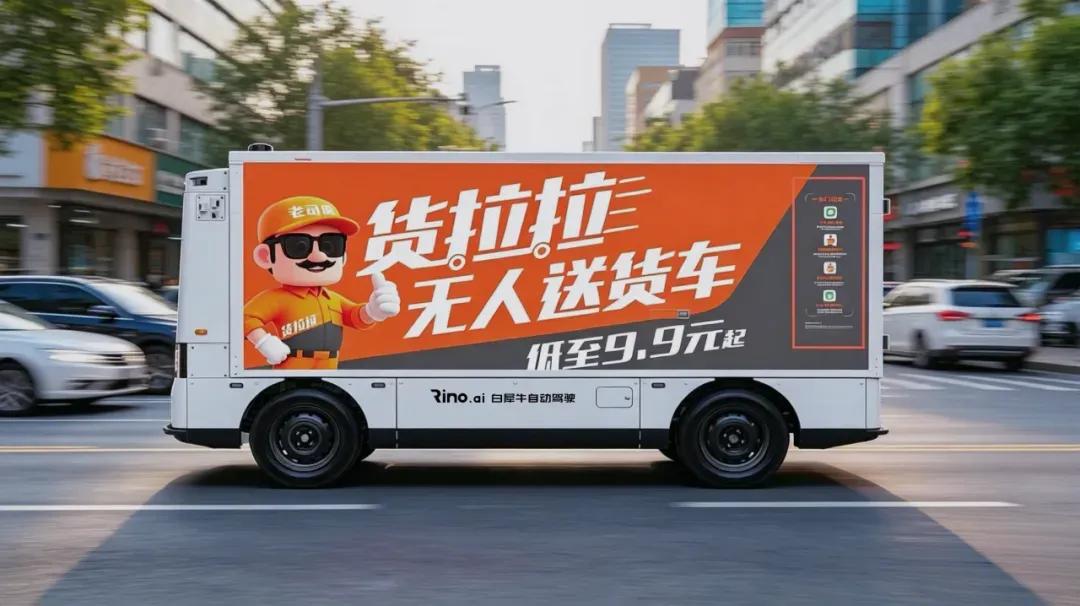
The signal of horizontal scenario expansion is also very clear. In April this year, White Rhino and Huolala launched large-scale operation of unmanned freight in Linyi, Shandong. The vehicle-grade logistics vehicle RX was connected to the Huolala platform, providing instant unmanned delivery for C-end users and small and micro merchants, and the fleet quickly expanded to 200 units for 24-hour normal operation. In Weifang, White Rhino cooperated with SF Express City to open up high-efficiency instant delivery scenarios such as supermarkets, fresh food and retail.
These scenarios fill the blank market between "using errand runners for small items and using trucks for large items". It is claimed that White Rhino's unmanned vehicles can carry 6 cubic meters of goods weighing over 1 ton, and for merchants with fixed delivery demands, the cost per order can be reduced by about 50%.
02
Spun out of Baidu, rooted in the express logistics scenario
The story of White Rhino started from Baidu. Its founders Zhu Lei and Xia Tian both came from Baidu's autonomous driving team. Zhu Lei has more than ten years of experience in the autonomous driving industry and is one of the earliest entrepreneurs in the field of unmanned logistics vehicles in China; Xia Tian is a founding member of Baidu Institute of Deep Learning.

Co-founder and CEO of White Rhino Zhu Lei
At the beginning of the company's establishment in 2019, White Rhino started with supermarket delivery, cooperated with retail enterprises such as Yonghui and Freshippo, and carried out unmanned delivery of fresh food and supermarket products in Beijing and Shanghai. The routes were fixed, the demands were real, and the technology could be verified quickly, which was the clearest business story that could be told at that time.
However, the ceiling of supermarket delivery is not high, and the turning point came in 2023.
In this year, White Rhino shifted its focus to the express logistics scenario, focusing on the "outlet to station" last-mile delivery. This is a key strategic judgment: the last-mile express delivery routes are fixed, with extremely high frequency and large proportion of labor costs, and the customers are giants such as SF Express, ZTO Express and China Post. Once the operation model is verified, the scale effect will emerge rapidly.
In hindsight, this shift has defined White Rhino's growth curve in the following three years.
Before the strategic shift, White Rhino's investors were mainly industrial capitals, including Linear Capital, GZ Capital, Chentao Capital, Yunjin Capital, etc.
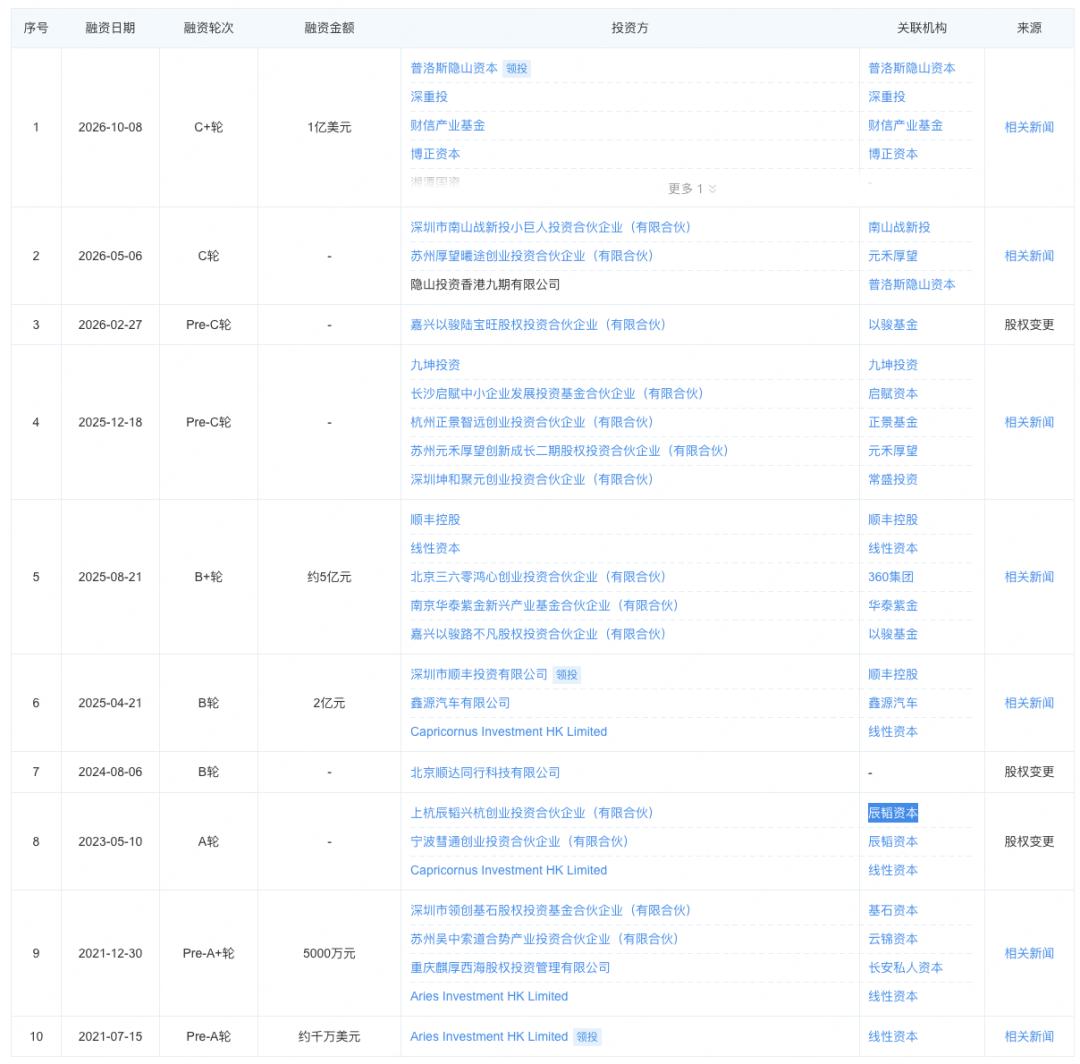
Financing status of White Rhino
After the transformation, White Rhino waited for SF Express. In August 2024, SF Express made its first capital injection. Within one year thereafter, SF Express continuously made multiple additional investments. In the Series B+ financing in August 2025, SF Express followed the investment again, bringing the total amount of Series B financing to nearly 500 million yuan.
It is not common in the industry for a logistics giant to invest in the same startup so intensively. SF Express's logic is not difficult to understand: last-mile delivery is the part with the highest cost in the express industry's cost structure and the most difficult to reduce. Couriers travel back and forth between outlets and stations, which takes 4 to 5 hours a day. If this part of capacity can be replaced by unmanned vehicles, the released human resources can focus on parcel collection and delivery, and the space for business volume improvement is directly visible.
SF Express's continuous capital injection also sends a signal: White Rhino's technology is at least usable. Logistics giants will not pay for "concepts", and only real operation data can convince them to write checks again and again.
03
Delivering 5,000 vehicles and connecting three core links
The premise for capital to make heavy bets is that the technology and products have been verified.
According to the latest data disclosed by White Rhino, it has established in-depth cooperation with leading logistics and retail enterprises such as SF Express, China Post, JD, SF Express City, Huolala, and Taobao Flash Purchase, with a total of more than 5,000 unmanned logistics vehicles delivered, covering 9 application scenarios including express delivery and intra-city freight, and operating normally in more than 200 cities across the country.
White Rhino claims that on the L4 autonomous driving track, it has connected three links: algorithm, product definition, and capacity delivery.
At the algorithm layer, the main line is mapless driving and physical AI. The mapless solution gets rid of the dependence on high-precision maps, and can be deployed in the whole city with ordinary navigation maps. In 2026, White Rhino's RX mapless solution has been put into operation in Shandong and many other regions, reducing the cost of a single vehicle and accelerating the pace of urban deployment; physical AI extends the capability boundary from autonomous driving to embodied intelligence.
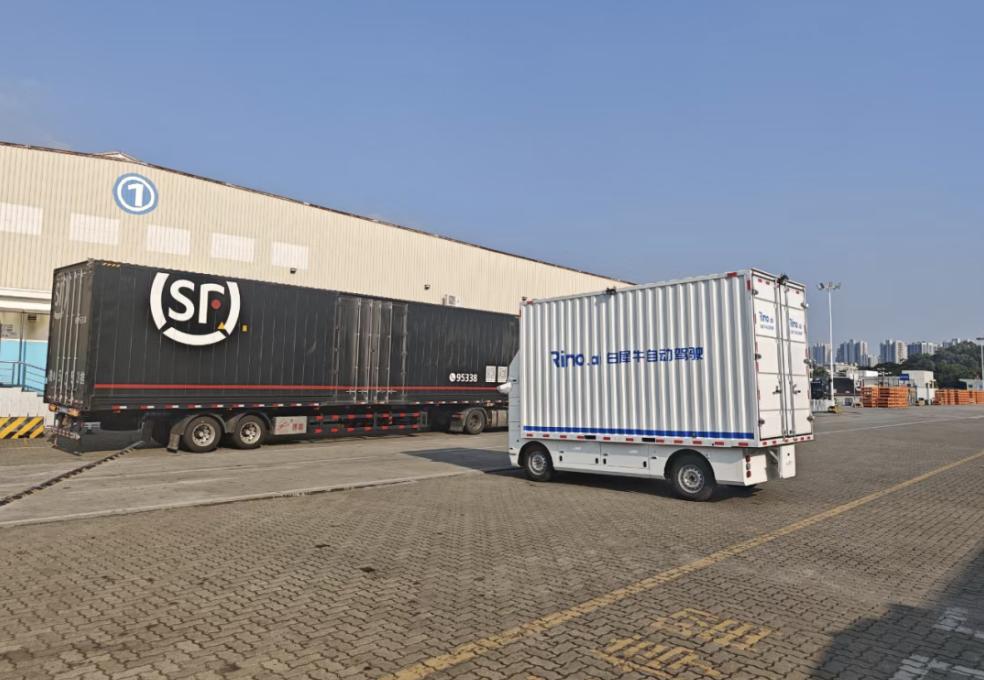
At the product layer, it is a complete matrix covering all scenarios of urban distribution. White Rhino RX is a full-vehicle-grade RoboVan: it took 18 months to complete the development, with a designed service life of 8 years and 300,000 kilometers, and 100% of the parts are vehicle-grade. Since its launch in April 2026, thousands of units have been delivered. White Rhino R24 is a 24-cubic-meter large-capacity light truck unmanned vehicle, benchmarking against small and medium-sized van trucks. It has been successively delivered to customers for operation, and has carried out public road tests in some cities, filling the market gap of large-item transfer in parks, warehouse-to-store allocation, and short-distance large-capacity urban distribution.
At the business layer, it is a two-wheel path of "technology output + capacity service". Rino Inside integrates the full-stack software stack into a standardized L4 hardware-software integrated solution, and opens authorization to original equipment manufacturers; Rino FaaS (Fleet as a Service) directly delivers capacity to customers, and customers settle accounts according to actual waybills. During the low ebb of express business, the vehicles can be transferred to the intra-city freight scenario, and the asset utilization rate of each vehicle continues to increase.
Algorithm determines whether the vehicle can be put into use, product definition determines whether mass production can be realized, and capacity delivery determines whether the company can achieve self-sustainability. The three layers of capabilities are indispensable.
04
Real challenges at the critical point
The reality is not only about growth, but also about difficulties.
Huang Gang, President of White Rhino, systematically expounded the challenges faced by the industry at an industry forum in 2026. His judgment can be summarized into four levels: technology is not omnipotent, the vehicle platform needs to prove its value, there is a lack of road right standards, and the price war has come prematurely.
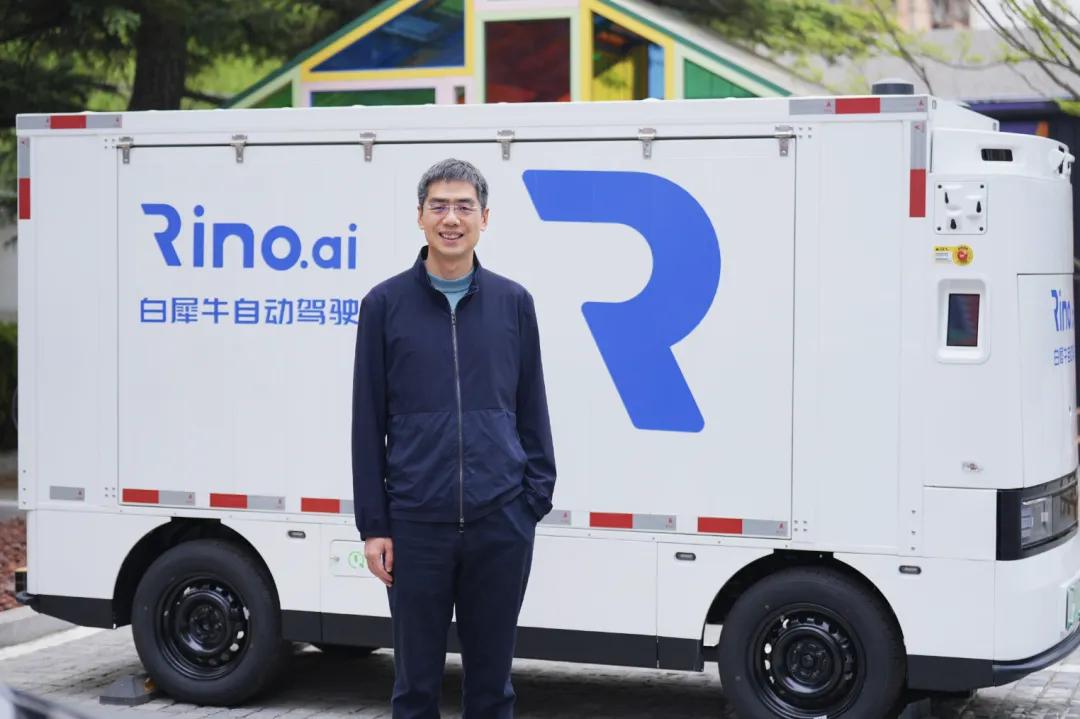
Co-founder and CTO of White Rhino Xia Tian
The challenge at the technical level is the most fundamental. Xia Tian put it more bluntly in a previous interview with *Cyber Auto*: At present, there are only tens of thousands of unmanned delivery vehicles across the country, scattered in various cities with very low density. "If there is occasional stutter or small problem on the road, the public and regulatory authorities can still tolerate it." But if the scale expands to hundreds of thousands of units, the tolerance will drop sharply. "Now we can still see problems with unmanned vehicles that do not conform to human driving habits, and these problems must be solved before the arrival of a larger scale."
This is no understatement. The "iPhone moment" of unmanned delivery requires two conditions to be met at the same time: at the technical level, the complete L4 end-to-end operation is realized, and an efficient data growth methodology supported by AI infrastructure is established; at the operation level, the whole process automation of vehicle scheduling and autonomous parcel sending and receiving is realized. Xia Tian's judgment is that this state will take another two to three years.
The larger structural dilemma lies in road rights. At present, there is no unified national mass production test standard and road right management rule for unmanned delivery vehicles in China. Each city carries out independent certification, and the cost of cross-regional large-scale implementation for enterprises remains high. Huang Gang said frankly that this has brought dual impacts on efficiency and cost for the further expansion and market promotion of unmanned vehicles.
At the same time, the industry has just seen a growth inflection point, and the price war has already started. "This industry has just seen a growth inflection point in the market, and it is already facing a very fierce competitive situation," Huang Gang said. For a startup that needs continuous R&D investment and has not yet achieved scale profitability, premature price competition is a kind of consumption.
Compared with the other two leading enterprises in the unmanned delivery field, Jiushi and Neolithic, White Rhino has no advantage either in the number of vehicles or the scale of financing.
The business model also faces challenges. Pay-per-order is the capacity service model that White Rhino mainly promotes, and the cost pressure brought by vehicle operation and maintenance and idle time is borne by the enterprise itself. In addition, after express delivery and intra-city freight are integrated into the same scheduling system, whether the effective operation time of vehicles can be truly increased still needs to be verified by daily data.
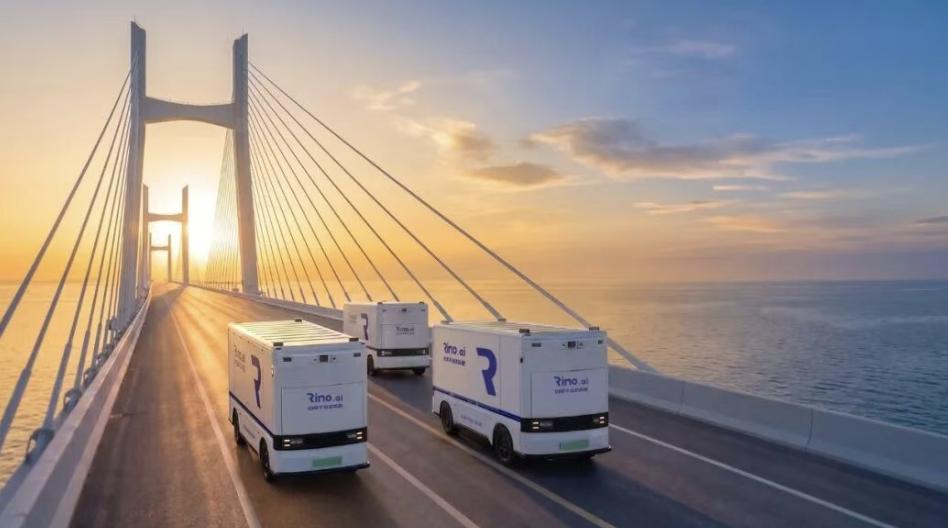
"Unmanned delivery as a business is becoming more and more viable," this is a sentence said by Xia Tian, which may be the best annotation for this stage.
The viability of the business means that the demand is real, the accounts are profitable, and customers are willing to pay continuously. But between "the business is viable" and "large-scale commercial success", there are still many barriers such as long-tail technical problems, lack of standards, road right game, and price competition.