The busiest high-speed railway station nationwide refuses to be content with merely holding the title of "the No. 1 in the universe"
"Ensure every Hunan native working hard in the Greater Bay Area has a job to go to on October 8." On the evening of October 7, a screenshot of the night high-speed train departure schedule on social media sparked a huge number of reposts and discussions.
The screenshot shows that in just 41 minutes, from 00:37 to 01:18, 8 high-speed trains departed consecutively from Changsha South Railway Station, all heading to the same destination — Guangzhou South Railway Station.
The "red-eye high-speed trains" departing in the wee hours are just a microcosm of the high-load operation of Guangzhou South Railway Station.
During the just-concluded National Day holiday, Guangzhou South Railway Station hit the trending searches for its extremely dense train departures, with the shortest departure interval being only 40 seconds, making netizens exclaim that it "runs high-speed trains like metro lines".
The peak passenger flow came on October 1. On that day, the total number of passengers arriving at and departing from Guangzhou South Railway Station reached 1.049 million, including 641,000 departing passengers and 408,000 arriving passengers, making it the first railway station in China to record a single-day passenger throughput exceeding 1 million.
However, "traffic flow" never equals "retained flow". As the single-day passenger throughput climbs to a new level of 1 million, this transportation hub known as the "No.1 Grand Station in the Universe" is also shouldering more expectations.
01
Hub
In fact, since it first surpassed Shanghai Hongqiao Station in 2017, Guangzhou South Railway Station has ranked first in China's total railway passenger flow for many consecutive years. In 2025, the total annual passenger throughput of Guangzhou South Railway Station reached 175 million, continuing to top the national list.
It is worth noting that against the backdrop of the continuous expansion of domestic high-speed railway hubs, Guangzhou South Railway Station is not the "largest" in scale: its building area is 615,000 square meters, half of that of Chongqing East Railway Station (1.22 million square meters); its station yard scale with 15 platforms and 28 tracks is also smaller than that of other hub stations such as Xi'an North Railway Station (18 platforms, 34 tracks), Zhengzhou East Railway Station (16 platforms, 32 tracks) and Shanghai Hongqiao Station (16 platforms, 30 tracks).
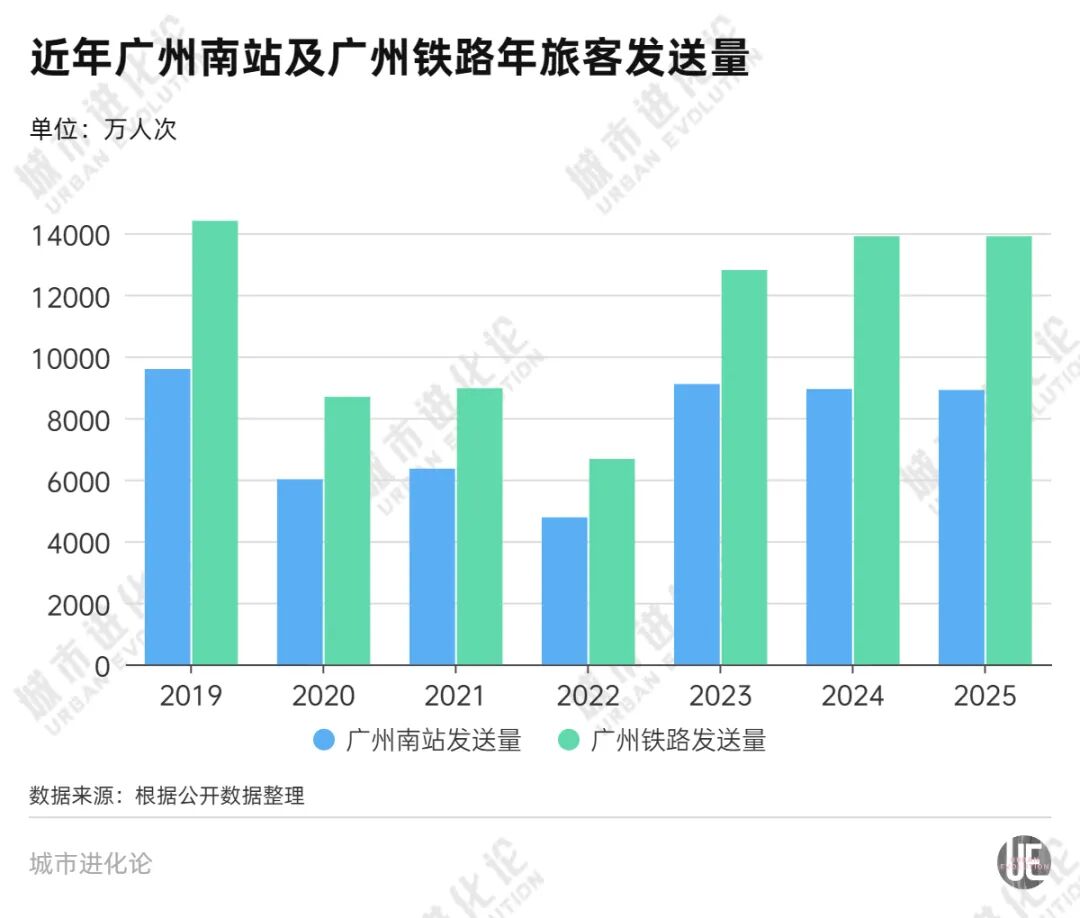
Compared with its scale, Guangzhou South Railway Station stands out for its hub status and network accessibility.
Located at the southern gateway of China, Guangzhou South Railway Station connects multiple high-speed trunk lines including Beijing-Guangzhou, Guiyang-Guangzhou, Nanning-Guangzhou, and Guangzhou-Shenzhen-Hong Kong, linking hub cities in different directions such as Beijing, Hong Kong, Guiyang and Nanning. Trains departing from Guangzhou South Railway Station can directly reach 196 cities across 23 provinces in China.
It can be said that Guangzhou South Railway Station is not only a station of Guangzhou city, but also the core gateway of the entire Greater Bay Area linking the inland hinterland — at present, Guangzhou South Railway Station has formed a transport network that "reaches all cities in the Guangdong-Hong Kong-Macao Greater Bay Area within 1 hour, covers the entire southern region within 4 hours, and connects all parts of the country within 8 hours".
Transport capacity and railway network determine the ceiling of a hub's transport capacity. But to fully release the passage capacity, sufficient passenger flow support is also required. Behind Guangzhou South Railway Station is one of the regions with the highest population and economic density in China.
Guangdong has a permanent resident population of 129 million, and its real-time resident population is as high as 165 million. More importantly, data from the 7th National Population Census shows that Guangdong is the province with the largest floating population in China (29.6221 million people), which is more than the sum of the second-ranked Zhejiang (16.1865 million people) and the third-ranked Shanghai (10.4797 million people).
Among the top 10 sources of cross-provincial floating population in Guangdong, Guangxi (6.93 million people) and Hunan (5.12 million people) both exceed 5 million people; Henan, Hubei, Sichuan, Jiangxi and Guizhou all have more than 2 million people each.
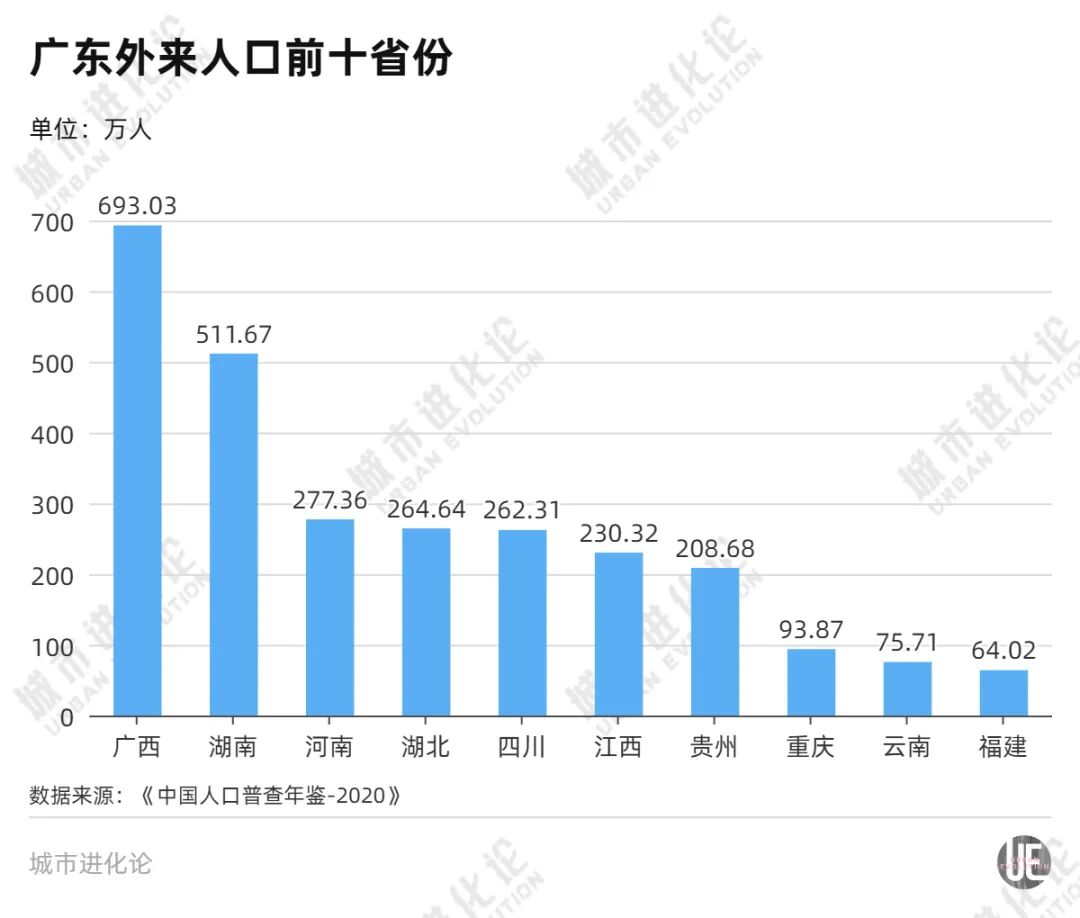
The origin of the migrant population highly overlaps with the direction of the high-speed railway lines, and the concentrated release of travel demands such as visiting relatives and traveling during holidays provides continuous demand support for the huge passenger flow of Guangzhou South Railway Station.
The transport capacity squeezed out from the supply side pushes the passenger carrying capacity to the extreme. To cope with the huge passenger flow during the National Day holiday, Guangzhou South Railway Station implemented the "one day, one diagram" scheme, dynamically adjusted the train operation plan, and increased the transport capacity to destinations including Shenzhen, Changsha, Nanning, Zhuhai, Zhengzhou and Chongqing.
The biggest variable is the night high-speed trains. During this year's National Day holiday, Guangzhou South Railway Station operated 202 night high-speed trains in a single day, accounting for about 1/6 of the total daily departures, which greatly eased the pressure of daytime high-speed railway passenger transport.
In response to this, Hu Gang, professor of Jinan University and founding president of South China Urban Research Association, pointed out to Urban Evolution that the root of the ultra-high passenger flow of Guangzhou South Railway Station lies in its unique strategic location —
Located at the geometric center of the Pearl River Delta, relying on the public transport-oriented operation system of Guangzhou-Shenzhen and Guangzhou-Zhuhai intercity railways, and with seamless connection to urban metro lines, Guangzhou South Railway Station efficiently gathers diverse passenger flows including cross-city commuting, business exchanges, visiting relatives and tourism, marking that the hardware transport capacity of this national-level super hub has been fully formed.
02
Radiation
Beyond passenger flow, Guangzhou South Railway Station also undertakes higher expectations.
As early as 2003, when selecting the site for Guangzhou South Railway Station, the convenience of citizens traveling from Foshan, Zhongshan, Zhuhai and other directions was taken into consideration. The site was finally chosen as Shibi, Panyu, the "geometric center of the Pearl River Delta", to enhance Guangzhou's status as a regional center and narrow the distance between Guangzhou and surrounding cities, especially Foshan.
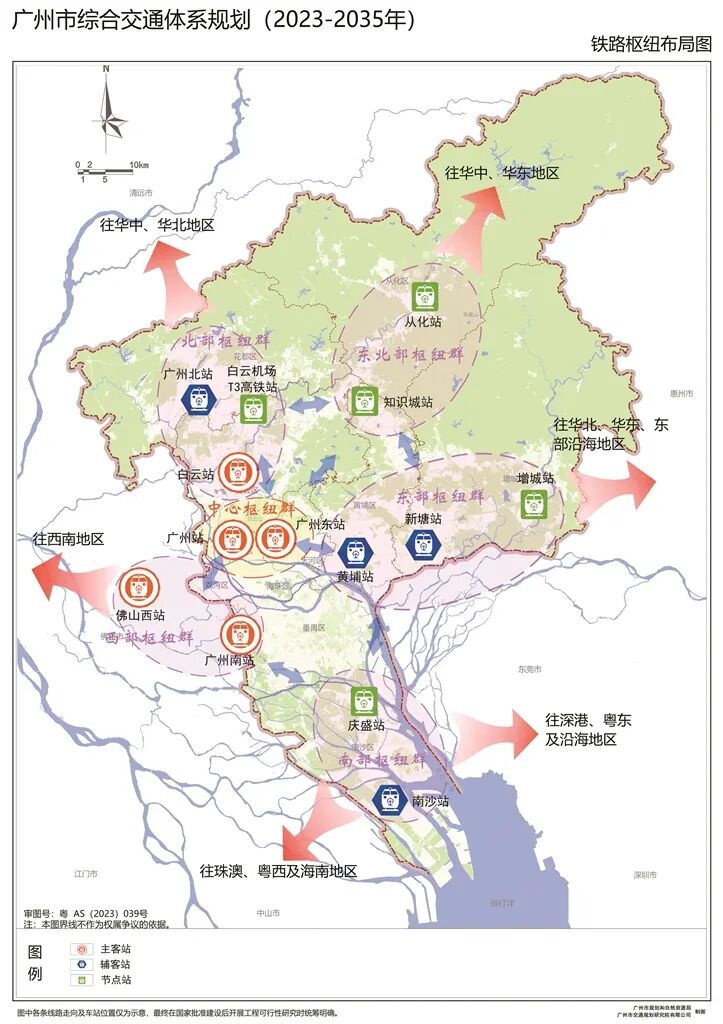
This geographical advantage was soon translated into passenger flow scale, and the status of "super hub" was thus established.
After the passenger flow reached its peak, the planning level of Guangzhou further upgraded its expectations for Guangzhou South Railway Station. In March 2021, the Guangzhou Municipal Government approved the Urban Design of the Core Area of Guangzhou South Railway Station, strengthening its radiation function to surrounding areas, and clearly proposed to build it into "the living room and gateway hub economic zone of the Guangdong-Hong Kong-Macao Greater Bay Area, the new core of high-quality integrated development between Guangzhou and Foshan, and the southern central district of Guangzhou".
According to the plan, by 2025, the core hub area of Guangzhou South Railway Station will realize the integrated development of transportation, industry and urban functions, and become a model of hub economic development in the Guangdong-Hong Kong-Macao Greater Bay Area and a new growth pole for the city's economic development.
However, in the process of implementation, the geographical constraints on the development of Guangzhou South Railway Station have also begun to emerge. According to local media reports, Guangzhou South Railway Station is about 20 kilometers away from Tianhe CBD. Residents in the main urban area need to spend more than 40 minutes taking the urban metro to go to Shenzhen, Hong Kong and other places, which greatly reduces travel efficiency.
In Hu Gang's view, as the area around Guangzhou South Railway Station is far from the traditional central urban area of Guangzhou, the pace of urban construction, living facilities and popularity gathering is relatively lagging behind. This leads to the current typical development characteristics of Guangzhou South Railway Station: "strong station but weak industry, sufficient transit but insufficient stay".
This can be confirmed by a public reply from the Guangzhou South Railway Station Regional Management Committee in 2024:
Guangzhou South Railway Station still mainly functions as a transportation transit hub, and most of the arriving passengers go to surrounding areas. The advantage of large passenger flow cannot yet be transformed into industrial advantage. This also leads to the fact that the core area of Guangzhou South Railway Station has not formed industrial scale and cluster effect, its connection with the industrial development of surrounding areas is not close enough, the operation effect is not ideal, the development mode of the peripheral area is relatively extensive, and the output benefit is low.
In response to this, Hu Gang emphasized that this situation is not irreversible. Upgrading from a single transportation hub to a composite economic hub requires long-term cultivation and gradual progress, and must not be rushed.
In the long run, precisely because the area around Guangzhou South Railway Station is far away from the built-up area of the old city, it has sufficient exploitable land resources and broad urban expansion space. With the continuous implementation of Guangzhou's southward urban expansion strategy, the commercial, educational, medical and living supporting facilities in the area are continuously improved, and the shortcomings of insufficient popularity and weak supporting facilities are being steadily addressed.
03
Capacity Upgrade
For Guangzhou South Railway Station to upgrade from a "transportation hub" to an "economic hub", industrial introduction is the key starting point.
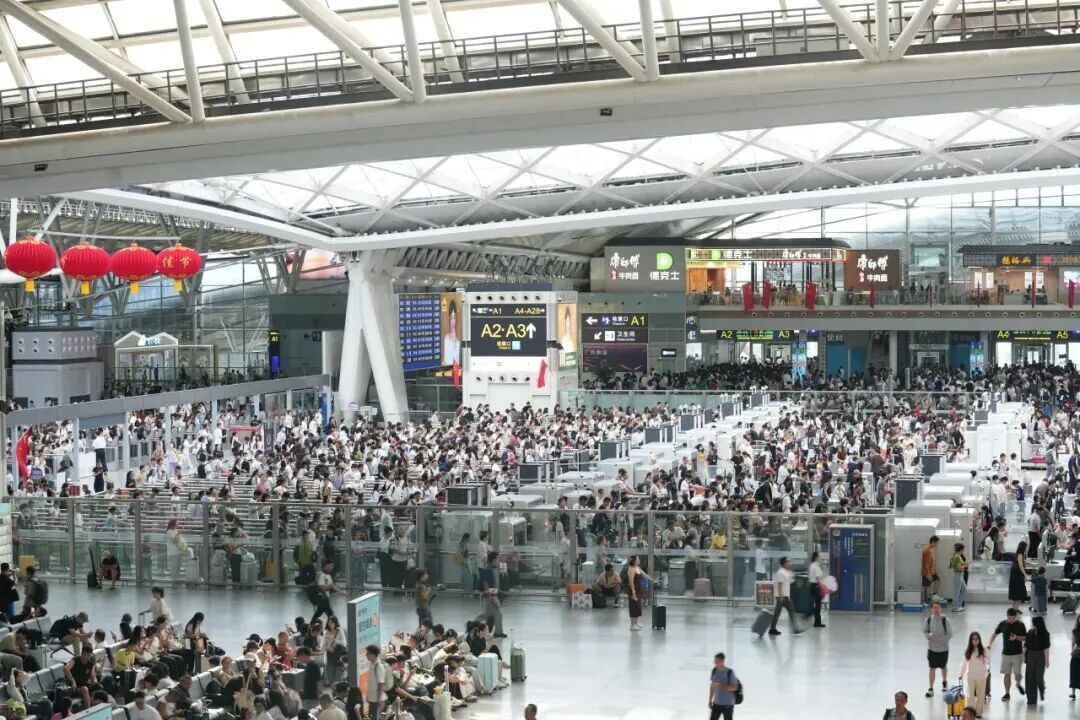
Photo source: Guangzhou Railway
The policy level has clearly pointed out this direction. The outline of the 15th Five-Year Plan of Guangzhou clearly mentions that Guangzhou South Railway Station is designated as one of the four hub-type international business districts, and proposes to improve the development and management mechanism of the Guangzhou South Railway Station area, support the accelerated development of reserved land parcels, build a high-speed railway gateway new town with integrated station-city and industry-city development, and realize integrated development with Wanbo Business District, Changlong Tourist Resort and Guangzhou Football Park.
The starting point is the construction of the station-adjacent economic zone of Guangzhou South Railway Station. In April this year, the Panyu District Government stated that revitalizing the resources of the South Railway Station area and optimizing and strengthening the station-adjacent economy is of great significance to the high-quality development of the region.
The construction of the station-adjacent economy has also attracted the attention of the national level. In June this year, the research team of the Department of Planning of the National Development and Reform Commission went to Panyu District to conduct on-the-spot investigation on the construction of the station-adjacent economy of Guangzhou South Railway Station. The first stop of the investigation route was Vanke Center at South Railway Station — a relatively mature industry-city integrated project in the station-adjacent economic zone, integrating corporate headquarters, hotels, exhibition facilities, apartments and commerce. In a sense, the investigation points to the business sector.
At present, the business capacity of Guangzhou South Railway Station still needs to be improved. Taking the scale of the business district as an example, as of 2025, the Guangzhou South Railway Station Business District has introduced more than 600 enterprises, while the number of legal person enterprises in Hongqiao International Central Business District has reached nearly 100,000 in the same year.
The improvement of transportation connectivity is expected to open up new space for the introduction of business capacity of Guangzhou South Railway Station.
On September 18 this year, the shield construction of the new liaison line project between Guangzhou Railway Station and Guangzhou South Railway Station entered the final sprint stage. After the project is completed, it will connect three major railway hubs: Guangzhou Railway Station, Guangzhou Baiyun Railway Station and Guangzhou South Railway Station. By then, the commuting time from Guangzhou South Railway Station to the city center will be reduced to 15 minutes, which means that the main urban area of Guangzhou and major CBDs will basically realize efficient commuting within half an hour to Guangzhou South Railway Station, expanding the "traffic entrance" of Guangzhou South Railway Station.
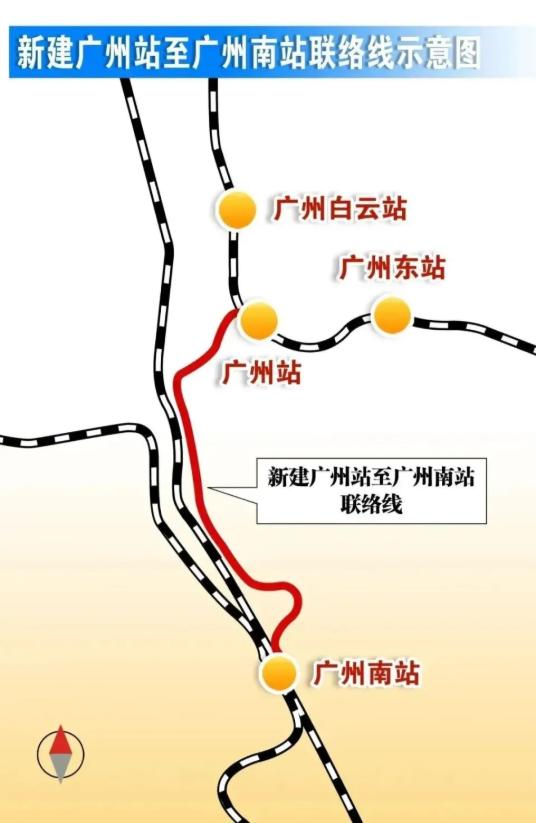
Photo source: Guangzhou Transport
Hu Gang believes that beyond the superficial value of improved commuting efficiency, from the perspective of long-term urban development layout, Guangzhou South Railway Station can gather producer services such as legal services, high-end conferences and government affairs consulting by coordinating transportation, ecology, public services and business supporting facilities, drive the development of high-end business and headquarters economy, and finally realize the systematic functional upgrade of the area.
This article is from the WeChat Official Account "Urban Evolution", written by Liu Xuqiang, and authorized for release by 36Kr.