59.6 billion yuan, the century-old retail giant has changed hands once again.
Recently (October 7), Wittington Investments under Canada's Weston Family (hereinafter referred to as Wittington) announced that it has reached a definitive agreement with Sycamore Partners and the Stefano Pessina family to acquire UK health and beauty retail chain Boots for $8.9 billion (approximately RMB 59.6 billion, including assumed debt).
The transaction is expected to close in the first quarter of 2027, at which point Galen Weston, Chairman of Wittington, will serve as Chairman of Boots.
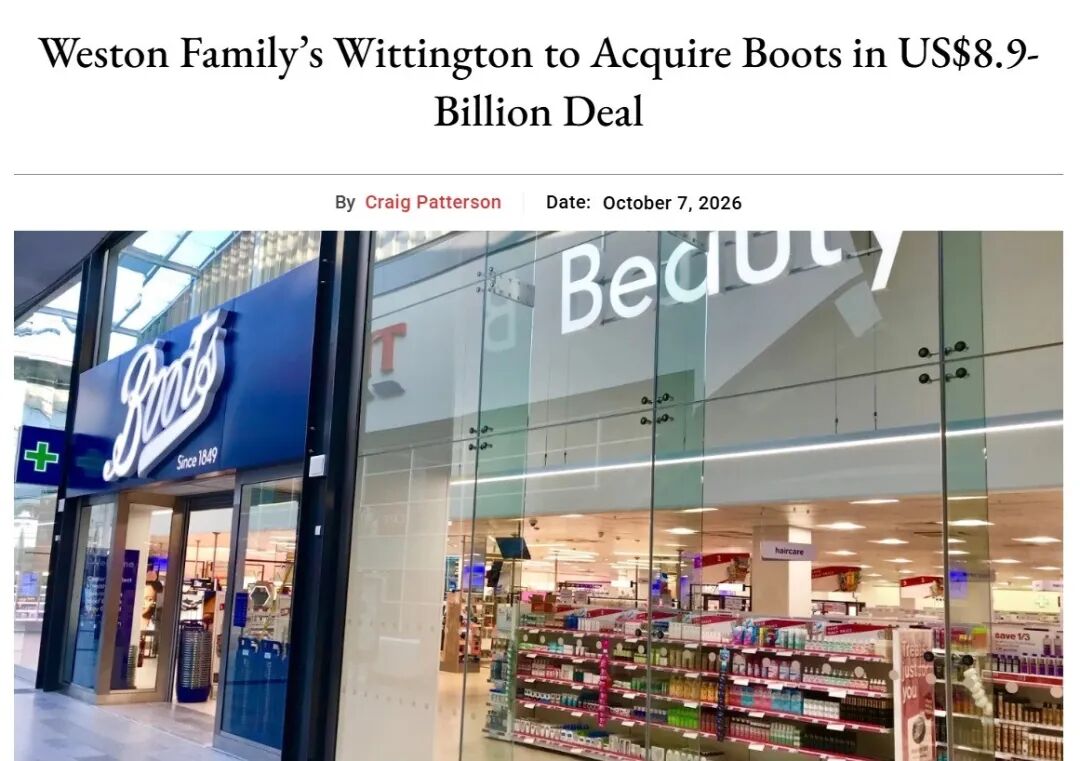
△ Image source: Retail Insider
Four changes of ownership in two decades
Founded in 1849, Boots operates more than 1,800 stores across the UK, running the largest community pharmacy chain in the country. Meanwhile, Boots also owns a large number of private beauty brands, which are uniformly managed by No7 Beauty Company, including No7, the UK's No.1 skincare brand, as well as Liz Earle, Soap & Glory, Botanics, Sleek MakeUP, etc. In addition, Boots' physical stores and online channels gather more than 500 beauty brands, covering MAC, NARS, Drunk Elephant, Fenty Beauty....
However, in recent years, Boots' performance has fluctuated significantly, and its overall operation is under pressure. In fiscal year 2021, its sales fell 2.3% to 5.8 billion pounds (approximately RMB 51.3 billion), with a post-tax loss of 111 million pounds (approximately RMB 1 billion); in fiscal year 2022, operating profit rebounded to 55 million pounds (approximately RMB 4.9 billion), and post-tax profit turned positive accordingly. In fiscal year 2023, operating profit further increased by 60% to 88 million pounds (approximately RMB 7.8 billion). However, in fiscal year 2024, after excluding the one-off pension gain of 219 million pounds (approximately RMB 19.4 billion), the actual operating profit fell back to 55 million pounds (approximately RMB 4.8 billion), a decrease of 33 million pounds (approximately RMB 2.9 billion) from the previous year, and the revenue growth rate also slowed to 3.7%.
To reverse the slowdown in growth, Boots has carried out reforms in recent years such as closing underperforming stores, introducing more than 60 new beauty brands, and opening beauty concept stores, and new growth has emerged in its performance at present[1].
According to the financial report disclosure, in fiscal year 2025, Boots' annual sales reached about 19.4 billion pounds (approximately RMB 171.5 billion), with post-tax profit growing 23.7% year on year, and the beauty business has become the core driving force.
However, this has not changed its fate of being repeatedly transferred in the capital market.
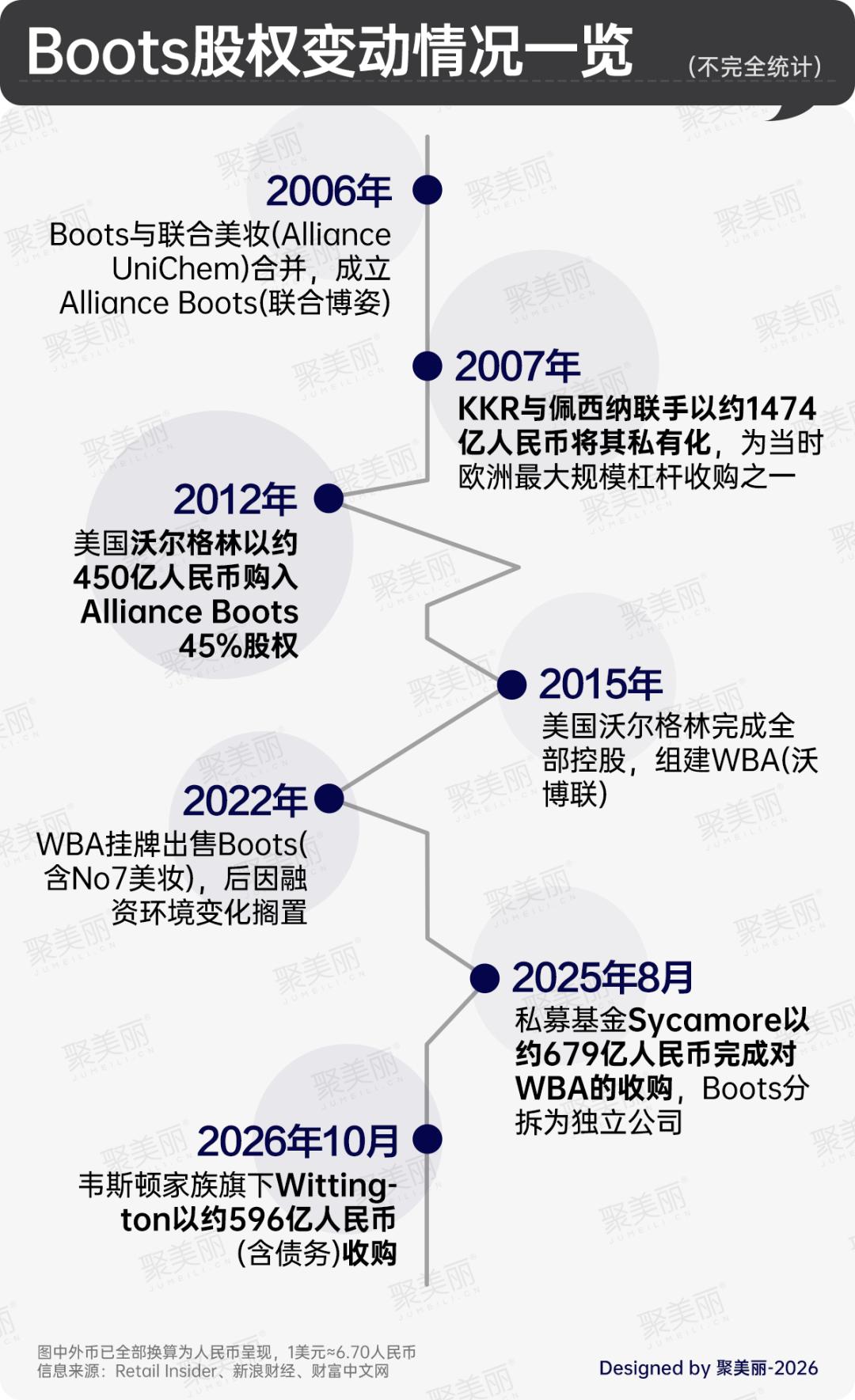
Looking back at its capital operation track, we can find that counting from KKR, Boots has changed its owner four times in about 20 years.
In this transaction, the acquirer, the Weston Family (Wittington), boasts strong strength that cannot be underestimated. As the controller of Loblaw, Canada's largest grocery retailer, the Weston Family owns Shoppers Drug Mart, Canada's largest pharmacy health and beauty chain, and previously held UK department store Selfridges from 2003 to 2021. From Shoppers Drug Mart to Boots, pharmacy-driven health and beauty retail is the familiar business track for this family.
From the perspective of transaction structure, the assets of the buyer and the seller are clearly divided. Wittington will take over Boots' retail business in the UK and Ireland, the Boots Opticians chain, No7 Beauty Company, as well as its Thailand business and franchise business; while the seller Sycamore and the Pessina family will retain the remaining equity including Mexican pharmacy Benavides, German Alliance Healthcare Deutschland, etc.
Divestment and store closures, beauty retailers are facing a tough time
Boots' frequent change of ownership is not an isolated case. Since 2026, the global beauty retail sector has been experiencing a round of intensive equity changes.
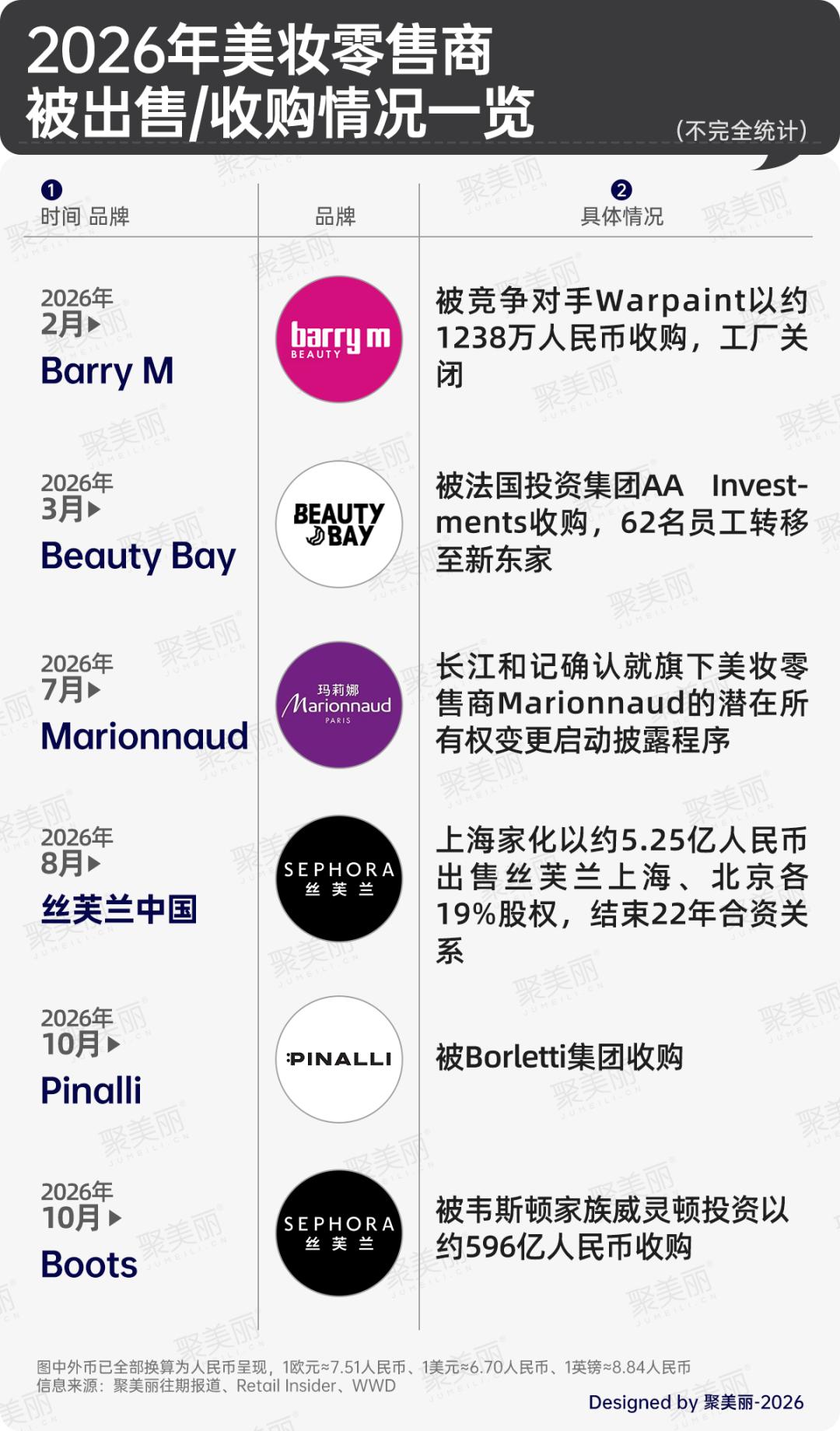
As shown in the figure above, the capital moves in the beauty retail sector in 2026 are intensive. From CK Hutchison launching the disclosure procedure for potential ownership change of its beauty retailer Marionnaud, to Jahwa selling 19% stake in Sephora China for 70 million euros (approximately RMB 555 million) to end a 20+ year joint venture relationship; to Italian perfume retailer Pinalli being acquired by the Borletti Group. Divestment, sale and ownership change may have become unavoidable keywords for the global beauty retail industry.
More severe than "being acquired" is the wave of store closures that is sweeping the entire industry. Neither the once-glamorous established chains nor the fast-rising new internet-famous collection stores in recent years have been spared.
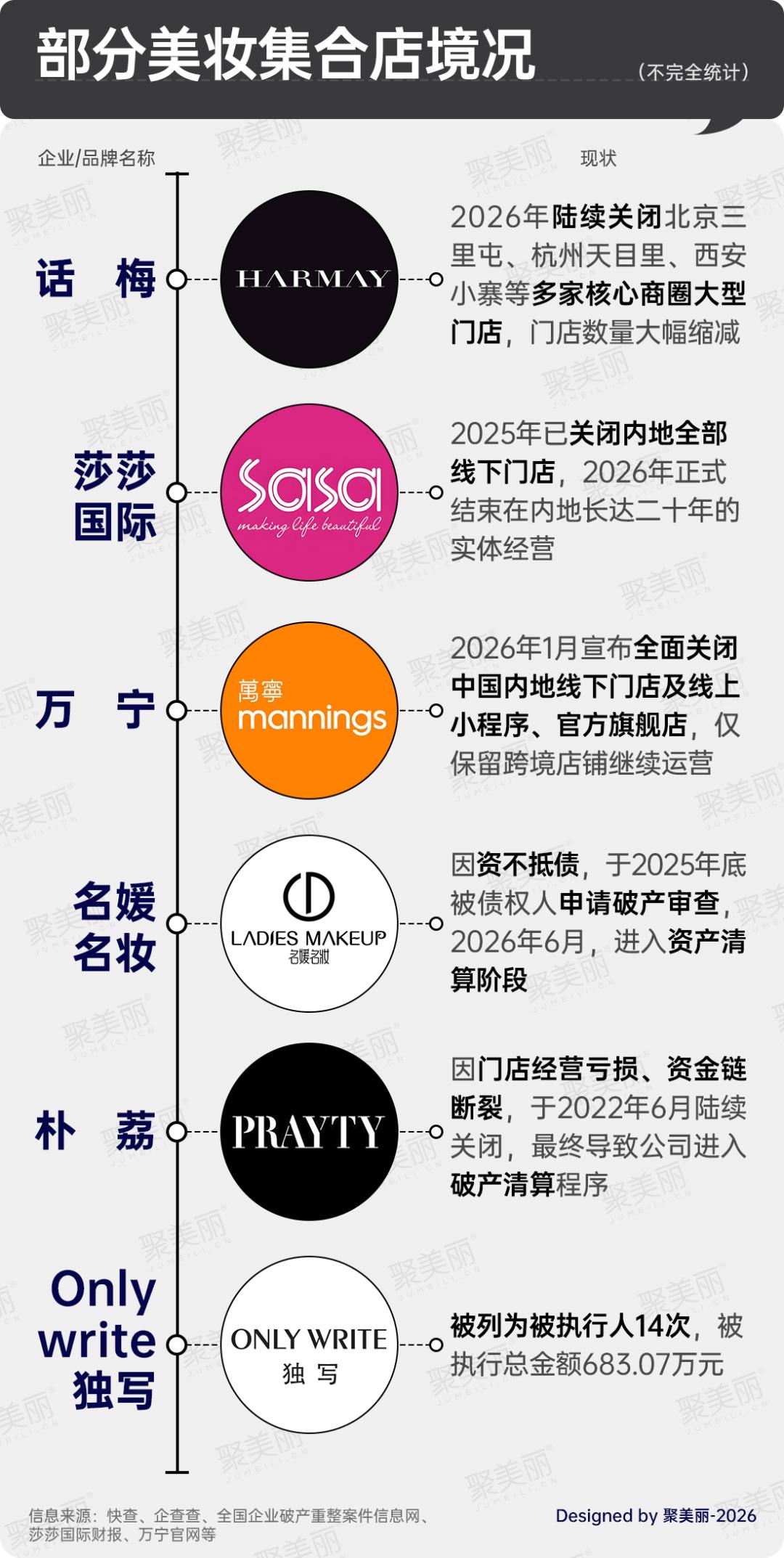
Take HARMAY, the representative of internet-famous collection stores, as an example. In 2026, it continued to close large stores in core business districts such as Sanlitun in Beijing, Tianmuli in Hangzhou and Xiaozhai in Xi'an, with its store scale greatly reduced.
Traditional beauty retailers are also having a hard time. Sa Sa International closed all its offline stores in the Chinese mainland in 2025, and officially ended its 20-year physical operation in the mainland in 2026; Watsons also announced in January this year that it would shut down all offline stores and official online channels in the Chinese mainland, retaining only its cross-border business.
In addition to store closures, there are also bankruptcy liquidation and debt disputes. Domestic beauty chain Mingyuan Mingzhuang, which claimed to be the benchmark of Sephora, went under on the eve of 2026 and has now entered the stage of asset liquidation; PRAYTY, a beauty collection store founded in 2017, was affected by continuous losses and capital chain rupture, with its stores closed one after another and entering the bankruptcy liquidation procedure. In addition, the parent company of Onlywrite is mired in debt, being listed as the person subjected to execution for 14 times, with the execution subject amounting to as high as 6.83 million yuan......
The beauty retail tracks at home and abroad are simultaneously facing in-depth reshuffling, and the underlying logic of industry competition may be being rewritten. As traffic dividends narrow, the number of stores and financing scale are no longer a safe moat. Finding a differentiated positioning, increasing repurchase rate, stabilizing cash flow and building a sustainable profit model may be the premise for beauty retailers to survive the winter and gain a foothold in the long run.
Note: The exchange rate conversion in the article is based on 1 euro ≈ 7.51 RMB, 1 US dollar ≈ 6.70 RMB, 1 British pound ≈ 8.84 RMB
Source:
[1] Report from Retail Insider;
[2] Report from Reuters;
This article is from WeChat official account "Jumeili" (ID: jumeili-cn), written by Shui Jin, authorized for release by 36Kr.