China Online has suffered successive setbacks: its Hong Kong IPO has been terminated, and its planned A-share private placement has also fallen through.
On October 8, Chinese Online, known as "the first stock of short drama overseas expansion", undoubtedly became the focus of attention for A-share investors.
Before the morning trading opened that day, Chinese Online officially announced the termination of its secondary listing plan in Hong Kong. Subsequently, the company's share price plummeted, falling by more than 12% on the same day. On the evening of the same day, the company released another major announcement, announcing the termination of the 2.8 billion A-share private placement.
The cause of this series of events can be traced back to 8 days ago, on September 30. On the evening of that day, the company released a private placement plan, planning to raise 2.833 billion yuan. The raised funds will be invested in projects including digital copyright content resource upgrading, IP derivative content development, AI large model technology R&D and upgrading, AIGC multi-modal content platform technology upgrading, intelligent middle-platform technology upgrading, and supplementary working capital.
Only two days later, the Shenzhen Stock Exchange "worked overtime" to send an inquiry letter to Chinese Online, one of the issues requiring the company to explain the rationality of simultaneously promoting two equity financings on the A-share and H-share markets.
The Shenzhen Stock Exchange also required Chinese Online to submit relevant explanatory materials before October 8 and disclose them to the public.
However, on the morning of October 8, Chinese Online did not release a reply letter, but announced the termination of its secondary listing in Hong Kong. The company stated that this decision is based on comprehensive consideration of the market environment and its own development plan, will not have a major impact on the company's operating activities and sustainable development, and there is no situation that damages the interests of the company and all shareholders, especially small and medium shareholders.
On the same day, Chinese Online's share price plummeted, closing down 12.75% at 20.39 yuan per share, and its total market value also fell below 15 billion yuan. Looking back to February this year, Chinese Online's share price once rose to a phased high of 43.80 yuan per share. Since then, the company's share price has fluctuated downward, and the latest share price has fallen by more than 53% from the high point of the year.
On the evening of the same day, Chinese Online released another announcement, announcing the termination of the A-share private placement. The company stated in the announcement that after comprehensively considering various factors such as the current market environment, and through full communication and research, the company's board of directors agreed to terminate this private placement matter.
After announcing the termination of the private placement, Chinese Online also disclosed the reply letter to the Shenzhen Stock Exchange's inquiry.
However, Chinese Online did not make specific responses to the issues mentioned in the inquiry letter, including the rationality of the fundraising scale exceeding 10 times of the attributable net assets, the rationality of the investment projects of the raised funds, the impact of fundraising on the company's main financial indicators, and the rationality of simultaneously promoting two phases of equity financing on A-share and Hong Kong stock markets. It only stated that the company has now terminated the Hong Kong stock listing and A-share private placement fundraising.
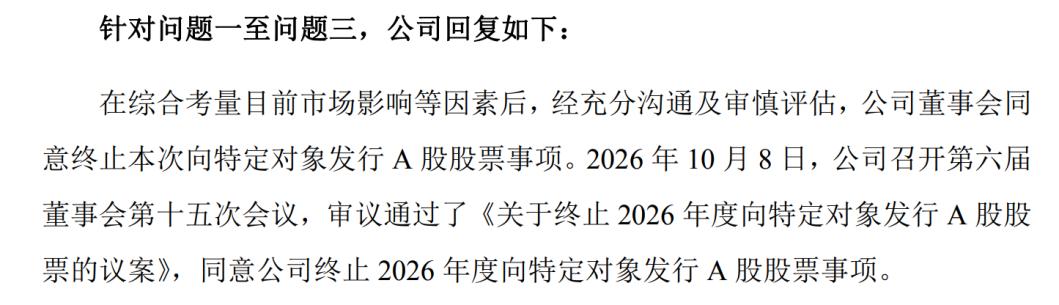
After the exchange's inquiry letter, Chinese Online successively withdrew its Hong Kong stock listing and A-share private placement applications, and such actions have also aroused investors' doubts.
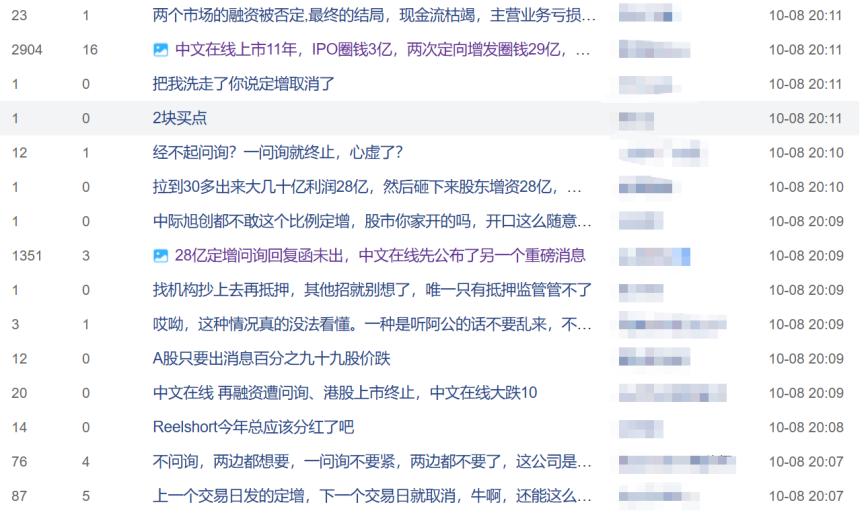
In investor communication communities such as Guba and Xueqiu, many investors said that they cannot understand the company's "withdraw immediately after being inquired" move, and believe that the company lacks confidence in the compliance of capital operation. However, some investors believe that the company's termination of equity financing avoids the dilution of existing equity, which objectively benefits existing shareholders.
Two financings failed on the same day
In the inquiry letter dated October 2, the Shenzhen Stock Exchange raised a total of 5 inquiries to Chinese Online. However, Chinese Online only positively responded to the differences between the current fund-raising investment projects and the previous declaration plan, and did not directly answer 4 questions including the rationality of the fundraising scale, the feasibility of the fund-raising investment projects, the derivation basis of profit forecasts, and the rationality of simultaneously promoting A-share private placement and Hong Kong stock listing. These pending inquiry contents have received high attention from the market.
Chinese Online is a veteran digital entertainment company that was listed on the Shenzhen Stock Exchange as early as 2015. At the beginning of its establishment, the company's main business was electronic book copyright business, and later developed multiple types of businesses such as online literature, IP authorization, games, and education. In 2022, the company established Fengye Interactive, and then incubated the short drama platform ReelShort through this company, entering the short drama overseas expansion track.
However, under the frequent changes of business, the profitability of Chinese Online has become more and more unstable. Since the short drama business requires a large amount of traffic investment, Chinese Online has to significantly increase sales expenses. Affected by this, the company was in a net loss state in both 2024 and 2025. In the first half of this year, although the company's revenue increased by 3.85% year-on-year to 578 million yuan, it still recorded an attributable net loss of 43 million yuan.
To make matters worse, after entering 2026, Chinese Online also fell into a dispute with its associate company Fengye Interactive. According to the statement of Fengye Interactive, the "Settlement and Governance Agreement" signed by both parties has extremely unbalanced rights and responsibilities, unilaterally restricting its board governance rights and reducing the company's accountability channels, so it has sued Chinese Online to the court.
In the 2026 semi-annual report, Chinese Online also failed to disclose the performance of Fengye Interactive from April to June.
Affected by various factors, the liquidity problem of Chinese Online has become increasingly prominent. As of the end of June this year, the company's total assets were 1.393 billion yuan, and the attributable net assets were 263 million yuan. In the same period, the company's monetary fund balance was 277 million yuan, and the sum of short-term borrowings and non-current liabilities due within one year was 359 million yuan.
The amount of funds raised by Chinese Online this time is as high as 2.833 billion yuan, which is twice the total assets of the company and more than ten times the size of the company's attributable net assets. Therefore, the first question of the Shenzhen Stock Exchange required the company to explain the rationality of this financing and the matching relationship between the financing scale and existing business, management capabilities, and personnel reserves.
The second question of the Shenzhen Stock Exchange mainly targeted the fund-raising investment projects of Chinese Online this time, requiring the company to make a more detailed description of the fund-raising investment projects, and demonstrate issues such as economic benefits and commercial feasibility.
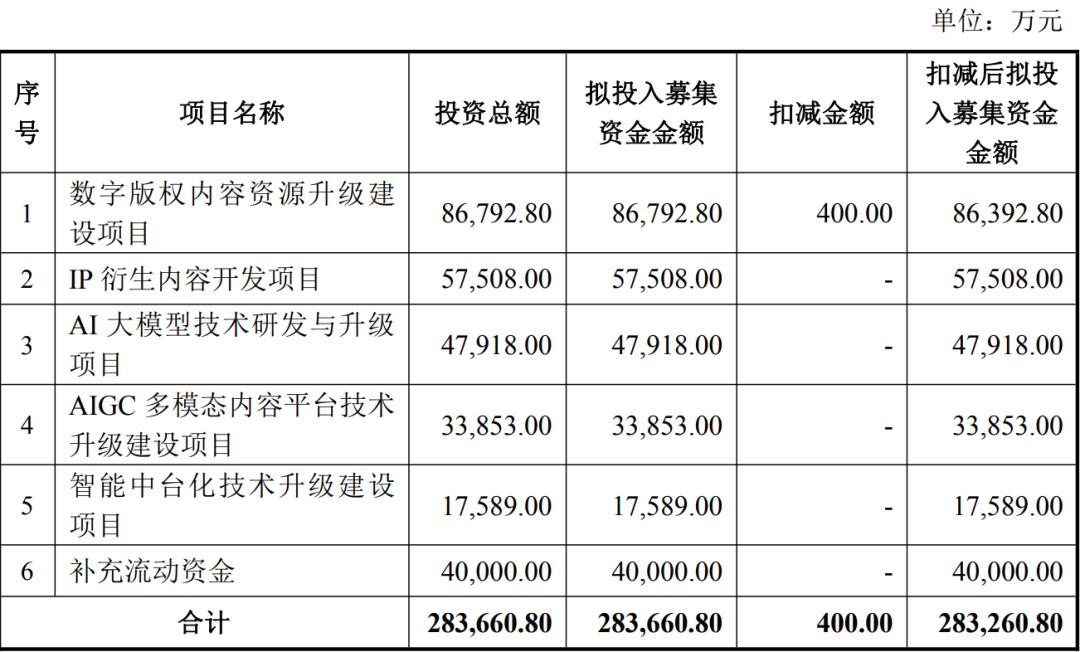
In addition, in the private placement plan, Chinese Online set the non-recurring profit and loss deducted net profit for 2026 and 2027 at 10 million yuan, 20 million yuan to 100 million yuan respectively. However, the company recorded losses in both 2024 and 2025. The Shenzhen Stock Exchange required the company to explain the derivation process of the profit forecast in detail, and quantitatively analyze the dilution effect of this issuance on the current return.
The issue concerning A-share private placement and Hong Kong stock listing is the most critical question in this inquiry. In the inquiry letter, the Shenzhen Stock Exchange required the company to explain the review progress of the Hong Kong stock IPO, the differences in the use of funds between A-share private placement and Hong Kong stock IPO, and demonstrate the rationality of the company's simultaneous promotion of equity financing on both A-share and H-share markets.
In February this year, Chinese Online submitted a prospectus to the Hong Kong Stock Exchange, planning to conduct a secondary listing in Hong Kong. In the prospectus, the company stated that the raised funds will be used to improve AI technology, build an overseas short drama ecosystem, reserve and develop more IPs, and supplement working capital. Only 8 months after promoting the secondary listing in Hong Kong, Chinese Online once again launched the A-share private placement plan.
Judging only from the fund-raising projects, the use of funds raised by Chinese Online's A-share private placement and Hong Kong stock IPO is relatively close.
In fact, there is no lack of listed companies in the market that simultaneously promote A-share private placement and Hong Kong secondary listing. For example, Jiangbolong, a well-known storage leader, submitted its application to the Hong Kong Stock Exchange in March 2025, and in December of the same year, the company announced the A-share private placement plan. From August to September this year, the company's A-share private placement and H-share listing were successively implemented.
Although the fundraising windows overlap, Jiangbolong clearly stated in its Hong Kong stock prospectus that the R&D projects invested by its Hong Kong stock fundraising are different from the A-share private placement investment projects. The investment directions of the two funds are not the same.
In the case of Chinese Online, as the company terminated the two equity financing plans, the company also failed to further disclose whether there are differences in the relevant fund-raising investment projects.
Investor return issues attract attention
Just as the regulator inquired about Chinese Online's fundraising situation, the situation that the company has frequently financed but rarely paid dividends since its listing has once again aroused investors' doubts.
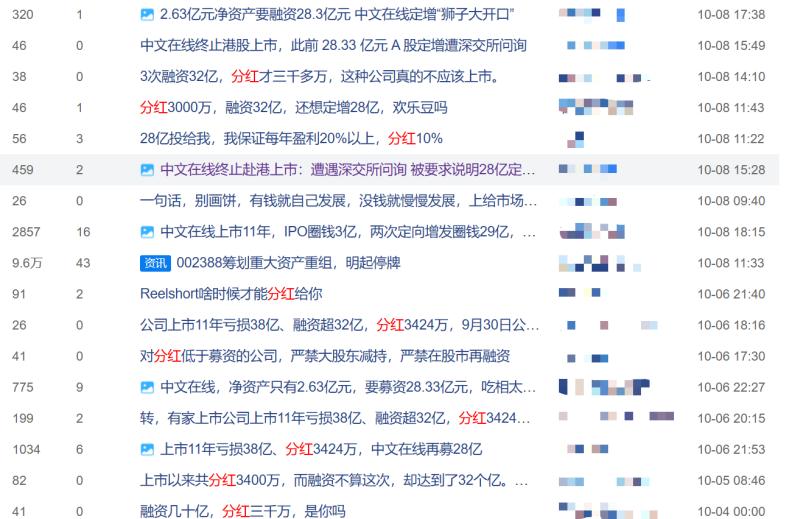
In investor communication communities such as Guba and Xueqiu, some investors pointed out that Chinese Online has been listed for 11 years, and the total amount of three equity fundraisings including IPO has exceeded 3.2 billion yuan, but the cumulative cash dividend is only more than 34 million yuan. This time, the company once again announced a large private placement of 2.8 billion yuan, and some investors believe that the company intends to pass on operating pressure to the market.
On the day the private placement announcement was released, Chinese Online released a three-year shareholder return plan for the future, promising that the annual cash dividend will not be less than 20% of the distributable profit of the year, and profit distribution will be carried out once every year.
However, as early as 2023, Chinese Online released a shareholder return plan, promising to pay dividends once a year from 2023 to 2025, with the dividend amount not less than 20% of the distributable profit realized in the current year. In the year when the plan was released, the company also recorded an attributable net profit of 89 million yuan. However, due to the negative accumulated undistributed profit, the company did not pay dividends. From 2024 to 2025, the company continued to lose money, and still no dividends were paid.
As of the end of June this year, Chinese Online's accumulated undistributed profit balance was -2.898 billion yuan. In the current fiercely competitive short drama overseas expansion and AI comic drama industry, it is not easy for Chinese Online to reverse the huge gap of undistributed profit and achieve stable profitability. And as the company withdrew the private placement application, the company also simultaneously revoked the review of the three-year shareholder return plan for the future.
In this context, whether Chinese Online's profitability can be further improved and whether the intensity of shareholder return can be enhanced in the future is still full of uncertainty.
This article is from the WeChat official account "Morgan Stanley Finance" (ID: damofinance), author: Damo Finance, published with authorization from 36Kr.