A snapped brake pedal: The full story of the Ford Mustang recall incident
In 2020, Mustang owners on both sides of the ocean received an unsettling piece of news almost at the same time: the brake pedal under their feet could snap off completely during emergency braking — that is, when pressed with extreme force, the connecting rod of the brake pedal might fracture.
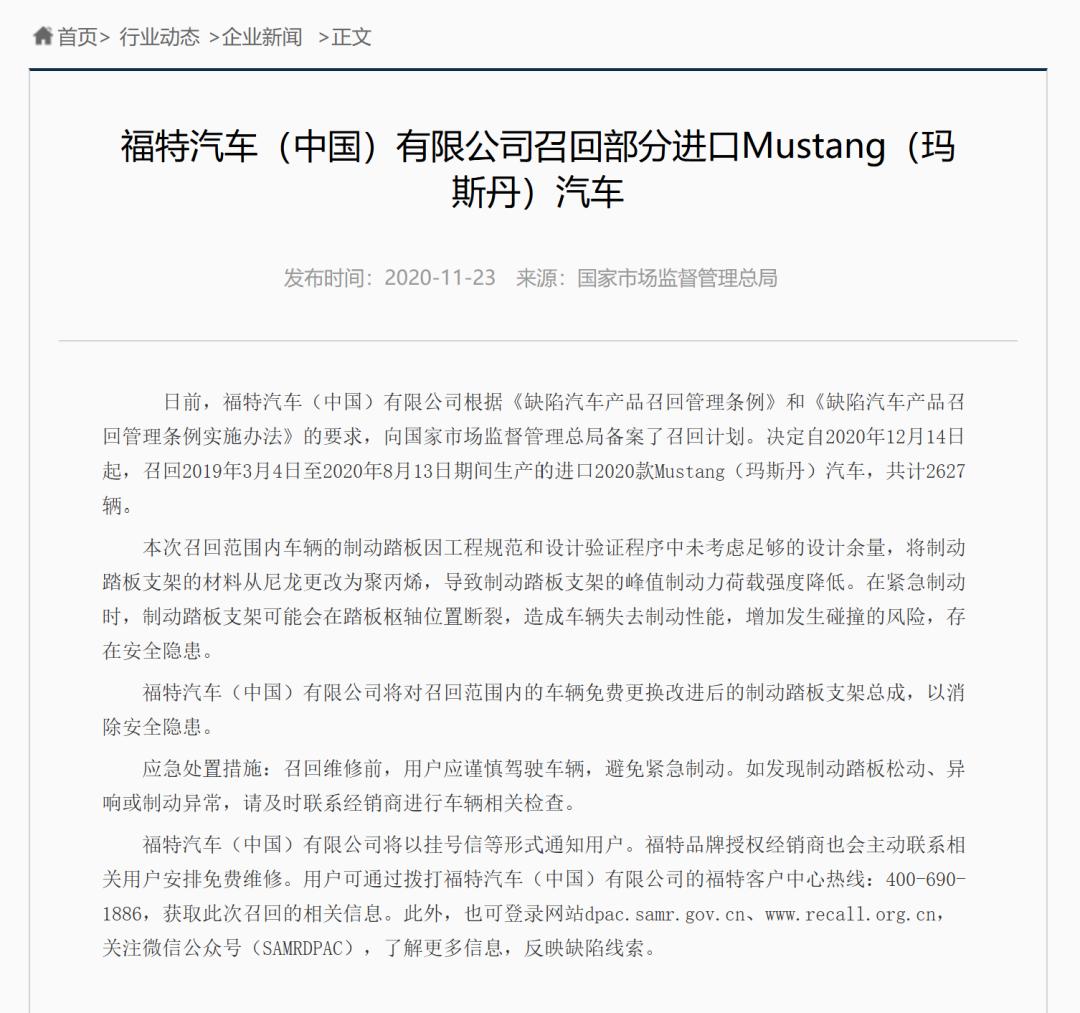
In September of that year, Ford submitted documents to the National Highway Traffic Safety Administration (NHTSA) in the United States, announcing that it would recall approximately 38,000 Mustangs in the US. Three months later, Ford China filed a record with the State Administration for Market Regulation in accordance with the Regulations on the Administration of Recall of Defective Automobile Products, and recalled 2,627 imported 2020 Mustangs produced from March 4, 2019 to August 13, 2020 starting from December 14, 2020.
An engineering change that was once highly expected eventually evolved into a cross-border defect recall spanning two countries.
The "Material Account" Behind a Single Pedal
The problematic part is the brake pedal bracket — the core structural component that connects the pedal to the braking system and bears the stepping force. The problem lies in material replacement: Ford changed the material of the bracket from nylon to polypropylene in the facelift model.
The official announcement stated the issue frankly: "Due to insufficient design margin considered in the engineering specifications and design verification procedures, the material of the brake pedal bracket was changed from nylon to polypropylene, which reduced the peak braking force load strength of the brake pedal bracket." The consequence is that during emergency braking, the pedal bracket may fracture at the pivot position, causing the vehicle to lose braking performance, increasing the risk of collision, and posing a safety hazard.
In other words, the car does not fail to brake, but "the pedal breaks before you realize it when you step on it". The material itself may not be unqualified, but after the material is changed, the strength reserve does not keep up — and the verification procedure failed to detect this gap in time, so the defective parts were released to thousands of vehicles on the production line.
An Engineering Concept: Robustness
This phenomenon of "passing the factory inspection but failing to withstand unexpected conditions" has a specific term in engineering: robustness (a transliteration, also translated as "stability"), which refers to the ability of a system to maintain its function without failure in the face of "unexpected situations" such as sudden loads and environmental changes beyond the normal design scope.
I have seen this term in many software test reports before, and I did not quite understand what this professional term meant at that time, and later I learned that it is a transliteration from English. In fact, it is easier to understand with practical examples.
Take a rope as an example: Rope A has a nominal load-bearing capacity of 100 kg, it deforms only when pulled to 150 kg and breaks at 200 kg, and there are warning signs before overloading; Rope B also has a nominal load-bearing capacity of 100 kg, but it snaps crisply at 105 kg without any warning. Both can pass the "100 kg" test, but their performance in the face of unexpected situations is vastly different — Rope B is a typical example of insufficient robustness.
Applied to this pedal, the lack of robustness is reflected in three aspects:
Insufficient
Severe failure mode: The bracket undergoes brittle fracture, with no deformation or warning before fracture, leaving the driver no reaction time;
Sensitive to fluctuations: Slight changes in material batches, temperature and wear are enough to break through the strength defense line, and the structure has no ability to "absorb differences".
For safety components such as brake pedals, robustness is the lifeline — because in real driving, no one can guarantee that they will always step within the design load "exactly", and the design must leave space for unexpected situations.
【Robustness Tips】"Robust" does not mean "thick and bulky". A good robustness design can be exquisite: it should be light and flexible in normal use, and deform and give an alarm first when overloaded, instead of failing instantly — this is exactly the realm that structural engineers pursue.
We must understand this term well, and we can use it in many meetings for test scenarios in the future.
A Recall Without Accidents
It is worth noting that Ford stated that no actual accidents had been caused by this defect at that time. This is more like a "preventive recall": the hidden danger was brought to the forefront in laboratories and tests, and the pause button was pressed before the accident occurred.
The recall scale in the United States is about 38,000 vehicles, and the regulatory documents clearly point out that the fracture will lead to "failure to brake normally and risk of serious accidents"; the 2,627 vehicles in China were also included in the recall in the same period. For affected car owners, Ford's disposal plan is very clear: replace the improved brake pedal bracket assembly for free to eliminate safety hazards. Before the maintenance is completed, the announcement specially reminds car owners: drive carefully and avoid emergency braking — this sentence not only clarifies the boundary of the risk, but also fills the blank of "not knowing what to do".
Responsibility Confirmation: No Buck-passing, Admit the "Design Verification" Mistake
The most commendable part of this incident is the attitude of responsibility confirmation. Ford did not shift the blame to material suppliers, nor did it attribute the problem to "users stepping too hard" or "extreme working conditions", but directly admitted that its own engineering specifications and design verification procedures did not leave sufficient design margin. The material change is an engineering decision led by the manufacturer, and the verification omission is the process responsibility of the manufacturer — both responsibilities are borne by itself.
In engineering terms, what Ford admitted is exactly that "robustness was not included in the verification standards": only the "pass line" was verified, but the "performance under overload" was not verified. In public information, Ford did not raise any objection to this characterization; the incident ended with "defect identification + free recall and replacement", and did not escalate to administrative penalties or large-scale lawsuits. Under China's automobile recall system, this is a standard and complete closed-loop sample: identify the problem, file a record in accordance with the law, announce the recognition of responsibility, repair for free, and follow up with reminders.
In the automotive industry, engineering decisions of "replacing materials for lightweight and cost reduction" happen every day, but whether the bottom line of "robustness" can be adhered to determines whether it is an optimization or a hidden danger. Ford used an active and thorough recall to block the hidden danger before the accident — this may be the answer that the 2,627 Chinese car owners deserve to remember.
(Factual basis: the recall announcement of the State Administration for Market Regulation, reports from Jiemian News, and related reports from the US NHTSA)
This article is from the WeChat Official Account "Chief Business Review" (ID: CHReview), author: Wei Ming, published with authorization from 36Kr.