The day Qualcomm paid Huawei marks the fork in the road for two distinct development paths of Chinese chips.
On October 5, Qualcomm's pre-market share price once rose by more than 4%. The reason for this rise is somewhat counterintuitive: this US chip giant that has collected "toll fees" for 30 years sat across the table from Huawei as a payer for the first time in history.
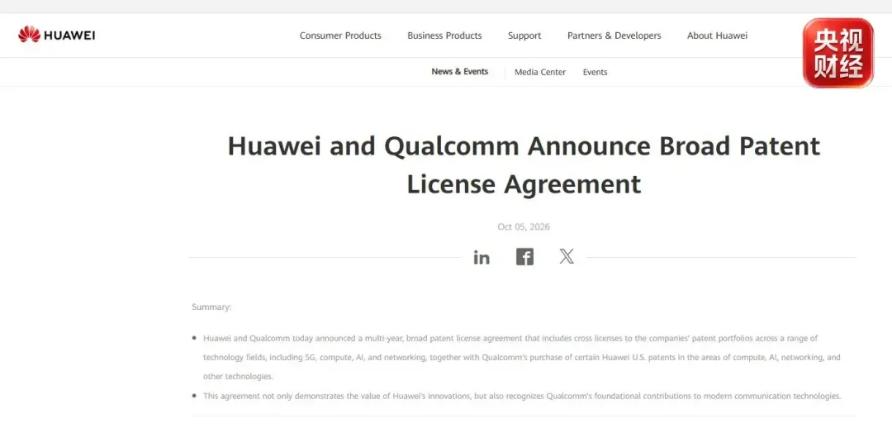
The same day, Huawei officially announced that it has reached a multi-year, wide-ranging patent licensing agreement with Qualcomm.
The content of the agreement includes that the two parties cross-license their patent portfolios in 5G, computing, artificial intelligence, networks and other fields, and Qualcomm will also purchase part of Huawei's US patents in the fields of computing, AI, networks and other domains at the same time.
If you put this agreement on the timeline, it is not an isolated news event, but a 25-year-long curve that has finally crossed the zero axis.
Right above and below this curve lie exactly two types of Chinese chips.
(Image source: CCTV Finance)
01
Twenty-five years, the direction of the bill has reversed
1. A reversed timeline
Let's sort out the timeline first.
In 2001, Huawei paid patent licensing fees to Qualcomm for the first time. Since then, it has paid fees every year and fought several rounds of cross-border patent lawsuits. In 2011, Huawei received patent licensing revenue from Motorola for the first time, and the direction of cash flow began to shift. In May 2019, Huawei was added to the US Entity List, and advanced process manufacturing and EDA tools were cut off at the same time, which was the darkest node. In 2021, Huawei's intellectual property licensing business achieved positive revenue for the first time. A 2026 report from the China Academy of Information and Communications Technology showed that Huawei ranked first in the world in valid 5G patent families with a 11.7% share, followed by Qualcomm at 8.05%. In May 2026, Huawei released the "Tao's Law". In September of the same year, the Kirin 9050 Pro was launched alongside the Mate XT2. In late September, the 8th round of China-US economic and trade consultations reached a reciprocal tariff reduction of "30 billion US dollars against 30 billion US dollars", and the atmosphere warmed up. Finally, the agreement was signed on October 5, 2026.
The party that paid the money 25 years ago has started to collect payments.
As public opinion fermented, on October 6, 2026, Qualcomm denied that it was the "net payer" and refused to admit that the transaction involved a logical reversal. The controversy is still ongoing, but the timeline itself has explained the situation. The reversal of direction does not depend on the wording of any party.
2. 680 patents, accounting for only 0.23%
Let's look at the structure of this deal. There are two core points in the agreement. The first is the cross-licensing of patent portfolios, covering 5G, computing, AI, networks and other fields. The second is that Qualcomm additionally purchases part of Huawei's US patents in computing, AI, networks and other fields, while Huawei retains the patent rights of these technologies in all other regions around the world.
To put it bluntly, cross-licensing is just five words: swap, and make up the price difference. Two libraries open their collections to each other, but the value of the books is different, so someone has to pay the difference. According to CCTV Finance, Qualcomm will pay to use more than 680 Huawei patents, some of which are registered in the United States. When you look at the full picture, Huawei owns about 296,000 valid or pending patents, and the 680+ patents only account for 0.23% of the total.
In the patent business, what is valuable is never the quantity, but the "impossibility of bypassing". It's like charging a big skill for 99.77% of the progress, but getting stuck at the last 0.23% - you still can't release the skill. Qualcomm paying for this 0.23% is equivalent to acknowledging that Huawei's position in 5G standard essential patents, near-packaging optics, and even chip architecture cannot be bypassed. After the transaction is completed, Huawei's total cumulative revenue from all patent licensing agreements is expected to exceed 6.9 billion US dollars. Note that this is the cumulative value of all agreements, not the price of this single deal, and the amount of this transaction has not been disclosed by either party.
3. Qualcomm also has its own time pressure
Qualcomm took this deal not to give Huawei face, but to buy time for itself.
Its basic business is under pressure from two sides. On one side is Apple, whose self-developed iPhone baseband is advancing step by step, and Qualcomm's most lucrative licensing revenue is shrinking before its eyes. On the other side is the manufacturing process: Samsung has been boasting about its 2-nanometer process for more than half a year, but its yield rate only broke 60% in the first quarter of 2026, which is not even enough to meet Qualcomm's 70% order threshold. No one can avoid the ceiling of Moore's Law. Purchasing this batch of patents from Huawei is essentially buying a ticket for the post-Moore era. Technologies that bypass the density limit of lithography machines, such as logical folding and near-packaging optics, are exactly the paths that Qualcomm itself has not yet mastered.
So in this handshake, no one is giving alms to the other.
Both parties have reached the point where they have to make this deal according to their own timetables.
02
The people who change the coordinate system
1. Everything started with a machine that no one could afford
After May 2019, Huawei was stuck at the very front by that machine: the extreme ultraviolet lithography machine. The entire semiconductor industry has taken only one path for 60 years, which is geometric miniaturization: making transistors smaller, and using higher density to improve performance. Without access to EUV, this path came to an end at the 5-nanometer threshold.
These were the darkest seven years in Huawei's timeline. But in hindsight, these seven years also forced the company to make a choice that no one in the entire industry had ever made: stop waiting for lithography machines, and switch to a new coordinate system.
2. Two completely different paths for new chips
The past two years have been the "boom year" for China's self-developed chips, but the ways of this boom are completely different.
In May 2026, He Tingbo, President of Huawei's Semiconductor Business Unit, released the "Tao's Law", which replaces "geometric miniaturization" with "time miniaturization": instead of competing on how small transistors are, it competes on how short the signal transmission distance is. More than 80% of the energy in a chip module is consumed on "moving data" rather than computing. Logical folding stacks the flat circuits vertically, allowing signals to "take the elevator" instead of "traveling long distances". Actual measurement data shows that under the same process, the transistor density increases by 55%, and the performance and power consumption of NPU, GPU and CPU are reduced by 66%, 58% and 41% respectively. The first mass-produced Kirin 9050 Pro was launched alongside the Mate XT2 in September 2026, with the overall performance of the device increased by 31% compared to the previous generation. Yu Chengdong disclosed the details of this chip in a media exchange: the Balong baseband, ISP, mobile security processor, Lingxi CPU, Maliang GPU, and the NPU using the Da Vinci architecture for AI computing are all self-developed. According to leaks, the subsequent Mate 90 series sold more than 270,000 units in the first sales period, of which the "ultra-large cup" equipped with the 9050 Pro accounted for about 40%.
As early as May 2025, Xiaomi released the Xuanjie O1, with a cumulative investment of over 13.5 billion yuan and a team of more than 2,500 people. It adopted TSMC's second-generation 4-nanometer process, and its benchmark scores caught up with the Snapdragon flagship of the same period.
To be fair, this is the most serious self-development attempt in the history of China's consumer electronics, and it deserves respect.
But pay attention to the difference between the two paths. The CPU of the Xuanjie O1 is based on ARM architecture authorization, the GPU is the ARM public version, and the manufacturing relies on TSMC. It uses the best foundation in the world, that is, it has walked to the forefront of the road on the old map, but it has not drawn a new map. A reference is that the Kirin 9050 Pro released in the same period has no CPU, GPU, baseband or NPU that comes from other people's drawings. The more realistic problem is that since its release more than a year ago, there are very few models equipped with this chip, and it is difficult to amortize the huge R&D investment. Chip companies without standard essential patents will always sit downstream of the negotiation table. What Qualcomm paid Huawei for is not the benchmark score of the Kirin chip, but the 0.23% of the 296,000 patents that cannot be bypassed by others.
3. Yu Chengdong made the point clear
At the international media roundtable on September 29, Yu Chengdong said a few very weighty words. Relying on self-developed chips, the HarmonyOS operating system and the domestic supply chain, Huawei has "basically got rid of its dependence on US technology". China is currently developing EUV lithography machines, but at this stage it still relies on DUV. Logical folding is "a method to improve capabilities when access to certain technologies is restricted".
Reading these three sentences together is equivalent to Huawei officially confirming its development path. It will continue to pursue lithography machine development, but will not wait for it. From 2007 to the end of 2025, Huawei's cumulative R&D investment exceeded 1.8 trillion yuan, which is the cost of changing the coordinate system, and also its confidence.
These achievements did not fall from the sky. Yu Chengdong recalled that Huawei only restarted the domestic production of smartphone chips in 2023. The previous few years were the darkest period when the company overcame numerous difficulties to survive. He also laid out the origin of HarmonyOS: it was released in 2019, starting later than Android, but before that Huawei was already one of the most important contributors to the Android community. Microsoft Windows Phone, Samsung bada, Nokia Symbian, these giants all made their own operating systems, but all failed. "Although we started later, we have achieved success." At present, more than 90 million devices are equipped with HarmonyOS 6 and HarmonyOS 7, and the number is expected to exceed 100 million by the end of the year. There are more than 450,000 applications and services in the ecosystem, and 11 million registered developers worldwide.
He did not only report good news. Yu Chengdong admitted that the price of storage components has skyrocketed in the past two years, and the additional hardware cost per mobile phone has increased by more than 200 US dollars. Huawei tried its best to absorb the cost on its own, and the price increase pace was much slower than its peers, but the profit margin still dropped significantly. The more critical bottleneck is production capacity: the domestic advanced semiconductor production capacity cannot yet meet the rapidly growing demand. The Ascend AI chips and mobile phone chips share the same production line, which explains Xu Zhijun's sentence that "the bottleneck is not in demand, but in production capacity". From ranking first in global market share in 2019 to current annual overseas sales of only several million units, the head of Huawei's consumer business laid out all the costs without evasion.
It is intriguing that Xiaomi took action in the same week: on October 7, Xiaomi officially announced that the Surge OS 4 is "fully compatible with the Apple ecosystem", enabling two-way information synchronization and cloud photo album interconnection, and the new flagship even supports AirDrop. A company whose hardware relies on other people's architectures and software relies on other people's ecosystems has made "compatibility" a selling point.
This just reflects the scarcity of the other path. HarmonyOS never acts as a compatibility layer for others; it wants to be the object that others are compatible with. The former is a smart business, while the latter is a arduous long march, and the 450,000 applications and 11 million developers prove that the long march has already passed the most difficult stages.
03
The stuck time
1. Dependence and anti-dependence of computing power
This logic also applies to new energy vehicles, and it is more intuitive.
The Xiaomi SU7 is a hit product, but its intelligent driving computing power comes from NVIDIA Orin, and its cockpit chip comes from Qualcomm 8295. It follows the same logic as the Xuanjie O1 in mobile phones: integrating the world's top components into the best product.
This path takes effect quickly, and you can make a hit product in three years.
Huawei took another path. Xu Zhijun revealed at the September Connect conference that Ascend's share in the Chinese market has surpassed NVIDIA, the 950DT super node will be supplied on a large scale by the end of the year, and the 950PR was launched in the first half of the year. The current bottleneck is not in demand, but in production capacity. He also responded to the statement that "US peers are calling for slowing down AI development": Chinese models are weaker, so they need to speed up instead, otherwise how can they perceive the risks.
2. The unit of competition is moving upward
What is really worth pondering about this surpassing is not the share number itself, but how the share is achieved. The basic unit of AI competition is moving upward from a single chip. When thousands or tens of thousands of accelerators are used for training and inference together, the model does not get the nominal peak computing power of a certain chip, but the effective computing power continuously delivered by the entire system. The interconnection, scheduling, fault tolerance, power supply and heat dissipation between chips have begun to determine the final result more than the parameters of a single card. What Huawei is stuck on is the process of a single chip, but it happens to hold another set of assets: Lingqu bus, all-optical interconnection, near-packaging optics, super node architecture, and 30 years of system engineering capabilities spanning communications, storage, data centers and digital energy. At the 2026 Connect conference, Huawei clearly oriented its strategy to "super node + cluster". What it is really betting on is rewriting the competition from "whose chip is stronger" to "who can organize more chips into an efficient whole".
At the end of September, two actions in opposite directions pointed to the same thing. DeepSeek cooperated with Huawei to develop and open source a series of underlying software tools for Ascend, and model companies changed from users of infrastructure to co-builders. Almost at the same time, AMD acquired World Labs founded by Li Feifei for about 8.2 billion US dollars, and chip companies moved upward into model research. The distance between models and computing infrastructure is shortening, and the past linear industrial chain of "chips, servers, cloud, models, applications" is becoming a mutually feedback system.
Of course, the system is not a panacea. NVIDIA's deepest moat has never been the GPU itself, but the function libraries, tool chains, talents and code assets accumulated by CUDA over 20 years. This path dependence is difficult to replicate through short-term investment, and Huawei's own CANN is still moving from "available" to "easy to use". The production capacity gap in advanced manufacturing cannot be filled by system architecture. It is more like a multiplier: chips, interconnection and software provide basic capabilities, and system engineering determines how many of these capabilities can be finally released. Moreover, competitors are also moving in the same direction. System competition is not a unique path for Huawei, but a common shift happening in the entire AI industry.
Building cars by integrating other people's chips, and making chips by defining your own architecture, are two real existing paths. But only the latter leads to