With the world's first certification for brain-computer interface in hand and sprinting towards an IPO, how far is Neuracle from turning a profit?
On September 29, Nuerobrain, a leading domestic enterprise in the brain-computer interface field, updated its IPO prospectus for the Sci-Tech Innovation Board (STAR Market).
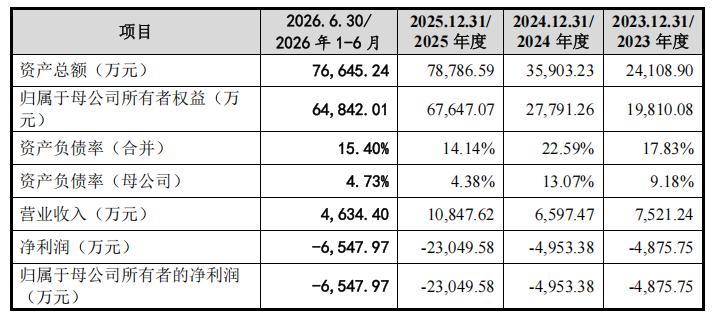
According to the latest financial data disclosed by Nuerobrain, in the first half of this year, the company achieved revenue of 46 million yuan, and recorded a net loss attributable to shareholders of 65 million yuan.
From 2023 to 2025 prior to that, Nuerobrain's cumulative loss over three years reached 329 million yuan, approximately 1.32 times the sum of the company's revenue in the same period.
Looking back at Nuerobrain's development path, its status as a strong competitor for the "first brain-computer interface public listed company" is inseparable from the efforts of Xu Honglai, a Tsinghua top student founder who has been deeply engaged in the industry for more than 20 years.
In 2011, Xu Honglai, together with his Tsinghua alumnus Huang Xiaoshan, co-founded Nuerobrain. In 2019, the company officially entered the field of invasive brain-computer interfaces.
In March 2026, Nuerobrain's invasive brain-computer interface product NEO-ONE SCI was approved for marketing by the National Medical Products Administration, becoming the world's first brain-computer interface medical device approved for market launch.
However, as a star product that has obtained the "world's first certification" for invasive brain-computer interface medical devices, NEO-ONE SCI is still in the initial stage of commercialization.
The prospectus shows that as of the first half of 2026, almost all of Nuerobrain's main business revenue came from non-invasive products. Among them, the EEG acquisition system contributed 29.7007 million yuan in revenue in the first half of the year, accounting for as high as 64.56% of the main business revenue.
In July this year, NEO-ONE SCI achieved its first commercial sale, with 13 units of products sold, 8 product implant operations completed, and letters of intent for more than 70 units obtained.
Nuerobrain Updates Prospectus, The Company Has Not Yet Achieved Profitability
On September 29, Nuerobrain, which is striving to become the "first brain-computer interface public listed company", disclosed its updated prospectus (application draft).
The latest financial data shows that in the first half of 2026, Nuerobrain achieved a revenue of 46 million yuan, recording a net loss attributable to shareholders of 65 million yuan.
Looking at a longer time horizon, from 2023 to 2025, Nuerobrain's revenue was 75 million yuan, 66 million yuan and 108 million yuan respectively, with an average annual compound growth rate of over 20%.
While the revenue has grown, Nuerobrain's losses have continued to expand. In 2023, Nuerobrain recorded a net loss attributable to shareholders of 49 million yuan, and the loss increased to 50 million yuan in 2024.
In 2025, Nuerobrain recorded a full-year net loss attributable to shareholders of 230 million yuan, a year-on-year increase of 365.33%. Over the three years, Nuerobrain's cumulative loss reached 329 million yuan, approximately 1.32 times the total revenue of the company in the same period.
According to the information disclosed in the prospectus, the sharp increase in the scale of Nuerobrain's losses in 2025 is related to the large amount of share-based payment expenses in the current period.
In 2025, Nuerobrain implemented equity incentives for its actual controllers Xu Honglai and Huang Xiaoshan, and recognized a one-time equity incentive expense of 192 million yuan. Based on the characteristics of the actual controllers' comprehensive management and the principle of prudence, the relevant amount was fully included in administrative expenses.
In addition, Nuerobrain's continuously increasing R&D investment has also squeezed the company's profit margin to a certain extent.
The prospectus shows that from 2023 to 2025, Nuerobrain's R&D expenses were 64 million yuan, 58 million yuan and 65 million yuan respectively, with a cumulative R&D investment of 187 million yuan over three years, accounting for 84.94%, 87.85% and 60.02% of the operating revenue respectively.
As of June 30, 2026, Nuerobrain's undistributed net profit was about -532 million yuan, with a large amount of accumulated unrecovered losses.
Nuerobrain clearly stated in the risk warning that for a period of time in the future, the company's R&D investment is expected to remain at a relatively high level. If the sales growth of the company's existing products falls short of expectations, or the R&D, registration or commercialization progress of the products under development is unfavorable, it will have a major adverse impact on the company's future profitability, and the company may face risks of continuous losses or the accumulated unrecovered losses cannot be eliminated and even continue to expand, and the net assets turning negative.
In terms of assets and liabilities, as of the end of the first half of the year, Nuerobrain's total assets were about 766 million yuan, the owner's equity attributable to the parent company was 648 million yuan, and the asset-liability ratio was about 15.4%.
The updated prospectus also mentions that Nuerobrain plans to publicly issue no more than 20 million RMB common shares for this listing application, with a total planned fundraising of about 2.5 billion yuan.
Among them, 1.776 billion yuan is planned to be invested in brain-computer interface R&D projects; 174 million yuan will be used for brain-computer interface production and construction projects; the remaining 550 million yuan will be used to supplement working capital.
Led by Tsinghua Top Student, Bringing Science Fiction Into Reality
Tianyancha information shows that Nuerobrain Technology (Shanghai) Co., Ltd. (referred to as "Nuerobrain") was founded in 2011, and one of the company's actual controllers is Xu Honglai.
According to public information, Xu Honglai was born in 1984 and entered the Department of Biomedical Engineering of Tsinghua University in 2001. In 2004, Xu Honglai became a member of the brain-computer interface research group.
The following year, the research group where Xu Honglai was located won the first prize in the international brain-computer interface data competition, and a set of brain-computer interface equipment developed by the group was even featured on the CCTV news program "Xinwen Lianbo", making the technology a hot topic at that time.
In 2006, Xu Honglai, who was about to graduate with a master's degree, received an offer from a large medical device manufacturer, but on the suggestion of his tutor Hong Bo, he finally chose to continue his further study before starting his own business.
During his doctoral studies, with sufficient financial support and assistance, Xu Honglai abandoned the mature foreign analog technology route and innovatively turned to the "fully digital" solution for brain-computer interfaces.
This route also defined Nuerobrain's earliest technical foundation, and determined its subsequent common underlying capabilities in invasive and semi-invasive brain-computer interfaces: low-noise acquisition, anti-interference, and emphasis on system performance.
In November 2011, Xu Honglai, together with his alumnus Huang Xiaoshan, founded Nuerobrain Technology (Changzhou) Co., Ltd. in Changzhou Science and Education Town.
After years of unremitting exploration, around 2015, the Nuerobrain team finally developed the first generation of usable product prototypes, which passed the blind test of hospital experts. Thanks to this product, Nuerobrain successfully obtained an angel round financing of tens of millions of RMB that year.
In 2019, as the brain-computer interface track continued to heat up, Nuerobrain received another 60 million yuan in financing. At this time, the company's non-invasive EEG products had already gained a firm foothold in China's scientific research market.
In 2019, Neuralink under Elon Musk released its brain-computer interface system, which quickly sparked global heated discussions. Nuerobrain then officially launched the R&D of invasive brain-computer interfaces.
Different from the fully implanted flexible electrode scheme adopted by Neuralink, Nuerobrain chose a more "pragmatic" semi-invasive route — placing the electrodes outside the dura mater instead of inserting them into the brain tissue. After that, Nuerobrain's development in the field of invasive brain-computer interfaces began to accelerate.
In October 2023, Nuerobrain completed the first invasive brain-computer interface surgery at Xuanwu Hospital of Capital Medical University.
In August 2024, Nuerobrain's invasive brain-computer interface medical device NEO-ONE SCI entered the special review procedure for innovative medical devices of the National Medical Products Administration.
In March 2026, NEO-ONE SCI was approved for marketing by the National Medical Products Administration, becoming the world's first brain-computer interface medical device approved for market launch.
Nuerobrain's prospectus shows that NEO-ONE SCI is suitable for patients with tetraplegia caused by cervical spinal cord injury. It collects the patient's EEG signals to identify motor intentions, and uses pneumatic glove equipment to assist in realizing the compensation of the patient's hand grip function.
Clinical trial and follow-up data show that 3, 6 and 12 months after the patients received the product implantation, the ARAT response rate assisted by NEO-ONE SCI was 100%.
Among them, 68.8% and 81.3% of the patients respectively had a significant improvement in ARAT grip score from the baseline under the unassisted state at 6 months and 12 months after the surgery. The paralyzed patients can gradually recover their hand motor function, showing a good recovery effect of the neural pathway.
It is worth mentioning that according to Beijing Daily, only two days after the product was approved, the medical insurance code was officially issued. A week later, the Shanghai municipal medical insurance department passed the green channel for rapid review, and on March 23, together with the health department, completed the document issuing procedure, including NEO-ONE SCI into the Shanghai municipal medical insurance medical consumables catalogue.
Holding the "World's First Certification" for Brain-Computer Interface, Commercialization Is Still in the Initial Stage
Although holding the "world's first certification" for invasive brain-computer interface medical devices, Nuerobrain's related products are still in the initial stage of commercialization.
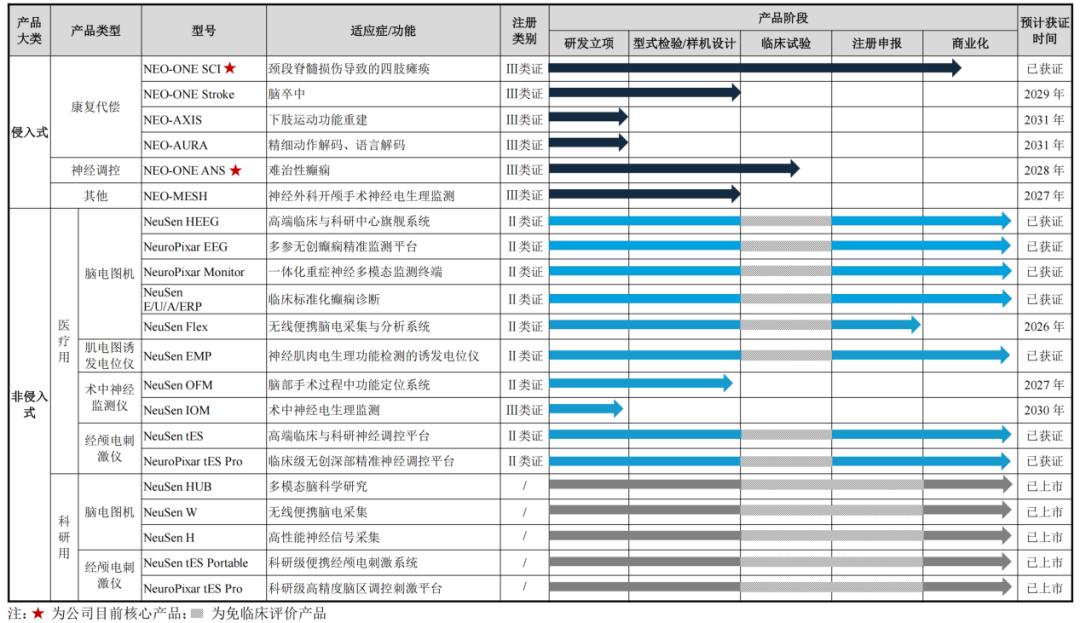
LeiDa Finance learned from the prospectus that Nuerobrain's products are mainly divided into two categories: invasive and non-invasive.
Among them, invasive products include rehabilitation compensation products, neuromodulation products and other products, with core products being NEO-ONE SCI and NEO-ONE ANS.
Non-invasive products cover medical electroencephalographs, electromyography evoked potential instruments, intraoperative neuromonitoring instruments, transcranial electrical stimulators, as well as scientific research electroencephalographs, transcranial electrical stimulators, etc.
However, from the perspective of the composition of main business, almost all of Nuerobrain's current revenue comes from non-invasive products.
Data shows that in the first half of 2026, the company's EEG acquisition system project contributed 29.7007 million yuan in revenue, accounting for as high as 64.56% of the main business revenue.
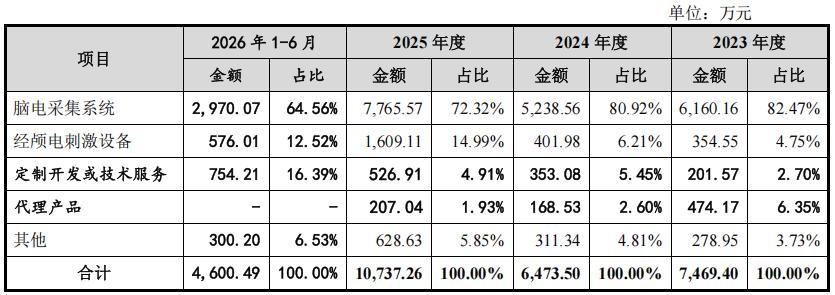
In the same period, Nuerobrain's revenue from transcranial electrical stimulation equipment was 5.7601 million yuan, accounting for 12.52%; revenue from customized development or technical services was 7.5421 million yuan, accounting for 16.39%; other products contributed 3.002 million yuan in revenue, accounting for 6.53%.
Nuerobrain stated directly that although NEO-ONE SCI has been approved for marketing, it is still in the initial stage of commercialization, while another core product NEO-ONE ANS and other products under development are still in the R&D stage, and no revenue has been generated during the reporting period.
However, Nuerobrain disclosed that as of the date of signing the prospectus, NEO-ONE SCI has completed the network listing in 27 provinces and is continuously promoting its admission into hospitals. In July this year, NEO-ONE SCI achieved its first commercial sale, with 13 units of products sold, 8 product implant operations completed, and letters of intent for more than 70 units obtained.
At the same time, Nuerobrain stated that a number of products under development will also be commercialized one after another in recent years, and the industrialization of core technologies is in good condition.
Nuerobrain also pointed out that the commercial performance of invasive brain-computer interface products will be affected by multiple factors such as clinical popularization and penetration, discipline construction and development, surgical procedure promotion, and patients' payment capacity.
"If situations such as slow progress of products entering hospitals, blocked clinical promotion, and weak payment capacity occur, there will be the risk that the commercialization of new products will fall short of expectations," Nuerobrain further stated.
Regarding the subsequent development of Nuerobrain, LeiDa Finance will continue to pay attention.
This article is from the WeChat official account "Leida Finance", Author: Zhou Hui, Editor: Meng Shuai, Published by 36Kr with authorization.