PwC Entertainment Outlook: The live music market will exceed $41.5 billion in size by 2030
PwC (PricewaterhouseCoopers) released the *Global Entertainment & Media Outlook 2026-30*, which covers 12 business segments and 53 countries and regions. What exactly do the future forecasts in this report illustrate?
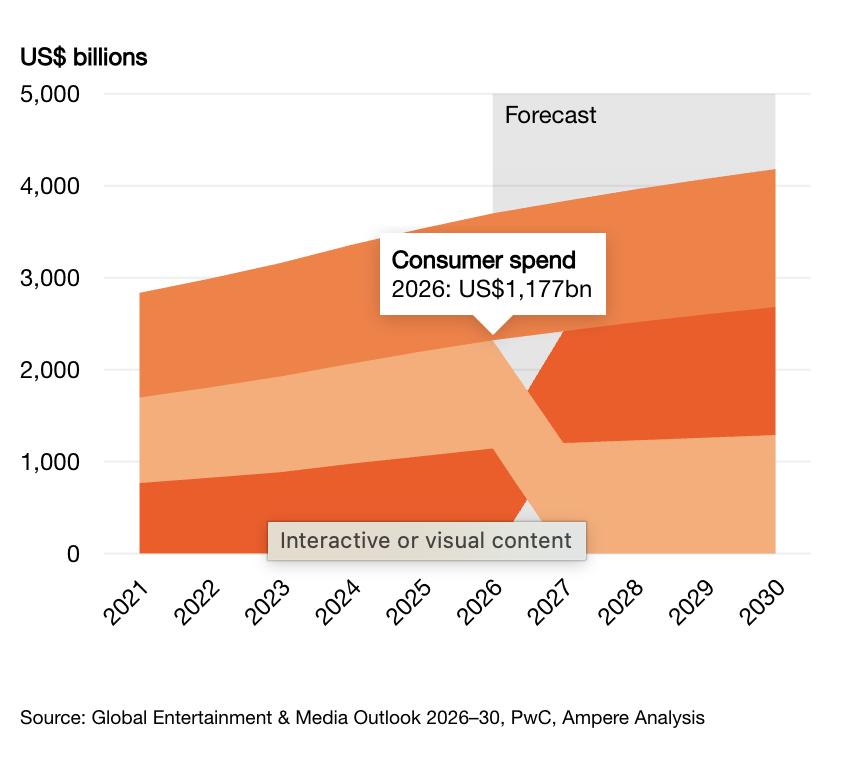
According to the report, the global entertainment and media industry grew by 5.3% in 2025, with a total revenue of 3.5 trillion US dollars. It will grow by another 4.6% in 2026, with a compound annual growth rate of 3.4% in the next five years, reaching 4.2 trillion US dollars by 2030. The new revenue added in 2030 alone is about 600 billion US dollars. Advertising is the fastest-growing segment, exceeding 1 trillion US dollars for the first time in 2025 and reaching 1.4 trillion US dollars by 2030.
The industry consists of three major sectors: advertising, internet connectivity, and consumer spending. PwC believes that no matter how digital and algorithm-driven the user experience becomes, the core of the entertainment and media industry remains human craft and human experience. Judgment, creativity, emotion and relationships drive engagement, and the role of AI is to connect people more efficiently.
It is worth noting that the China summary section was released separately on September 3, 2026.
Forecasts show that the total revenue of China's entertainment and media industry will reach about 613.5 billion US dollars in 2030, accounting for 15% of the global total, with a compound annual growth rate of 3.4% from 2025 to 2030, which is on par with the global average. Among them, revenue from music, radio and podcasts will climb to 8.7 billion US dollars at a compound annual growth rate of 6.2%. In 2025, China's recorded music revenue accounted for 62% of total audio revenue, compared with 39% globally in the same period.
01
Subscription Model Fatigue
Mature Markets Are Approaching the Ceiling of Users' Willingness to Pay
Total OTT (streaming) revenue grew by 13.9% in 2025, rising from 199 billion US dollars in 2024 to 226.6 billion US dollars. This growth rate will not continue. By 2030, the compound annual growth rate of OTT revenue will drop to 6.1%, with a total scale of 304 billion US dollars, adding 77.4 billion US dollars in five years.
The reason for the slowdown is that consumers in mature markets such as Australia, Spain and South Korea are beginning to experience subscription fatigue, and the industry is touching the upper limit of users' willingness to pay.
In terms of advertising, OTT advertising currently accounts for 19.4% of the segment's revenue, and will expand at a compound annual growth rate of 9.4% by 2030, with its share rising to 22.6%. The report judges that streaming media will move towards stronger integration and larger bundling, because platforms aim to become the hub of home entertainment, and will integrate TV, movies, games, music, sports, social media and user-generated content into the same entry.
Traditional TV is following a reverse curve and has been declining. Global traditional TV revenue fell by 2.7% in 2025 to 360.5 billion US dollars, and will continue to decline at an annual rate of 1.1% to 341.2 billion US dollars by 2030.
"Internet connectivity" is the largest of the three sectors, with a compound annual growth rate of only 2.3%, rising from 1.3 trillion US dollars in 2025 to 1.5 trillion US dollars in 2030.
There are obvious regional differences on the advertising side. Mainland China is the world's second largest internet advertising market, with revenue of 159.1 billion US dollars in 2025, which is expected to increase to 228.4 billion US dollars by 2030. The compound annual growth rate of internet advertising inside and outside streaming platforms is 7.42%, making it one of the fastest-growing market segments.
The overall market of music, radio and podcasts will reach 125.5 billion US dollars in 2025 and 145.1 billion US dollars in 2030. Streaming media will still be the largest segment in this field by 2030, reaching 56.6 billion US dollars. Live sports is one of the few types of content on streaming media that can still gather large crowds at specific points in time. The 2026 North America World Cup is described by the report as one of the longest shared reality experiences in history.
Amazon Prime Video has continued to increase its investment after obtaining NFL copyrights, Netflix and Paramount+ are focusing on UFC and WWE content, and a considerable number of Ligue 1 matches in France have been moved to Ligue 1+.
02
Growth Shift of Live Entertainment
Compound Annual Growth Rate Higher Than the Industry Average
"Live and Immersive Experiences" is the fastest-growing group in the report. The five segments of movie box office, live music, out-of-home advertising, exhibitions and online gambling will grow at a combined compound annual growth rate of 5.2% to 2.94 trillion US dollars by 2030, higher than the overall industry growth rate of 3.4%.
In terms of movie box office, it will reach a scale of 39.5 billion US dollars by 2030, with a compound annual growth rate of 3.2%, but the annual growth rate of global moviegoers is only 1%. Revenue growth is supported by ticket prices and high-end viewing formats. Large screens, luxury seats, upgraded sound systems and catering services are the investment directions for cinema operators. Out-of-home advertising will increase from 37.9 billion US dollars in 2025 to 45.8 billion US dollars in 2030, and digital out-of-home advertising will expand at a compound annual growth rate of 9.2% to 26.5 billion US dollars, accounting for 57.9% of out-of-home advertising expenditure by then.
Exhibition expenditure reached 38 billion US dollars in 2025, a scale comparable to that of live music, with a faster growth rate, reaching 44.6 billion US dollars by 2030 at a compound annual growth rate of 3.3%. The growth comes from the demand for face-to-face communication, and the industry is also transforming traditional booths into experience-based commercial festivals. For example, the Dubai World Trade Centre is expanding its capacity, India's Bharat Mandapam has 7,000 seats, and the 2025 Bharat Mobility Global Expo attracted about 1 million visitors and more than 1,500 exhibitors.
The report also directly points out the current problems in the mainland China film market: insufficient content supply, long investment cycles and uncertain returns have dragged down growth. The mainland China box office in 2025 is about 7.7 billion US dollars, accounting for 22% of the global total.
The fastest growing segment is online gambling. This sector is included in the report for the first time this year. Across ten markets, the total revenue of regulated online gambling (GGR) doubled from 37.1 billion US dollars in 2021 to 79.5 billion US dollars in 2025, and will reach 119.7 billion US dollars by 2030, with a compound annual growth rate of 8.5%. The report concludes that the scale of online gambling will exceed that of out-of-home advertising and movie box office by 2030.
Live music itself will exceed 41.5 billion US dollars by 2030, with a compound annual growth rate of 2.1%.
Live music faces a harder constraint, that the number of seats in venues is limited. PwC has included this point in its judgment: since the number of people who can attend live events is limited by venue capacity, organizers can only achieve growth by raising ticket prices and building new venues. For example, the Sphere in Las Vegas recorded revenue of 781 million US dollars in 2025, with a program including 4D screenings of *The Wizard of Oz* and Eagles concerts, and its parent company is replicating this model in other cities in the US and Dubai. Immersive venues like Cosm are also classified into the same category by the report.
The flip side of rising ticket prices is demand elasticity. Live Nation's 2025 financial report shows that the company's full-year revenue reached 25.2 billion US dollars, a year-on-year increase of 9%. It received 159 million viewers across 55,000 performances, and the number of viewers in international markets exceeded that in the US for the first time. The adjusted operating profit of the concert segment was 687 million US dollars, up 30%, with a profit margin of 3.3%, the best in the company's history.
There is another detail in the same financial report: the company kept the minimum ticket price for all kinds of venues in the US at the same level as 2024, and 75% of tickets nationwide are sold for less than 100 US dollars. The record-high profit margin and stable minimum ticket prices coexist, and the room for price increase is concentrated on headliners and high-priced ticket segments.
The growth trend of sponsorship cannot be ignored. Taking Live Nation's sponsorship and advertising business as an example, its revenue in 2025 was 1.32 billion US dollars, and its adjusted operating profit was 845 million US dollars, up 11%. The investment is concentrated in travel, beverage and financial services categories, and brand budgets for both online and live scenarios are increasing.
The data on the ticketing side shows that Ticketmaster's full-year revenue was 3.1 billion US dollars, with 346 million paid tickets, of which the concert segment grew by 4%, while sports and other performances declined by 2%.
Of course, the venue side is still expanding capacity. Venue Nation received 65 million visitors in 2025, and is expected to exceed 70 million in 2026. More than half of the new capacity is in overseas markets. The company's performance-related deferred revenue at the end of 2025 was 4 billion US dollars, up 21%, and more than 80% of large-scale venue performances in 2026 have been confirmed or are in the quotation stage.
As a reference, exhibition expenditure reached 38 billion US dollars in 2025, a scale comparable to that of live music, with a faster growth rate, reaching 44.6 billion US dollars by 2030. Obviously, cultural performances and industry festivals built around exhibitions are becoming an independent business.
Summary
In the short term, the industry's incremental growth mainly comes from advertising and the digital ecosystem, and AI reduces costs on both the creative and delivery sides. In the medium term, the truly scarce resources are the seats in offline venues and the experience economy that can support high prices, which PwC calls "shared reality".
Nowadays, such live entertainment experiences have become social currency among young people, which can prove their taste and cultural status on social platforms. Consumers in 2030 want more choices, lower prices and digital accessibility, and their willingness to pay remains limited. Therefore, whether "shared reality" can maintain its premium depends on how widely this premise holds.
For the Chinese market, the total revenue of China's entertainment and media industry will reach about 613.5 billion US dollars in 2030, accounting for 15% of the global total, with a compound annual growth rate of 3.4% from 2025 to 2030, which is on par with the global average.
However, the differences in industry structure are even greater. For example, revenue from music, radio and podcasts will increase at a compound annual growth rate of 6.2% to 8.7 billion US dollars by 2030, faster than the global audio segment. Therefore, the *China Summary* points out that "mixed reality, internet advertising and music" are the three segments that still maintain relatively high growth, and the entertainment and media industry has long been at the intersection of the integration of various industries.
In 2025, China's recorded music revenue accounted for 62% of total audio revenue, compared with 39% globally in the same period. The payment habits of subscribing to and purchasing digital albums have been fully established among domestic audio users, and the incremental growth brought by users switching from free to paid will be smaller than that in overseas markets in the future.
From the perspective of podcasts, the report predicts that China's podcast revenue will account for 10% of audio revenue in 2030, while the global figure is only 4%. The monetization paths of knowledge payment and brand-customized content are more mature in China.
This article is from the WeChat official account "Music Business" (ID: musicbusiness), written by An Ran Yi, and published with authorization from 36Kr.