Quietly doubling, thermal power is back at the table.
Since 2021, leading new energy power generation enterprises represented by Three Gorges Energy have generally seen their share prices halve, while leading thermal power enterprises headed by Guodian Power have risen sharply by about 200%.
The old energy sector has outperformed the new energy sector, which seems like a huge joke played by the market. What on earth has happened behind this scene?
The Operating Model of Thermal Power Has Changed
Over the past decade, the share of domestic thermal power in the power system has continued to shrink.
From 2015 to 2025, the proportion of thermal power installed capacity dropped all the way from 66.4% to 39.6%, and the proportion of power generation fell from 74.9% to 64.8%.
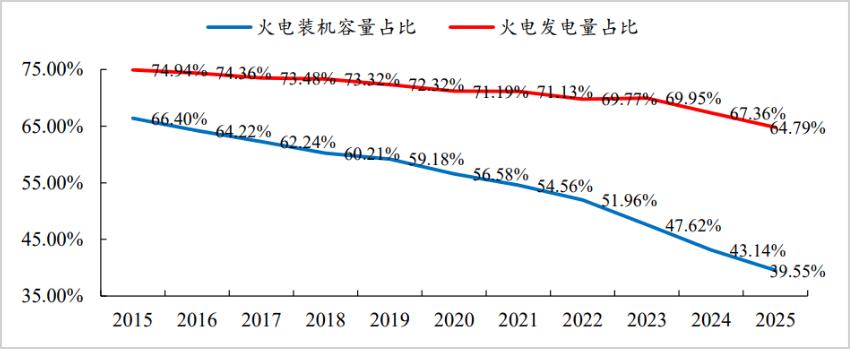
▲ Source: Kaiyuan Securities
Judging from the data trend, the market share of thermal power is being eroded at an accelerated pace by new energy. However, the profits of thermal power enterprises have shown a completely opposite curve.
In 2025, Huaneng Power International's net profit attributable to shareholders reached 14.41 billion yuan, a year-on-year increase of over 40%, hitting the highest profit record since its listing. Datang Power Generation recorded a net profit of 7.386 billion yuan, and Guodian Power 7.161 billion yuan, all hitting new highs collectively.
While the installed capacity share is shrinking, profits are soaring. This deviation points to the same answer: the profit model of thermal power has been completely transformed.
In the past, the profit model of thermal power enterprises was very simple: power generation volume multiplied by the electricity price spread. The more electricity they generated, the higher the revenue, and the profit usually rose accordingly. However, after the large-scale grid connection of new energy, this logic has been broken.
Because the marginal cost of photovoltaic and wind power is close to zero, and they have relative priority for consumption in the power market, the annual power generation hours of thermal power have been continuously compressed. If thermal power enterprises still rely on the original "generating more electricity" to make profits, they will inevitably fall into cut-throat competition with sharp price cuts, and the road ahead will only get narrower and narrower.
The turning point came with the implementation of the capacity electricity price mechanism.
In 2023, the National Development and Reform Commission and the National Energy Administration made a clear policy that the new rule would be implemented from 2024: the fixed cost of coal-fired units is calculated at 330 yuan per kilowatt per year. From 2024 to 2025, most provinces recover 30% of the cost to get 100 yuan, and seven provinces with rapid transformation recover 50% to get 165 yuan.
Since 2026, most provinces will recover at least 50% to get 165 yuan, regions such as Yunnan and Sichuan can recover 70% to get 231 yuan, and a few individual provinces will further raise the ratio.
This means that even if the thermal power units generate less electricity, as long as they remain in an available state and respond to peak dispatching at any time, they can obtain a certain fixed income, and the recovery ratio will increase year by year. According to the calculation of Soochow Securities, the average capacity electricity price income of coal-fired power in 2026 will rise from about 0.027 yuan per kWh to about 0.040 yuan per kWh.
Therefore, the business model of thermal power enterprises has been transformed into a three-layer structure.
The energy volume price, namely the traditional power generation income, fluctuates with supply and demand in medium and long-term contracts and spot markets. The capacity electricity price is priced by the government at a certain proportion of the verified fixed cost, providing a deterministic guaranteed return. The auxiliary service income refers to the market-oriented return obtained by thermal power in grid peak regulation and frequency regulation with its flexible regulation capability.
The significance of this transformation is no less than that of the supply-side reform for the coal industry in 2015. With institutional guarantee for the recovery of fixed costs of thermal power, the cyclical fluctuation of earnings is weakened, and the stability and predictability of cash flow are improved.
This is the fundamental reason for the underlying change of the valuation logic of the thermal power sector.
Misaligned Cyclicality
The fuel of thermal power is coal, and the coal price fluctuates drastically. This determines that the current performance of thermal power enterprises still has certain cyclicality, but the reaction of the capital market is often significantly misaligned with the current performance.
Looking back at the thermal power market represented by Huaneng Power International in the past six years, there are two clear anchors.
The first anchor is that the market has formed expectations for the electricity price of the next year since the second half of the previous year. If the market expects the electricity price of the next year to rise, the thermal power sector will most likely have a good performance. If the market expects the electricity price to fall, the market performance is usually not good. This is because the profit elasticity of thermal power depends to a certain extent on the spread between electricity price and coal price. When the expectation of electricity price goes up, the market will price for the profit improvement in advance.
The second anchor is the correction of the previous year's expectation by the coal price of the current year. For example, the sharp rise in coal price in 2022 corrected the expectation of electricity price rise formed in the second half of 2021, and the thermal power sector came under pressure accordingly.
The interweaving of these two anchors creates the misalignment between thermal power stock prices and fundamentals. What the market trades is never how much money it makes right now, but which direction the spread will go in the coming year.
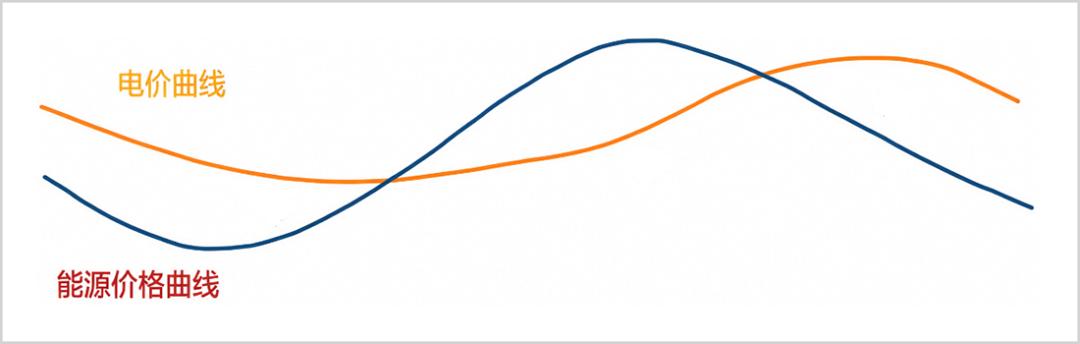
▲ Misalignment between electricity price and energy price, Source: Market Value Observation collation
2021 is the best sample to understand this misalignment. In that year, the main futures price of thermal coal skyrocketed from the lowest 588 yuan/ton to the high point of 1982 yuan/ton in October, with a cumulative increase of over 200%.
The sharp rise in coal price is a huge negative factor for the current performance of thermal power enterprises (which was confirmed afterwards, all thermal power groups recorded large losses), but the thermal power sector advanced triumphantly during this period. Among them, Huaneng Power International's maximum increase reached nearly 200% that year, and China Resources Power nearly 300%.
The logic of market game is very clear: when the coal price rises to this level, policies will inevitably be introduced for regulation, and the electricity price will inevitably be raised. In October 2021, the National Development and Reform Commission officially lifted the floating range of grid electricity price for coal-fired power generation, and expanded the upper and lower floating range of electricity price for market transactions to no more than 20% in principle.
The earnings expectation of thermal power enterprises reversed accordingly, and the market started far ahead of the performance.
Looking back at the present, the environment faced by the thermal power sector this year has certain similarities with that in 2021. Coal prices have rebounded significantly from the bottom, which has once again put pressure on the current cost of thermal power, and it is almost certain that the performance will be under pressure.
However, the core concern of the market is shifting to the long-term agreement electricity price negotiation at the end of the year. If the long-term agreement electricity price can be raised next year, and the coal price stabilizes or even falls under policy regulation, the profit spread space of thermal power will be significantly improved. But this ideal state is based on the background that coal prices are still at a high level this year.
Comparison of Five Leading Enterprises
There are not many players in the A-share thermal power track, and the market pattern is highly concentrated.
In terms of thermal power installed capacity, the five central SOEs of China Energy, Huaneng, Datang, Huadian and SPIC account for about 40% of the total national thermal power installed capacity. At the listed company level, Huaneng Power International accounts for 7.1% of the thermal power market share, Guodian Power 5.3%, Huadian Power International 5%, Datang Power Generation 3.8%, and China Resources Power 2.9%.
But market share is not the only measure of enterprise value, performance growth and profitability are more critical.
From 2020 to 2025, the cumulative revenue growth rate of China Resources Power and Guodian Power is about 46%, followed by Huadian Power International, Huaneng Power International and Datang Power Generation. In terms of the cumulative growth rate of net profit attributable to shareholders, Huaneng Power International, Guodian Power and Datang Power Generation rank the top three, with 215.7%, 172% and 143% respectively.
In 2025, China Resources Power's net profit margin reached 16.18%, leading significantly among the five leading enterprises. The figures of Huaneng Power International, Guodian Power and Datang Power Generation are all around 8%, while Huadian Power International ranks at the bottom with only 6.5%.
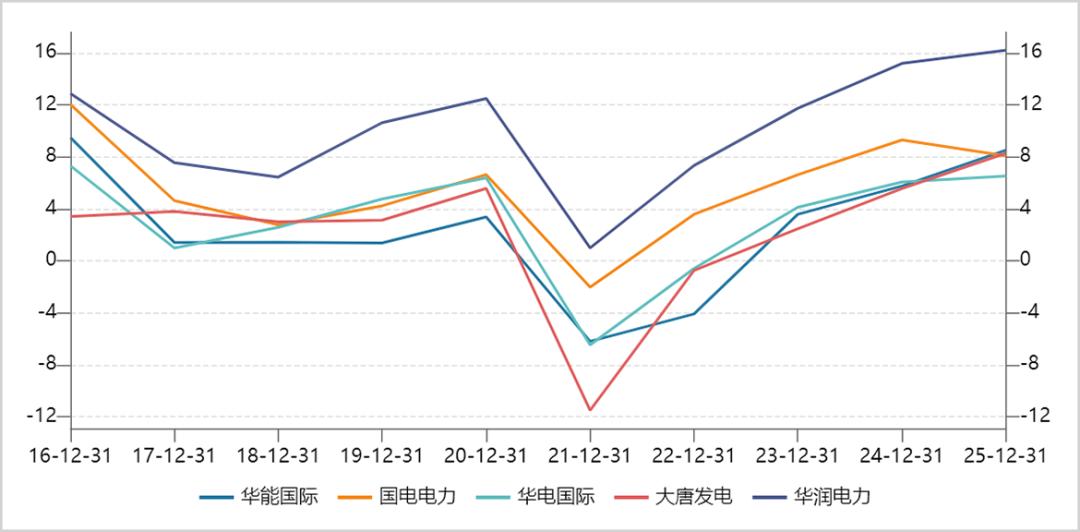
▲ Comparison of profitability of five thermal power enterprises, Source: Wind
The core reason for China Resources Power's outstanding profitability is that it is the leading power generation enterprise with the fastest energy transformation.
The company has the highest proportion of renewable energy installed capacity among the five leading enterprises, and the profitability of wind power and photovoltaic assets is generally stronger than that of traditional thermal power, which raises the overall profit level. In contrast, the revenue and installed capacity structure of Huaneng Power International, Guodian Power, Datang Power Generation and Huadian are still absolutely dominated by thermal power, and the progress and intensity of new energy transformation vary from each other.
From an overall perspective, among these five leading thermal power enterprises, Guodian Power has the best fundamental performance, and the capital market also gives it the highest valuation level. As of October 8, the dynamic P/E ratio of Guodian Power is 14.9 times, higher than the 9.6 to 11.9 times of Huaneng Power International, Huadian Power International and Datang Power Generation. While China Resources Power is listed on the Hong Kong Stock Exchange, its overall liquidity is weak, and the valuation discount is obvious, with only 7.7 times.
In terms of capital market performance, Guodian Power has risen by more than 250% cumulatively since the end of May 2020, ranking first, followed by China Resources Power with 230%, while Huaneng Power International and Huadian Power International have risen by nearly 100%, ranking at the bottom, which roughly reflects the advantages and disadvantages of fundamentals in the past few years.
In any case, thermal power has significantly outperformed leading new energy power enterprises in the past five years. The latter's main players include Three Gorges Energy, Longyuan Power, etc., and the market votes with their feet for two reasons.
First, in 2020 and 2021, due to the boom of the new energy track, the valuation level given by the market was much higher than that of thermal power, and the continuous decline in recent years is to pay back for the overvalued valuation in the past. Second, the performance has continued to show negative growth, which is behind the continuous decline of new energy electricity prices.
Looking ahead, the long-term value of the five leading thermal power enterprise assets lies in the profit stability brought by the capacity electricity price mechanism in the main thermal power business, and the valuation anchor is shifting from cyclical stocks to utility stocks. The transformation to expand new energy power business provides more possibilities for performance growth.
However, the current capital market has not fully priced this change. A notable data is that in the second quarter of 2026, the proportion of public funds' heavy positions in the power sector was only 0.18%, down by one third from the first quarter, hitting a new low.
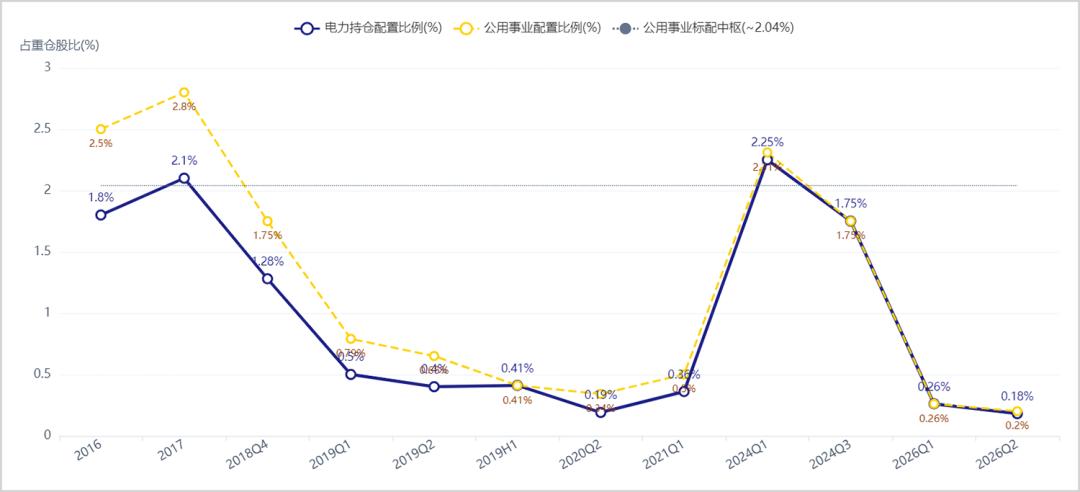
▲ Change of position allocation ratio, Source: Morrowind1223
The standard allocation ratio of the power industry in A-shares is about 2%, and the current over-allocation ratio is as low as -1.84%. Looking back at history, the position holding rhythm of the power sector is highly correlated with the overall A-share market cycle. At the market top in the first quarter of 2021, the power allocation ratio was 0.36%. By the market bottom area in the third quarter of 2024, the power position holding rose to 1.75% instead.
When the overall market goes down, funds are concentrated in defensive sectors such as power, and when the overall market goes up, the power sector is continuously under-allocated. In the second quarter of 2026, when the technology sector strongly attracted funds, the power position was further compressed to a low of 0.18%.
While the power sector was under-allocated in the second quarter of 2026, there were also divergences in its sub-sectors. Hydropower assets represented by China Yangtze Power were contrarianly increased positions, while the positions of thermal power, nuclear power and new energy power continued to decline.
On the whole, there is a certain probability that the performance of thermal power enterprises will reverse and rise next year, and in the medium and long term, the capacity electricity price mechanism has reshaped the profit model of thermal power, but the institutional position holding is at a historical freezing point, and the expectation difference may be hidden in these deviations.
This article is from WeChat official account "Market Value Observation", author: Li Xiaofeidao, authorized by 36Kr to release.