Japan's automotive software lags behind overseas counterparts by 5 years
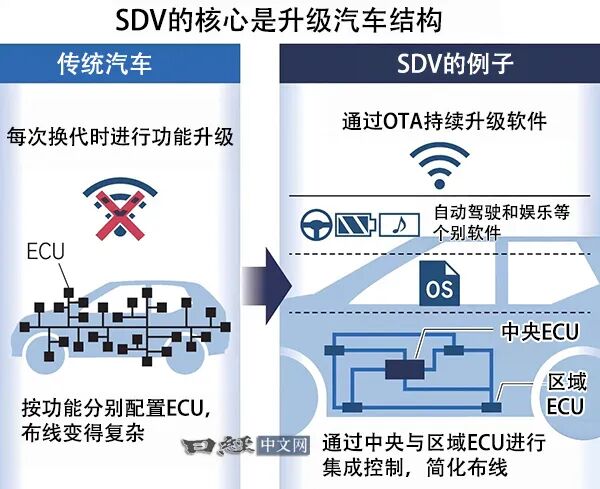
Software-defined Vehicle (SDV) refers to vehicles whose functions can be continuously improved via software even after being sold. According to the "SDV Maturity" data from a US research firm, Volvo, Tesla, and NIO from Shanghai, China have obtained the highest "Level 5" rating. Toyota, Honda, and Nissan only rank at "Level 1"...
"The speed of China is beyond expectation. However, we ourselves also have the potential to catch up," a technician who once participated in the cooperation negotiations between Honda and Nissan said excitedly.
The two companies announced on August 31 that they will jointly develop the operating system (OS) that serves as the foundation of Software-defined Vehicle (SDV), as well as the electronic control unit (ECU) for core computers and other related components.
SDV refers to vehicles that can continuously improve their functions via software even after sale, just like smartphones. The pure electric vehicle (EV) "Model 3" launched by US-based Tesla in 2017 set the precedent for this trend.
Tesla has turned software products such as the driving assistance function subscription service (monthly billing) into an important source of revenue, which is transforming the business model of the automotive industry.
China's BYD launched the light EV "Racco" in Japan in July, a model that can continuously acquire the latest functions after vehicle purchase through wireless communication.
To compete with overseas enterprises, Honda and Nissan announced in March 2024 that they would explore cooperation. The two sides once advanced to negotiations on business integration, but finally failed to reach an agreement. It took two and a half years for the two to reach a cooperation agreement in the SDV field. During this period, not only emerging automakers, but also traditional European automakers have begun to deliver positive results.
"Even if you try to accurately tell 100 'boxes' what to do, it will probably be difficult to get effective results," Håkan Samuelsson, CEO of Swedish Volvo Cars, said in an interview in April. The "boxes" refer to ECUs.
Traditional vehicles are equipped with about 100 ECUs scattered according to different functions. To upgrade the software, the vehicles need to be transported to factories and other locations, which is time-consuming and laborious. Volvo has innovated the vehicle architecture to let the core high-performance ECU control the entire vehicle, making software updates easier.
Technologies of this kind have been adopted by models including the large pure electric SUV "EX90" that Volvo will launch in Japan in the summer of 2026. After its launch, the vehicle functions will be continuously improved through over-the-air (OTA) wireless software updates. In September, a software update was released for the small pure electric SUV "EX30", which enables the vehicle to use its on-board battery as a power source for external devices when parked.
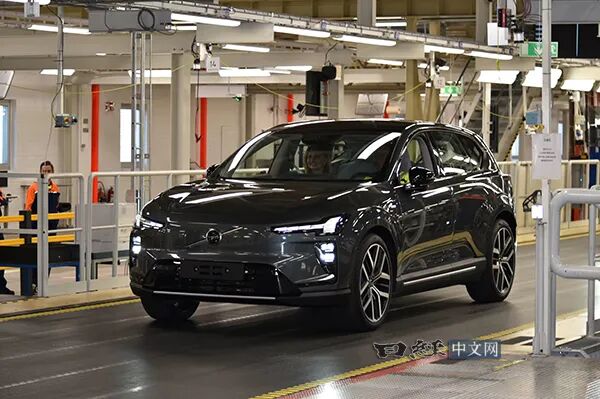
Volvo "EX60" (Gothenburg, Sweden, April)
Volvo's latest pure electric mid-size SUV "EX60", whose delivery started in Europe in July, has been receiving a steady stream of orders. Thanks to the high efficiency in development and structure, its maximum cruising range reaches 810 km, ranking first among models of the same class, while its price is kept at the same level as the plug-in hybrid (PHV) "XC60" of the same class.
The first SDV model of German BMW, the new "iX3", has performed strongly after its launch. The iX3 opened for pre-orders in Europe in September 2025, and the number of orders has reached nearly 100,000 as of July 2026. The vehicle is controlled by four high-performance ECUs called "super brains", which reduces the length of wiring harnesses for transmitting electrical signals by 600 meters and cuts the weight of wiring by 30%.
The path to where they are now has not been smooth sailing for Volvo and BMW.
Samuelsson, CEO of Volvo, recalled that "this was a step full of growing pains". Due to software failures, the delivery of EX90 was delayed, and it took 2 years from release to market launch. BMW has invested more than 10 billion euros in shifting to the new EV series "Neue Klasse".
The reason why the two companies did not stop moving forward is that SDV is gradually becoming a necessary condition in EV sales competition. Tsuguo Nobe, a visiting professor at Nagoya University in Japan, said, "In addition to the simpler structure and lower manufacturing cost, SDV can also improve the cruising range and charging time through continuous upgrades of functions such as battery management."
According to the "SDV Maturity" data released by US market research firm Mobility Global (as of August 2026), Volvo, Tesla, and NIO from Shanghai, China are tied for the highest "Level 5" rating. BMW and China's Xpeng Inc. etc. are rated at "Level 4".
On the other hand, among Japanese enterprises, in addition to Honda and Nissan, Toyota, which has its independent software platform "Arene", only stays at "Level 1".
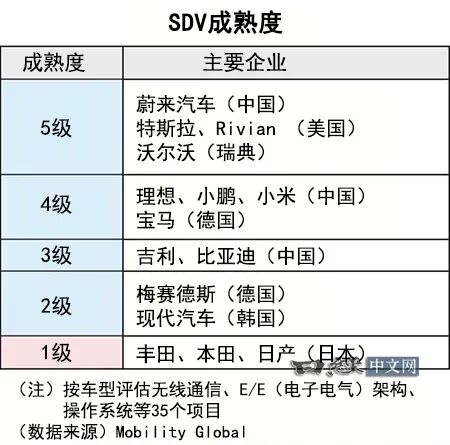
Apurva Thakre, an analyst at Mobility Global, pointed out that "the background is the large scale of internal combustion engine vehicles (ICE) and hybrid vehicles (HV) (of Japanese automakers)".
EVs have fewer parts than gasoline vehicles and are driven by electric motors, making them easier to control via electricity. Emerging automakers that have been built with EVs as the premise from the very beginning, and European automakers that are eager to transform to EVs, are more likely to carry out comprehensive innovation on the design of ECUs, sensors and wiring harnesses, which is called the "E/E (Electrical/Electronic) architecture".
Emerging automakers adopt a vertical integration approach to develop ECUs and complete vehicles, while the Japanese automotive industry has long formed a model of purchasing components from a large number of suppliers. As a result, it is difficult for Japanese automakers to completely transform their vehicles in one step.
Taku Takizawa from Boston Consulting Group said, "Compared with Tesla and BYD, Japanese automakers are 5 to 10 years behind."
For Honda and Nissan, this cooperation is the first step for a comeback. The two sides will share technologies and experience, and split the investment costs. They strive to equip their respective launched models with generalized components and software after 2029.
Japanese automakers may face a period of journey accompanied by growing pains in the future, just like what large traditional automakers such as Volvo have experienced before. Not only the new vehicle development process will be forced to change, but also the relationship with component suppliers will face adjustments. Whether Japanese automakers can withstand the growing pains brought by transformation and catch up with overseas automakers will put their flexibility to the test.
This article is from the WeChat Official Account "Nikkei Chinese Net" (ID: rijingzhongwenwang), written by Kakeru Kono, Moe Matsumoto, Takako Fujii, authorized for release by 36Kr.