Time is running out for the "coal king".
During the National Day holiday, temperatures plummeted in many regions of northern China. As the peak winter energy consumption period is approaching, top provincial Party and government officials in Shanxi have made intensive arrangements to ensure stable coal production and supply.
On September 28, the Secretary of the Shanxi Provincial Party Committee went to Jinzhong to investigate coal mine work safety, requiring "to promote resumption of work and production, as well as stable production and supply in an orderly manner on the premise of ensuring safety".
Two days earlier (September 26), the Governor of Shanxi Province chaired a provincial work promotion meeting on safe, stable coal production and supply, which also emphasized strictly abiding by the safety bottom line, fully promoting resumption of work and production, stable production and supply, and "accelerating the reversal of the output decline trend".
For Shanxi, the pressure is not only to solve the immediate "coal supply emergency".
Entering the 15th Five-Year Plan period, China's coal consumption will usher in a critical period of peaking, with multiple challenges such as regional coordination and the transformation of coal and power roles coming one after another. There is not much time left for Shanxi to coordinate the three goals of supply security, safety and transformation.
01
Status
Behind this round of intensive deployment in Shanxi is the market trend of coal prices rising against the trend in the off-season.
Since September, the domestic spot price of thermal coal has remained at a high level, and the price of 5500 kcal thermal coal in Qinhuangdao is approaching the 1000-yuan mark. Supply contraction is the most direct cause. The core of the contraction is exactly Shanxi, known as the "top coal province" —
After the gas explosion accident at the Liushenyu Coal Mine of Shanxi Tongzhou Group on May 22 this year, a large number of coal mines across Shanxi were suspended for rectification.
Data from the National Bureau of Statistics shows that from June to August this year, the raw coal output of industrial enterprises above designated size nationwide reached 1.08 billion tons, a decrease of 96 million tons compared with the same period last year. During the same period, Shanxi's output decreased by more than 30% in June, July and August respectively, with a cumulative reduction of more than 100 million tons, which directly affected the national coal supply.
Not long ago, three departments including the National Development and Reform Commission jointly issued a notice, requiring all coal-producing provinces and coal enterprises to fully ensure supply on the premise of ensuring safety, actively and steadily promote the resumption of production and full operation of coal mines, and promote the steady recovery of coal output.
As a major coal province, Shanxi has long shouldered the mission of "energy supply".
The cumulative coal output is about 6.5 billion tons, accounting for nearly 30% of the national output, delivering affordable power coal to 24 provinces across the country; the cumulative net output of electricity exceeds 740 billion kWh, ranking firmly among the top in the country... During the 14th Five-Year Plan period, Shanxi still fulfilled its promise of "not letting the country worry about coal".
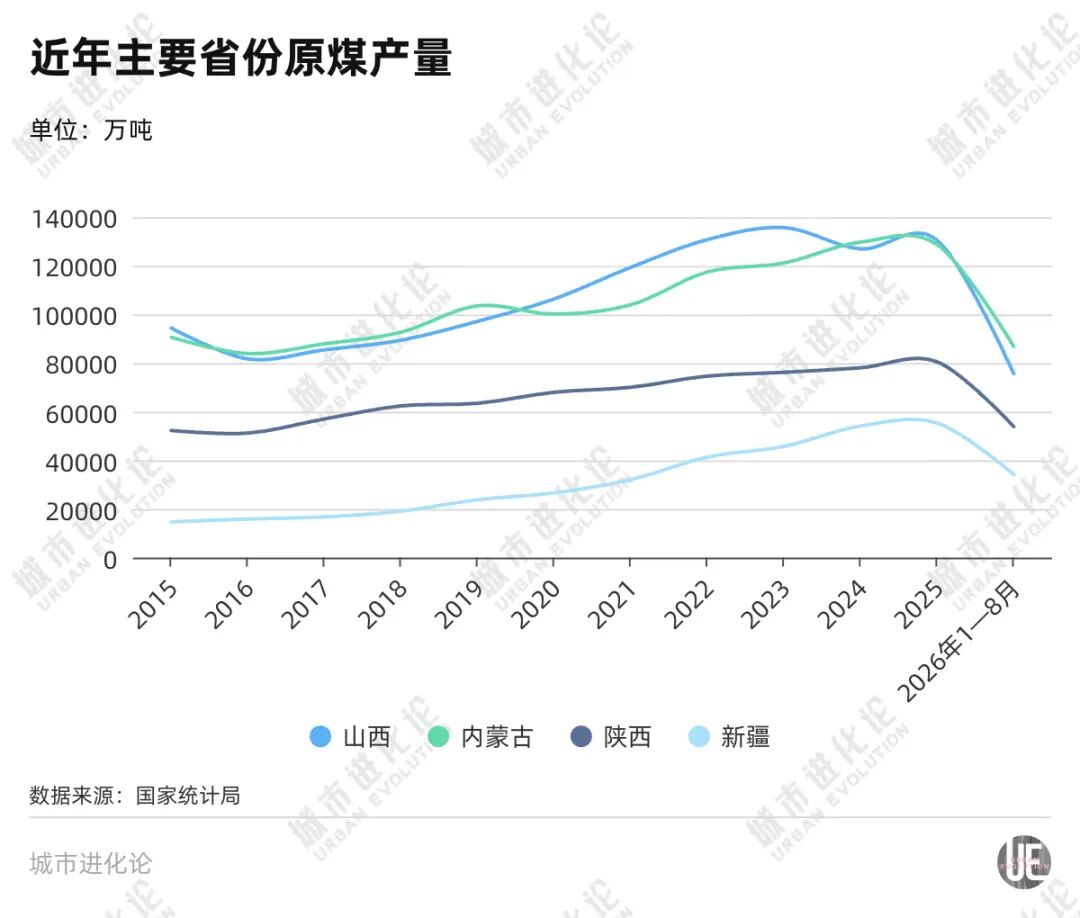
However, with the continuous changes of the national energy structure in recent years, Shanxi's advantageous position as a "major energy province" is loosening. A typical example is the alternation of Shanxi and Inner Mongolia as the "largest coal-producing province":
In 2024, Shanxi took the rectification of "three excesses" of coal mines and hidden working faces as the starting point, lowering the annual output target from 1.378 billion tons of the previous year to about 1.3 billion tons. In that year, the raw coal output of enterprises above designated size in the province was 1.269 billion tons, a year-on-year decrease of 6.9%, and the position of "top coal province" was also replaced by Inner Mongolia.
By 2025, Shanxi's coal production achieved restorative growth, with an output of about 1.305 billion tons, while Inner Mongolia's output dropped slightly to 1.286 billion tons, making Shanxi return to the title of "province with the largest coal output". As of August this year, Inner Mongolia has once again surpassed Shanxi.
More importantly, China's energy structure is undergoing significant changes.
In the past five years, the proportion of coal consumption in China's total energy consumption has dropped from 56.7% in 2020 to 51.4% in 2025, a decrease of 5.3 percentage points. During the 15th Five-Year Plan period, China's coal consumption will reach its peak, and the positioning of coal power will also shift from the traditional main power source to a basic guarantee and system regulating power source.
The outline of the 15th Five-Year Plan clearly proposes to fully implement the dual control of carbon emissions and promote the peaking of coal consumption; in the first half of this year, the General Office of the Communist Party of China Central Committee and the General Office of the State Council issued the *Comprehensive Evaluation and Assessment Measures for Carbon Peaking and Carbon Neutrality*, which takes the total consumption of coal and petroleum as the main control indicators and incorporates them into the "5+9" evaluation and assessment indicator system.
For Shanxi, this is no different from a clear signal to accelerate transformation.
02
Balance
Nevertheless, in the view of Chen Yao, Vice President and Secretary-General of the Chinese Regional Economic Association, "Although China's coal consumption has entered the peaking plateau period, the status of coal as the 'ballast stone' for energy security will not change in the short term." In other words, Shanxi still needs to a large extent to assume the role of "providing the last resort guarantee" for the whole country.
Moreover, Shanxi's economic development has long been deeply bound to the coal industry, and there are structural resistances to low-carbon transformation.
As an important national energy base, coal and its related industries are the foundation of Shanxi's economy — at its peak, the coal industry once contributed more than 30% of the province's GDP.
With "coal" as the core, Shanxi has built a complete industrial chain from mining, washing and processing, transformation to outward transportation and consumption, and the industrial tentacles have also extended from secondary industries such as mining, coking and electric power to service industries such as logistics, trade and finance.
This "dominated by coal" structure also makes Shanxi's economic growth highly correlated with the industry cycle, showing obvious fluctuation characteristics.
Image source: 699pic_378296717
Since 2000, Shanxi has achieved rapid growth relying on the "golden decade of coal". In 2021, due to the recovery of the coal market, Shanxi's GDP growth rate also reached 9.3%, ranking third in the country.
However, after that, the coal market went down again, and Shanxi's economic growth rate fell back, ranking last among all provinces in China in 2024. By 2025, Shanxi's coal output returned to the first place in the country, but its economic growth rate still ranked last among all provinces.
This high degree of dependence is more prominent in Shanxi's fiscal and employment levels.
The China Tax Yearbook and Shanxi Statistical Yearbook show that from 2019 to 2023, the contribution rate of the coal industry to Shanxi's tax revenue rose from 38% to 60%, and the proportion of coal-related employees in the employment of industrial enterprises above designated size rose from 44% to 46%. A research report from Shanxi Kecheng Energy and Environment Innovation Institute shows that in Shanxi, every coal mining job can drive 3.62 jobs in other industries.
In Chen Yao's view, coal supports the bottom line of Shanxi's finance, employment and growth, but it also makes Shanxi's economy repeatedly pulled by the industry cycle, and creates a crowding-out effect on other industries. As long as this structural dependence is not substantially replaced, Shanxi's economy will still be in the cycle of "coal dominating the rise and fall".
In the long run, reducing the "coal content" of the economy is a necessary task for Shanxi, but in the short term, it must not "remove coal in a cliff-like manner", and must adhere to the principle of "establishing first and then breaking".
Chen Yao suggested that at the present stage, Shanxi can take the coal industry as a stable source of cash flow to support the cultivation of emerging industries, gradually adjust the economic structure, and find the optimal balance among supply security, transformation and growth.
03
Transformation
"Stability" is also the core logic for Shanxi to promote the leap from a major coal province to a strong energy province.
In accordance with relevant plans, during the 15th Five-Year Plan period, on the basis of maintaining a production capacity of 1.3 billion tons per year and a stable output of 1.25 billion tons per year, Shanxi will on the one hand promote the intellectualization of coal mines from "existence" to "excellence", accelerate the deep integration of digital technology with the whole chain of coal exploration, mining and processing; on the other hand, tackle key core technologies such as high-end coal-based chemicals and high-end carbon materials, so as to transform coal from primary fuel to high-value products.
Image source: 699pic_374831190
Echoing the "seeking progress while maintaining stability" of the coal industry is the integrated development of "energy +".
At the provincial level, Shanxi will rely on resource-rich areas to build an integrated comprehensive energy base of "wind, solar, thermal and energy storage", and finally promote the "role change" of coal power — from the main power source that runs 24 hours a day in the past, to a supporting and regulating power source that can be fully available during peak electricity consumption and adjustable during low valleys.
As of July this year, the installed capacity of wind and solar new energy in Shanxi has reached 80.94 million kW, 2.47 times that of 2020. The installed proportion of new energy and clean energy has exceeded half, and more than 1 out of every 3 kWh of electricity used is clean electricity.
Shanxi also proposes to transform energy from "selling products" to "selling services", that is, no longer satisfied with being the country's "coal warehouse" and "power plant", but to become a provider of integrated energy system solutions.
Looking across the country, major energy provinces such as Inner Mongolia and Shaanxi are also actively promoting energy transformation, with relatively distinct paths:
Based on its rich wind and solar resources, Inner Mongolia focuses on "expanding volume, improving quality and reliable replacement" of new energy, with annual power generation reaching 910 billion kWh, of which new energy power generation exceeds 3000 billion kWh, accounting for 33%;
Shaanxi gives full play to its innovation endowment to promote energy renewal. During the 15th Five-Year Plan period, it will expand and upgrade the "Yu-E-Ning modern coal chemical industry cluster" to add more than 8 million tons of new coal-based chemical product production capacity.
In this regard, Chen Yao believes that Shanxi should highlight its own differentiated advantages and find the right focus.
For example, in the field of coal-based new materials, Chen Yao pointed out that Shanxi still needs to accelerate the extension, supplementation and strengthening of the coal chemical industry chain, make up for the shortcomings of innovation and high-end fields, rely on scientific research institutes such as Huairou Laboratory Shanxi Research Institute, and focus on breaking through the most high-value coal-based new materials. This is the core direction to promote the upgrading of coal from "fuel" to "material".
Another focus is the coordination of computing and electricity. During the 15th Five-Year Plan period, Shanxi plans to add 100 million kW of renewable energy installed capacity, so that the newly increased electricity consumption can be met by new energy power.
However, after the green power is generated, it must find a stable, nearby and high-value consumption outlet. "Green power should not only be generated, but also be fully utilized." Chen Yao suggested that Shanxi should give full play to its geographical advantage of being close to the Beijing-Tianjin-Hebei computing power application scenarios, take the computing power industry as the top priority, and use the advantages of coal bases to develop the coordination of computing and electricity.
This article is from the WeChat official account "Urban Evolution Theory", written by Liu Xuqiang, and published by 36Kr with authorization.