20 Biotech Companies Founded by Nobel Laureates: Some Generate Tens of Billions in Annual Revenue, Others Perish in the Valley of Death
On October 7, the 2026 Nobel Prize in Chemistry was announced. Henri B. Kagan and Kenso Soai were awarded the prize for their discovery of nonlinear effects and autocatalysis in asymmetric organic synthesis.
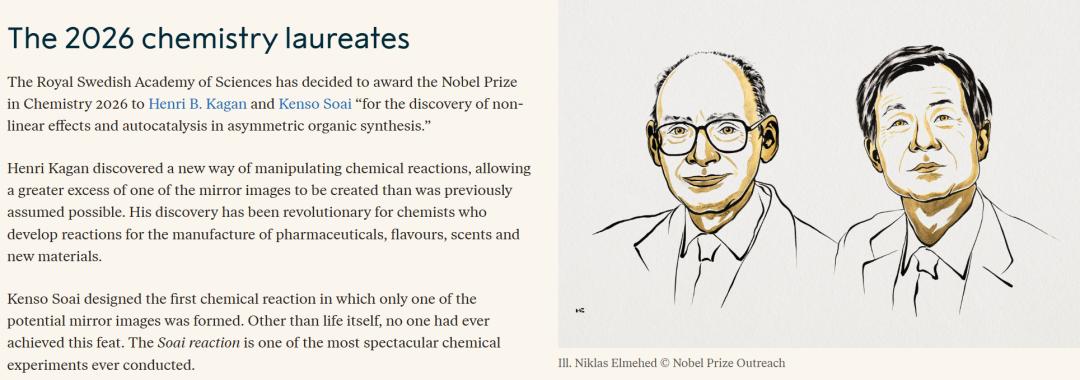
Their combined research answered a question that has perplexed the chemistry community for more than a century: Why do chemical reactions prefer one type of mirror-image molecule?
Among them, Kagan discovered a new method to regulate the enantioselectivity of reactions, which can significantly increase the proportion of one specific mirror-image molecule, that is, achieve a higher enantiomeric excess.
This breakthrough has profoundly influenced asymmetric synthesis and promoted the research and development of drugs and new materials.
Two days earlier, another Nobel Prize turned the spotlight to another form of "precise control" in biological systems: using light to control neurons.
On October 5, the 2026 Nobel Prize in Physiology or Medicine was announced first. Karl Deisseroth, Peter Hegemann and Georg Nagel jointly won the award for their "discoveries of light-gated ion channels and optogenetics".
Over the past 20 years, optogenetics has almost redefined the way neuroscience studies brain circuits: researchers can use light to turn specific neurons on or off at the millisecond scale, observing how a certain type of cell or a certain neural circuit affects memory, emotion and behavior.

From left to right: Karl Deisseroth, Peter Hegemann, Georg Nagel
But today, the impact of optogenetics has long gone far beyond laboratories and academic papers. The scientific insights formed around neural circuits are being further translated into drug targets, technology platforms, and even numerous Biotech companies.
Karl Deisseroth, the 2026 Nobel Prize in Physiology or Medicine laureate, is a direct participant in this industrialization chain. He is not only an important founder of optogenetics, but also a co-founder of a Nasdaq-listed Biotech company.
On October 6, MapLight Therapeutics issued a special announcement to congratulate Deisseroth on winning the award. Founded in 2018, the company is using optogenetics and neural circuit research to identify cell types and molecular targets related to psychiatric disease symptoms, and then translate these findings into traditional oral small-molecule drugs.
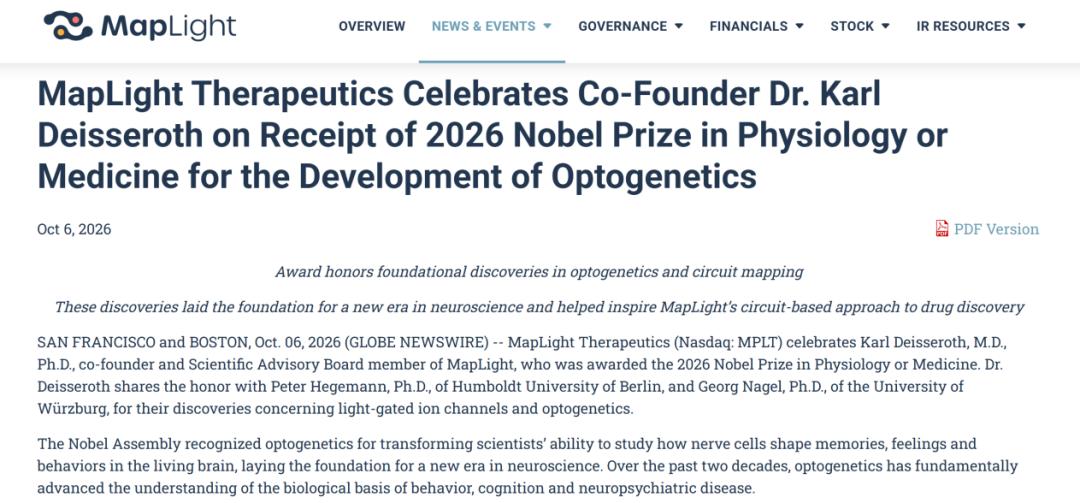
Image source: MapLight Therapeutics official website
According to the official introduction, its schizophrenia project ML-007C-MA has just reached the primary endpoint in the Phase II ZEPHYR study, and the company plans to advance to Phase III; as of the end of June 2026, MapLight has US$351.3 million in cash, cash equivalents and investments, and announced in August that it completed a private placement financing of approximately US$150 million.
After the 2026 Nobel Prize in Physiology or Medicine and Chemistry were announced one after another, MapLight just provides a realistic window to observe the "distance between Nobel Prize achievements and Biotech industrialization".
How long does it take for a basic scientific discovery to go through papers, technology platforms, startups, clinical trials, IPO, mergers and acquisitions, and product sales?
More importantly, with the endorsement of Nobel Prize scientists, is it really easier to build a successful Biotech company?
In response to this, Medical Insight has sorted out 20 life science companies where Nobel laureates clearly serve as founders, co-founders or chief scientists, covering fields including optogenetics, Treg, mRNA, CRISPR, glycobiology, tumor immunology, bicyclic peptides, super-resolution imaging, GPCR and RNAi.
The sorting results are quite unexpected — the 20 companies have completely different fates today.
Some have quarterly sales reaching the billion-dollar level; some have just completed IPO and are sought after by capital; some have been acquired by large pharmaceutical companies for US$2.1 billion; some are only one step away from the approval of their first product.
There are also companies that, many years after the Nobel Prize achievement was written into textbooks, still have not crossed the "Valley of Death" for Biotech.
01
Divergence:
The same laurel, 20 different fates
First of all, let's look at several recent winners who stood on the Nobel Prize podium.
The companies they founded before and after winning the award have directly brought their research results into clinical practice, the capital market and merger and acquisition negotiation tables.
Taking 2026 Nobel Prize winner Deisseroth as an example, MapLight is not his only entrepreneurial venture.
He is also a scientific co-founder of spatial omics company Stellaromics. The company's official website shows that Deisseroth and Xiao Wang serve as Scientific Co-founders together.
The scientific foundation of Stellaromics includes technologies such as spatial transcriptomics and STARmap, with the goal of achieving in situ high-throughput analysis of a large number of cells and RNA molecules in tissues.
MapLight turns neural circuit knowledge into drugs, and Stellaromics turns laboratory technology into a scientific research platform — the same scientist corresponds to two completely different commercialization routes.
MapLight has entered the capital market one step earlier. In October 2025, the company completed its IPO by issuing approximately 16.96 million shares at US$17 per share, raising approximately US$261.6 million in net proceeds, and completed a private placement financing of approximately US$7.5 million in the same period.
In 2026, the company further concentrated resources on ML-007C-MA. After the Phase II schizophrenia study reached the primary endpoint, it is advancing towards the pivotal Phase III study.
The 2025 Nobel Prize also quickly translated into commercial results.
The 2025 Nobel Prize in Physiology or Medicine was awarded to Mary Brunkow, Fred Ramsdell and Shimon Sakaguchi in recognition of their discoveries in peripheral immune tolerance.
The Nobel Committee specifically pointed out that the three's research established our understanding of how regulatory T cells (Treg) control autoimmune responses. Two of the winners have turned Treg research into commercial companies.
For example, Fred Ramsdell is one of the four founders of Sonoma Biotherapeutics.
Founded in 2019, the company's core goal is to use engineered Treg to treat autoimmune and inflammatory diseases, and it is now a clinical-stage Biotech firm.
Its core product SBT-77-7101 is an autologous CAR-Treg therapy, which is currently in Phase I studies for refractory rheumatoid arthritis and hidradenitis suppurativa respectively; in July, Sonoma also cooperated with Cellares to introduce the product into the automated Cell Shuttle manufacturing platform to prepare for subsequent scaled-up production.
Understanding how Treg maintains immune tolerance, and then engineering it to restore the balance of the immune system — this is probably the most "orthodox" commercial extension path for Nobel Prize achievements.
Another 2025 Nobel Prize winner Shimon Sakaguchi is the scientific founder of RegCell.
In September 2026, RegCell announced the completion of US$44 million in Series A financing, and received approximately US$22 million in non-dilutive grants from Japan's AMED, bringing the total new funds to US$66 million.
The company stated that the funds will be used to advance the epigenetic reprogramming platform built on the basis of Sakaguchi's Treg research into clinical practice, including supporting IND applications and advancing the second autoimmune indication to the Phase II proof-of-concept stage.
When they won the award in 2025, Treg was still a scientific achievement on the award podium; within one year, clinical projects, manufacturing systems and new rounds of venture capital have emerged around it.
If we look for the most typical case of "Nobel Prize scientist entrepreneurial exit" in recent years, Drew Weissman is impossible to ignore.
In 2023, he and Katalin Karikó jointly won the award for discoveries related to nucleobase modification. These studies solved key problems such as the tendency of mRNA to cause inflammation and insufficient protein expression after entering the human body, laying the foundation for the subsequent COVID-19 mRNA vaccines.
Beyond vaccines, the two companies founded by Weissman focus on next-generation RNA therapeutics, and were acquired by two large pharmaceutical companies respectively within one year.
The core idea of Capstan Therapeutics is to use targeted lipid nanoparticles to deliver CAR-encoding mRNA directly to T cells in the patient's body, "manufacturing" CAR-T on-site in the human body, bypassing the complex processes of traditional CAR-T including blood collection, in vitro engineering, expansion, and reinfusion.
In June 2025, AbbVie announced the acquisition of Capstan for up to US$2.1 billion in cash, and the transaction was completed in August; at the time of acquisition, the core product CPTX2309 had entered Phase I study for B cell-mediated autoimmune diseases.
Orbital Therapeutics' technology platform covers linear RNA, circular RNA, LNP delivery and in vivo immune cell reprogramming at the same time.
In October 2025, Bristol Myers Squibb announced the acquisition of Orbital for US$1.5 billion in cash, obtaining its next-generation RNA platform and core in vivo CAR-T candidate OTX-201.
The Nobel Prize focuses on "whether mRNA is a sufficiently important medical technology", while large pharmaceutical companies use billion-dollar funds to pay for the industrial application of next-generation mRNA.
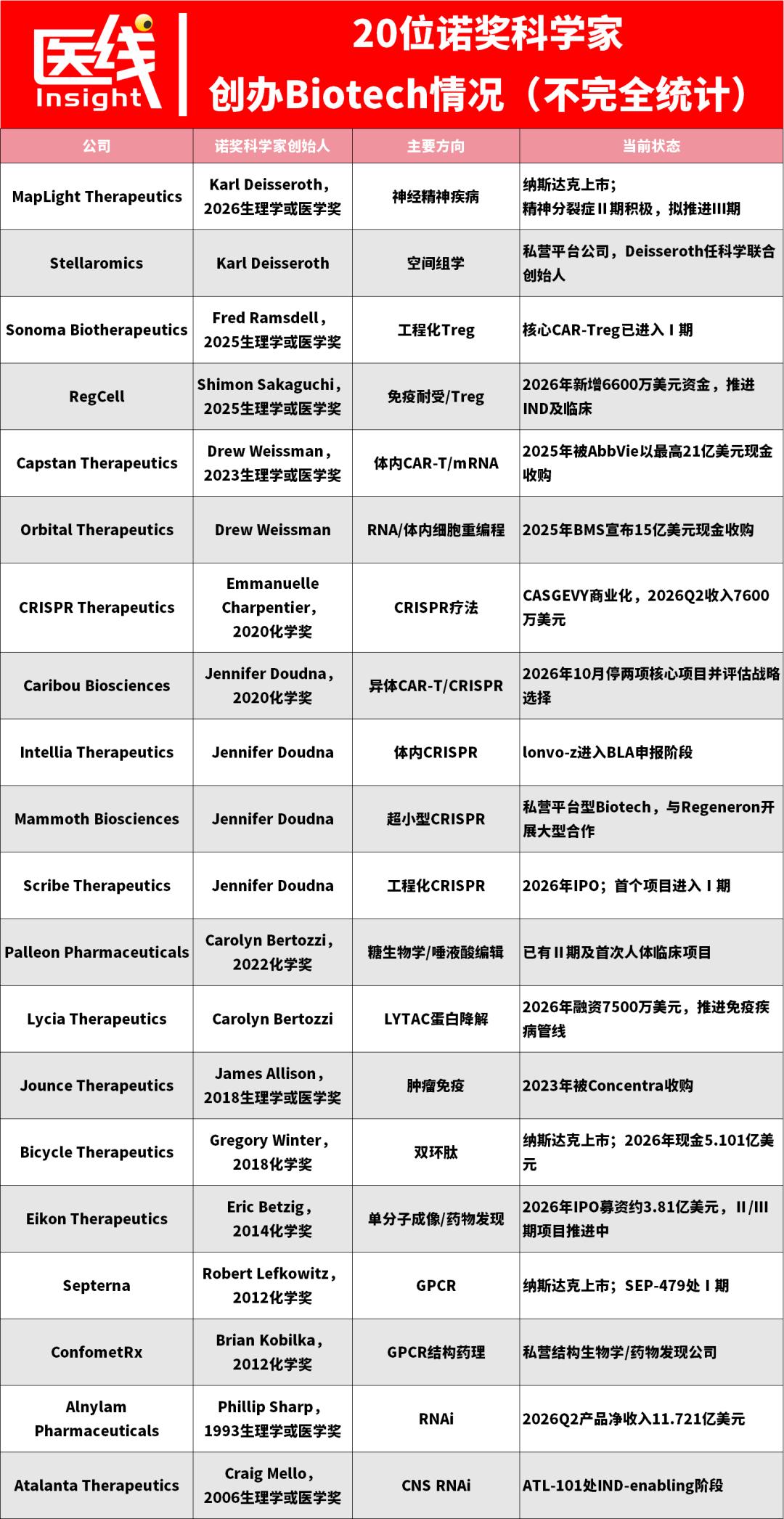
When the 20 companies are placed on the same timeline, their outcomes have diverged into five categories.
The first category has grown into platform-type Biopharma with real commercial products, with Alnylam as the most typical representative, and CRISPR Therapeutics is moving in this direction.
The second category was acquired by Big Pharma in advance, represented by Capstan and Orbital.
The third category continues to invest in clinical development after entering the public market, including MapLight, Intellia, Scribe, Eikon, Septerna and Bicycle.
The fourth category are platform companies still supported by venture capital, with Stellaromics, Sonoma, RegCell, Mammoth, Palleon, Lycia, ConfometRx and Atalanta at different development stages.
The fifth category has undergone strategic contraction, sale or exit: Jounce has been acquired, and Caribou is seeking a strategic way out.
How did these outcomes come about?
Let's first look at the companies that are at the forefront.
02
Path:
Science turns into drugs, each takes its own path
The farthest samples are enough to outline several ways of scientific industrialization.
Some have completed the entire industrial chain, some have turned Nobel Prize science into product revenue, and some have turned knowledge systems into sources that continuously generate new platforms.
If there is a complete path from basic discovery to commercial product for scientific industrialization, Alnylam has almost gone through this entire industrial chain from beginning to end.
If you want to find the company closest to the "completed state of Nobel Prize scientific industrialization" among the 20 companies, the answer is most likely Alnylam.
Founded in 2002, the company's founders include Phillip Sharp, the 1993 Nobel Prize in Physiology or Medicine laureate, as well as David Bartel, Thomas Tuschl, Paul Schimmel and Phillip Zamore.
Here we need to clarify a fact that is easily confused — Sharp won the prize for the discovery of split genes and RNA splicing, while RNA interference itself was discovered by Andrew Fire and Craig Mello, who won the Nobel Prize in Physiology or Medicine in 2006; it was Sharp who actually promoted the industrialization of RNAi as an entrepreneur.
Alnylam was founded in 2002, and its first RNAi drug was not approved until 2018, a full 16 years apart.
When the company reviewed this period of history, it mentioned that delivery was one of the most difficult problems, and the industry even lost confidence in RNAi around 2010.
Now it has entered a new stage. In the second quarter of 2026, Alnylam's global net product revenue reached US$1.1721 billion, a year-on-year increase of 74%; among which revenue from TTR products was about US$1.030 billion, a year-on-year increase of 89%.
A controversial new mechanism went through Nasdaq listing, approval of the first drug, and eventually grew into a company with quarterly revenue exceeding US$1.1 billion — this is the longest and most complete chain of basic scientific industrialization.
Different from Alnylam which completed the entire industrial chain with one company, CRISPR shows another diffusion path: a Nobel Prize-level science has spawned at least 5 important Biotech companies.
Among all Nobel Prize entrepreneurial stories, CRISPR has the largest commercial ecosystem.
In 2020, Emmanuelle Charpentier and Jennifer Doudna won the Nobel Prize in Chemistry for "developing a method for genome editing". The Nobel Committee called CRISPR/Cas9 a "gene scissors", which allows researchers to modify DNA with unprecedented efficiency and precision.
Only the companies that Doudna is clearly involved in founding include Caribou Biosciences, Intellia Therapeutics, Mammoth Biosciences and Scribe Therapeutics.
CRISPR Therapeutics, co-founded by Charpentier, has already produced one of the most important commercial achievements in the entire field.
The most prominent asset of CRISPR Therapeutics is CASGEVY, co-developed with Vertex.
As of the second quarter of 2026, CASGEVY has been approved in 39 countries including North America, Europe and the Middle East, with quarterly revenue reaching US$76 million, a month-on-month increase of 78% and a year-on-year increase of 151%.
This company has thus crossed the most critical step in the industrialization of gene editing — CRISPR has truly become a business that generates product revenue.
When Intellia was founded, Doudna was a founding member and scientific advisor. CASGEVY represents ex vivo editing, where cells are removed, modified and then returned to the patient's body; Intellia has a greater ambition to complete gene editing directly inside the patient's body.
Its hereditary angioedema project lonvoguran ziclumeran has obtained positive Phase III data, and launched rolling BLA submission in April 2026. The company expects to launch it in the United States in the first half of 2027 after approval.
As of the end of June 2026, Intellia held approximately US$