CATL has great chemistry with DeepSeek
According to media reports, DeepSeek is undergoing its latest round of financing, with a scale of at least 800 billion yuan. CATL and Tencent are "one of the leading investors", and the specific capital contribution amount has not yet been disclosed.
In June this year, DeepSeek officially announced its first round of financing with a total amount of about 510 billion RMB. The CATL system contributed about 50 billion RMB. This time, CATL continues to increase its investment, and one of the core purposes is widely recognized as: to lock in the largest customer on the power supply chain of AI computing power, and then sell it a complete set of energy solutions.
Over the past year, Zeng Yuqun, who manufactures batteries, has continuously placed CATL next to the power switches of DeepSeek and other similar enterprises through various industrial investments. What he values behind this is the future potential of the "computing-power and power coordination" track.
DeepSeek: Increasingly Heavy Computing Power Strategy
In August this year, a recruitment notice was posted on DeepSeek's official website: the IDC data center team, with work locations including Ulanqab, Inner Mongolia, and the post requirements covering majors such as electrical engineering, HVAC, automation, energy, and civil engineering.
A sentence was written in the recruitment copy: "Every generation will encounter its own infrastructure revolution. In the past, it was railways, power grids and the Internet, and today it is the ultra-large-scale computing power cluster that supports the development of AI."
As early as April, the media exposed that DeepSeek was recruiting staff in Ulanqab. Among them, Senior Data Center Operation and Maintenance Engineer and Senior Data Center Delivery Manager, the two posts have a salary range of 15-30K, with 14 months' pay per year.
A team that mainly focuses on large model algorithms has begun to recruit civil engineers, sending a clear signal: DeepSeek is turning into a heavy-asset company, and its computing power strategy is becoming increasingly heavy.
According to media reports, DeepSeek plans to build a gigawatt-level data center in Ulanqab, whose power is equivalent to that of a nuclear power generating unit, and the planned deployment includes at least 160,000 Huawei Ascend 950DT chips. Once completed, this will become one of the largest domestic domestic AI inference computing power clusters. The entire cluster is expected to be put into operation gradually from the end of 2027 to the beginning of 2028.
Do not underestimate these 160,000 chips. Most of the currently publicly available domestic AI chip clusters are at the "thousand-card" level. According to the retail guide price in September, the selling price of a single Ascend 950DT accelerator card exceeds 250,000 RMB (not the final actual transaction price). Estimated only at this unit price, the procurement cost of 160,000 chips theoretically exceeds 400 billion yuan. These 160,000 chips are mainly used for model inference (that is, running models and processing user requests), while DeepSeek's current training process, according to public information, still mainly relies on NVIDIA chips.
Ulanqab was not chosen at random. Inner Mongolia is the province with the largest installed capacity of new energy in China. Ulanqab has concentrated wind power and photovoltaic resources and cheap electricity prices. The "West Inner Mongolia Power Grid" (western Inner Mongolia power grid) here is also the only provincial-level power grid in China that is independent of the State Grid and China Southern Power Grid. It has an independent electricity price formation mechanism, strong power regulation capacity, and feasible direct supply of green power.
However, cheap electricity cannot be obtained just by signing a contract. The load curve of a gigawatt-level data center is almost a straight line, operating at full load 24 hours a day. To allow such a "behemoth customer" to access green power, supporting energy storage facilities, green power direct connection solutions, and personnel to negotiate energy consumption indicators and access solutions are required.
DeepSeek cannot do these things by itself, but Zeng Yuqun can.
10 Billion Yuan, Buying a Full Set of Gateways for "Electricity Entering the Computer Room"
In 2026, CATL has continuously made large-scale moves in the field of computing-power and power coordination, with a cumulative investment of over 105 billion yuan, connecting a complete industrial chain.
In August, 4.1 billion yuan was used to increase capital in the parent company of Zhongheng Electric. This is an enterprise that "provides power supply" for data centers and communication base stations. It can be metaphorized as the "power steward" of AI computing centers.
With the surge in power consumption of AI data centers, HVDC (High Voltage Direct Current Transmission) is regarded as one of the core infrastructures of AI computing centers. Zhongheng Electric's domestic market share of HVDC (High Voltage Direct Current Transmission) in intelligent computing centers is about 31%, ranking first, with customers covering Alibaba, Tencent, ByteDance and the three major operators.
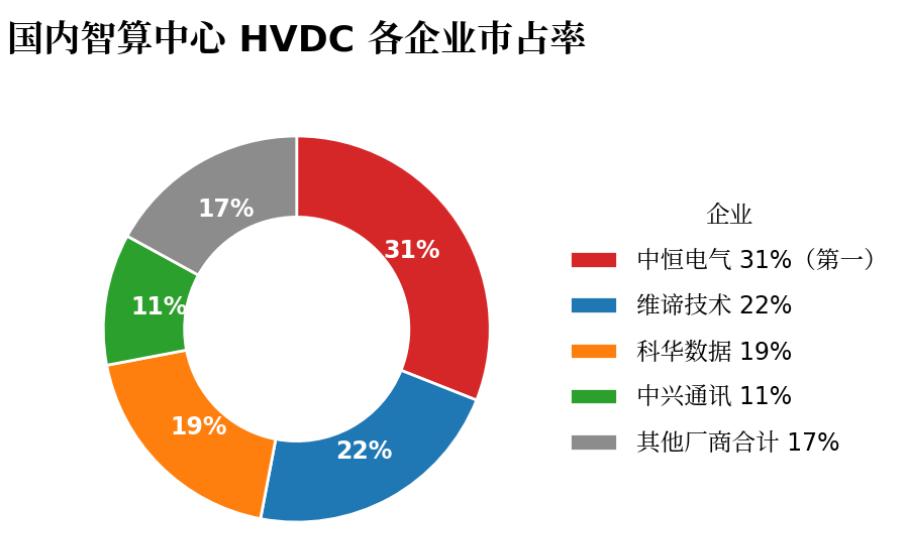
CATL obtained 49% of the shares of Zhongheng Technology with a cash consideration of 3.512 billion yuan and equity consideration of 588 million yuan, becoming the second largest shareholder of Zhongheng Electric. Through this capital increase, CATL has taken control of the key link of how to efficiently transmit power from the power grid to the computer room.
In May, CATL spent about 64 billion yuan to take shares in 21Vianet, which is a "super computer room" operator.
CATL's related parties acquired up to 38.1% of the shares of 21Vianet for about 942 million US dollars, becoming the largest shareholder of China's first US-listed IDC (Internet Data Center) listed company.
According to public information, 21Vianet operates more than 50 data centers in more than 30 cities across the country, with 889 MW of wholesale capacity and more than 49,000 retail cabinets, and its customers include ByteDance, Alibaba and Tencent.
The link of where the computing power is placed has also been taken over by CATL.
This did not stop. In June, in DeepSeek's first round of 510 billion yuan financing, the CATL system contributed about 50 billion yuan, including CATL and Puquan Capital, ranking second among external investors, second only to Tencent's 100 billion yuan.
The views of industry observers are straightforward: "Investing in DeepSeek is to lock in big customers, because the main cost of large AI models is actually electricity bills." Research from Changjiang Securities shows that in the operating costs of large AI models, the proportion of power costs is as high as 60%-70%.
Connecting these three investments, we can see Zeng Yuqun's entire strategic layout arrangement in the AI energy field.
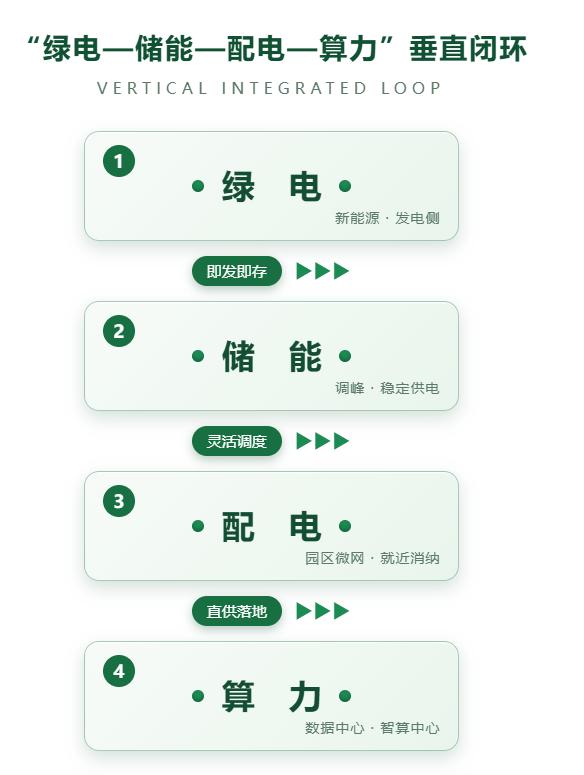
Zhongheng Electric manufactures HVDC high-voltage DC power distribution, 21Vianet operates data centers, and DeepSeek consumes computing power. Connected together, it forms a vertical closed loop of "green power - energy storage - power distribution - computing power".
CATL is shifting from "selling battery cells" to selling "computing power energy solutions", which means that it is transforming from a component supplier to a general contractor that helps data centers "solve power problems", packaging energy storage, power supply, green power, and scheduling as a whole to sell to AI computing centers.
What Does "Standing Next to the Power Switch" Actually Mean
As mentioned earlier, electricity bills are the largest part of AI computing power costs. Gao Wen, an academician of the Chinese Academy of Engineering and director of the Pengcheng Laboratory, said at the World Artificial Intelligence Conference held in Shanghai this year: To achieve long-term sustainable development of computing power, the electricity price should not exceed 0.3 yuan per kilowatt-hour.
What Zeng Yuqun can provide to DeepSeek is considered to be exactly the ability to optimize this cost.
Fu Qiang, Associate Partner of Roland Berger and Chief Expert in the Energy Industry, pointed out in an interview with Jiemian News that CATL "can reduce electricity bills through peak-valley arbitrage of energy storage, provide direct green power supply and BBU backup power supply, etc.". These are the energy network resources owned by battery manufacturers.
Of course, the final switch of the power gate does not mean that everything is in CATL's hands.
Zeng Yuqun can help DeepSeek provide energy solutions, but whether the power grid can carry a gigawatt-level user with continuous full-load operation, and whether green power can be stably supplied when wind and photovoltaic output fluctuates, still needs to be adjusted and optimized in practice.
The current status of the power grid at the location of the DeepSeek project, the access plan, and the new construction cycle, all of which require the cooperation of the power system, and the leading right of the power system is in the hands of power grid companies.
Another variable is competition. The direction Zeng Yuqun bets on is backed by national strategies, but it also means that more players will pour into this track, and everyone wants to stand next to DeepSeek to provide it with energy solutions.
This is what CATL needs to face.
Essentially, CATL's investment in DeepSeek "is industrial positioning after the growth rate of its main business slows down, not a financial investment". CATL cannot easily stand aside and share the profits, and it will definitely participate in more practical operations in the future.
Computing-power and Power Coordination, the Next Growth Outlet
Looking at the cooperation between Liang Wenfeng and Zeng Yuqun, we can ask an initial question: Why did Liang Wenfeng, who has always been cautious about taking money from others, choose Zeng Yuqun?
Tencent and Alibaba once contacted DeepSeek in 2025. It is said that the reason Liang Wenfeng gave for rejection at that time was: Capital will pursue short-term returns, and commercialization will compromise the technical route.
But Zeng Yuqun is different. It seems that he invests money, but in fact he provides electricity, or a complete set of solutions that allow a gigawatt-level data center to operate stably next to wind farms in Inner Mongolia.
This is what Liang Wenfeng wants.
An executive of a computing power industry in Hangzhou's analysis to National Business Daily confirms this judgment: DeepSeek's acceptance of CATL is most likely considering that "computing-power and power coordination requires photovoltaic energy storage in the later stage".
In the past three years, "computing-power and power coordination" has gradually changed from a buzzword to a new infrastructure project in China. Its core essence is one: Let computing power facilities (data centers) cooperate deeply with the power system, so that computing power follows electricity, and electricity also serves computing power.
In August 2026, when 21Vianet and CATL officially signed a strategic cooperation agreement, the two sides stated that they would build a three-layer computing-power and power system of "gigawatt-level computing-power and power factory + distributed computing-power and power network + zero-carbon Token ecosystem".
Observers said that this is the first time that "Token" and "electricity" have been placed in the same cooperation framework — Token is the output of AI, electricity is the input of AI, and what CATL wants to do is the middle layer connecting the two.
Zeng Yuqun and others standing next to the power switch are actually waiting for the next industrial opportunity. When computing-power and power coordination changes from a policy concept to an industrial demand, the person standing next to the power switch at that time will have the pricing power over "how AI uses electricity".
Can CATL "bet right" again this time.
This article is from the WeChat official account "Muhe Business Finance and Economics", Author: Gong Zheng, Editor: Yang Jing, published with authorization from 36Kr.