This National Day, Chinese people are traveling by air more than ever.
Wang Bo (pseudonym) realized something unusual during the Mid-Autumn Festival.
He was scrolling through his WeChat Moments in bed, and saw consecutive overseas location tags for more than ten days. What was even more absurd was that two friends in the second and fourth posts did not know each other at all, yet they were both in the Baltic Sea, seven thousand kilometers away.
He scrolled down and saw someone showing off a koala in Australia, and someone posting photos of the crystal clear sea in the Maldives. "I once doubted whether I had missed some kind of group notice," Wang Bo said with a laugh.
The experience of Cai Zi (pseudonym) was even more exaggerated: she opened her work group and found that one of her colleagues was in Italy for the National Day holiday, and directly overlapped the travel itinerary with her own friend.
Almost everyone has felt this contrast between personal experience and macro data.
According to the prediction of Umetrip on September 17, from September 25 to October 7, the number of outbound flight bookings increased by about 4% year-on-year.
In the "four peak" forecast given by the National Immigration Administration, the maximum daily customs clearance volume is expected to exceed 2.4 million person-times — but that is the total number of inbound and outbound travelers, and a large part of the additional passenger flow is foreigners.
4%. This number looks rather sluggish. But the intuition of Wang Bo and Cai Zi is not an illusion.
Data from the 2026 National Day Outbound Travel Trend Report released by GZL Travel shows that the number of customers received for visa-free long-haul destinations increased by about 300% month-on-month; the number of customers for outbound long-haul products of more than 10 days increased by 62% month-on-month; the number of customers for "one group per family" small group routes increased by about 100% month-on-month.
Routes to farther destinations have risen even more sharply — data from Qunar shows that the number of pre-booked air tickets to long-haul destinations such as Europe, America, Australia, New Zealand, and South America on the platform has increased significantly, among which the number of tickets booked to Brazil has increased by 3.6 times, and the number of tickets to Portugal has doubled.
In short: The old logic was "just go out", but now the logic is "make every trip out different".
Consumers' expectations have been raised, and all the 4% increment has flowed to the long-tail and high-end segments: mass short-haul outbound travel is shrinking, but flights to the Baltic Sea, Cape Town, and the Amazon Basin are in short supply.
01
13-day Holiday
"Pushes" Travelers to Farther Destinations
The reason why Wang Bo's friends could appear in the Baltic Sea and Italy is that they managed to get enough time off.
"Take 3 extra days off to get a 13-day consecutive holiday" is no longer a niche operation this year, but has become the mainstream.
Data from Trip.com shows that one in every ten tourists combined the Mid-Autumn Festival and National Day for a vacation, and nearly half of the people who arranged combined holidays traveled for more than 8 days.
Data from Qunar is more specific: the number of people who traveled on combined holidays from September 28 to 30 increased by 52% year-on-year, and one in every seven travelers took leave to avoid peak travel periods.
With longer vacation time, destinations naturally become farther. In the past, a 5-day holiday was just right for a flight to Japan, South Korea or Southeast Asia. Now with 13 days, travelers even feel it is "a waste" to go to a destination within a 4-hour flight radius.
So everyone started to do the math.
The average air ticket price for departure on September 22 is more than 30% lower than that on the first day of the Mid-Autumn Festival, and nearly 50% lower than that on the first day of the National Day; taking the Beijing-Guiyang route as an example (the price gap of domestic routes is also very large), the ticket price on September 22 is about 500 yuan, and it has risen to 1275 yuan on October 1.
The return trip is even more exaggerated: for the flight from Urumqi to Shanghai, the lowest price on September 24 is 1250 yuan, and the lowest price on October 7 is 3280 yuan, more than doubling.
The price calendar has never been so transparent, and consumers have never been so good at calculating costs.
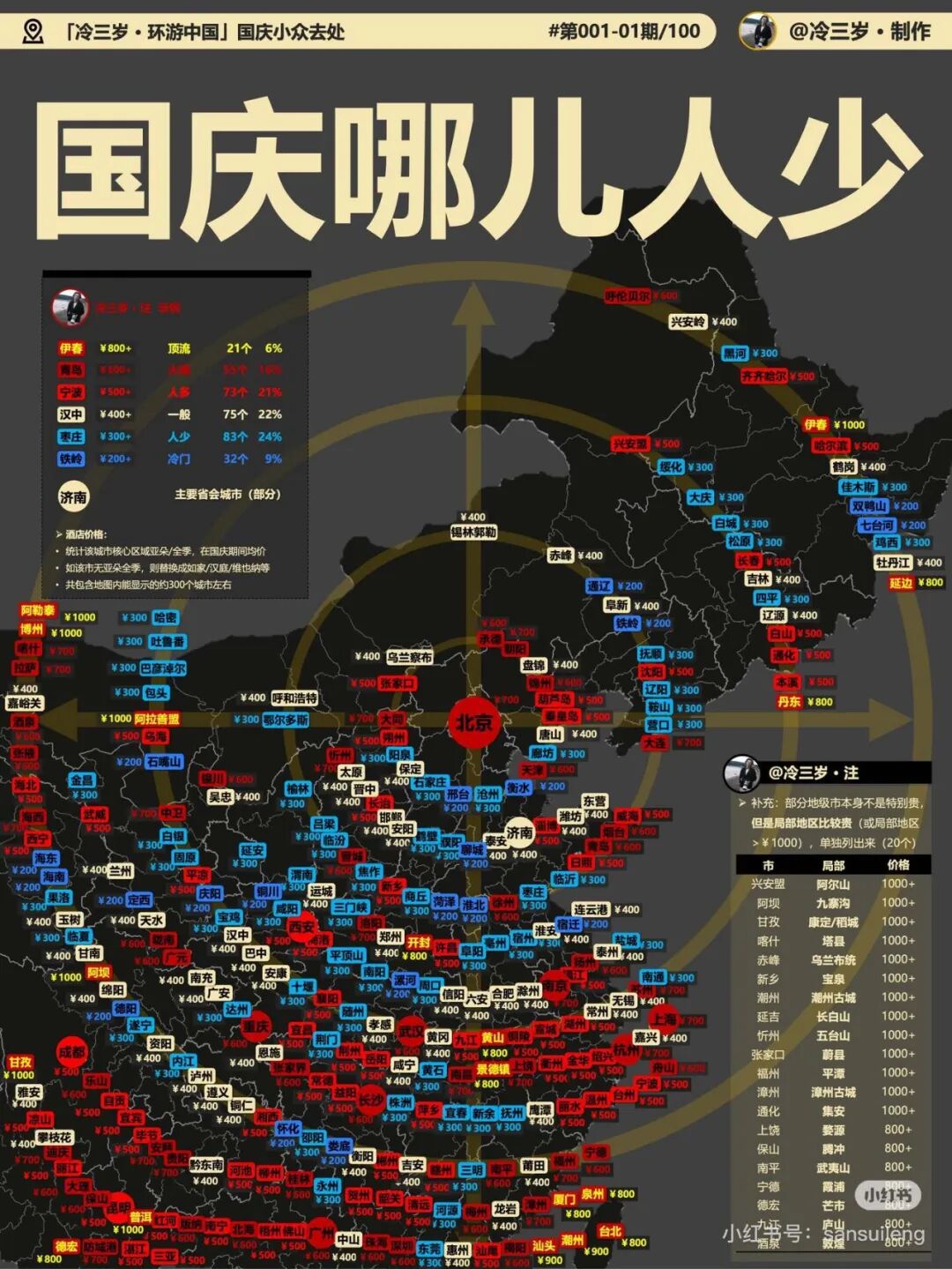
A blogger on Xiaohongshu posted a heat map of the average hotel price during the National Day holiday in early September, which got 17,000 likes and more than 2,500 comments. What everyone in the comment section really wants is not "which place in China has fewer people", but to ask AI "starting from my city, where can I go with fewer people and lower cost".
Long-haul travelers are naturally the quickest to respond.
Spring Travel stated that more than 50% of outbound long-haul tourists during this year's two consecutive festivals had already departed before September 25. The sales pace of transoceanic long-haul routes such as Spain, Portugal, the Balkans, Northern Europe, Greece, and New Zealand is significantly faster than last year, and some routes were almost sold out in mid-August.
Tuniu has a similar statement: more than 35% of users in the National Day tour groups choose to depart before the holiday, and more than 10% "head off early" before the Mid-Autumn Festival. Pure play tours of more than 10 days have become the first choice for long-haul travel, and some popular routes were sold out more than a month in advance. The number of groups departing from GZL Travel on September 24 reached twice that of the same period last year, and all products are super long-haul tours of 9 to 27 days.
Interestingly, this holiday has a rare "four peaks" pattern: the National Immigration Administration predicts that the passenger flow peak this time is not at the beginning or end of the holiday, but at four points: September 25, September 27, October 1, and October 4, and the maximum daily customs clearance volume is expected to exceed 2.4 million person-times.
The four peaks mean four different price expectations. People departing on September 25 are "buying at the bottom price", people departing on October 1 are rigid demand travelers, and people departing on October 4 are "picking up leftover bargains".
Consumers themselves have divided the holiday into different price bands. If the platforms do not follow this division, they will miss every wave of travelers.
Tongcheng's approach is "peak shaving and valley filling": before the holiday, it jointly launched more than 60 million yuan of cultural tourism consumption coupons with more than ten destinations, accurately targeting pre-holiday departure routes and in-depth county tourism products, using a leverage of 1 yuan to drive 6 yuan of consumption, diverting the crowds that would otherwise gather on October 1 to September 27 and 28.
Fliggy's approach is to capture leftover bargains: before the holiday, it launched a special offer channel, specifically for leftover tour products after October 4.
Trip.com's approach is more aggressive: TripGenie launched a large number of new functions before the holiday, using AI to help users find the optimal solution under the four-peak pattern.
The three platforms point to the same logic: the holiday is no longer a single product, but a price curve.
02
Foreigners Are Flooding Into China
Chinese Travelers Are Going Farther
Time has been reconstructed, and space is also being reconstructed. This year, the overall cross-border travel market presents a picture of "both sides are hot, but the heat is different".
Inbound tourism is the hottest this year.
The National Immigration Administration announced that during the Mid-Autumn Festival period, mainland residents made 3.206 million inbound and outbound trips, an increase of 5.3% year-on-year; trips by Hong Kong, Macao and Taiwan residents increased by 27.7%; foreigners made 728,000 inbound and outbound trips, an increase of 37.7% year-on-year. Among the inbound foreigners, 247,000 entered the country under the visa-free policy, an increase of 32.7% year-on-year.
Foreign tourists no longer only focus on Beijing, Shanghai, Guangzhou and Shenzhen, but start to go deep into the scenic and cultural hinterland of China.
Data from the Trip.com Research Institute shows that during the consecutive Mid-Autumn Festival and National Day holidays, second- and third-tier cities are booming across the board — the number of tourists in Zhangjiajie increased by 129% year-on-year, that in Nanjing, Guilin and Sanya all exceeded 90%, and Fujian's growth rate reached 49%, ranking among the top five popular provinces. Chongqing is the city with the highest growth rate, and Luoyang has become the top cultural experience destination relying on its peony culture.
Policies are also adding fuel to this boom.
In May, six departments including the Ministry of Commerce launched the 2.0 version of the tax refund policy for overseas visitors; starting from July 1, tax refund orders under 10,000 yuan are changed to random inspection with fully paperless processing; starting from September 1, the instant tax refund service can be processed in different places. This means that foreign tourists can get cash immediately after shopping in China, and they can also complete the tax refund when leaving the country from another city.
As of April, the number of "instant tax refund" stores across the country has exceeded 8,000, more than doubling the previous number. The Guangzhou Baiyun Border Inspection Station predicts that the proportion of foreigners during the two festivals will be about 45%.
On the outbound travel side, the total volume looks sluggish, but the structure hides strong momentum.
The 4% growth rate from Umetrip is indeed not high, but if you break it down: the number of customers received for visa-free long-haul destinations increased by 300% month-on-month, the number of "one group per family" small group routes increased by 100% month-on-month, and the number of long-haul products of more than 10 days increased by 62% month-on-month (data from GZL Travel).
Data from Shanghai Pudong Airport provides a more precise structure: in the first three days of the National Day holiday, about two-thirds of mainland residents traveling outbound chose surrounding short-haul destinations; but driven by the 13-day super long holiday, nearly 30% of the travelers went to long-haul destinations such as Europe, America, Oceania and Africa.
Routes to farther destinations have risen even more sharply. The number of flight bookings to super long-haul destinations such as South America, Australia and New Zealand increased by more than 40% year-on-year, the number of flight bookings to Cape Town, South Africa increased by 4.3 times year-on-year, and flight orders to destinations more than 10,000 kilometers away such as Brazil and Portugal have doubled.
The Travel Trend Report released by Fliggy before the holiday also confirms this trend: the destinations with the fastest growth are not Bangkok or Tokyo, but "dark horses" such as Slovenia, Romania, Madagascar, Chile, and Kyrgyzstan;
Among the experience-based products, the number of bookings for whale watching tours overseas increased by more than 200% year-on-year, and the search popularity of hot keywords such as "concert" increased by nearly 9 times year-on-year.
Only by putting the two sides together can we see the full picture: international travel as a whole is booming, but the way it booms has changed.
Foreigners are coming in faster, and Chinese people are going farther — the former is incremental growth, while the latter is consumption upgrading.
The two friends that Cai Zi ran into in Italy, one went to a Tuscan winery, and the other took a round-the-island tour of Sicily, both of which are small group routes of more than 10 days. They did not know each other, but they chose the same kind of "faraway travel".
03
After "Flight + Hotel"
How Far Can the Tourism Industry Go Next?
Consumers have changed. The holiday has been divided into four segments, outbound travel has changed from "flying casually" to "flying far away", and inbound travel has changed from superficial sightseeing to in-depth experience — the same 13 days have been split into completely different demand segments.
With more segments, the days of relying on packaged "flight + hotel" products are gone. OTAs must answer a new question: when users are no longer satisfied with "flying to Bangkok and checking into a hotel", what else can the platform sell?
Trip.com's approach is "selling AI services + selling inbound travel products".
TripGenie launched a large number of new functions before the holiday, which is not a gimmick, because under the four-peak pattern, consumers really need AI to help them find the optimal solution in the 13-day price curve.
Users no longer search for keywords, but describe their needs, and AI generates itineraries including winery hiking in Georgia and hot air balloon experiences in Turkey. This model of "users put forward demands, AI generates plans" is not yet mature, but it is gradually replacing the old model of "users search for keywords, platforms provide lists".
Inbound tourism is another incremental pool for Trip.com.
During the two festivals, the number of one-day tour orders for inbound tourists increased by more than 4 times year-on-year, the number of ticket orders increased by more than 220% year-on-year, and the number of train ticket orders increased by more than 170% year-on-year. The number of group tour orders and food experience product orders increased by more than 10 times and 7 times respectively.
However, the fulfillment of these orders is far more complicated than selling air tickets: foreign card payment must be smooth, multilingual services must be in place, and intangible cultural heritage handicraft experiences must be authentic.
The "Inbound Traveler Party" held by Trip.com in Luoyang has reached more than 35 million views in overseas communication, which is essentially providing "content-based inbound experience supply".
Tongcheng's approach is "selling sinking market products + selling time-based products".
87% of Tongcheng's registered users come from non-first-tier cities. When the middle class in counties travel abroad for the first time, the first stop they skip is often not Japan or South Korea, but directly go to visa-free long-haul destinations: this exactly matches the data of 300% month-on-month growth in outbound long-haul travel.
Public data shows that Tongcheng issued more than 60 million yuan of consumption coupons before the holiday, targeting pre-holiday departure routes, using 1 yuan to drive 6 yuan of consumption leverage.
What Tongcheng targets is not the high-end market, but the "first-time" market: the first long-distance trip of county users, the first time they use consumption coupons, the first time they travel abroad with combined holidays.
Fliggy's approach is "selling niche products + selling experience products".
In the 2026 Mid-Autumn and National Day Travel Trend Report released by Fliggy, holiday resorts on the other side of the earth such as Australia, New Zealand, Italy, as well as top popular destinations within the "four-hour flight radius" such as South Korea, Thailand, Malaysia and Hong Kong, China are all on the list. As emerging "dark horses", Slovenia, Romania, Madagascar, Chile, and Kyrgyzstan lead the growth rate.
In the 4% total volume of outbound travel, Fliggy targets the small segment with the highest unit price and the deepest experience.
The Baltic Sea and Cape Town destinations in Wang Bo's WeChat Moments are most likely derived from this kind of long-tail supply. It bets on "small but excellent" rather than "large and