Just now, GPT-6 Astra overturned the 59-year-old nuclear fusion conjecture.
A 59-year-old unsolved nuclear fusion problem took GPT-6 Astra only 20 minutes and 34 seconds to work out a complete answer.
The physicist who raised the problem only added an encouraging line at the end of the prompt:
You have solved many open mathematical problems before, so I know you can make it as long as you stick to it long enough!
What ChatGPT returned was a family of exact solutions that no one had been able to derive for 59 years.
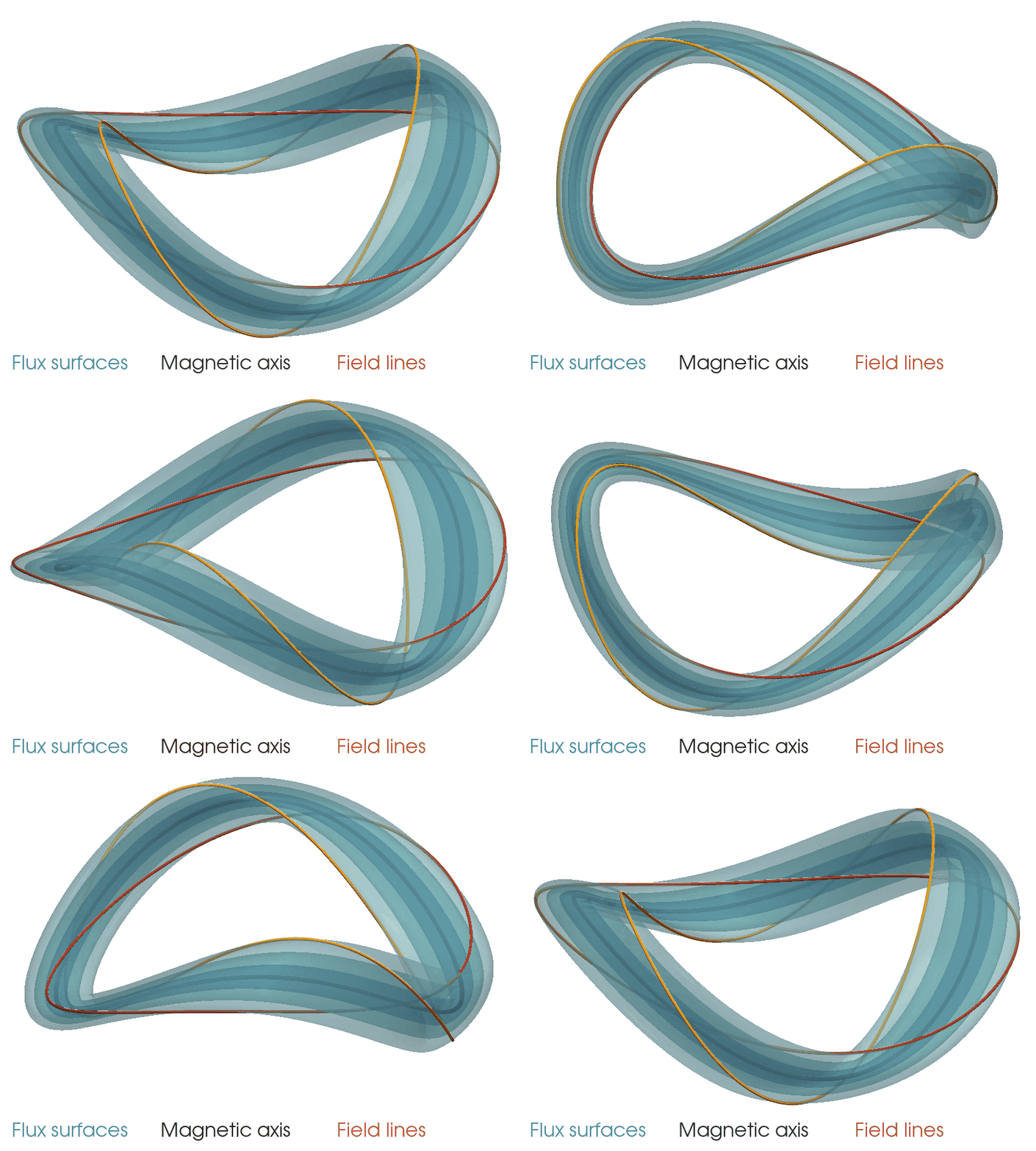
The first family of solutions found by Astra: nested magnetic surfaces stacked together, the red and yellow lines are magnetic field lines
Recently, this incident went viral on X.
An AI content creator who graduated with a postgraduate degree in nuclear fusion from Kyoto University posted a long thread exclaiming that the era of new scientific discoveries made jointly by AI and humans has truly arrived!

The problem broken through this time is the conjecture left by plasma physicist Harold Grad in 1967.
He asserted at the time that smooth 3D plasma equilibrium cannot exist without symmetry.
This statement has hung over the stellarator route in nuclear fusion for 59 years.
In late September, two papers published just one day apart overturned this assertion. Among the three families of counterexamples, two were found by Astra.
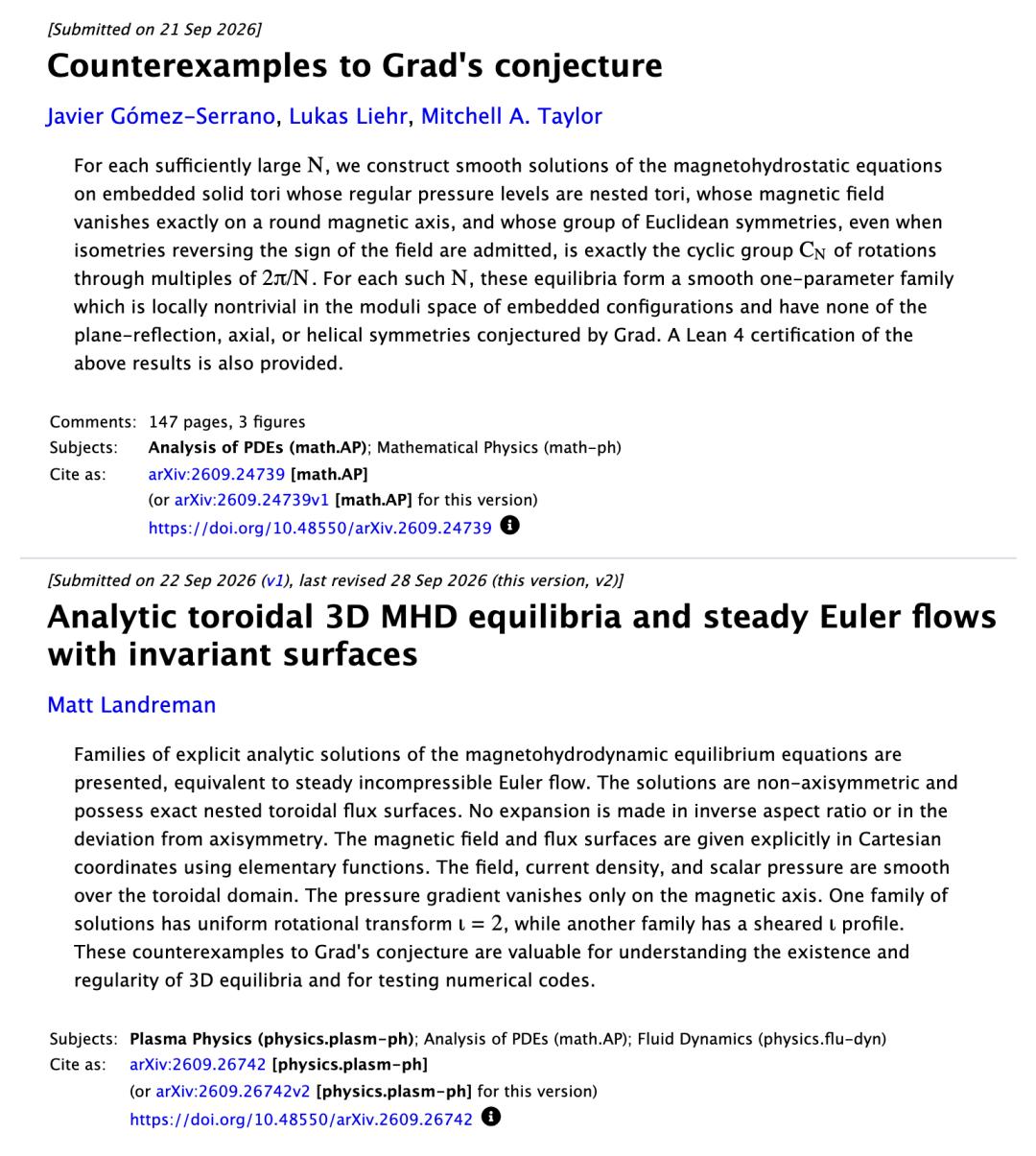
In Two Days, Astra Delivered Two Families of Solutions No One Had Derived in 59 Years
At 6:44 a.m. on September 10, plasma physicist Matt Landreman from the University of Maryland sent a prompt to GPT-6 Astra Pro.

What he wanted was to let Astra design a magnetic cage that can confine plasma, and it had to be asymmetric.
Among the requirements, the magnetic field must have nested magnetic surfaces stacked layer by layer like an onion; the divergence must be zero, which means magnetic field lines cannot appear or disappear out of nowhere; when magnetic field lines travel along the donut-shaped torus, they must also circle around the cross-section to advance helically like a twist, and the number of such rotations is called "rotational transform" by physicists, denoted as ι.
Finally, the entire magnetic cage must also satisfy MHD (Magnetohydrodynamics) force balance, where the outward pressure of the plasma and the force of the magnetic field cancel each other out everywhere.
He also specifically noted that ι is preferably not an integer, but this is not a mandatory requirement.
He even provided three ideas for constructing the rotational transform: twist the magnetic axis, make the cross-section rotate as it moves, or pass a current along the magnetic axis.
When he wrote the last two sentences, he changed his tone to sound like he was encouraging a doctoral student who had stayed up all night working.

The first sentence Astra wrote when it submitted its result was:
I have found a family of explicit, exact solutions.
This family of solutions meets all the hard requirements Landreman listed.
The pressure is not constant, it changes layer by layer from the inside to the outside; the nested magnetic surfaces can all be accurately expressed by formulas.
The magnetic axis in the very center fluctuates up and down, forming a non-planar curve; when the donut-shaped torus rotates one full circle, the shape of every part is different, with no axial symmetry.
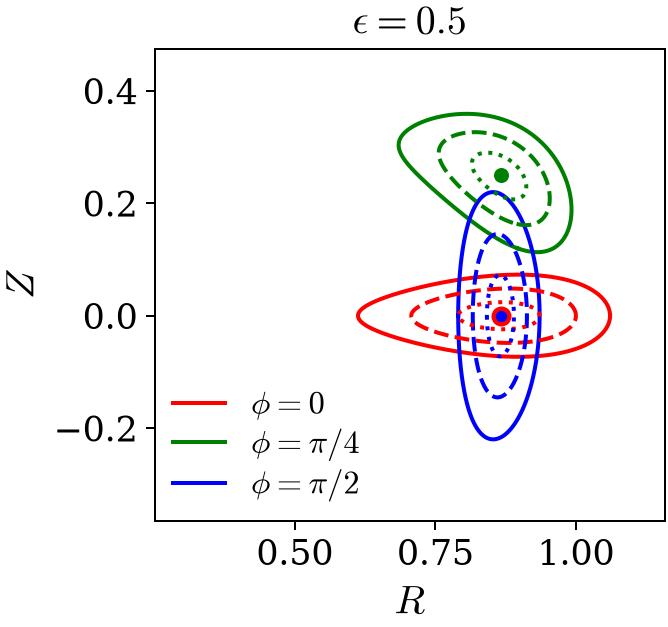
Cutting through the first family of solutions, the cross-sectional shapes at the three positions are all different, and the magnetic axis also moves up and down accordingly
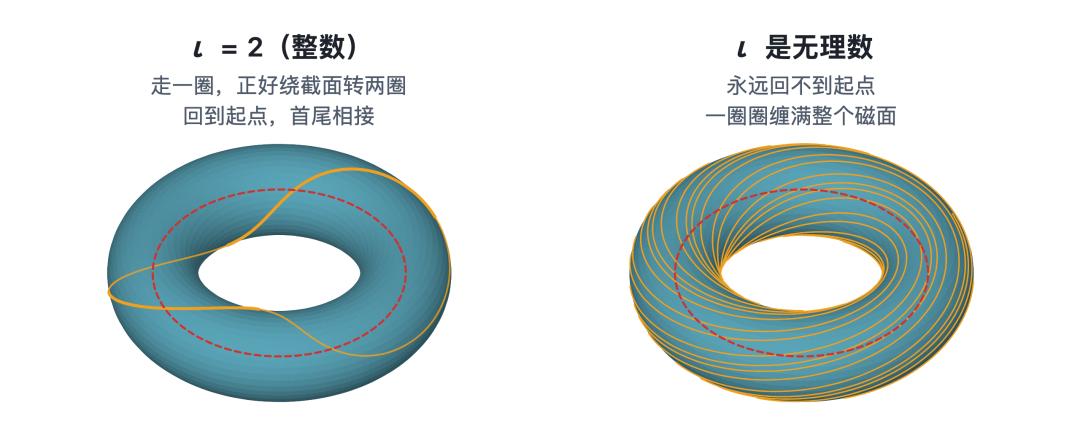
Then, it voluntarily stated the shortcoming of this solution: the rotational transform ι of this family of solutions is an integer. When the magnetic field line travels one full circle along the donut, it rotates exactly two full circles around the cross-section, returns to the starting point, and closes on itself.
In its own words, the return map after one full toroidal loop is the identity map.
Landreman stated in his prompt that a non-integer ι is only a bonus condition, so this family of solutions is qualified. But what he really wanted was the case where ι is an irrational number, where the magnetic field lines can never return to the starting point, and eventually wind around the magnetic surface again and again to cover the entire surface.
At 4:05 p.m. the next day, Landreman sent back this family of solutions as an attachment, asking it to meet the bonus condition this time.
Among the requirements, ι must be a non-integer, preferably an irrational number, so that the magnetic field lines can never close on themselves. He ended the prompt with the same encouraging line as before.
This time, Astra thought for 33 minutes and 37 seconds, and the first result it returned was "I can't work it out".

But it did not return empty-handed, instead it proved a limiting condition.
The first family of solutions is based on a "quadratic oscillator" construction, where the motion of magnetic field lines along the x, y, and z directions is like three spring oscillators with frequencies 1, 1, and 2 respectively.
No matter how you adjust the frequencies and parameters, the three frequencies will always be locked in an integer ratio, ι will always be an integer, and the magnetic field lines will eventually close on themselves.
In other words, patching and modifying based on the first family of solutions is fundamentally impossible.
In the same conversation, it then switched to a different construction and delivered the second family of solutions.
This time, ι changes with the magnetic surface, which physicists call magnetic shear, and ι on almost every layer of the magnetic surface is an irrational number.
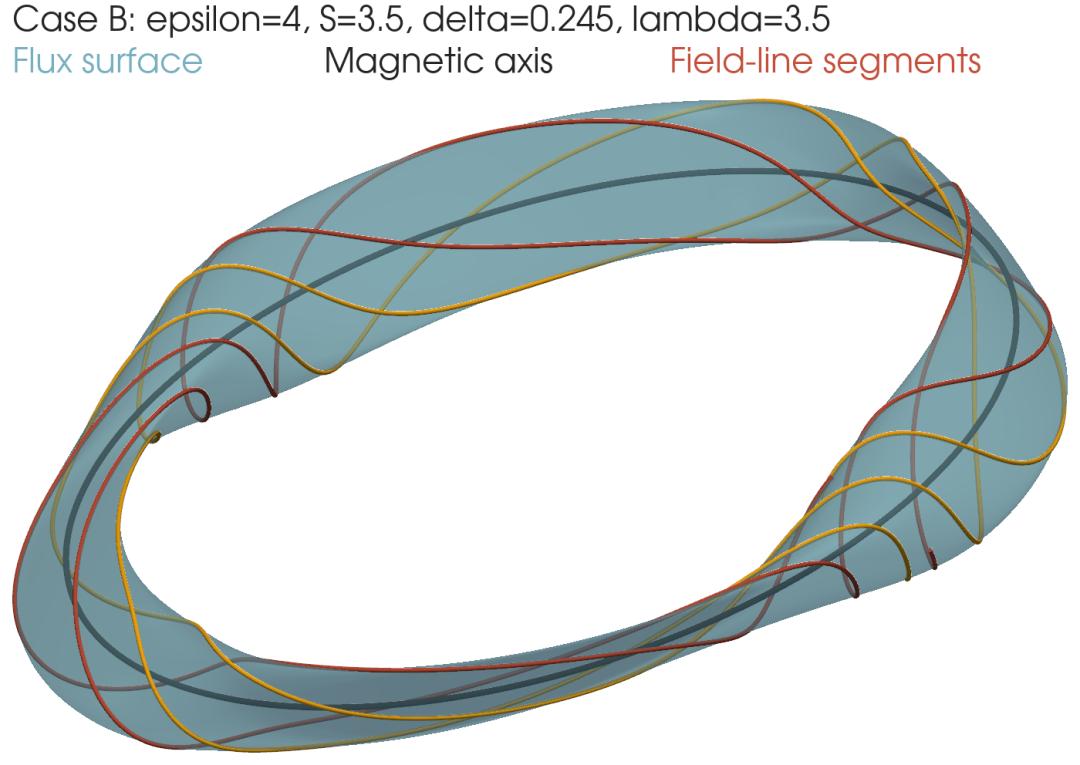
The second family of solutions: the magnetic surface twists as it moves, the red and yellow lines are magnetic field lines
Before submitting the result, it also did verification by itself: substituting the equation at 1202 points, checking the error with 64-bit automatic differentiation, and then independently verifying it again with fourth-order finite difference.
At 8:27 p.m. that same day, Landreman followed up with two more details.
The first was whether the magnetic axis was a planar curve; the second was whether the vacuum rotational transform was non-zero, that is, without relying on the current of the plasma itself, only using the external coils, whether the magnetic field lines would still rotate around the cross-section.
11 minutes later, Astra gave the answers.
The magnetic axis lies on a plane and is an ellipse; the vacuum rotational transform is small, but it is indeed non-zero.
In just two days, Astra delivered two families of solutions. The remaining ten days or so were human work.
He used the stellarator equilibrium solver DESC to calculate each of the two families of solutions, and then derived the equations term by term using SymPy and Mathematica.
On September 22, the paper was uploaded to arXiv, and the beginning of the acknowledgments reads:
These solutions were discovered using the artificial intelligence model GPT-6 Astra Pro, and part of the paper was also drafted by it. All equations have been manually confirmed by the authors.

He also exported the three segments of the conversation as a PDF, and put them together with the verification scripts into the paper's GitHub repository.
Papers that fully disclose even the original prompts like this are rare.
Grad's Assertion Hung Over Stellarators for 59 Years
The goal of nuclear fusion is to confine plasma at hundreds of millions of degrees inside a donut-shaped magnetic cage.
An ideal magnetic cage is made of nested magnetic surfaces stacked layer by layer, like an onion. The magnetic field lines circle along their respective magnetic surfaces, and the pressure decreases layer by layer from the center outward.
The outward impact force of the plasma cancels out the magnetic force everywhere, and physicists call this state MHD equilibrium.
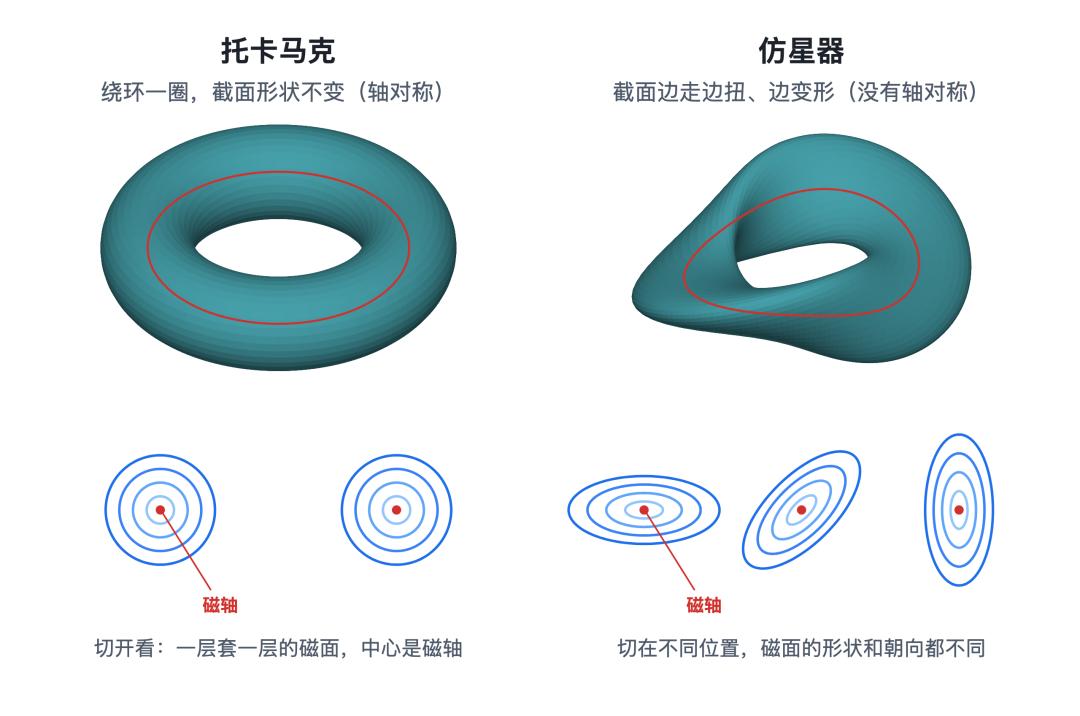
Tokamaks (such as ITER and China's EAST) are axisymmetric, and the cross-sectional shape remains unchanged when rotating around the torus. This kind of equilibrium boils down to a 2D Grad-Shafranov equation, which was fully solved decades ago.
The Grad in the name of the equation is exactly the person who later proposed this conjecture.
Stellarators (such as Germany's Wendelstein 7-X) take a different path, using a set of twisted coils to generate the magnetic field, deliberately introducing asymmetry.
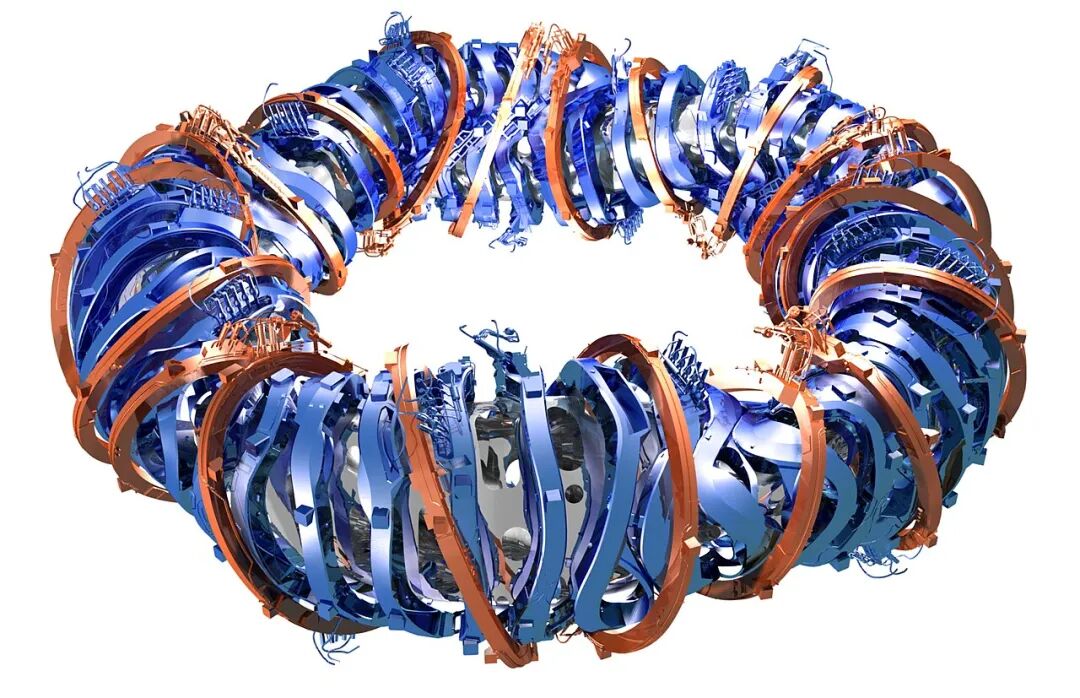
The magnet of Wendelstein 7-X, the blue parts are the twisted non-planar coils
The problem lies precisely in this asymmetry.
In 1967, Harold Grad from the Courant Institute of New York University published a paper in *Physics of Fluids* that put forward a judgment:
We believe that it is unlikely that a general class of toroidal equilibria with smooth pressure exists.
In 1985, he went one step further and asserted that except for symmetric exceptions, there is no family of solutions that smoothly depend on parameters. That is to say, even if asymmetric solutions happen to exist, they can only be isolated individual cases.
The title of that paper is *Theory and Applications of the Nonexistence of Simple Toroidal Plasma Equilibria*.
This is equivalent to telling the stellarator community that the perfect magnetic cage they want to build may not exist at all in a strict sense.

In the following decades, stellarators continued to be designed and built, relying entirely on approximate solutions and computer numerical calculations. No one could guarantee whether the calculated equilibrium was real, or just an illusion brought by the approximation.
There are two types of attempts that came closest to the strict answer.
The first type is the near-axis expansion, which only calculates approximate solutions near the magnetic axis,