Claude is too expensive, Microsoft has slashed over 30% of its relevant budget, and Meta's user base has been directly halved.
Just now, Anthropic's two largest backers hit the brakes at the same time.
This came on the eve of Anthropic's planned listing bell-ringing.
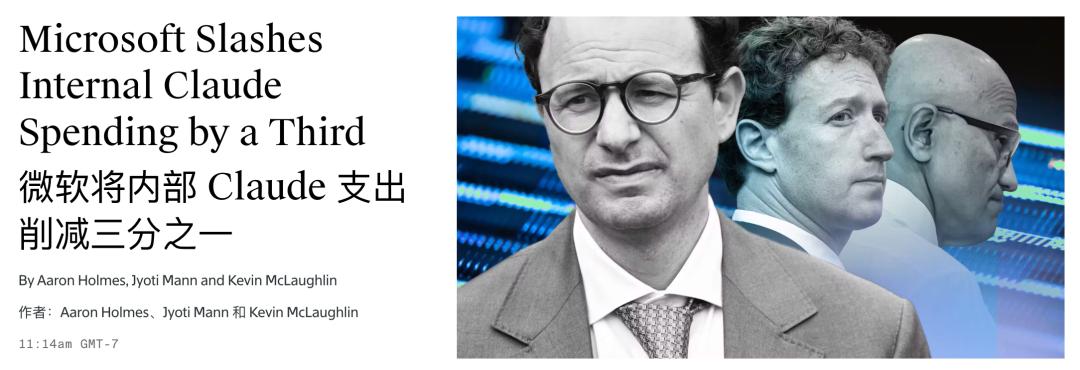
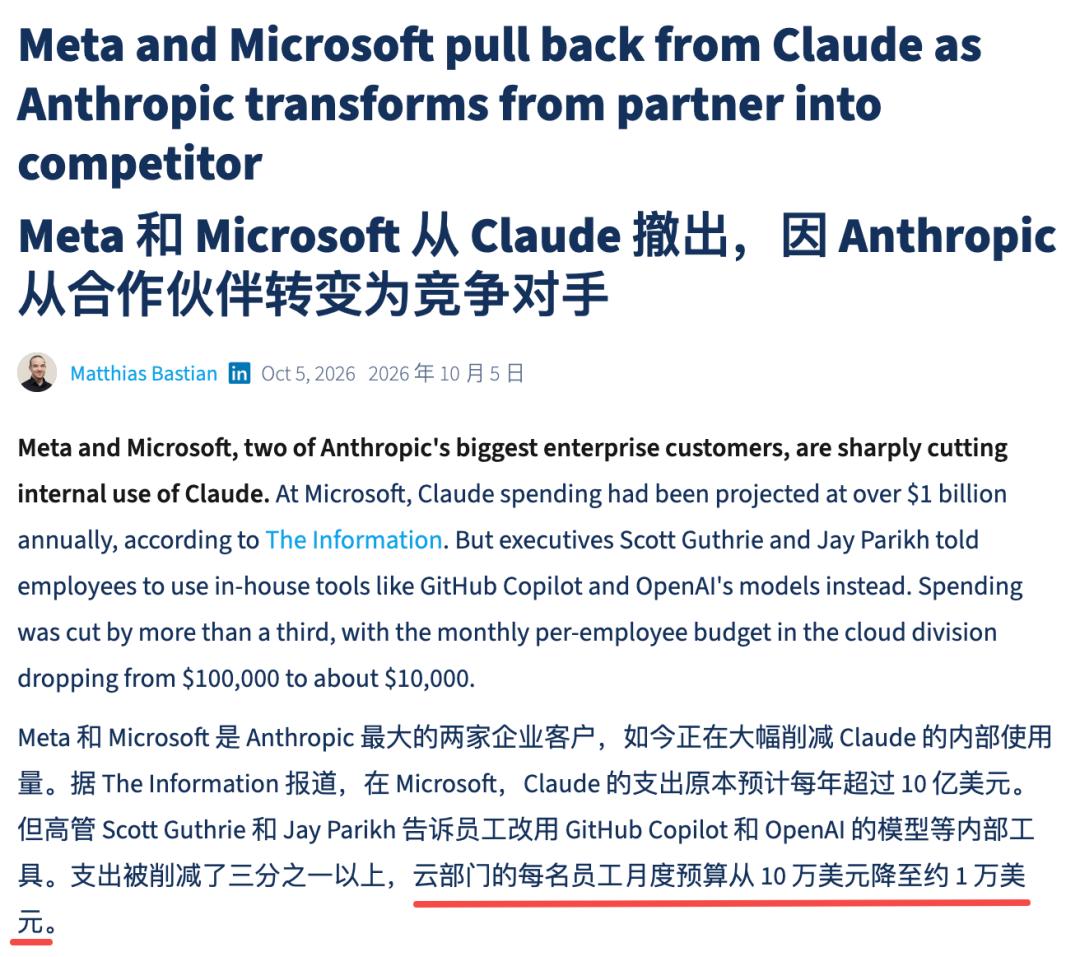
According to the latest report from The Information, Microsoft's internal budget originally projected to exceed 1 billion US dollars on Claude this year has been cut by more than a third.
Meta went even further: the number of internal employees using Claude Code dropped directly from around 60,000 to roughly 30,000, a 50% cut.
What's even more surreal is that even with this halved user base, Meta spent over 105 million US dollars on Claude Code alone in the last 28 days.
What is Claude's biggest problem?
It's not that it's not easy to use. On the contrary, it's far too capable to use.
The bill exploded: the better it works, the more money it burns
Last December, Microsoft granted thousands of engineers in its Experiences and Devices department access to Claude Code.
No one promoted it, no one mobilized users, it became popular purely on its own merits. In the first few months, Token consumption directly doubled.
The monthly Token cost per engineer ranged from 500 to 2000 US dollars, and the entire team burned millions of dollars in total.
Scott Guthrie, head of Microsoft Cloud and AI, and senior executive Jay Parikh could no longer sit still, and directly gave the order: reduce the use of Claude, switch to GitHub Copilot and the company's own in-house models.
According to a report by The Decoder, the monthly Claude quota per person in the cloud department was directly cut from 100,000 US dollars to about 10,000 US dollars, a 90% reduction in one go.
By May 2026, Microsoft canceled most of the Claude Code licenses, requiring full migration before the end of the fiscal year on June 30.
Mustafa Suleyman, CEO of Microsoft AI, said that Anthropic's solution is "extremely expensive", and the goal is to drastically reduce usage until it is completely phased out.

Now let's look at Meta.
The recent 10% layoff only explains part of the loss of employee users, the bigger reason is: Meta has developed its own alternative.
The internal programming tool MetaCode already has more than 30,000 users, and Muse Code, which began external testing in August this year, also has more than 6,000 internal users.
Meta's self-developed Muse Spark model has improved so fast that it has largely directly replaced the demand for Claude.
There is a dashboard inside Meta that employees jokingly call "Claudeonomics", which shows that 60 trillion Tokens were burned in 30 days. That is equivalent to massive amounts of internal code and data being sent through third-party servers to run and then returned every single day.
Which major tech company can tolerate this kind of thing?
This is the deadlock of the token-based billing model.
When chatting, you ask one question and get one answer, the traffic volume is limited. But the Agent mode is different: it will read code on its own, run tests, revise over and over again, and work for hours on end, with the usage meter running nonstop. The better the tool works, the more people use it, and the more complex the tasks it handles, the more terrifying the bill will be.
The more capable it is, the more expensive it gets. The more expensive it is, the more you want to build your own.
The most poignant part of this incident is not just the money, but the timing.
Anthropic secretly submitted its S-1 filing to the SEC in June this year, and the prospectus made public in September states that two unnamed customers contributed a combined 25% of its total revenue.
The market widely speculates that these two customers are Microsoft and Meta.
According to the rhythm of previous reports, Anthropic will launch its official roadshow as early as mid-month this month, sprinting for a Nasdaq listing.
A company that is trying to convince investors that a quarter of its revenue comes from two clients, and those two clients are simultaneously cutting back at this very critical juncture. If you were sitting in the audience at the roadshow, you would definitely want to think twice before making a decision.
There is also a more thought-provoking contrast. Microsoft is desperately cutting costs on Claude, but Anthropic still has to spend huge sums of money on Microsoft Azure.
The prospectus shows that Anthropic has approximately 314 billion US dollars in non-cancelable infrastructure procurement commitments with Microsoft.
This picture is more than a little awkward.
How partners turned into rivals
The deeper logic is the shift of identity.
A year ago, everyone regarded Anthropic as a shovel seller: the model was a tool that anyone could buy and use.
But things are different now. Claude Code can write code, modify documents and run workflows on its own, and Claude Cowork is increasingly becoming a substitute for Office — and Office happens to be Microsoft's lifeline.
The same goes for Meta: it wants to make Muse a service sold to enterprises, so there is no reason to pay its competitor while building a competing product of its own.
According to reports, Meta also wants to restrict Anthropic's access to its own training data.
The more powerful the model gets, the closer it gets to the customer's core business. The closer it gets to the core business, the more reluctant the customer is to hand it over to an external party.
This trend has not only affected these two companies.
In July, Alibaba completely stopped using Claude Code and switched to its self-developed Qoder. In September, NVIDIA, Palantir, and Booz Allen also tightened their usage policies, with NVIDIA preferring to use its own Nemotron when processing proprietary information.
The reasons vary: some are for cost, some are for data security, and some are to prevent model distillation.
But the direction is the same: for core matters like coding, tech giants want to keep full control in their own hands.
Anthropic is certainly not naive, and it is also taking countermeasures.
Fable 5.1, released in early September, keeps the base price unchanged, but the cache read cost is reduced by 75% in one go, the overall cost of typical workloads is about 25% lower, and highly agent-heavy intensive tasks can be up to 45% cheaper.
At the same time, Anthropic also adjusted its previously controversial data retention policy, allowing enterprises to retain data on their own infrastructure, trying to win back customers who were scared off by security concerns.
But the problem is that price cuts can only ease the conflict, not solve the root cause. The giants are not just complaining about the high cost, what they care more about is that this supplier is turning into their competitor.
AI programming enters the accounting period
In the past two years, the AI industry has been competing for who has the stronger model, and whose Agent can work independently for longer.
Now, CFOs are starting to ask another question: How much does each line of code actually cost?
Microsoft went through exactly this path. Claude Code was so good that its usage doubled on its own, and the bill rose accordingly. Then they took back most of the licenses.
No matter how much engineers love to use it, it still has to pass the budget review.
The answer to this question is splitting the market into two layers. Models that are sufficient, cheap, and controllable will take over a large number of daily tasks; the most powerful models will only be reserved for the small fraction of the most difficult tasks.
For the entire ASI race, this is a cruel reminder — being the most powerful is not enough, the product also has to be affordable.
The capability curve and the cost curve of AI are racing against each other. No matter how fast the capability improves, if the cost cannot be brought down, it will only stay within a small number of teams with sufficient budgets. The party that first makes intelligence cheap enough will truly integrate it into the daily work of every engineer.
Reference: https://www.theinformation.com/articles/meta-microsoft-work-wean-staff-anthropics-claude
This article is from the WeChat official account "AI Era", author: ASI Revelation, editor: Solomon, published with authorization from 36Kr.