Embodied AI Rushes Into the IPO Market: The Frenzy Ebbs After the Valuation Feast
A tech journalist joined an embodied intelligence company valued at 20 billion yuan in Beijing this June. On his first day at work, he spent the whole time in meetings from 2 p.m. to 10 p.m., excluding a one-hour dinner break. The meetings had only one theme: preparing for the IPO.
A marketing candidate went for an interview at a robotics company in Shanghai, and was told that her main responsibility would also be IPO-related: investor-facing PR. An R&D employee at a Shanghai-based embodied intelligence enterprise said the company currently has only one goal: financing and going public.
Their stories all took place in the first half of this year.
At that time, embodied intelligence was going through a capital carnival. This June, at least four robotics enterprises were exposed to be preparing for IPO or already in the IPO process. Unitree Robotics had just passed the review of the Shanghai Stock Exchange's listing committee, and was about to become the first embodied intelligence enterprise to land on the secondary market.
The competition to become the second enterprise to enter the capital market became the focus of all players. Every embodied intelligence enterprise has created a unique narrative system for itself, such as the first stock in the home service scenario, the first stock in the industrial scenario, the first full-stack stock in embodied intelligence......
For embodied intelligence enterprises whose business models have not yet been fully verified, the significance of being the "first stock" is extraordinary. "Whether it is the Hong Kong Stock Exchange, the US stock market or the A-share market, the first stock has the highest investment value. If you become the second or third, there are already benchmarks ahead, the market will give you a fair value, and there will be no premium space," an investor who has invested in leading embodied intelligence enterprises told Tech Planet.
Thus, the race to compete for listing qualifications heated up rapidly.
According to a report by China Business Journal, more than 20 core humanoid robot enterprises in China have entered the IPO tutoring, application or issuance stage at present, and 46 robot-related enterprises are queuing up for listing on the Hong Kong Stock Exchange.
Unitree Robotics has become the highly anticipated price benchmark. On August 19, Unitree Robotics went public, and its opening price soared to 7.3 times of the issue price, reaching 1100 yuan per share. The price peaked right at the opening, and then fell continuously for many days to around 450 yuan per share. "We expected Unitree's stock price to fall, but we didn't expect it to drop so fast," more than one investor expressed the same view to Tech Planet.
When the market is no longer willing to give sustained valuation premium even to the most anticipated first stock, those robotics companies with less revenue, earlier-stage technology and weaker financing capabilities have to face a problem that was temporarily covered by the IPO narrative before: how much is an embodied intelligence enterprise actually worth?
01
The carnival feast of embodied intelligence is ebbing
The Pudong Shangri-La Hotel in Shanghai is 160 kilometers away from the headquarters of Unitree Robotics in Binjiang District, Hangzhou.
On the morning of August 19, the gong for Unitree Robotics' listing resounded across the entire A-share market. While investors, industrial capital and partners gathered at the Pudong Shangri-La Hotel to celebrate Unitree Robotics' market value of over 400 billion yuan, the headquarters office building of Unitree Robotics 160 kilometers away was exceptionally quiet.
Employees went to and from work as usual, R&D staff walked into the office building with breakfast. There were no piles of flowers, no tables full of champagne, not even a cup of cola. It looked like just an ordinary working day.
They seemed to know better than anyone else that this was a carnival that had been prepaid in advance. The carnival only lasted for one morning. As capital began to cash out, Unitree's stock price gradually fell back, closing at 845 yuan per share on the listing day.
In the following 40+ days, embodied intelligence enterprises that were busy rushing for IPO suddenly quieted down. They no longer promoted their IPO plans, and there were no overwhelming publicities.
"IPO is a sensitive word inside our company," said the aforementioned former tech journalist who joined a leading embodied intelligence enterprise.
In the past three months, he did not have a single complete weekend, working at least 10 hours almost every day. The latest time he worked was 3 a.m., and he got up at 7 a.m. to continue working. Now, the company has completely stopped PR dissemination, and he has ushered in a short rest period. He gets off work on time every day, and spends most of his working time slacking off.
This sudden relaxation does not come from the embodied intelligence enterprises learning to improve efficiency, but from the overall rhythm of the entire industry changing.
In the past, everyone was racing against time.
Almost every position in the embodied intelligence industry is operating at high intensity. A person who used to work in the embodied intelligence industry said that if you think the internet industry is highly competitive, it is almost a paradise compared to embodied intelligence. He calculated that if the internet industry works 55 hours a week, the embodied intelligence industry works 78 hours a week. "We are talking about whether we can get off work at 11 p.m. on weekends," the employee complained on social platforms.
Enterprises are also raising higher and higher requirements for talents. "Master's and bachelor's degrees from top 3 universities are just the minimum threshold, now the bar has been raised to PhDs," said an R&D staff member at a leading embodied intelligence enterprise. However, academic qualifications are only a stepping stone, robotics enterprises value practical operation more. R&D personnel need to reproduce papers, and some people are even forced to leave after only two months or a few weeks because they cannot reproduce the results of academic papers in the short term.
"This is an industry where no one talks about efficiency," the aforementioned R&D staff added. How many people can a robot stably replace? What are the maintenance costs, deployment costs, and when can large-scale deployment be achieved? No company can answer these questions, and no company will talk about them.
Embodied intelligence involves multiple fields such as algorithms, control, hardware and software. R&D personnel cannot predict where problems will occur at all, and often spend months of effort to troubleshoot. A large amount of their time is spent on ensuring that a single robot can work normally.
A typical example is that when a robot stops working, it seems to be a software problem at first glance, but after a week of troubleshooting, people find that a certain component overheats and causes the chip's computing performance to fail.
In this industry, "whether the product can be developed" is still the primary problem that many enterprises need to solve, and "whether the developed product is cost-effective" is put on the back burner.
But the capital market no longer has that much patience.
Financing in the primary market is the most sensitive. By the middle of this year, the financing scale began to cool down. Statistics show that in July 2026, about 34 enterprises in China's embodied intelligence robotics track obtained financing, with the disclosed amount of about 120 billion yuan; compared with more than 178 billion yuan in June, it dropped by about 32.6% month-on-month.
After Unitree Robotics' market value plummeted, the wait-and-see sentiment became even stronger. Many investors told Tech Planet that their companies no longer look at embodied intelligence projects, and there has not been a single project that passed the internal review in the past month.
Those newly established small-scale enterprises have started to downsize. Tech Planet learned that some embodied intelligence enterprises with a valuation of less than 2 billion yuan have begun to shrink their teams. An embodied intelligence enterprise established in February this year has run out of 100 million yuan, and now cannot pay salaries.
The salary levels that used to double easily no longer exist. An employee of an embodied intelligence enterprise said that now companies poach talents with flat salaries, and the crazy expansion has been suspended.
Capital has already celebrated the future of robotics in advance, but the industry suddenly cooled down rapidly.
"Unitree's market value of around 100 billion yuan is reasonable. It is a hardware company, and according to the valuation logic of hardware companies, its market value will naturally come down. You can look at the hardware companies in Shenzhen, UBTECH's current market value is more than 30 billion yuan, and Insta360, which went public last year, also dropped from 100 billion yuan to more than 30 billion yuan now. After the first wave of hype, the market will definitely return to rationality," an investor analyzed to Tech Planet.
From autonomous driving to chips, from large models to embodied intelligence, leading technology companies are getting more and more capital, and the speed from entrepreneurship to IPO bell-ringing is getting faster and faster. The market is willing to pay for the future in advance, but rarely willing to wait for an enterprise to grow slowly.
Therefore, many technology companies have to face the real test of the market only after they go public. The shrinking of Unitree's market value makes everyone re-examine how this feast started.
02
Valuation carnival: expand the market size first
"The money is already in the account, can you help me get the share of this company, and invest 50 million yuan first?"
At the beginning of this year, Hu Lei, a partner at a hard technology investment firm in Shenzhen, received a demand from an LP (limited partner).
At that time, grabbing share allocation was the top priority for all investment institutions, especially for popular projects. The share Hu Lei wanted to get was from a dexterous hand company, whose unique advantage was its leading position in robot tactile data, with a very attractive business narrative.
In order to get the share, LPs spared no expense. "No due diligence, no negotiation on the agreement, just directly invest," Hu Lei added. A founder once turned off his phone to avoid being chased by more than a dozen investment institutions over calls, but when he opened the door, there were already two investors sitting in the corridor, one of whom even had the contract open at the signature page.
A more common situation is that before the current round of financing is fully closed, the project party will inform investors that the valuation has doubled. Many investors have to face the situation that "we are still negotiating a round with a valuation of 4 billion yuan today, and the project party says someone is going to invest in them at a valuation of 8 billion yuan the next day". More than one industry insider said that many projects are pushing two rounds of financing at the same time, because the available share allocation is not enough to distribute.
Few people care that during this period, the revenue of the project party has not increased significantly, and even the technology has not made substantial breakthroughs.
No one can clearly explain the logic of the skyrocketing valuation. "Actually there is no logic, it's all decided by rough estimates," an investor told Tech Planet. The project party will even take the initiative to create scarcity, "they will take money from some small funds with tight time requirements, and the core is to see who can offer a higher valuation."
A widely spread financing trick is that if ten investors add the founder or senior executives on social platforms, they will wait a few days before accepting the friend request, only meet one or two of them, and will not tell them who the other team members are, creating a sense of mystery. The harder it is to meet, the more they want to meet, the more mysterious the better.
The valuation miracle happened in this way. Zhipingfang's valuation rose from 10 billion yuan in February to 20 billion yuan in June, which took 126 days; Zibianliang's valuation rose from 10 billion yuan to 20 billion yuan in 124 days; Xinghaitu took 49 days; Qianxun Intelligence only took 33 days.
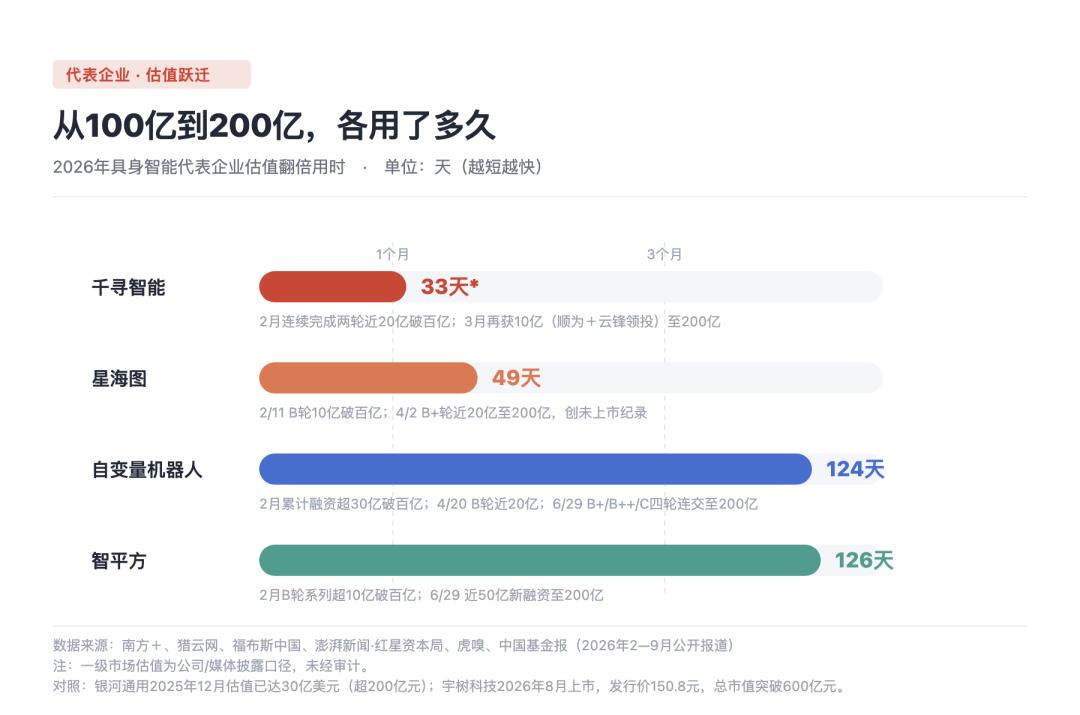
Figure note: Tech Planet's chart made based on public information.
But the growth pushed everyone's FOMO (fear of missing out) emotion to a climax. The long-standing investment rules in the primary market began to loosen. In the past, whether it was autonomous driving or chips, investment institutions were either under the HSG ecosystem or the GL Ventures ecosystem, with clear boundaries. "Now everyone can make money, why should we divide into factions?" said the aforementioned investor.
"In the industry, we classify companies into T0, T1, T2 tiers. HSG, the absolute top-tier player, together with industrial investors like CATL, after they invest in a project, other investors will easily follow. Several investment institutions form a special fund, and the special fund also values the shareholder lineup. The more luxurious the shareholders are, the more guaranteed the listing certainty and return rate look," said a hard technology investor.
More and more people started their own businesses. An investor of a super leading embodied intelligence company in Beijing joined the invested enterprise in March this year. At least eight executives of Li Auto left their jobs to set up embodied intelligence enterprises; the "iron triangle" of Xiaopeng Robotics, Zheng Cunyuan, Shi Xiaoxin and Mi Liangchuan, left one after another within three months to start their own businesses.
"Many of our investor friends basically only pay attention to embodied enterprises that have obtained investment from top-tier institutions, and it is difficult for mid and low-tier enterprises to stand out. Why do embodied companies like to talk about how much financing they have obtained and what leaders have come to visit? Because it is convenient for them to build momentum and endorsements, poach talents, raise more capital, and establish a leading image," said a hard technology investor.
Personnel inside embodied intelligence enterprises are also flowing at a high speed. According to incomplete statistics from Tech Planet, at least 16 management members and core technical personnel of embodied intelligence enterprises have left their jobs to start their own businesses, or joined other embodied intelligence enterprises with higher positions.
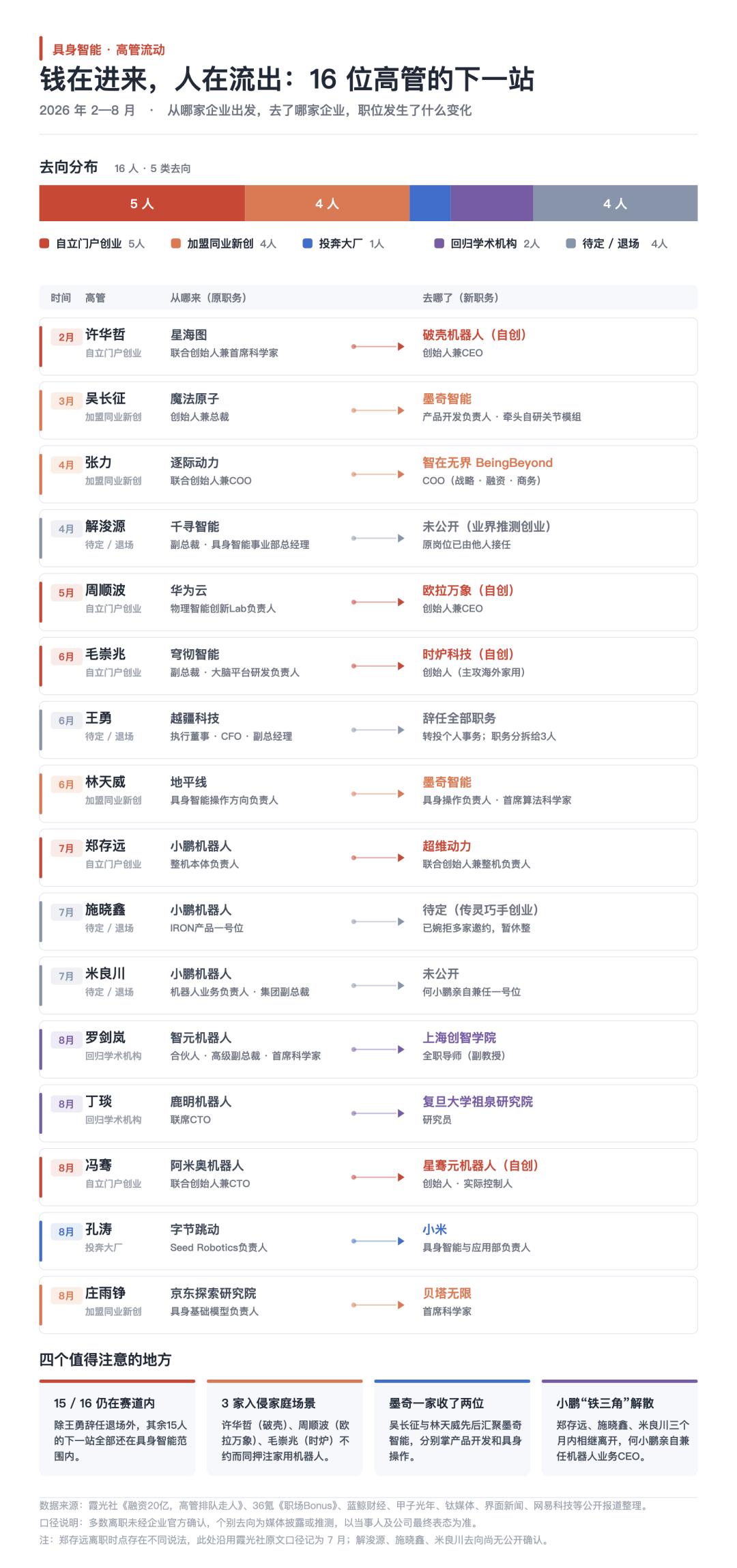
Figure note: Tech Planet's chart made based on public information.
Everyone is going crazy for the dream of physical AI.
03
900 billion yuan in financing, R&D investment is far from enough
Capital is pouring in like running water. According to statistics from IT Juzi, in the first half of 2026, the total financing of domestic embodied intelligence exceeded 900 billion yuan, and there were as many as 22 enterprises with a valuation of over 10 billion yuan.
Employee benefits are also rising. This April, UBTECH publicly recruited the global chief scientist of embodied intelligence, with an annual salary starting at 15 million yuan, up to 124 million yuan; an R&D employee who joined an embodied intelligence company last year said that his income almost doubled when including options; a motion control talent who just graduated with a master's degree in 2024 got an annual salary of nearly one million yuan right after graduation, and by 2026, his external quotation has reached 3 million yuan per year; even for ordinary functional positions, the income has increased by 50%, which is extremely rare in the current employment environment.
According to the 2026 Maimai Spring Recruitment Report, from January to April 2026, the number of embodied intelligence positions increased by 15 times year-on-year, and the average monthly salary of the positions rose from 59,000 yuan to 62,000 yuan.
Hot money is everywhere, but very little of it actually goes to the product and R&D side. "The actual annual R&D investment of some companies is only tens of millions of yuan," an investor told Tech Planet. If calculated based on an investment of 50 million yuan, excluding social security costs, and each R&D staff is paid 1 million yuan per year, 50 million yuan is only enough to pay salaries for 50 people. And Unitree Robotics, the industry benchmark, had a total R&D investment of 145 million yuan in 2025.
"The servers of a very small department in our company are all at the level of tens of millions of yuan, but they are far from enough," said an R&D staff member at an embodied intelligence enterprise.
"These embodied intelligence companies have a common problem: basically everyone is no longer doing real R&D. Very few companies have more than 100 GPUs. It seems that the embodied intelligence industry has raised a lot of money, but the companies themselves know clearly that they cannot achieve commercialization in the short term, so they spend money very carefully. They will not stock up on a large number of GPUs, nor recruit too many R&D personnel to run data and improve model capabilities,"