95% of people are unwilling to pay for AI, and 1% of super players support the entire AI industry.
Interpretation of a16z Report
After tracking consumer-grade AI applications for three full years, renowned venture capital firm a16z has just released its 7th edition of "Top 100 AI Consumer Apps" list. It is thought-provoking that this list ranked by traffic metrics has been completely solidified:
Only 11 new products are listed this time, hitting a record low in history.
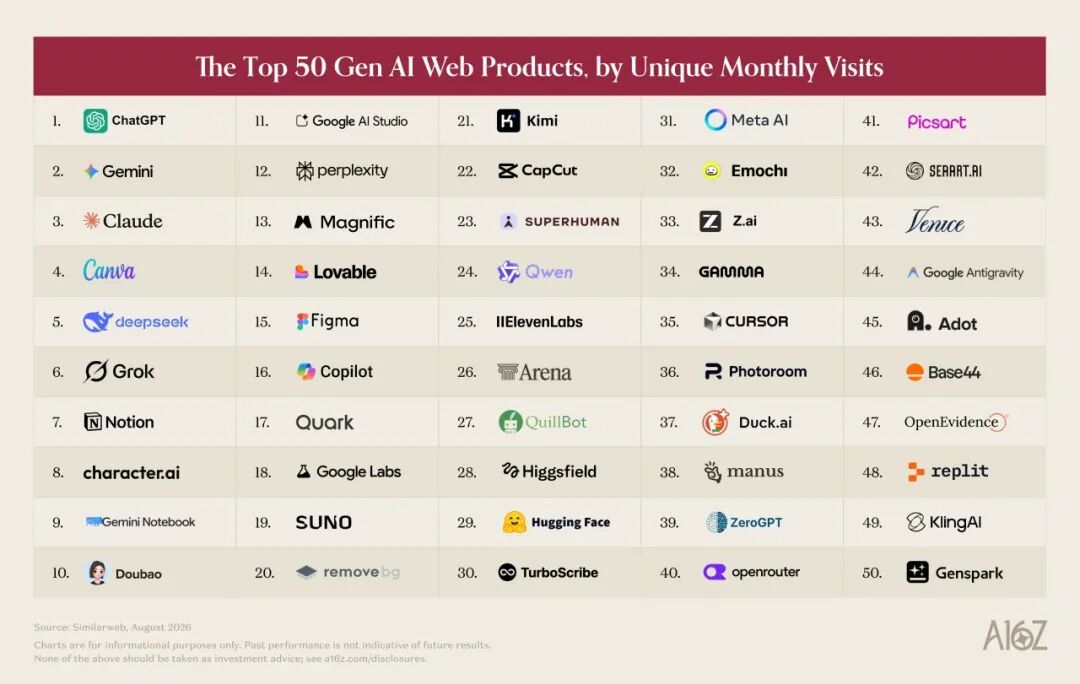
It is not that the most powerful AI models have lost their appeal, but that the "traffic" metric itself has been somewhat distorted. More and more people are quietly using AI on desktop or in traditional internet software, and these behaviors are not included in the statistical caliber of traditional web traffic at all.
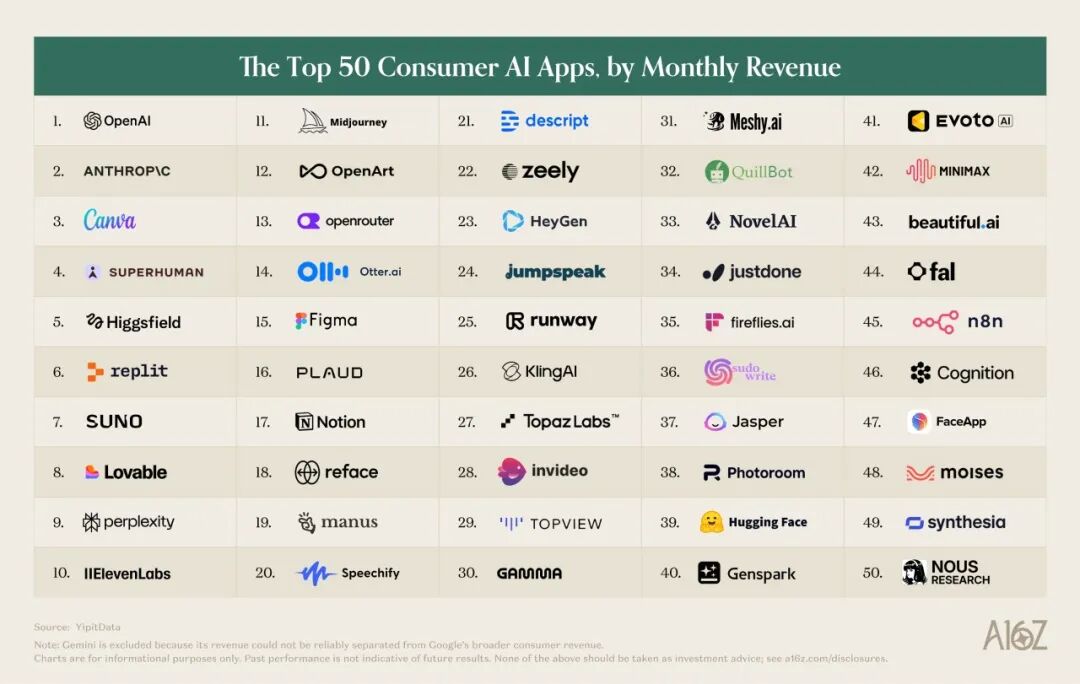
To see the full picture clearly, a16z has for the first time introduced real U.S. consumer credit card spending data sourced from YipitData. This list built with real money reveals an extremely counterintuitive and even somewhat harsh reality in the current AI industry:
AI has attracted massive users, but only a small number of users are willing to pay continuously, and the revenue of manufacturers is increasingly focused on professional users who use AI for work. To break this deadlock, AI manufacturers have also started looking for new revenue sources beyond subscriptions, launching an exploration around "who will pay for AI".
Spending $903 per month, who is supporting the AI empire?
AI has a wide coverage of users, but the engagement depth is surprisingly low.
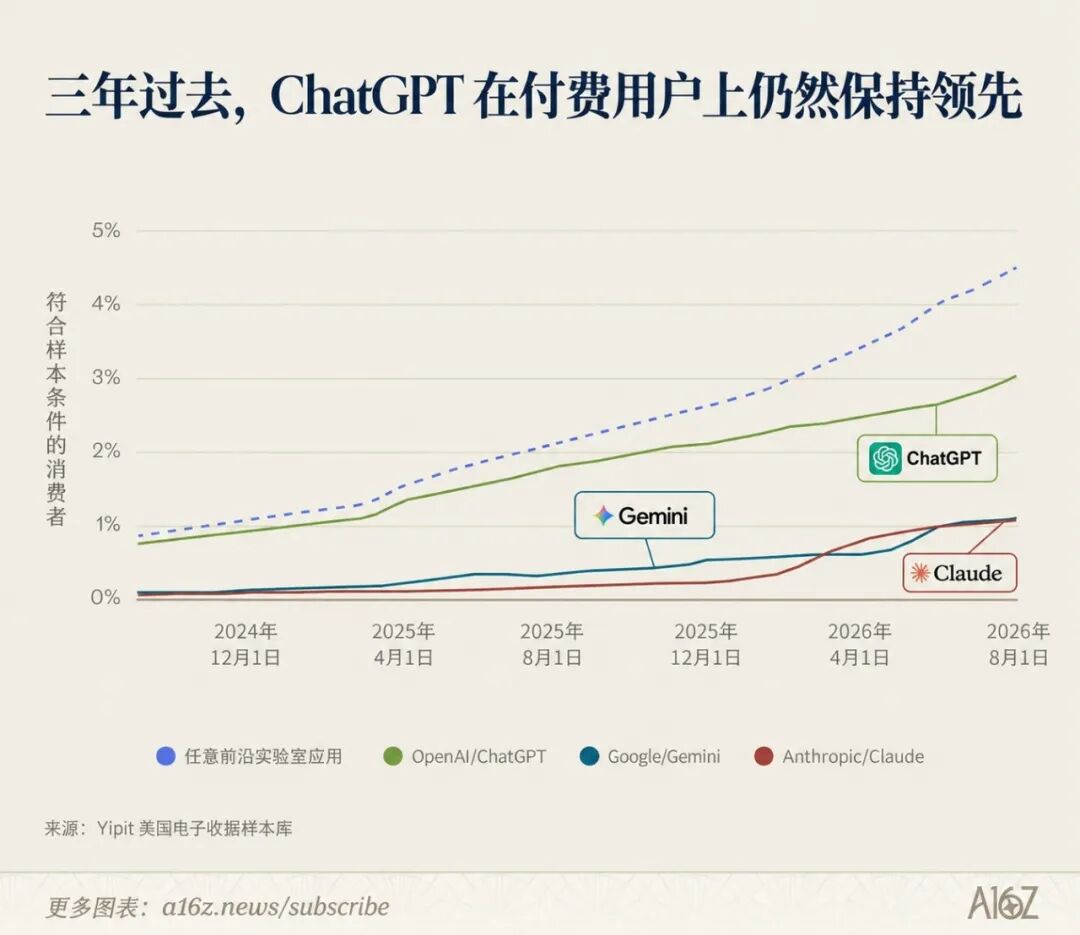
Nearly half of Americans claim they have used AI, but only 25% use it on a daily basis. More strikingly, as of August this year, only 4.5% of consumers actually pay for subscriptions to ChatGPT, Gemini or Claude.
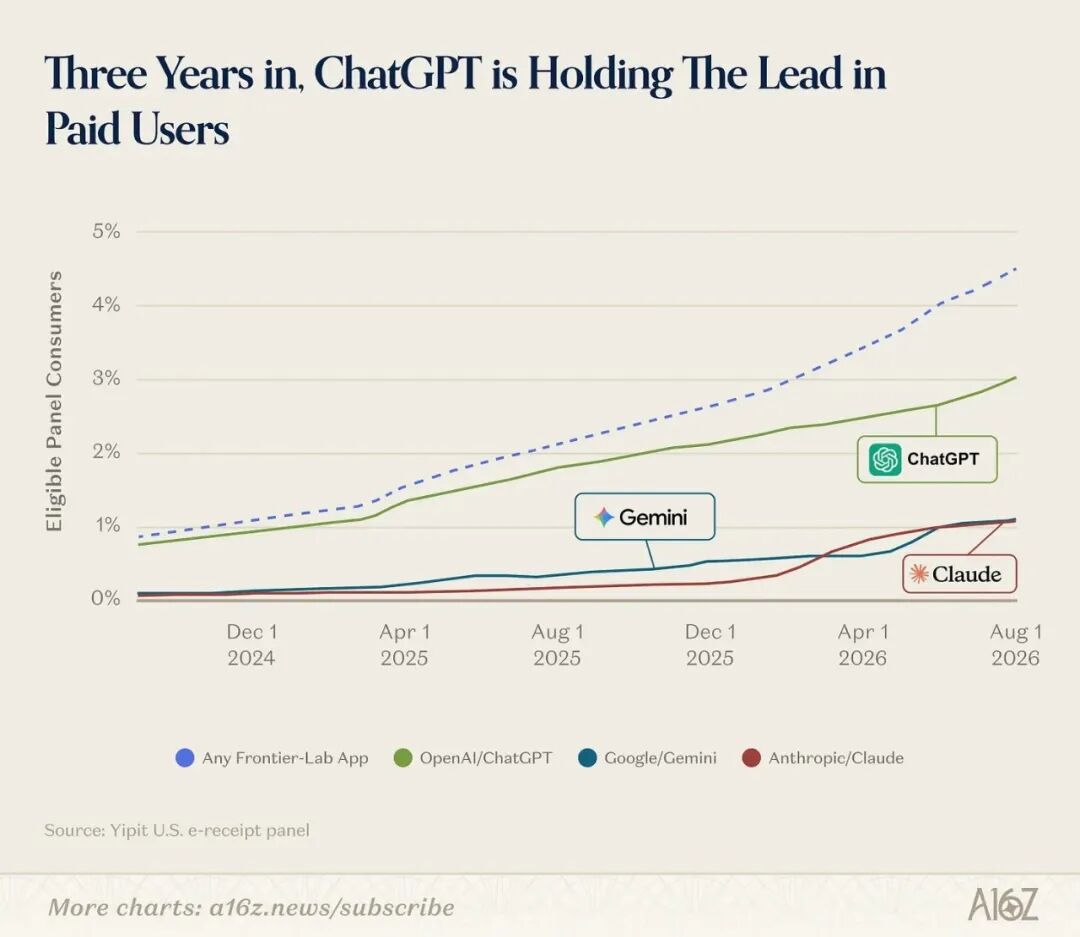
Then who on earth is supporting those AI unicorns whose valuations easily reach tens of billions or hundreds of billions of dollars?
The answer is the top 1% of "super high-paying users" at the peak of the pyramid.
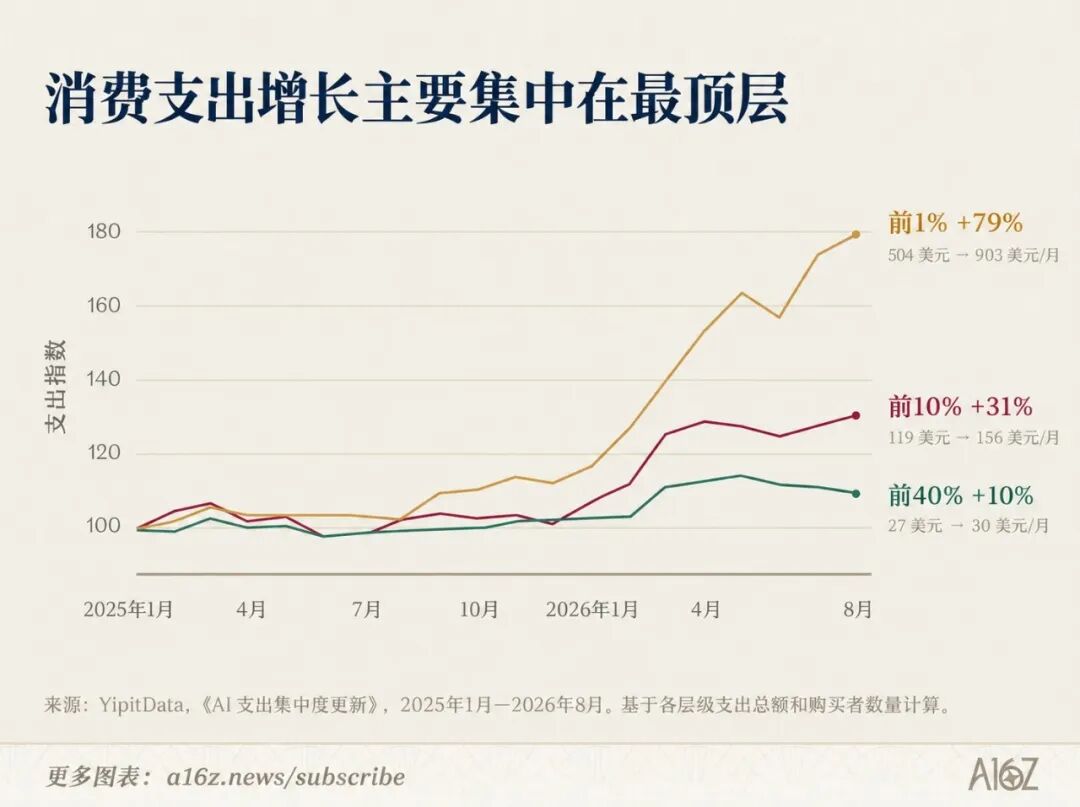
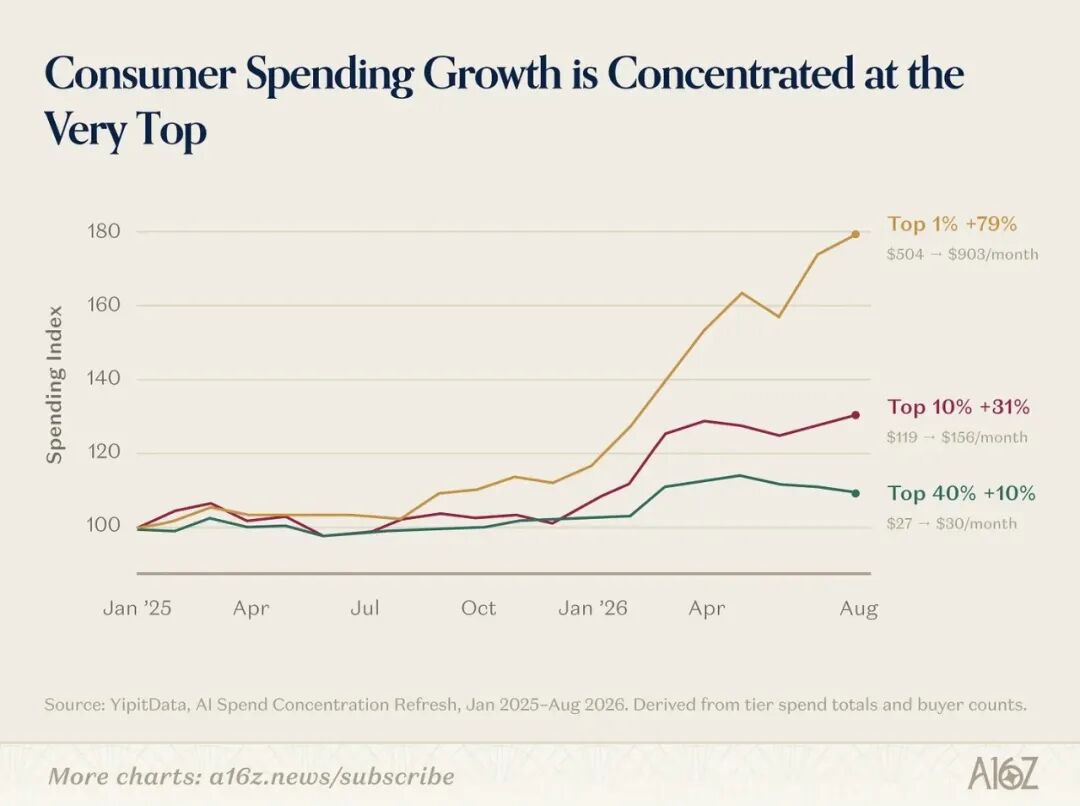
a16z's data shows that the AI consumer market presents an extreme power-law distribution: The top 1% of paying users contribute 19.5% of the revenue of the consumer-grade AI market, which even exceeds the total expenditure of the bottom 50% of users (16.6%).
These top paying users spend a staggering $903 per month (about 6054 RMB) on AI tools, and their total consumption in the past 18 months has surged by 80%.
In contrast, the median ordinary paying user only spends $25 per month, and their budget has barely increased anymore.
While these super users are frantically purchasing automation tools such as n8n and Manus, they are also heavily investing in creative productivity platforms such as Higgsfield, Figma and HeyGen.
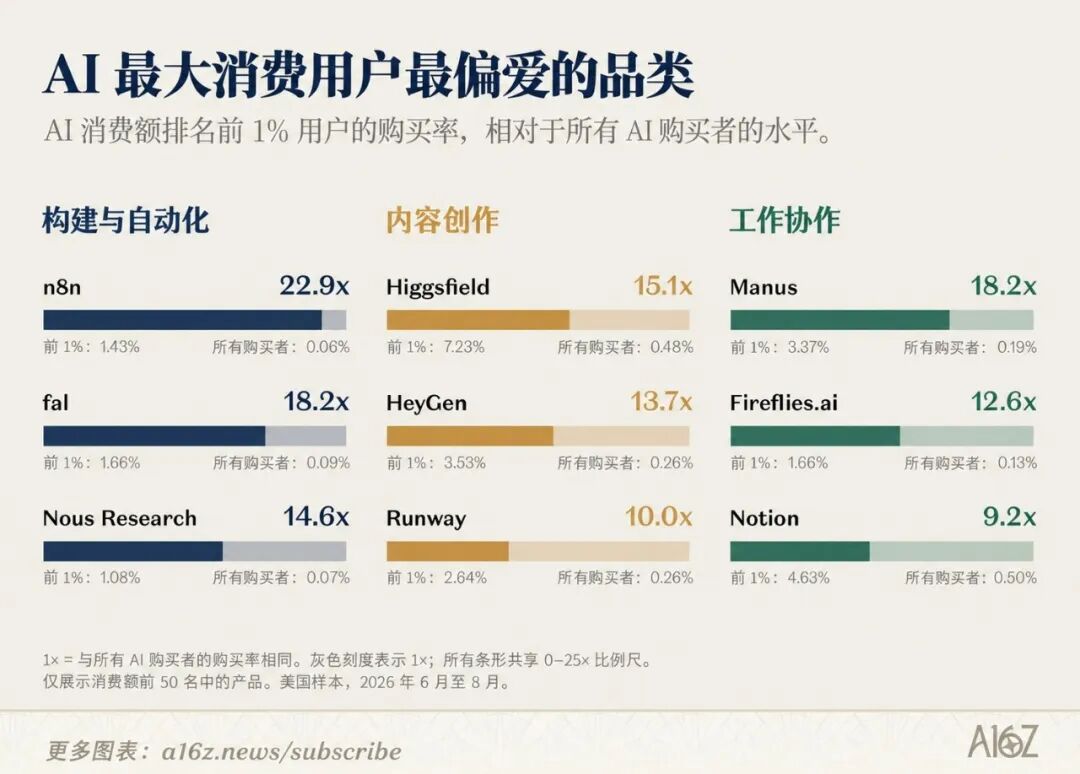
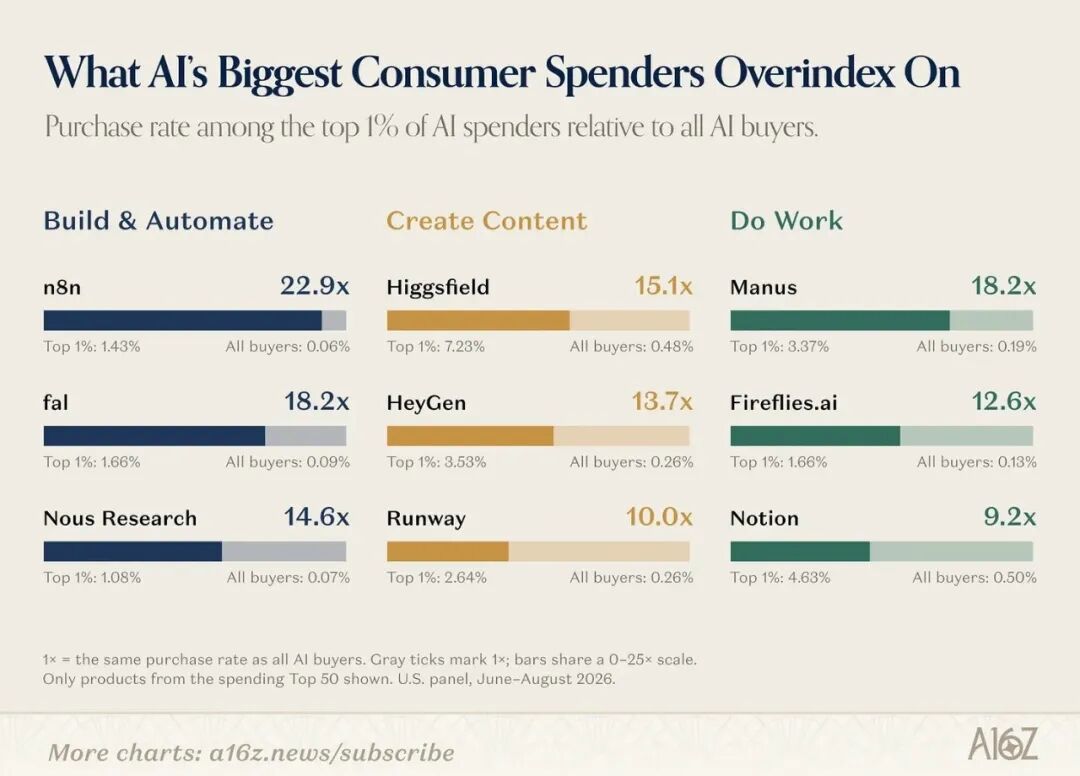
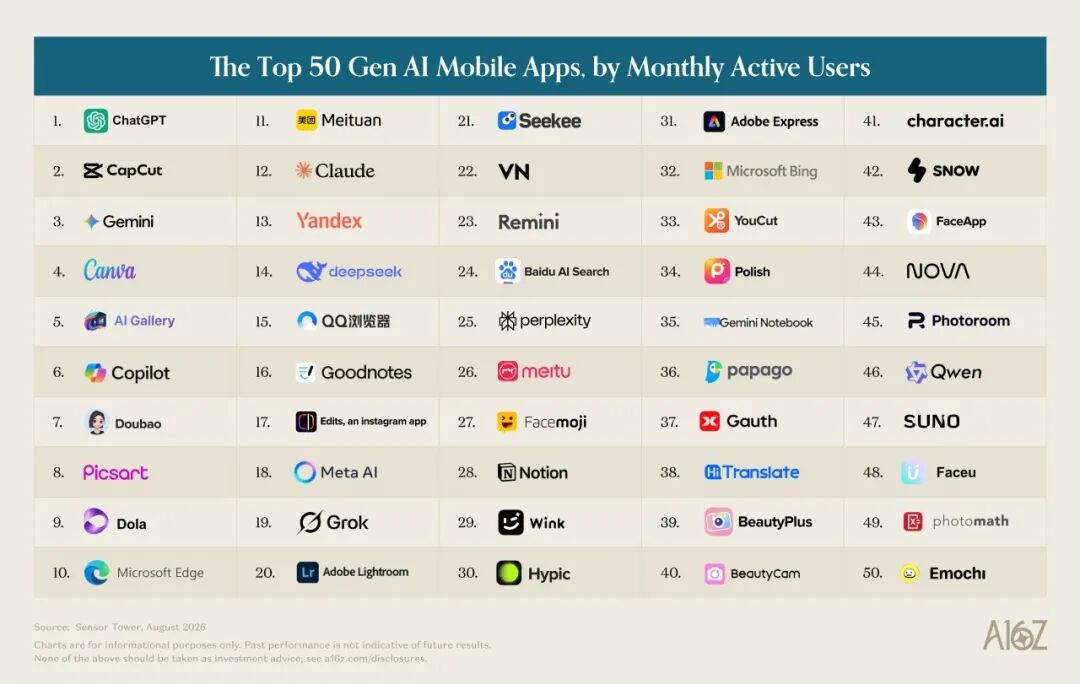
This also explains why there is a huge gap between the "traffic list" and the "revenue list": 29 of the top 50 AI vendors ranked by real consumption do not appear on the traffic list at all.
Among the three major lists of web traffic, monthly active mobile users and real revenue counted by a16z, only 7 companies are on all three lists: apart from the two veterans ChatGPT and Claude, the rest are model company Suno, AI-native apps Perplexity and Photoroom, as well as established giants Canva and Notion.
The vast majority of star products that boast about free traffic cannot even get a seat at the table of real consumption.
Launching 127 products in half a year, Claude staged a comeback through "precision targeting"
Beyond super users, the mass market remains a fierce battlefield for the three giants. To compete for users, Anthropic, Google and OpenAI have frantically released 127 new products in just half a year.
Unsurprisingly, ChatGPT is still the absolute leader.
Whether on web or mobile, its traffic has an overwhelming advantage over Gemini and Claude (its monthly active mobile users are even 14 times that of Claude); in terms of the number of paid subscribers, ChatGPT is 3 times higher than the latter two.
In July this year, with the release of the GPT-5.6 family (Sol, Terra, Luna) and ChatGPT Work, its growth engine started roaring again.
But the most notable variable is the rapid rise of Claude.
In the first version of the list in September 2023, Claude was not even on the radar; now it has not only greatly increased its traffic, but also briefly surpassed the well-funded Gemini in the number of paid users across the United States earlier this year.
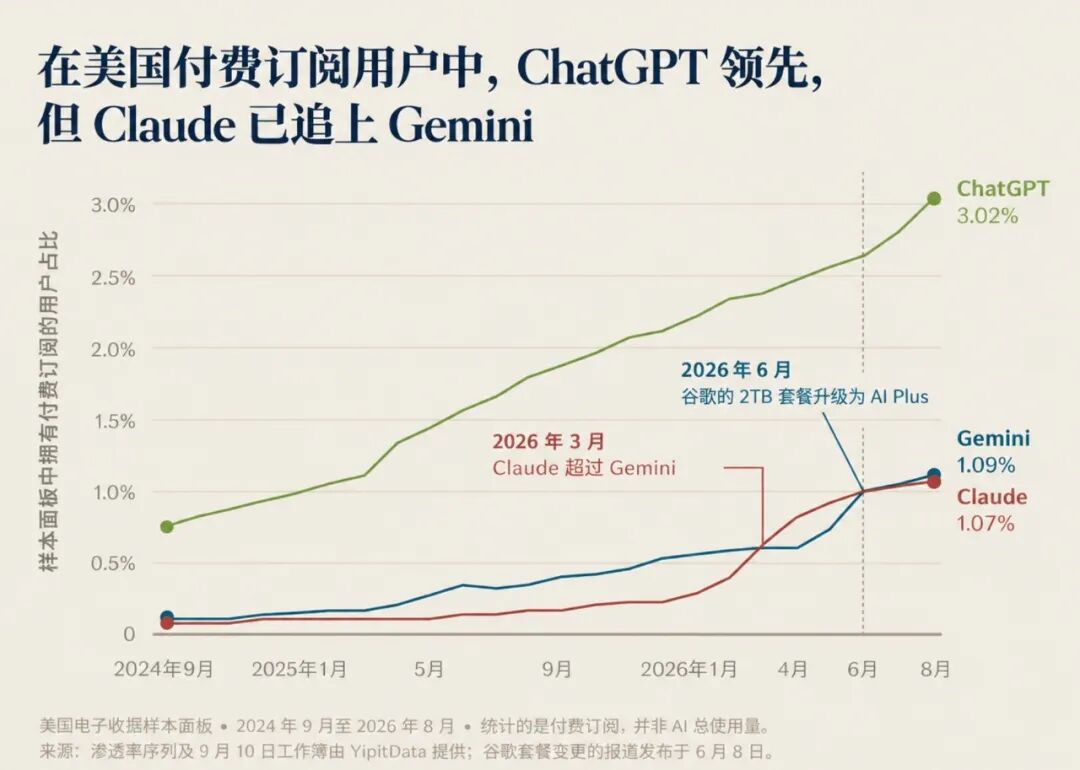
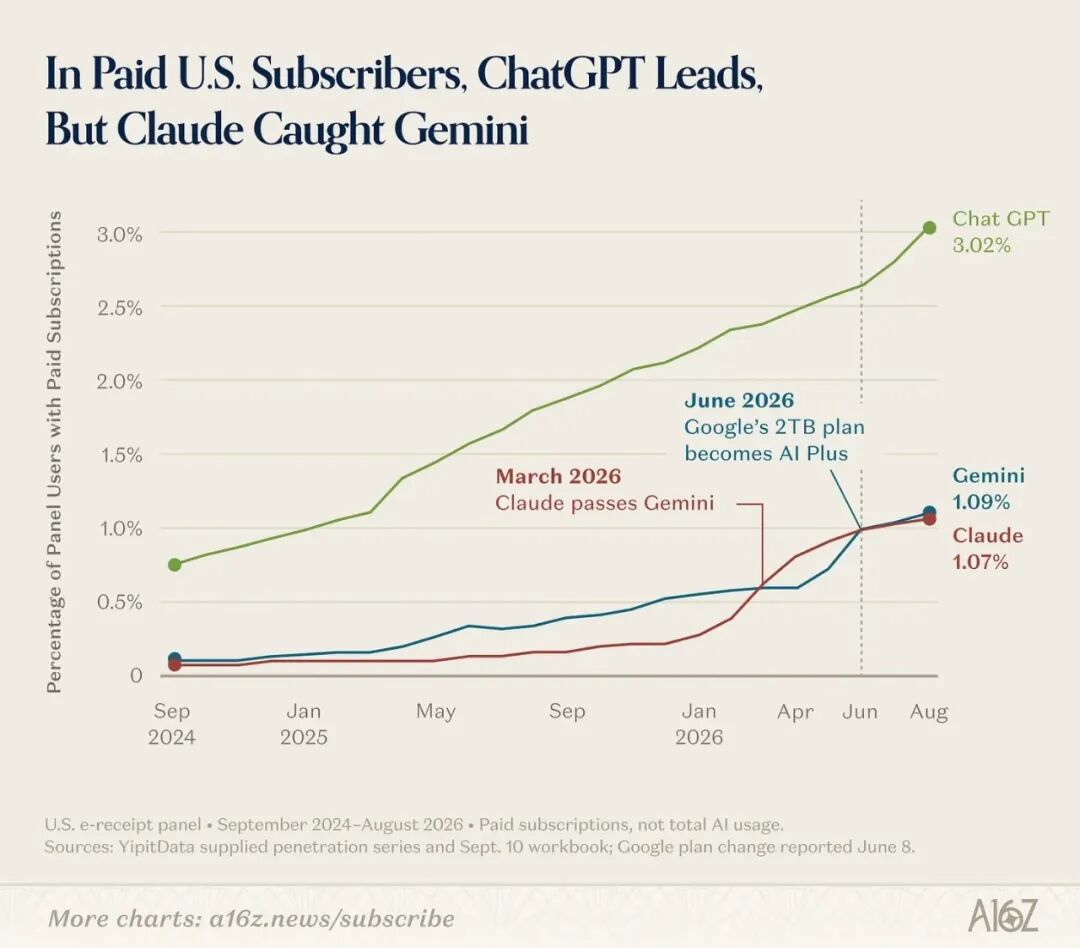
In the final analysis, Anthropic's strategy focuses on achieving miracles through massive investment.
While ChatGPT tries to cover everything (launching personal finance, job hunting and even health tools), and Google is focusing on creative models (Lyria 3 Pro, Gemini Omni), Claude has almost devoted all its energy to professional consumers (Claude Design, Code Review).
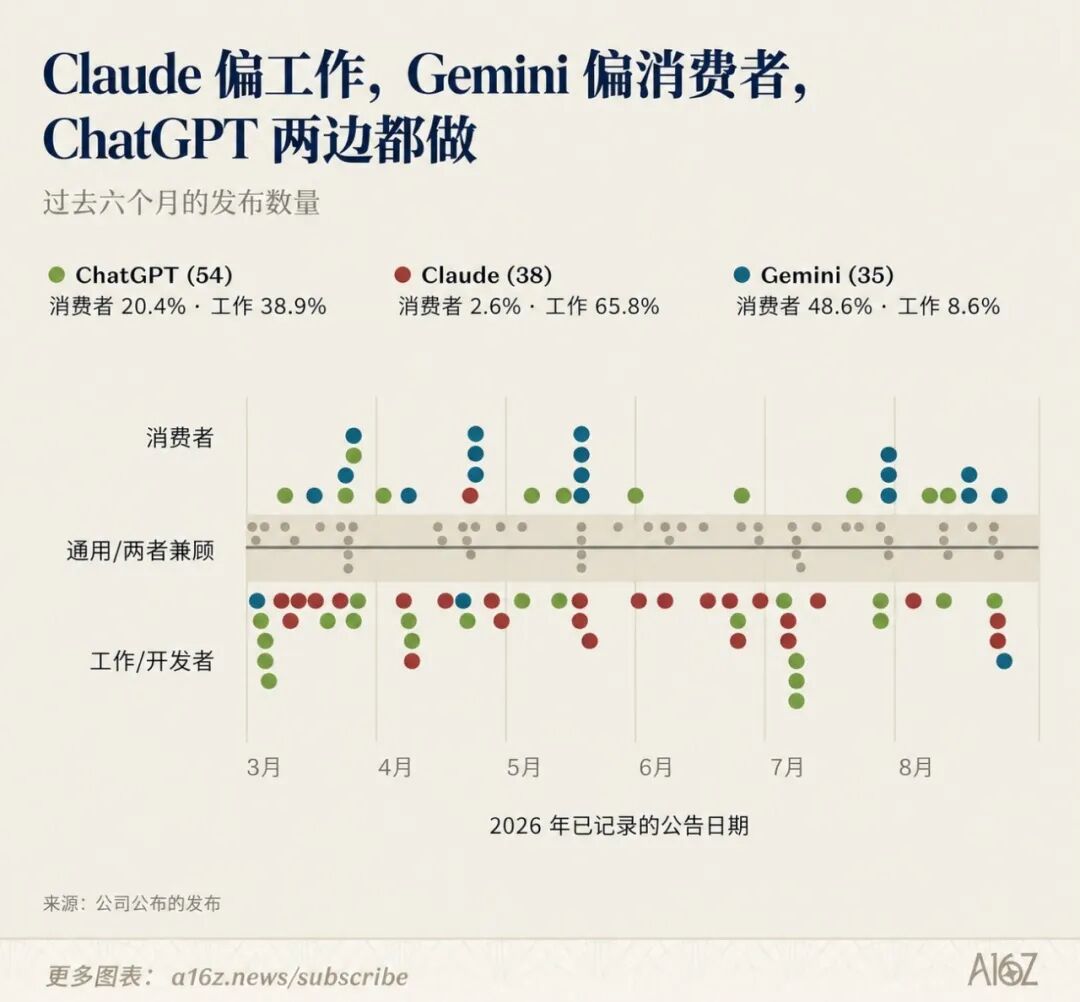
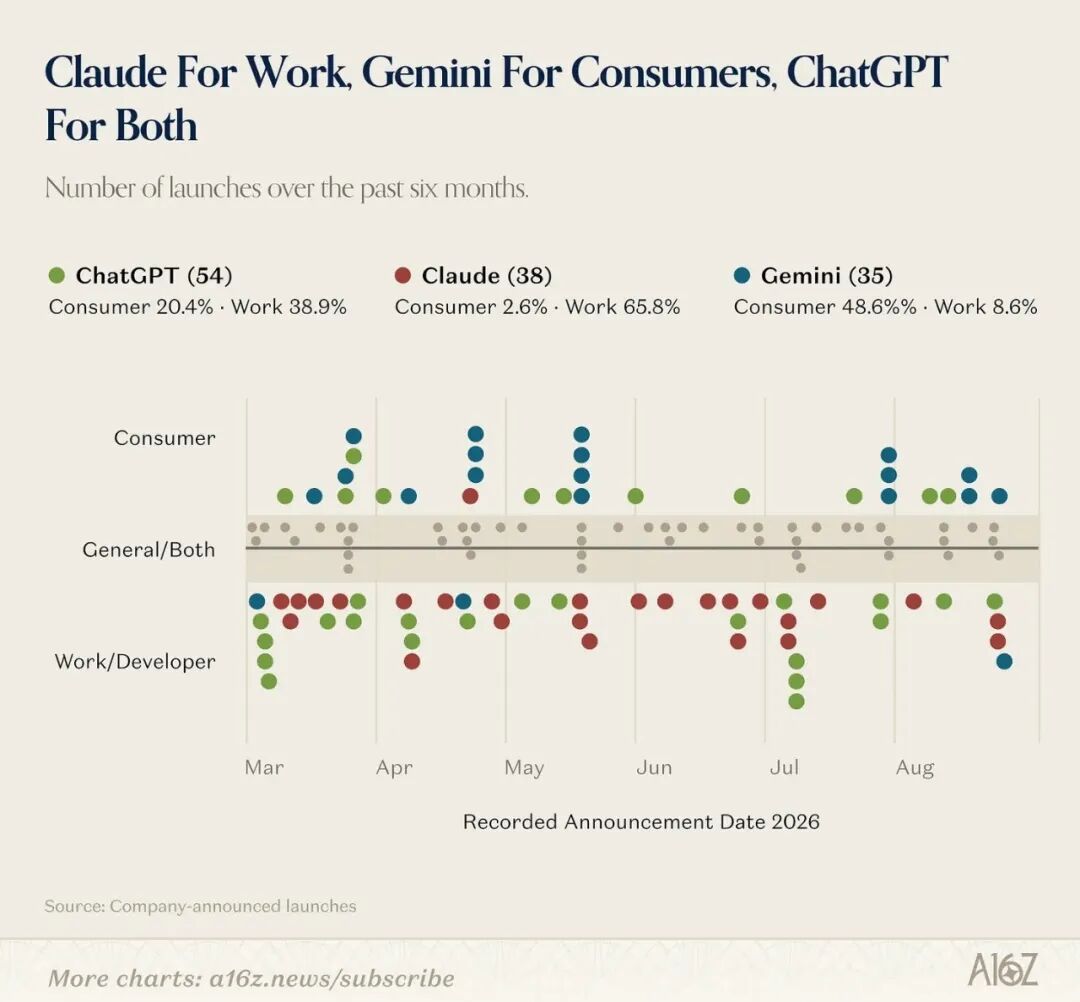
In addition, Anthropic has explicitly stated that it will never get involved in advertising, and with its excellent models, C-end user subscriptions are also becoming an important source of revenue.
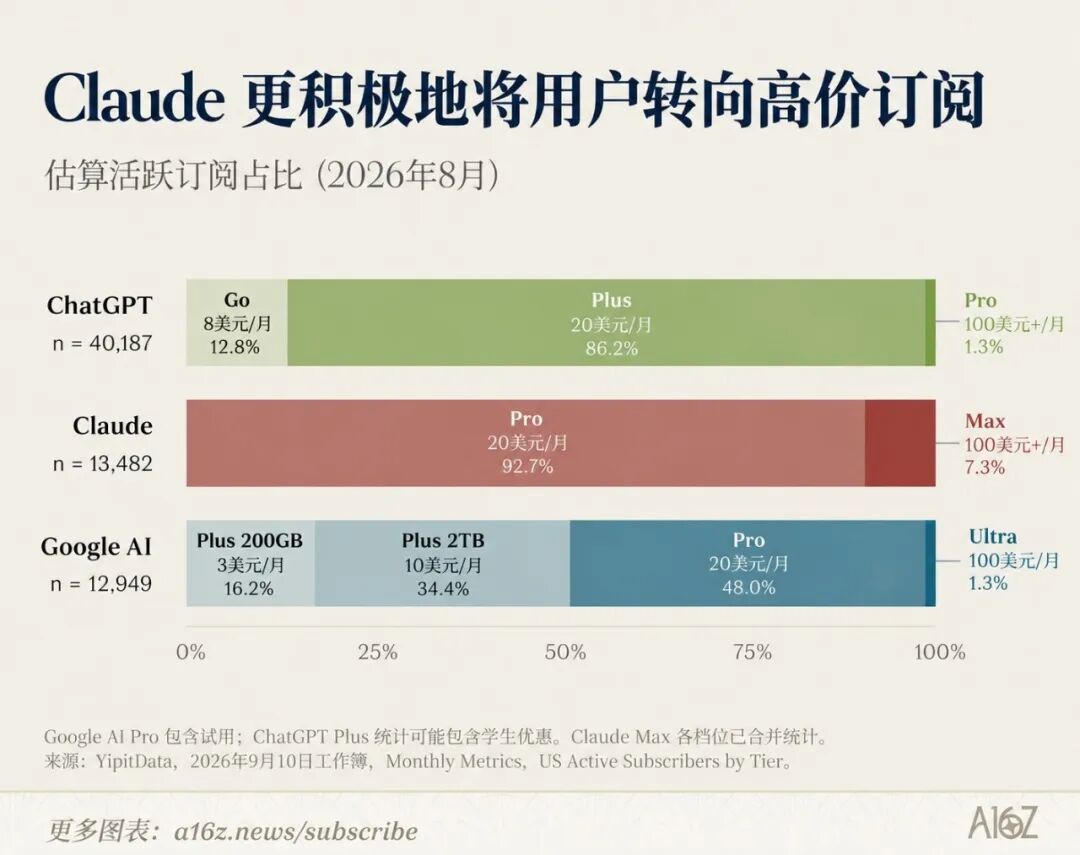
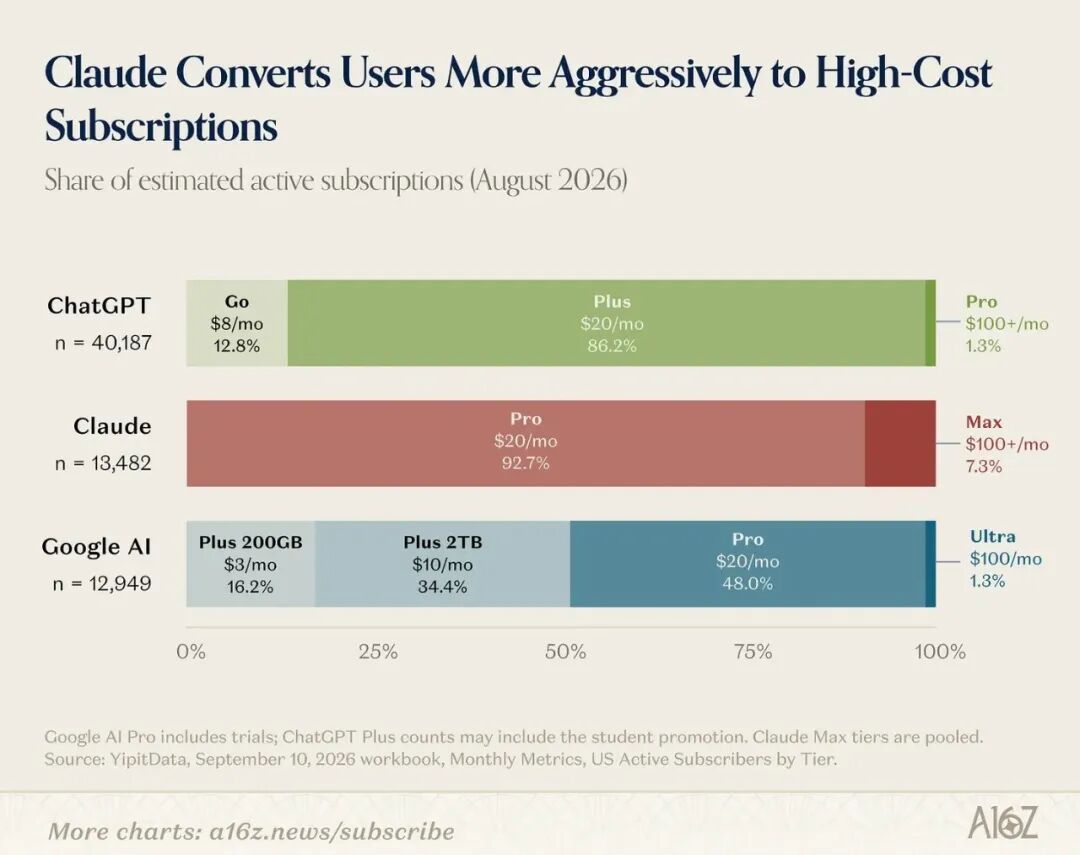
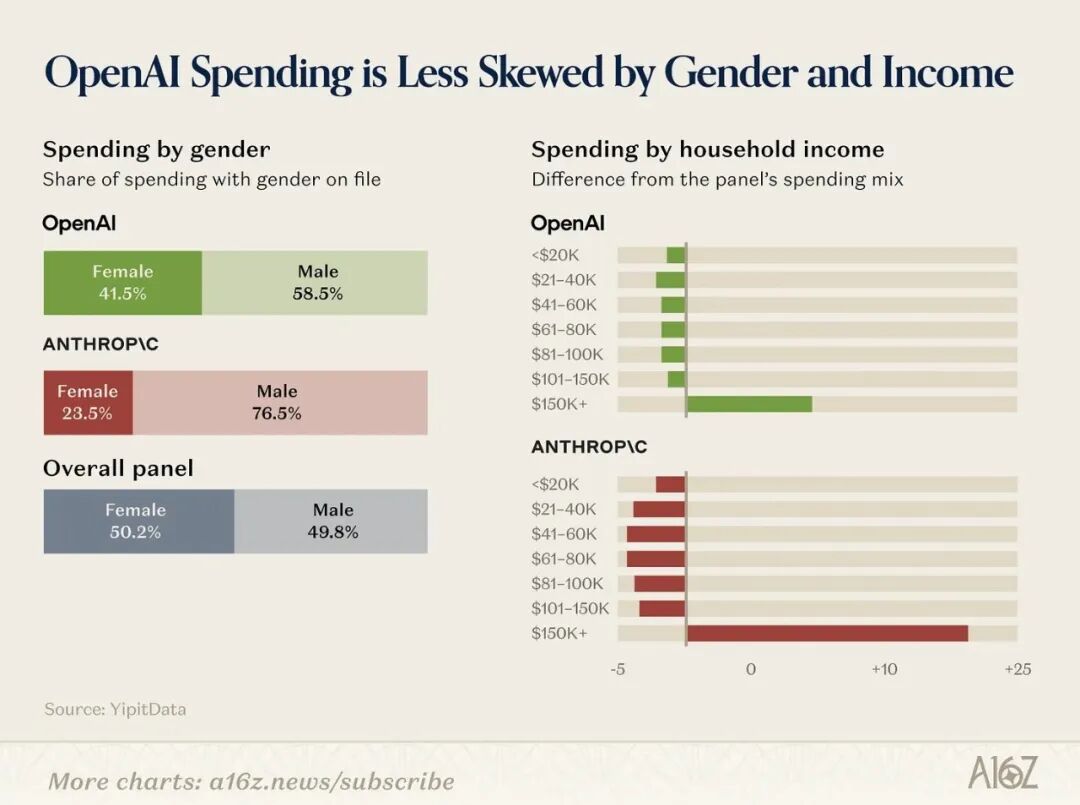
Among Claude's highest-tier personal subscription plan priced at $100 per month, 7.3% of paying users have chosen to subscribe; by comparison, the conversion rates of Google and ChatGPT for plans at the same price point are only 1.3% and 1.1% respectively.
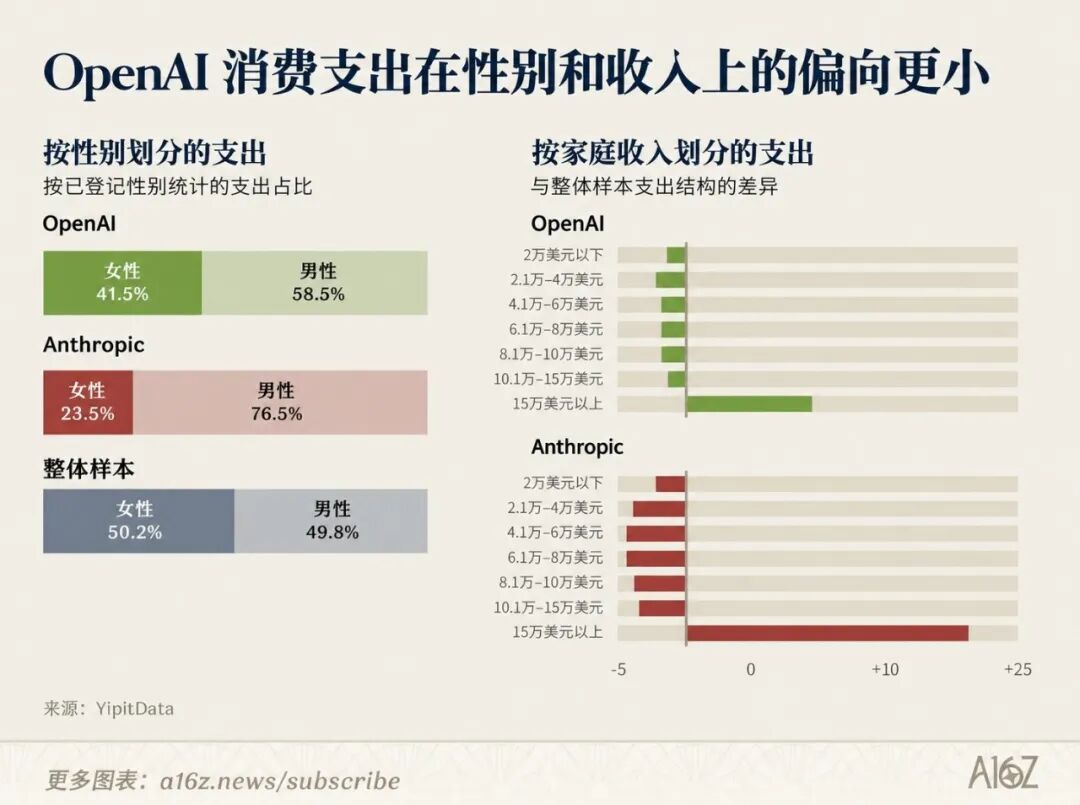
In addition, data shows that only 8% of ChatGPT subscribers also subscribe to Claude.
How can startups escape the crushing pressure from tech giants?
When traffic is drained by players like ChatGPT, and traditional SaaS giants such as Superhuman and Canva seamlessly embed AI into existing workflows, the living space left for startups is being infinitely compressed.
But it is not impossible to survive under the shadow of giants, and a16z has summarized four pieces of experience for this:
First, master exclusive differentiated models.
No matter how powerful the general large model is, it cannot achieve ultimate performance in specific vertical fields, and Suno (ranked 19th in traffic, 7th in revenue) and ElevenLabs are the best proof. For creators, unique visual styles, sound textures or proprietary training data are all worth paying for.
Second, if you can't beat them, integrate with all of them.
The hit code editor Cursor (whose ranking has soared to 35th) supports calling models from multiple labs. For users, being able to freely switch to the most suitable model according to specific tasks is far more pleasant than being locked into the ecosystem of a certain giant.
Third, dive into the "hidden corners" that giants are unwilling to touch.
Compliance policies and privacy concerns are exactly the moat for startups: OpenEvidence, which focuses on medical privacy, has penetrated 50% to 60% of doctors in the United States; those NSFW (adult content) AI applications that are deliberately excluded from this issue's list actually account for more than 20% of the share on the traffic list.
Markets that giants dare not sink into for the sake of their reputation are exactly the hotbeds for vigorous growth.
Finally, since software entrances are occupied by Google Docs and ChatGPT, seize the physical entrances. For example, AI recording hardware Plaud, with its "device + subscription" model, directly ranks 16th on the consumer spending list.
Giants are also acting quickly: Meta has integrated Muse into smart glasses, and even developed AI digital pets; OpenAI's acquisition of io Products