The chemotherapy group delivered an unexpectedly outstanding performance, dealing a heavy blow to Allist's global ambitions.
On October 6, 2026, an announcement from the other side of the ocean suddenly cast a pall over China's innovative drug industry.
ArriVent Biopharma, the international partner of Allist, announced the top-line data of the global Phase III FURVENT trial of furmonertinib: the primary endpoint did not meet statistical significance, the median PFS evaluated by BICR (Blinded Independent Central Review) was 11.0 months (240mg group) versus 9.5 months (chemotherapy group), HR 0.75, P=0.0654, which did not reach the preset statistical significance threshold (usually p<0.05). On the day the news was released, ArriVent's share price plummeted by nearly 47%, and its market value was almost cut in half.
For Allist, this is far more than a stock price fluctuation of an overseas partner. What it has lost is a time window that is rapidly closing. Behind this window lies an area that global pharmaceutical giants have repeatedly competed for, investing billions of dollars, yet a large number of patients still have no access to effective drugs to date — non-small cell lung cancer (NSCLC) with EGFR exon 20 insertion mutation (exon20ins).
To understand exactly what Allist has lost, one must first understand how tough this "hard bone" is.
01
exon20ins: A notoriously tough nut to crack
Today, when therapies for NSCLC (non-small cell lung cancer) are already very mature, EGFR exon20ins remains a blue ocean market.
exon20ins is the third most common EGFR mutation subtype in NSCLC, accounting for about 10% of all EGFR-mutated NSCLC cases. In the United States, there are approximately 1,500 to 2,500 newly diagnosed patients each year. The absolute number is not large, but there has long been a dilemma of "no available effective drugs" for these patients.
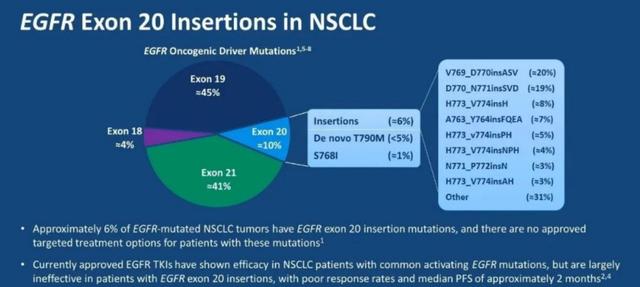
Figure: Proportion of various EGFR mutations, Source: Southwest Securities
The core reason lies in the change of the three-dimensional structure of the EGFR protein. exon20ins inserts amino acid sequences, which alters the spatial conformation of the ATP binding pocket. Traditional first-generation, second-generation and third-generation EGFR-TKIs all inhibit kinase activity by competitively binding to the ATP pocket, but the conformational change caused by exon20ins makes it difficult for these drugs to bind effectively. The vast majority of exon20ins subtypes show primary resistance to traditional TKIs.
What is more tricky is that exon20ins is not a single mutation and has high heterogeneity. More than 60 known activating insertion variants have been identified so far, which can be divided into three categories according to the insertion position: C-helix region, near-loop region and far-loop region. A multicenter retrospective study including 124 patients showed that insertions in the near-loop region accounted for 71%, those in the far-loop region accounted for 22%, and those in the C-helix accounted for only 7%. Different insertion sites and sequences have completely different effects on drug binding, which means it is difficult for one drug to cover all subtypes effectively.
In addition, diagnosis itself is also a major barrier. Due to the wide variety of exon20ins variants, conventional PCR testing often only covers the most common subtypes, leading to high risk of missed detection. NGS sequencing is a necessary condition for accurately identifying all exon20ins subtypes, but the accessibility of NGS is still limited in many primary medical institutions. A patient may carry a targetable exon20ins mutation, but be treated as "wild-type" due to the limitation of testing methods, missing the opportunity for precise treatment.
Combining the above factors, exon20ins was once regarded as an undruggable hard nut.
02
The Peak: First-line monotherapy
There is a well-known saying in the oncology track: The one who dominates the first-line indication wins the whole market.
No matter how well a drug performs in clinical trials, its value will be greatly reduced if it cannot enter the first-line indication, and the first-line indication for EGFR exon20ins is currently short of monotherapy options. The largest cake in this segment market has not yet been claimed by any player.
Janssen's amivantamab is not only the first targeted drug for exon20ins to be approved, but also the only drug currently approved for first-line indication.
In May 2021, based on the data from the CHRYSALIS trial, amivantamab received accelerated approval from the FDA for exon20ins patients who had progressed after platinum-based chemotherapy, becoming the first targeted drug in this field. Later in 2024, Janssen verified the advantages of amivantamab combined with carboplatin plus pemetrexed over chemotherapy alone through the Phase III PAPILLON trial: the median PFS was 11.4 months versus 6.7 months, reducing the risk of disease progression or death by 60% (HR 0.40). What is more remarkable is the final OS analysis: the median OS of the combination regimen reached 34.3 months, compared with 27.9 months in the chemotherapy group, extending by about 6 months. This is the longest median OS reported to date in the exon20ins field.
However, amivantamab needs to be combined with chemotherapy, requires intravenous administration, and its treatment cost is also extremely high, which to a certain extent constitutes a barrier to access for patients. This is exactly why the first-line indication of EGFR exon20ins is short of monotherapy options.
The first player that accurately targets this unmet clinical need is AstraZeneca. With the continuous strong sales of osimertinib, AstraZeneca has built a strong competitive moat in the NSCLC field, but it has never managed to capture the EGFR exon20ins indication, which has become the Achilles' heel of AstraZeneca.
To continuously strengthen osimertinib's dominance in the NSCLC field, AstraZeneca acquired the global rights of sunvozertinib from Dizal Pharma in July 2026 with a $600 million upfront payment and up to $900 million in milestone payments, with a total potential transaction value of $1.5 billion, setting a new record for the highest upfront payment for domestic Chinese small molecule targeted drugs.
The reason why AstraZeneca is willing to invest such a huge sum of money is that it values the great potential of sunvozertinib. In July 2025, sunvozertinib received accelerated approval from the FDA, successfully obtaining the second-line indication for exon20ins, becoming the only oral drug approved in the United States for exon20ins. Meanwhile, the WU-KONG28 trial of sunvozertinib for the first-line indication has also successfully met its primary endpoint: median PFS assessed by BICR was 10.3 months versus 7.5 months, HR 0.65, P=0.0008; confirmed ORR was 58.9% versus 31.1%, median DoR was 11.2 months versus 7.1 months.
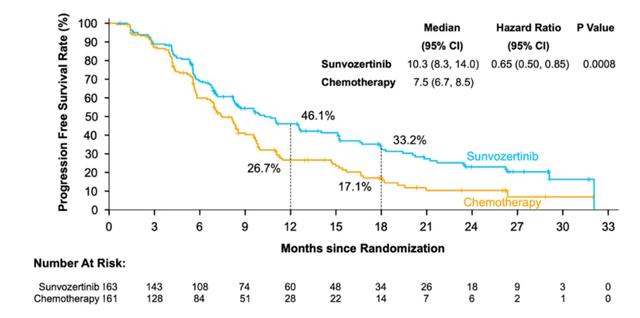
Figure: Data of the WU-KONG28 study of sunvozertinib
The core selling point of sunvozertinib lies in the upcoming realization of the expectation of oral first-line indication. Its supplemental New Drug Application (sNDA) was accepted by the FDA on August 30, 2026. In the NSCLC field, AstraZeneca has a complete and mature commercialization team. Once sunvozertinib successfully obtains the first-line indication, AstraZeneca is expected to continue its strong dominance in the exon20ins field, and advance its strategic layout of "super osimertinib".
Another player targeting this market is zipalertinib from Cullinan. Although zipalertinib is also an oral drug, it did not follow the path of sunvozertinib, but chose to combine with chemotherapy to target the first-line market, directly competing with Janssen's amivantamab. Data from the Phase III REZILIENT3 trial show that the median PFS of zipalertinib combined with chemotherapy reached 14.5 months, compared with 8.5 months in the chemotherapy group, HR 0.50, P=0.00015, which is the longest PFS reported to date in the first-line exon20ins field.
Cullinan has initiated rolling submission of NDA through the FDA's Real-Time Oncology Review (RTOR) pathway in October 2026, and the drug is very likely to be launched in the near future. However, zipalertinib currently does not focus on clinical development for first-line monotherapy indication, and it remains unknown whether it will follow up on the first-line monotherapy indication later.
Based on the analysis of the current competitive landscape, all players are targeting the oral market of the first-line indication, and the first-line monotherapy indication is undoubtedly the peak of EGFR exon20ins.
03
Why did furmonertinib fail?
Back to the FURVENT trial data itself. Why did furmonertinib fail? The most likely reason lies in the flawed trial design.
First look at the trial group, the median PFS of the 240mg group was 11.0 months, and the ORR was 60%. This set of data is not poor in any exon20ins trial. Compared with sunvozertinib's 10.3 months and 58.9%, it even has a slight advantage; compared with amivantamab's 11.4 months in the combination chemotherapy regimen, it is also at the same level. But since there is no head-to-head comparison between different trials, simply comparing the data of the trial groups does not make much sense.
When the control groups are both chemotherapy, the comparison between the trial group and the control group is more meaningful, and the problem of the FURVENT trial lies in the control group. The median PFS of the chemotherapy group, assessed by BICR, reached 9.5 months, which is significantly higher than the historical data of chemotherapy control groups in previous trials.
A systematic literature review and meta-analysis summarized the efficacy of first-line chemotherapy for exon20ins patients: the pooled PFS was 5.6 months, and the pooled ORR was 25.7%. Another study reported that the ORR of first-line chemotherapy was 19.2%, and the median PFS was about 4.5 to 5.7 months. Real-world data also points to a PFS range of 5 to 6 months.
Even considering the "trial effect" that may be brought by factors such as trial enrollment screening, imaging evaluation quality, and follow-up density, the PFS of the chemotherapy group reaching 9.5 months still far exceeds historical expectations. BTIG analysts clearly pointed out in their comments that the failure of FURVENT did not stem from insufficient efficacy of furmonertinib, but from the fact that the performance of the chemotherapy control group was significantly better than historical expectations — the estimated value was 7.5 to 8 months, but the actual value reached 9.5 months.

Figure: Overview of FURVENT trial data, Source: Company official website
The data within the same trial also confirms this point. The PFS of the chemotherapy group assessed by investigators was only 7.1 months, while the PFS of the chemotherapy group assessed by BICR was 9.5 months. The 2.4-month gap between the two exactly constitutes the watershed between the success and failure of the trial. The PFS of the furmonertinib 240mg group assessed by investigators was 11.1 months, which is highly consistent with the 11.0 months assessed by BICR, indicating that the efficacy evaluation of the furmonertinib group is stable; the problem lies in the "generous" evaluation of the chemotherapy group by BICR.
Comparing with sunvozertinib's WU-KONG28, the median PFS of the trial group was 10.3 months, which is basically equivalent to furmonertinib's 11.0 months; but the PFS of sunvozertinib's chemotherapy control group was 7.5 months, which forms a sharp contrast with furmonertinib's 9.5 months. The efficacy of the trial groups in the two trials is close, but the outcomes are completely different.
Many investors may feel sorry for furmonertinib, believing that its own efficacy is strong enough, but it just encountered a chemotherapy arm that performed "exceptionally well". However, the exact reason for this result does not actually matter, because furmonertinib has already lost the opportunity to be the first to reach the peak of oral first-line indication, which is the biggest market expectation for furmonertinib's global market.
04
The cost of radical strategy
Furmonertinib skipped the second-line indication and directly moved to the first-line trial, with a very clear strategic intention: to seize the market window of "oral monotherapy, chemotherapy-free".
The key to this window is in the hands of sunvozertinib. The success of WU-KONG28 means that sunvozertinib may become the world's first oral monotherapy TKI approved for first-line treatment of exon20ins. Its sNDA with the FDA has been accepted, and the application to China's NMPA has also entered the priority review process.
However, furmonertinib has not obtained any marketing approval in the United States so far. Originally, the first-line treatment of exon20ins was furmonertinib's biggest opportunity, but with the recent announcement of the failure of the FURVENT trial, this expectation has been completely dashed. Of course, furmonertinib can choose to fall back to the international second-line indication. After all, this indication was already approved in China in February this year, but under the joint siege of sunvozertinib and AstraZeneca, how much return can the second-line indication bring?
After this battle, the competition for the first-line indication of exon20ins has become very clear.
Combination chemotherapy and oral monotherapy belong to two different dimensions of competition. Oral monotherapy shifts the toxicity profile from myelosuppression to manageable EGFR-related toxicities, and allows once-daily oral administration, which are all real advantages; but it raises the logical difficulty of the trial by an order of magnitude: the monotherapy must beat chemotherapy on its own, rather than adding an extra layer on top of chemotherapy. Amivantamab and zipalertinib are competing head-to-head in the chemotherapy combination track, while AstraZeneca relies on sunvozertinib to exclusively occupy the first-line oral monotherapy indication.
After the failure in the first-line exon20ins indication, furmonertinib has very few retreat options left. Although ArriVent said it is evaluating the full dataset to determine the most appropriate development path, the reality is that the largest piece of cake in the overseas market has already been lost.
What exactly did Allist lose? It originally licensed furmonertinib to ArriVent for a low upfront payment of only 40 million US dollars, in pursuit of the subsequent $765 million in milestone payments, but now this expectation is very difficult to realize. At the same time, furmonertinib has also lost the qualification to compete for the international first-line exon20ins market