Can small county towns properly handle the overwhelming traffic surge brought by the two consecutive holidays?
This year, the overlapping of the Mid-Autumn Festival and National Day holidays with paid leave arrangements has created an extra-long time window of "taking 3 days off work to get 13 consecutive days of rest", which has also led to an unprecedented boom in the tourism market. In particular, many little-known small towns across the country have been forced to implement visitor flow limits due to overwhelming crowds.
During the National Day holiday, the phrase "reverse tourism turned out to be nothing but a letdown" became a hot topic of public discussion throughout the vacation. Data from Qunar shows that the number of hotel reservations in county-level destinations during the Mid-Autumn Festival and National Day holidays surged by 35% year on year, with the growth rate of hotel reservations in popular counties in regions including Xinjiang, Tibet, Qinghai-Gansu region, and Western Sichuan exceeding 50%. The top 10 most popular scenic spots across the country are all located in small towns, including Gexian Village in Shangrao, Haotou Old Street Scenic Area in Tangshan, Hebei, and Wanshan Martial Arts City in Kaifeng, Henan.
Over the past few years, a growing number of people have given up popular big cities and turned their attention to previously little-known county towns, gradually turning "rushing to counties" from a "reverse trend" into a mainstream fashion. These small county towns are also sparing no effort to seize the opportunities brought by the extra-long holidays, trying to gain greater economic benefits from the tourism boom.
It is the county towns' turn to drive the overall cultural and tourism market
As the holiday approached, Ye Zhen, an office worker who has worked in Wuhan for many years, has already made a road trip plan with Yixian County, Anhui Province as her destination. She plans to visit Hongcun Village first to enjoy the night view, then go to Lucun Village to watch the sunrise the next morning, visit Bishan Village in the afternoon, stroll around nearby small villages on the third day, and finally arrive at Yixian County in the evening to taste the famous stinky mandarin fish.
Avoiding internet-famous cities and popular scenic spots, choosing less crowded and distinctive county towns to slowly experience local customs and culture, is becoming the consensus of more and more people.
This year's May Day holiday, according to the *2026 May Day Travel Trend Report* released by Tongcheng Travel, the booking popularity of travel products related to county-level destinations increased by 128% year on year, outpacing the growth rate of most provincial capitals. Among them, Pingtan in Fujian, Anji in Zhejiang, Yangshuo in Guilin, Libo in Guizhou, Pingyao in Shanxi, and Jianshui in Yunnan ranked among the top 10 most popular destinations. By the National Day holiday, the popularity of county-level tourism has not faded at all.
Data from Tongcheng Travel shows that the booking popularity of county-level travel products during the 2026 Mid-Autumn Festival and National Day holidays increased by 42% compared with the same period last year, and the number of air tickets booked to "100 hidden gem cities" at the third-tier and lower levels increased by more than 30% year on year. The average length of stay of tourists in county-level destinations has further extended, with the average number of travel days 3.2 days more than that of the same period last year.
In fact, since 2023, reverse tourism from big cities to county towns has become an obvious trend in the development of China's cultural and tourism consumption. When office workers in first- and second-tier cities get tired of the exhaustion caused by overcrowding in popular scenic spots, and the consumption pressure brought by the inevitable skyrocketing prices of accommodation and catering during every holiday, small county towns, with fewer crowds, no traffic jams and a peaceful, slow-paced lifestyle, seem to be able to bring them more comfort.
More importantly, local consumption in county towns is high-quality and low-cost, which can be regarded as a highly cost-effective travel option for tourists.
The boom of county-level tourism is also a strong driving force for the highly active cultural and tourism consumption in recent years, directly driving the cultural and tourism revenue of all provinces and cities.

Taking 2023 as an example, according to the data calculation of *2024 National County Tourism Development Research Report*, the total tourism revenue of 1,866 counties across the country reached about 8 trillion yuan in 2023, with a total of about 9.4 billion tourist visits. Meanwhile, according to incomplete statistics, in 2023, the total comprehensive tourism revenue of 28 provinces including Guizhou, Yunnan, Jiangsu, Hebei, and Zhejiang was about 17 trillion yuan, with a total of about 17 billion tourist visits. It can be seen that county-level tourism has almost occupied half of the market share in the industry.
This year, county-level tourism plays an even more important role in the overall cultural and tourism consumption market. Monitoring data from the Ctrip Research Institute points out that the upgrading speed of tourism consumption in fourth-tier and lower cities has for the first time significantly exceeded that of third-tier and higher cities, with the market tourism popularity increasing by 25% year on year, 11 percentage points higher than that of high-tier cities.
Where people go, money flows there. The continuous warming of county-level tourism has become a new increment field for the cultural and tourism industry. However, whether these destinations can retain tourists is the biggest challenge facing them.
Overnight-famous county towns are easily trapped in one-off traffic
On the vast land of China, there are 1,866 counties and county-level cities in total, and where are the tourists flocking to? The answer can be seen from the accommodation data.

According to data from Qunar, during this year's summer vacation, hotel and homestay reservations spread across more than 1,000 counties nationwide. Among the top 10 destinations, the number of hotel reservations in Xingyi of Guizhou, Yanshan of Jiangxi, Pingtan of Fujian and other places has doubled compared with last year. Looking back on the past three years, many previously little-known hidden gem small towns on the list have gradually become popular, becoming the first choice for tourists to travel to county-level destinations, and the head effect of the list has become increasingly stable.
However, behind this list, there are far more small towns that became popular briefly under the impact of explosive traffic but gradually faded out of public sight soon after.
For example, Rongchang, last year, because the internet-famous creator "Hyperthyroidism Bro" was fed and taken care of in multiple cities across China, Lin Jiang and his Rongchang brine goose brought huge unexpected traffic to this small city in western Chongqing. During the May Day holiday, Xiabu Town, as the top popular scenic spot, received 891,100 tourists, a year-on-year surge of 743.6%. But by the Mid-Autumn Festival and National Day holiday, the number of tourists it received dropped significantly to 377,600.
Similarly, in the spring of 2024, Tianshui in Gansu became famous for its spicy hot pot noodles. During the National Day holiday, an endless stream of tourists came to Tianshui to taste local delicacies including spicy hot pot noodles. Data shows that during the National Day holiday that year, Tianshui received a total of 4.0025 million tourists. While during the Mid-Autumn Festival and National Day double holidays last year, according to the cultural and tourism big data platform of China Telecom, Gansu Province received more than 29.5 million tourists in total during the holiday, among which Tianshui ranked second with a proportion of 10.25%, that is, about 3 million tourists, a significant drop from its peak period.
Xixian County in Shanxi, Rongcheng in Shandong, Rongjiang in Guizhou, Zhengding in Hebei... Many places that once experienced explosive popularity have seen a sharp drop in tourist numbers after the traffic faded away. The public may visit a place once out of temporary curiosity or to follow the trend, but attracting them to revisit requires more supporting conditions, while most county towns are very weak in terms of tourism resources, service experience, and order maintenance.
Especially in terms of infrastructure and entertainment supporting facilities, not every small county town has high-end hotels, and not every small place has scripted murder mystery game venues.

A large number of the first batch of young people who traveled to county towns have been discouraged by the lack of entertainment options. In many small county towns, there are only one or two pedestrian streets to visit, with several milk tea shops, and the most trendy entertainment options are watching movies, going to KTV and playing billiards. Stand-up comedy, stage plays, musicals are completely out of the question. "The entertainment activities are limited to wandering around, wandering for one day, two days, from the streets to supermarkets and the wet market, and you will feel bored enough on the third day", a tourist said.
Another travel enthusiast who has visited more than 100 cities and more than 50 county towns said that among all the county towns he has been to, only Tiantai and Linhai are worth visiting repeatedly, "they have delicious food, well-built infrastructure, beautiful scenery, and profound cultural heritage."
The feedback that a destination is not worth revisiting is undoubtedly unfavorable for county towns to form long-term attraction in the tourism market and accumulate good reputation.
If they only rely on one-off traffic, they will be forgotten sooner or later.
Is county-level tourism still difficult to retain local young people who once left?
In the past two years, the boom of cultural and tourism consumption has spread to small county towns. With more and more tourists coming to the streets and lanes, the economy of many county towns seems to be revitalized.
Zhao'an in Zhangzhou, Fujian Province, was originally a little-known small county town. A local resident said that the number of tourists visiting Zhao'an in the past two years has increased significantly compared with before, especially during holidays, long queues often appear in time-honored local characteristic restaurants, such as Zepo Noodles, local sweet soup, and Ma Zai Congee. Local hotels, taxi services, and old commercial blocks also benefit a lot from the tourism boom.
Macroeconomic data is more intuitive. According to public data, in 2025, Wuyuan in Jiangxi received 36.022 million tourists, with a total comprehensive tourism revenue of 34.91 billion yuan; Pingtan in Fujian received 12.0455 million tourists throughout the year, with a tourism consumption of 13.962 billion yuan, achieving the goal of "over 10 million tourist visits and over 10 billion yuan revenue" for three consecutive years.
The booming county-level tourism has indeed brought a lot of income to local economies, but to truly become the pillar of the local economy, the key lies not only in how much money the local residents can earn, but also in whether the young people who once left their hometown can be successfully attracted to return.
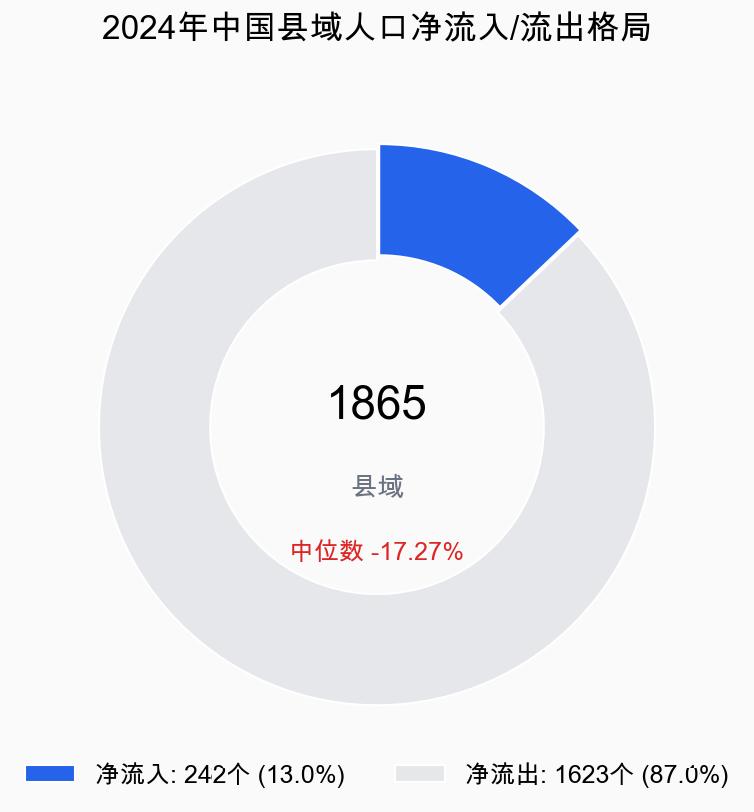
Because population outflow is one of the root causes leading to the insufficient vitality of the economy in many county towns. The Institute of Urban Sciences of Nanjing University once released the *Report on Population Changes of 1865 County-level Regions in China*, which sorted out the population change data of 1865 county-level units in 28 provinces across the country (excluding Beijing, Shanghai, Tianjin, Hong Kong, Macao and Taiwan regions) from 2020 to 2024. The results show that from 2020 to 2024, 1623 counties saw net population outflow, accounting for 87% of the total, and only 242 counties had net population inflow, accounting for only 13%.
In the short term, the population outflow in county towns cannot be reversed. Although county-level tourism continues to boom, the biggest problem is whether it can retain tourists for a long time. The tourism reception capacity of many county towns and small cities is difficult to cope with the sudden surge of tourist flow, and various exposed shortcomings leave negative impressions on out-of-town tourists, making them unwilling to visit again after one trip.
If the number of tourists cannot be stabilized, for young people who return to their hometowns to start businesses, the situation may still be full of risks and challenges.
A few years ago, internet-famous coffee shops in big cities gradually lost their popularity, while "village coffee" suddenly became popular. The first batch of internet-famous village coffee shops such as Waterfall Coffee and Deep Blue Plan once created more than 100 million yuan of annual revenue for Anji, Zhejiang. Influenced by this trend, many office workers in first-tier cities chose to return to their hometown villages to open village coffee shops, imagining that they could realize their self-worth again in the poetic and peaceful rural environment. However, in the village coffee track, many people have already quit and returned to big cities.
"On the day I closed my shop, I couldn't even resell the equipment, because there were three other newly opened village coffee shops nearby, and like me, they were all relying on holiday business to support their operation for the whole year", a village coffee entrepreneur said. Another person who originally planned to return to his hometown to start a business said, "Village coffee shops are almost everywhere in southern Anhui where I'm from, but I went back to investigate and found that although village coffee shops are very photogenic for social media posts, the number of tourists is not stable, and there are very few returning customers."
Of course, positive changes are taking place slowly.
In Yanji, there used to be only 2 travel photography shops in the whole city, but now the number has risen to more than 1,000, and the number of coffee shops has also increased from a dozen scattered ones to more than 1,000. Young people can return to open travel photography shops or work as homestay managers. In Miyi, more middle-aged people have found jobs as service staff and physical therapists in the health care industry, and some young people are also choosing to return to their hometowns.
Big cities hold people's dreams, while small cities offer a place for people to rest their tired minds. In the cultural and tourism market, the hidden gem small towns across the country may occupy a more important position, thus completely changing the overall pattern of the tourism industry. When the tourism trend flows from big cities to county towns, more previously unpopular and little-known places will be discovered, baptized by tourist flow, and stimulate huge economic value, which may bring new changes to more people's lives.
This article is from the WeChat official account "Consumer Observatory", written by Gu Yue, and authorized for release by 36Kr.