After sifting through all 722 mathematical manuscripts from OpenAI, we have picked out the 30 most challenging and representative classic problems.
On the morning of the 7th, OpenAI uploaded a total of 722 mathematical manuscripts generated by an unreleased internal model to GitHub at one go. The full context of this release, the background of the model, and the controversies in the mathematics community have been sorted out in our previous report. This article will take a different perspective, open the repository, and see exactly what achievements are on the list.
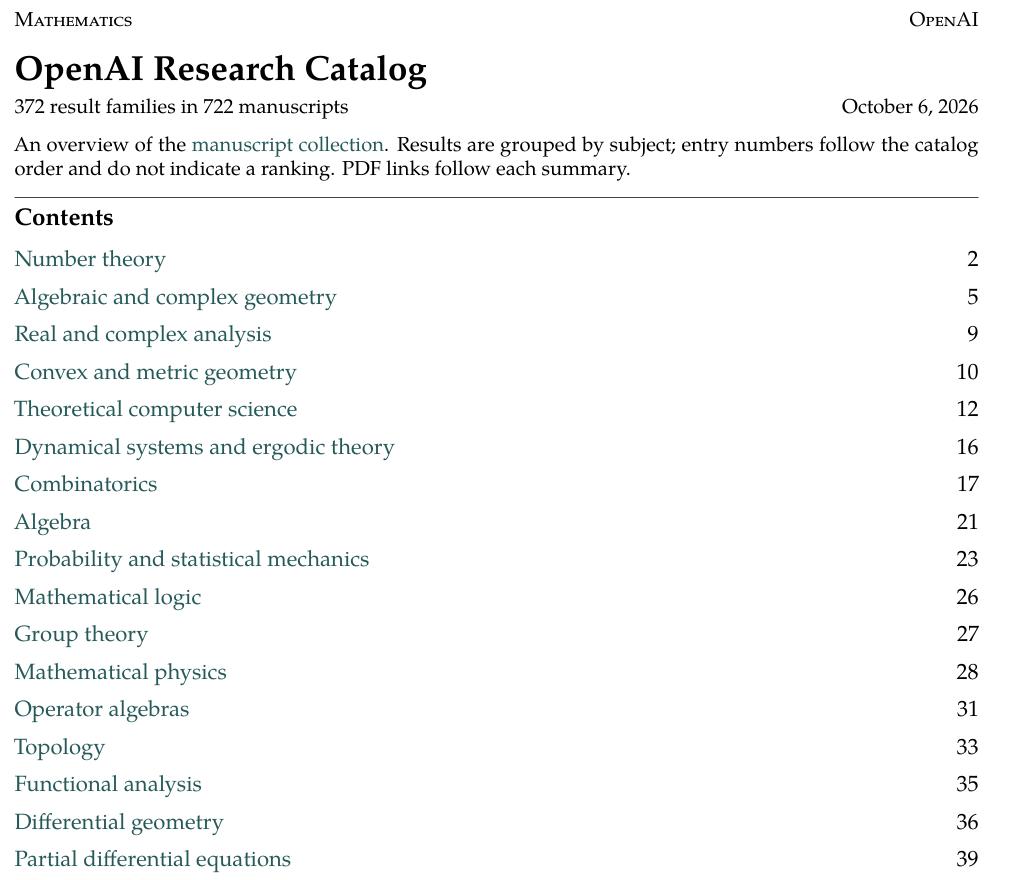
Repository address: https://github.com/openai/math
First, it is necessary to make some clarifications:
First, these 722 manuscripts are grouped into 372 "achievement families", covering 17 directions including number theory, geometry, theoretical computer science, and mathematical physics. This article selects the most well-known and oldest involved problems from each direction to introduce.
Second, the list contains both "proofs" and "disproofs". According to our rough search, there are about 50 achievement families with the words "disproof" and "counterexample" in their abstracts, and some conjectures that have been circulated for more than half a century have been overturned rather than proven.
Third, and most importantly: all the expressions of "proved" and "solved" in the following text are OpenAI's own statements, and the vast majority have not yet undergone peer review. About 60% of the achievement families are attached with Lean formalization, that is, proofs that have been checked line by line by a computer, which we will note when mentioned; results without formalization can only be regarded as "claims" at present.
Number Theory: From Riemann to Hilbert
Number theory is the most astonishing part of this list, and several of the 31 achievement families are directly associated with the most famous names in history.
The Quasi-Riemann Hypothesis, ranked No. 003 in the repository, is one of the most widely spread results. Riemann proposed in 1859 that all non-trivial zeros of the zeta function fall exactly on a vertical line; this ultimate goal is too far away, so mathematicians have settled for the second best, hoping to at least prove that there are no zeros at all on the right side of a certain vertical line. For more than a hundred years, this goal has never been achieved. OpenAI claims that this line is drawn at the position of 7/8, which holds for both the zeta function and all Dirichlet L-functions, and the result is attached with Lean formalization.
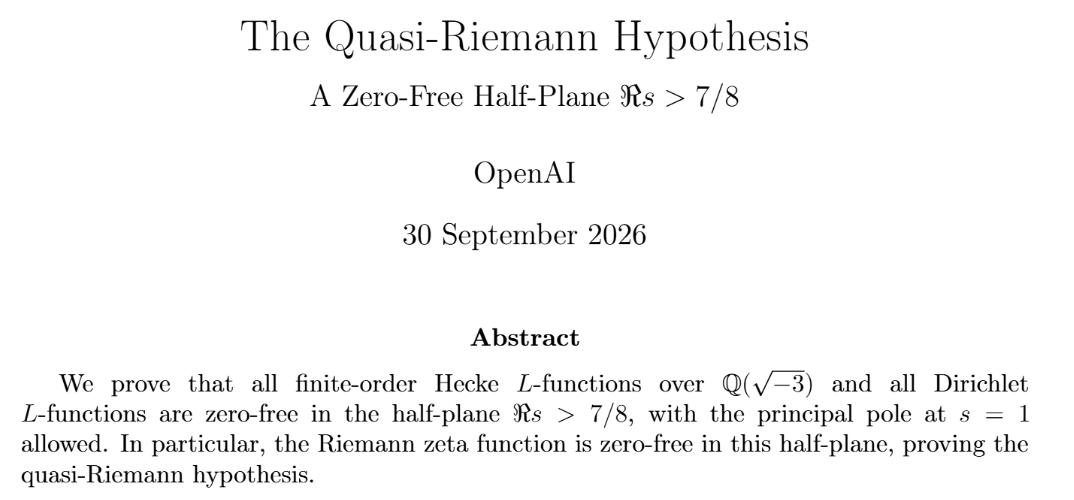
Quasi-Riemann Hypothesis
The BSD Conjecture, which is listed alongside the Riemann Hypothesis as one of the Millennium Prize Problems, also appears on the list. It discusses the exact correspondence between the number of rational points on an elliptic curve and the behavior of an analytic function at a certain point. OpenAI's No. 002 and No. 006 achievement families together claim to have proved the complete BSD formula for "almost all" quadratic twists of every rational elliptic curve; among them, No. 006 also incidentally proved the Goldfeld conjecture proposed by number theorist Dorian Goldfeld in 1979. Neither of these two results has formalization.
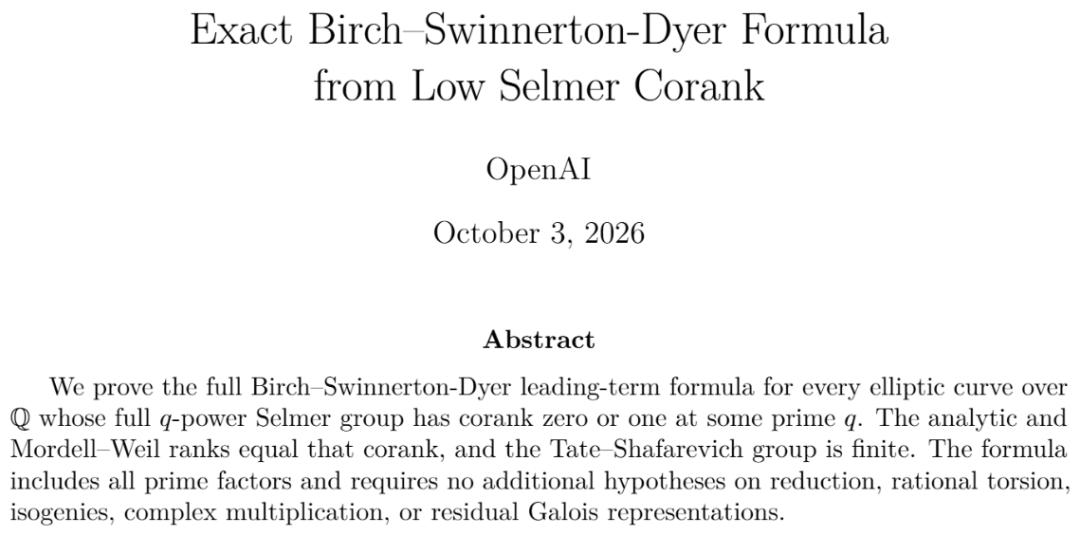
BSD Formula
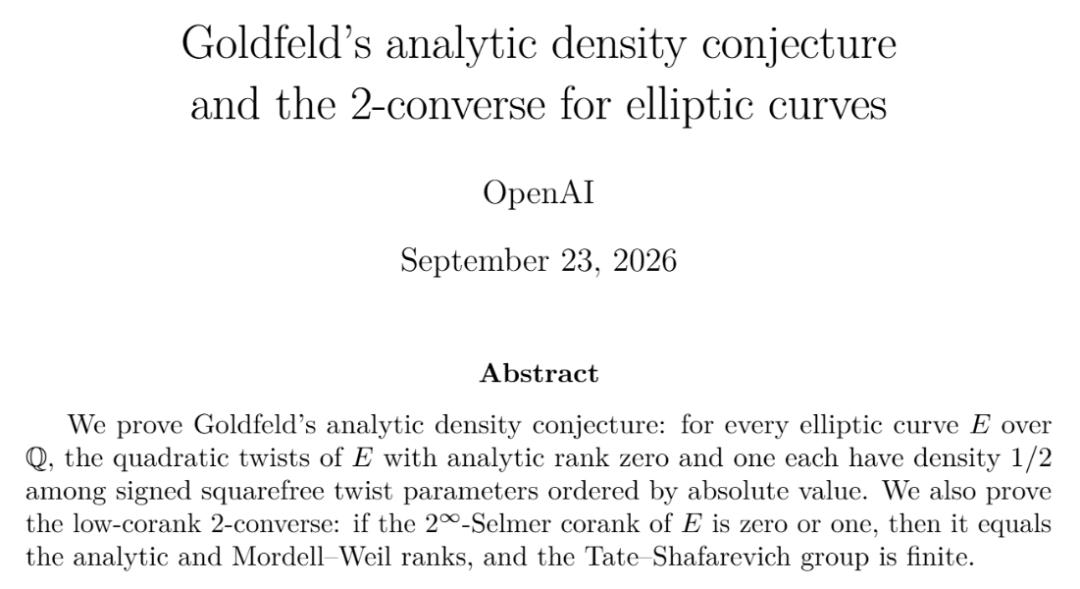
Goldfeld Conjecture
No. 004 points to the 10th of the 23 problems proposed by Hilbert in 1900. The original question is: Is there a general algorithm that can judge whether any polynomial equation with integer coefficients has an integer solution? In 1970, Yuri Matiyasevich gave a negative answer on the basis of previous work. But if "integer solution" is replaced with "rational solution", the problem has been pending for more than half a century. OpenAI claims that the answer to this version is also negative, and this result also has no formalization.
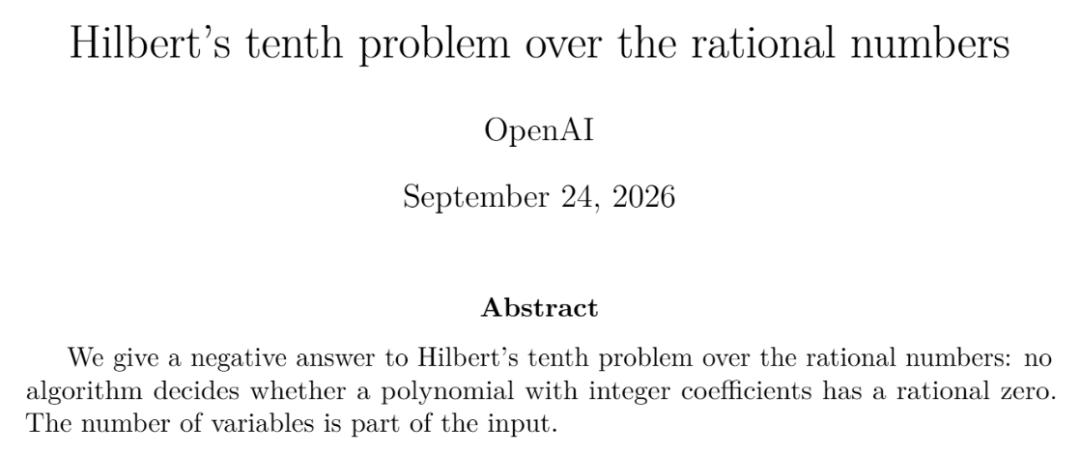
Hilbert's 10th Problem (over the rational number field)
There are two other results whose problem statements can be understood at a glance by ordinary readers.
The first is Catalan's constant, which is the alternating sum of 1 minus 1/9 plus 1/25 minus 1/49 and so on. No one has ever known whether it is an irrational number; OpenAI claims that it is.
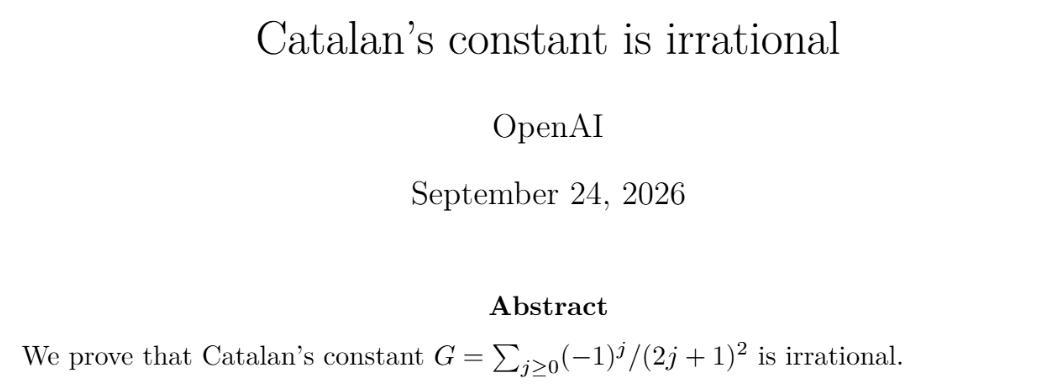
Catalan's Constant
The second is "how difficult it is to approximate π with fractions": the upper bound that mathematicians could prove before is about 7.1, OpenAI claims that the optimal value is exactly 2, which means that π is as ordinary as "almost all" irrational numbers in this respect. The latter also incidentally solves a problem that has been circulating in the recreational mathematics community for many years, that is, whether the so-called Flint Hills series converges. Both of these results are attached with Lean formalization.
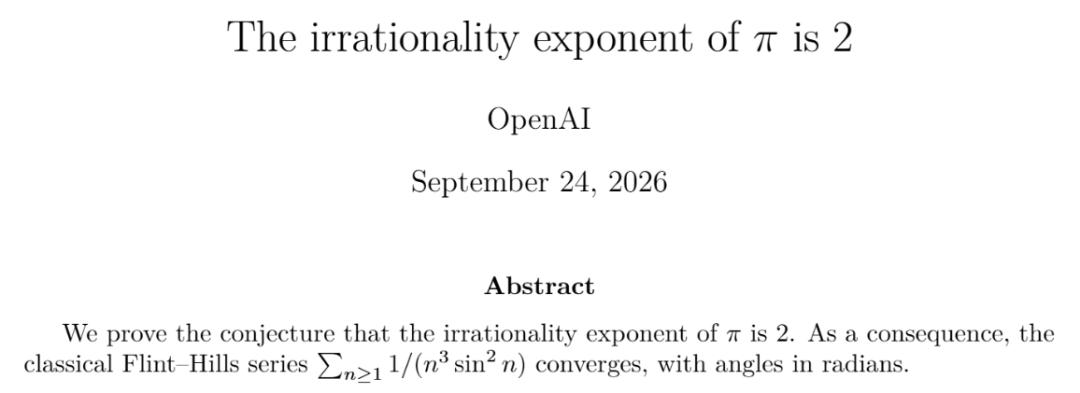
Irrationality Measure of π
Algebraic Geometry: A Glimpse of the Hodge Conjecture and the Mystery of Rationality
Algebraic and complex geometry ranks third with 36 achievement families. The most striking one here is No. 032: Prove the rational Hodge conjecture for all complex CM abelian varieties. The Hodge conjecture is one of the Millennium Prize Problems. Its general idea is that certain things that "look like geometric objects topologically" must indeed be cut out by algebraic equations. CM abelian varieties are a special class of objects with extremely strong symmetry, far from covering all cases, but OpenAI claims that with the help of James Milne's previous theorems, this result can also deduce the Tate conjecture for all abelian varieties over finite fields. The repository README also specially notes that this result does not follow the standard process of the model, and there is no formalization at present.
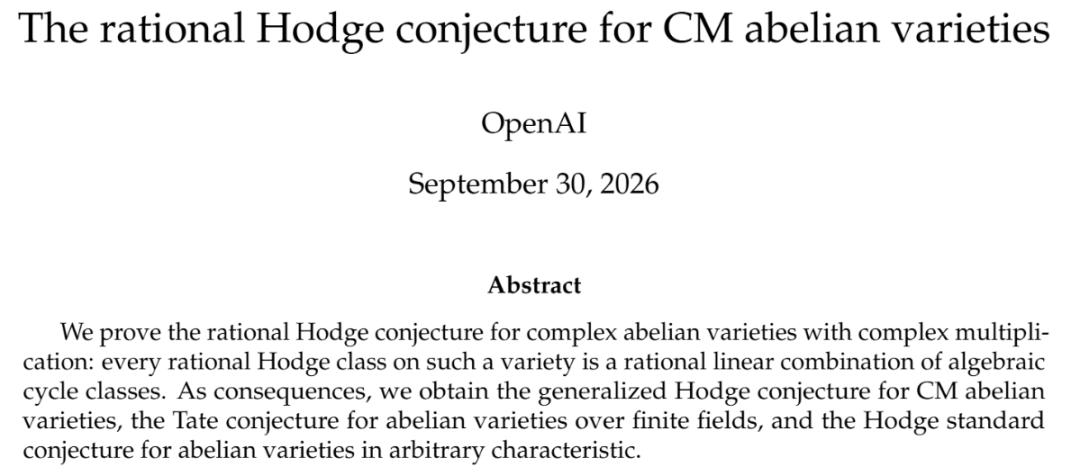
Hodge Conjecture for CM Abelian Varieties
Another noteworthy result is No. 054. Whether a cubic fourfold can be rationally parameterized is a famously difficult problem in algebraic geometry. Alexander Kuznetsov once proposed a conjecture judged by the language of "category". OpenAI claims to have constructed examples that meet this criterion but still cannot be rationally parameterized, thus overturning this conjecture.
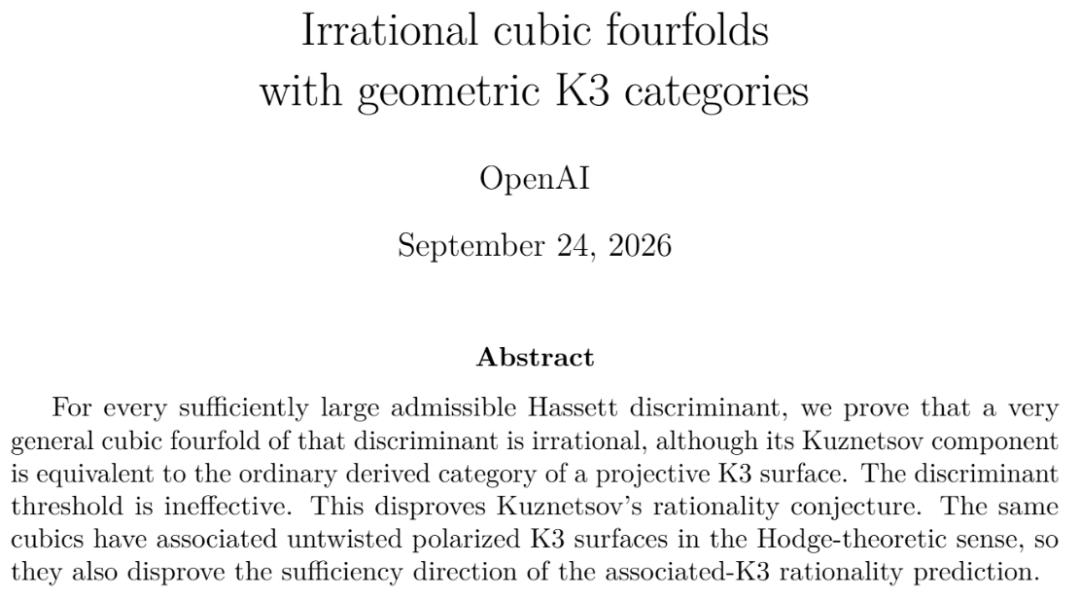
Cubic Fourfold (Counterexample to Kuznetsov's Conjecture)
Moving to more abstract fields, there is also the quantum geometric Langlands correspondence of No. 069 in the list. In 2024, Dennis Gaitsgory and others proved the geometric Langlands conjecture in a series of nearly 1000-page papers. OpenAI claims to have also derived its "quantum" version under irrational parameters.
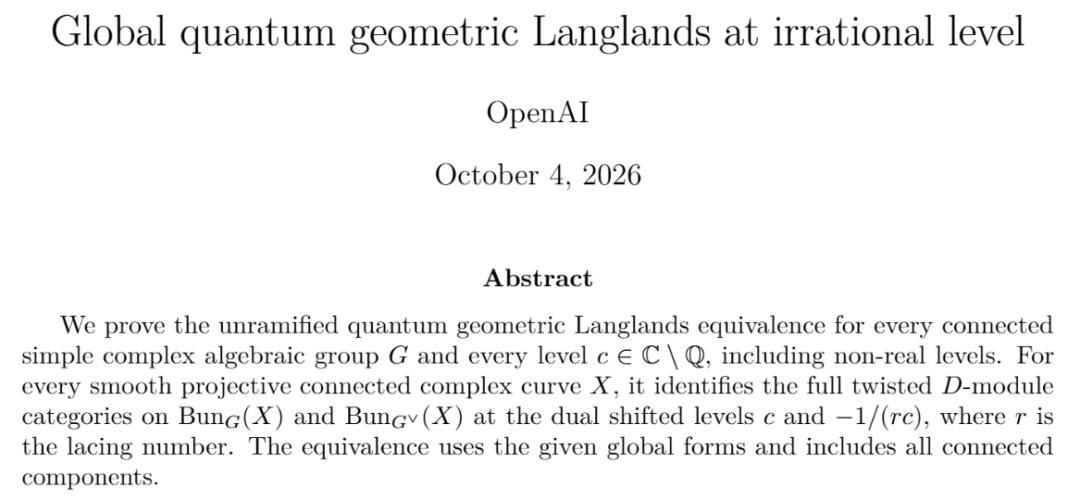
Quantum Geometric Langlands
No. 008 claims to have solved the Deligne–Drinfeld conjecture about the structure of the Grothendieck–Teichmüller Lie algebra, and it is attached with Lean formalization.
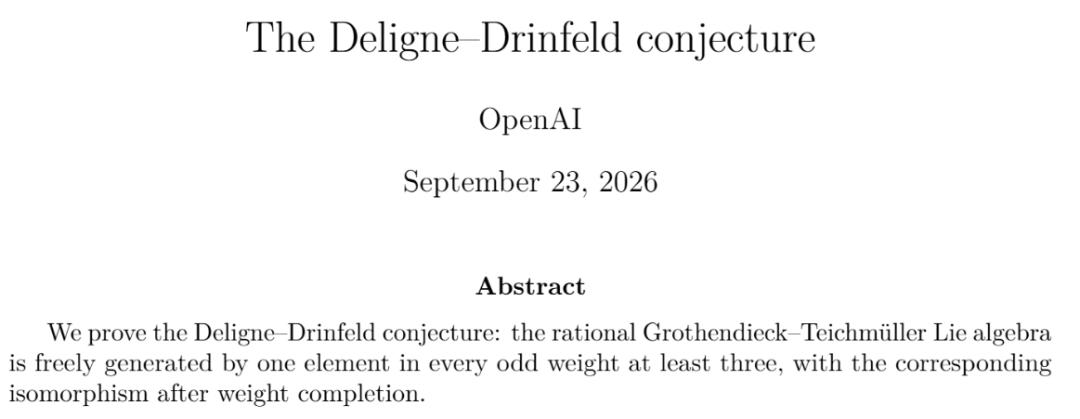
Deligne–Drinfeld Conjecture
Analysis and Geometry: Kakeya, Mahler and Conjectures from a Century Ago
Famous problems in the direction of geometry and analysis are equally dense.
The Kakeya problem (No. 074) originated from a small question raised by Japanese mathematician Sōichi Kakeya in 1917: What is the minimum area that a needle needs to sweep to rotate a full circle on a plane? Its high-dimensional version has evolved into one of the core difficult problems in harmonic analysis. In July this year, Wang Hong won the Fields Medal for his joint proof of the three-dimensional Kakeya set conjecture with Joshua Zahl; OpenAI claims to go a step further on this basis, proving the stronger version in three dimensions and the dimension conjecture in four dimensions. This result has no formalization and is also one of the achievements that most urgently need to be reviewed by experts as soon as possible.
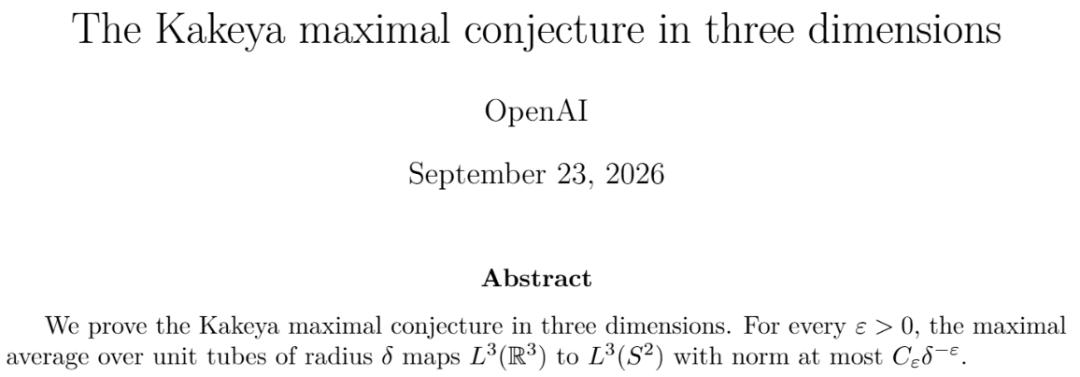
Three-dimensional Kakeya Maximal Conjecture
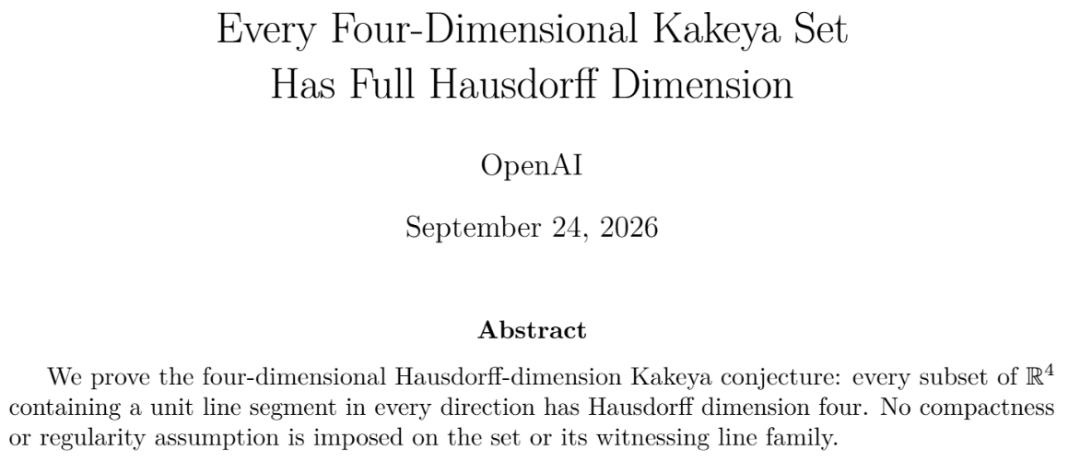
Four-dimensional Kakeya
The Mahler conjecture (No. 087) was proposed by Kurt Mahler in 1939. It asks what the minimum value of the volume product of a convex body and its "dual body" can be. It was not until 2020 that a Japanese mathematician solved the three-dimensional symmetric case. OpenAI claims to solve both the symmetric and asymmetric versions simultaneously in all dimensions, and characterize all the cases where the minimum value is obtained, which is attached with Lean formalization.
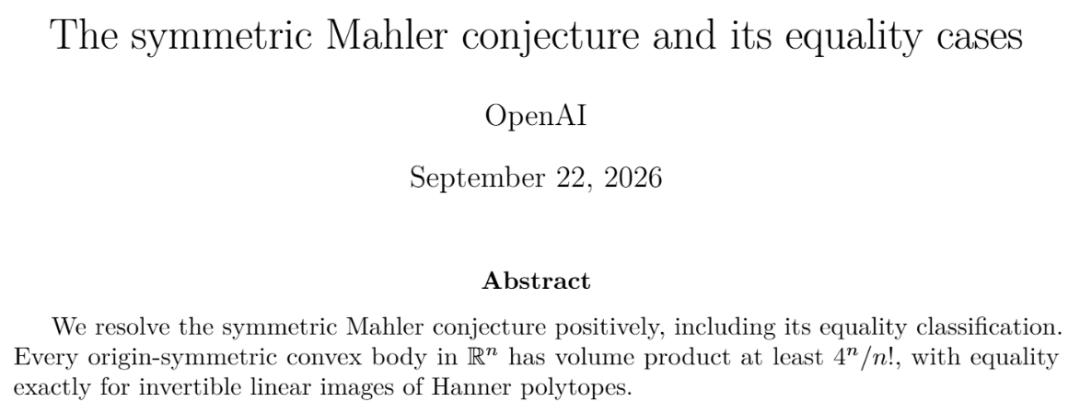
Mahler Conjecture (Symmetric)
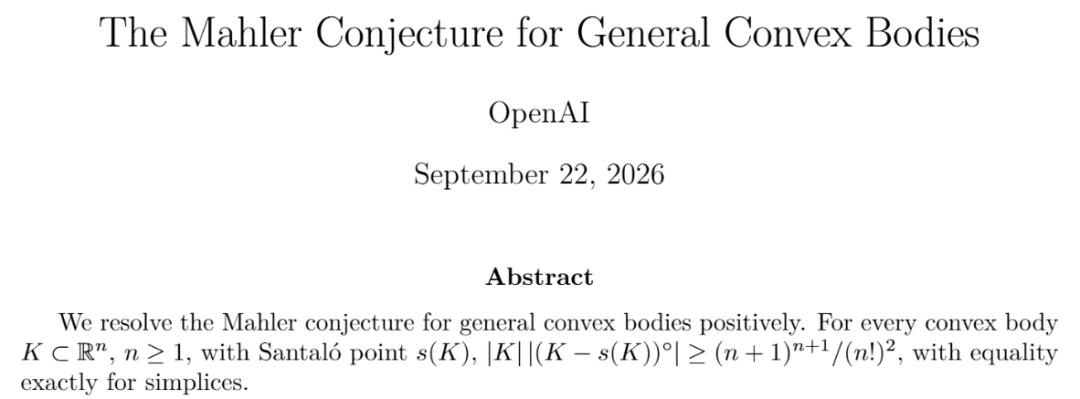
Mahler Conjecture (General Convex Body)
No. 071 goes back to an older era. In 1908, Paul Koebe conjectured that any domain on the plane can be conformally transformed into a "circle domain" whose boundaries are all circles or points. OpenAI claims to have solved the existence part of this conjecture, which is attached with Lean formalization.