AI cannot change its "DNA", how much longer can SanDisk remain so dominant?
In the previous two articles, "From Foliage to Blossom: How AI Inference Reshapes NAND's Fate" and "NAND's Inherent 'High Yield' Trait: How Does Western Digital Sustain an 80% Gross Margin?", Dolphin noted that AI not only lifts NAND demand to a new level but also is expected to break its years-long "silicon cycle" destiny.
Under the new logic dominated by inference workloads, NAND has evolved from a "peripheral data warehouse" to a "necessity on the computing path". With the shift from training to inference and the prevalence of long contexts, today's SSD has become a "Token battery" that stores computing power.
This article will follow this main line to answer two questions:
I. How long can this "super bull run" of price hikes last?
II. At the current valuation node, is there still upside potential for Western Digital after its transformation?
Detailed analysis is as follows
I. How long can this "super bull run" of price hikes last?
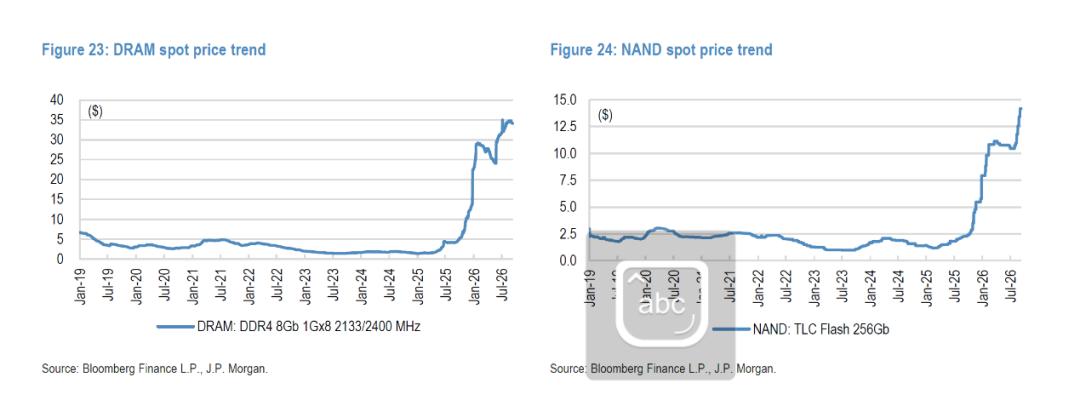
From an industry perspective, this round of price increases is a once-in-decade "super bull run" for the storage industry: In the more than one year since July 2025, the spot price of DDR4 8Gb has risen 7-8 times, from about 4.5 USD to about 35 USD; NAND has also seen a staggering increase, with the spot price of 256Gb TLC rising from about 2.5 USD to about 14 USD, 5~6 times the starting point.
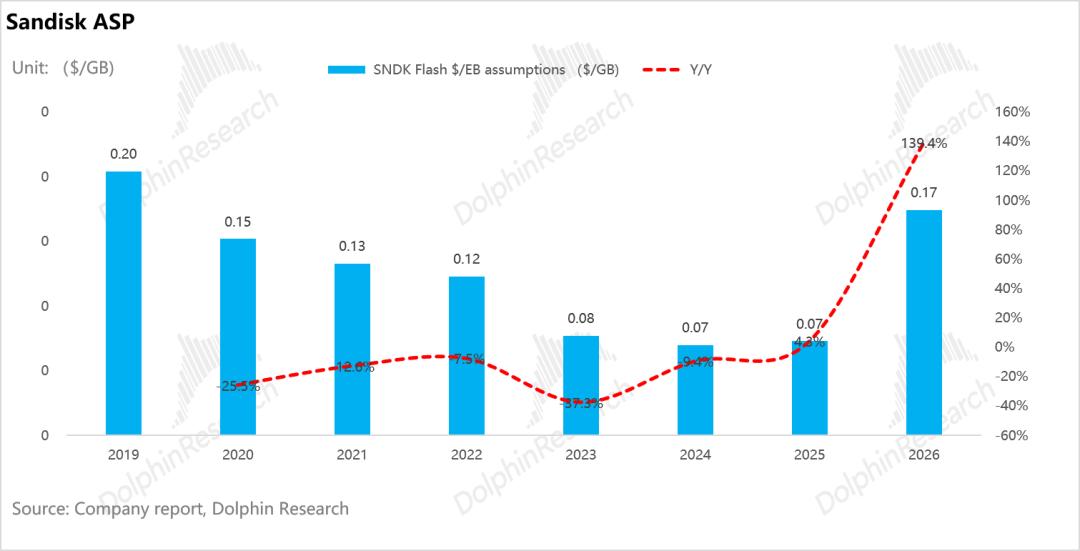
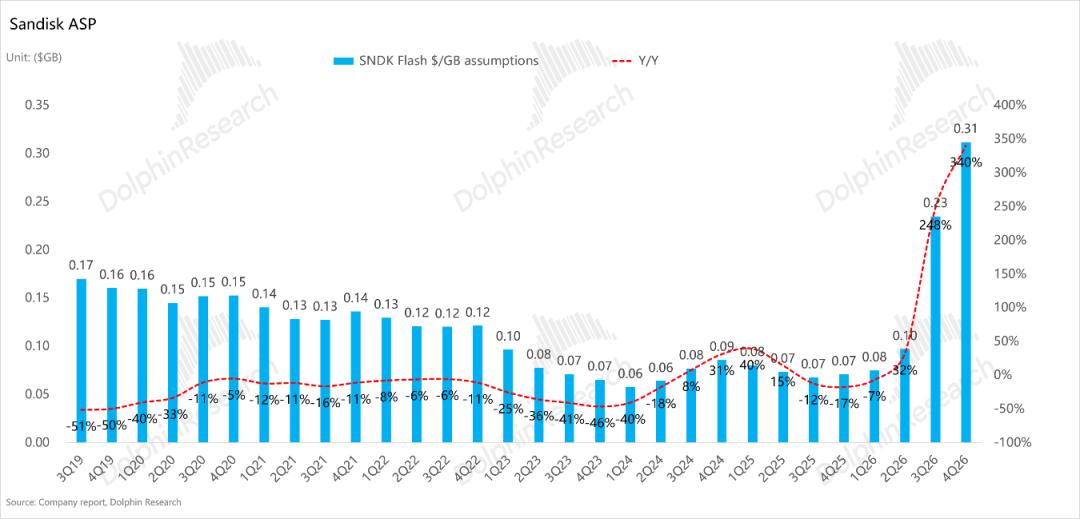
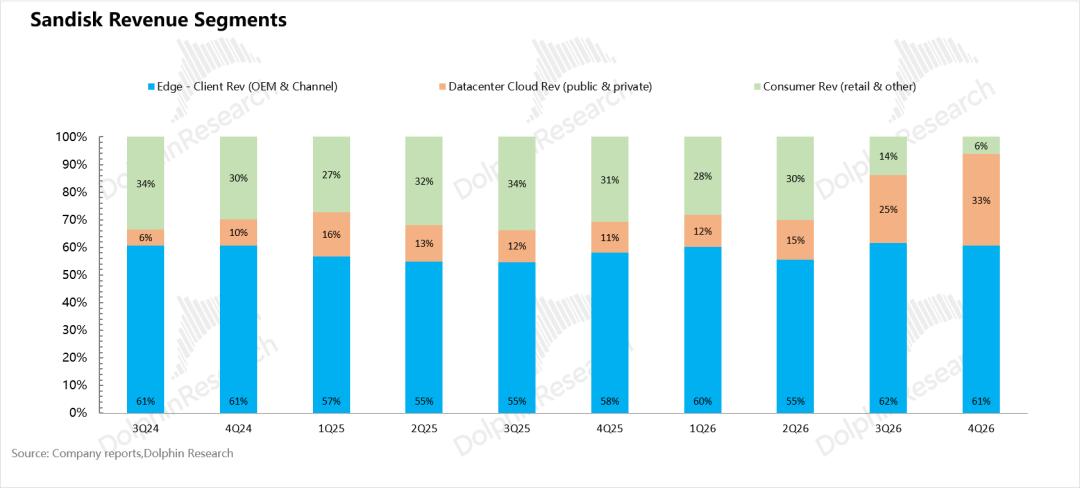
According to estimates, Western Digital's combined ASP for FY2026 (ending June 2026) is approximately 0.17 USD/GB, up about 139% year-on-year, which is significantly lower than the spot price increase. This is mainly because the price increase in the first half of the fiscal year was not obvious, Western Digital has a large number of long-term agreements, and the proportion of data center revenue did not rise to 25% and 33% until FY26Q3-Q4.
On a quarterly basis, FY26Q4 ASP is approximately 0.31 USD/GB, up about 340% year-on-year, which has almost caught up with the spot price in the same period (about 0.33~0.34 USD/GB).

Western Digital's revenue in FY26Q4 is about 9 billion USD, up 372% year-on-year, almost entirely driven by price increases: bit shipments only increased by about 7% year-on-year to 29EB.
By business segment, the data center segment has the fastest growth: FY26Q4 revenue is about 3 billion USD, up about 13 times year-on-year, and the revenue share has risen from 11% to 33%.
In AI scenarios, the growth is driven by performance-oriented TLC eSSD for AI inference scenarios such as KV caching and high-performance computing. In addition, the high-capacity UltraQLC large-capacity eSSD (starting from 128TB, currently under certification at multiple hyperscale customers) has started shipping and recognized revenue in FY26Q4 (April-June 2026); the 256TB version is expected to be launched in the mid-to-late 2027.
Gross margin jumped from a low of 22.5% in FY25Q3 (January-March 2025) to 84.6% in FY26Q4, almost entirely driven by price increases:
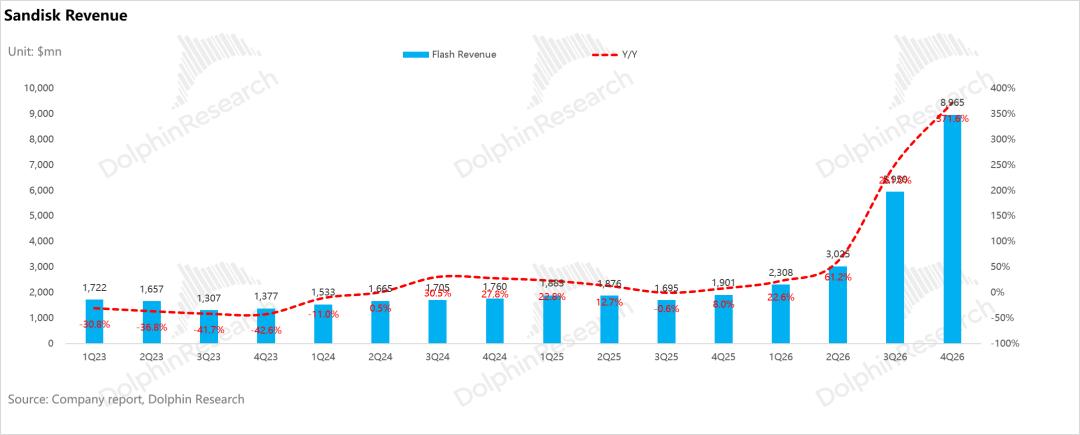
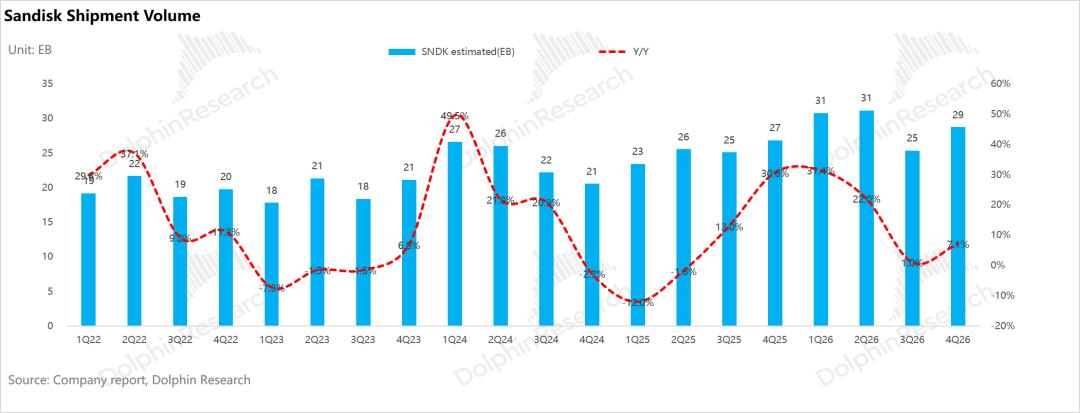
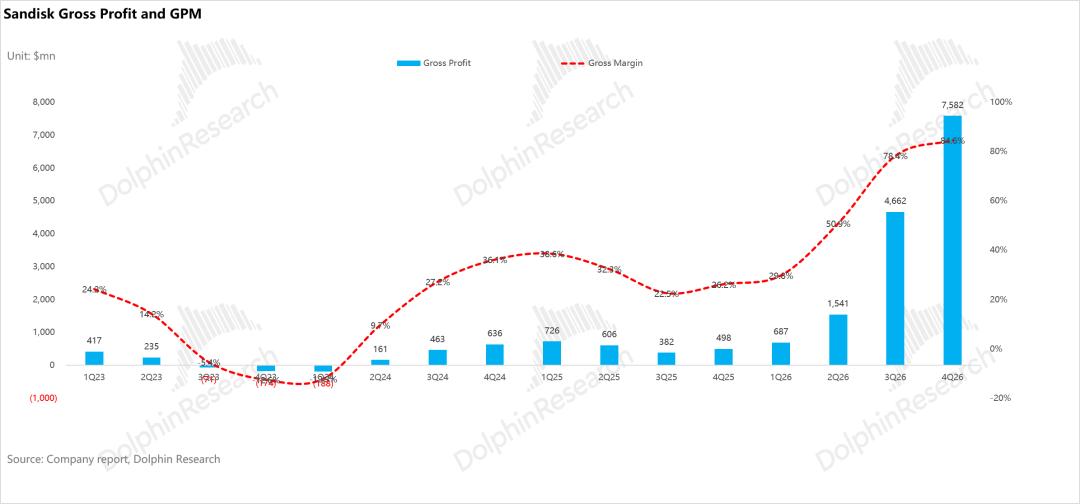
The question is: How long can this "super bull run" last? How long can Western Digital's ultra-high gross margin of 80%+ be maintained?
Dolphin will judge from the perspective of the overall supply and demand of the NAND industry:
1.1 Supply Side:
① NAND Capacity Expansion: No additional production lines via capital expenditure
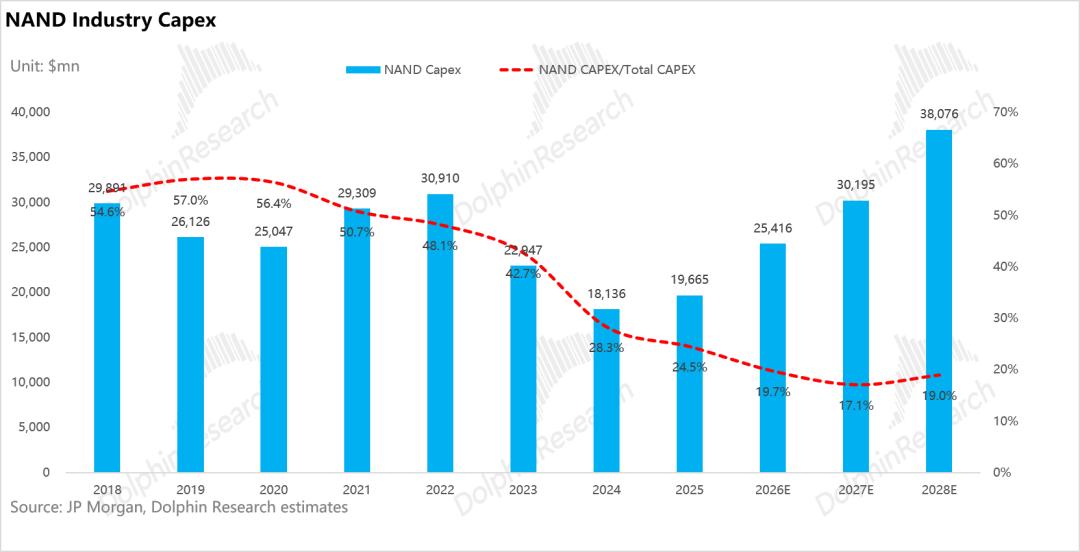
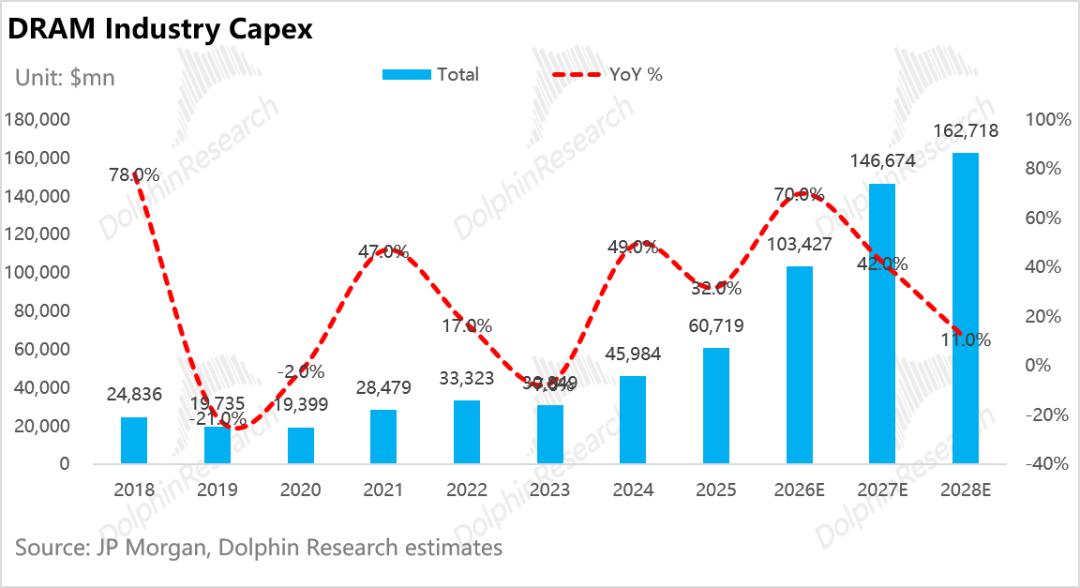
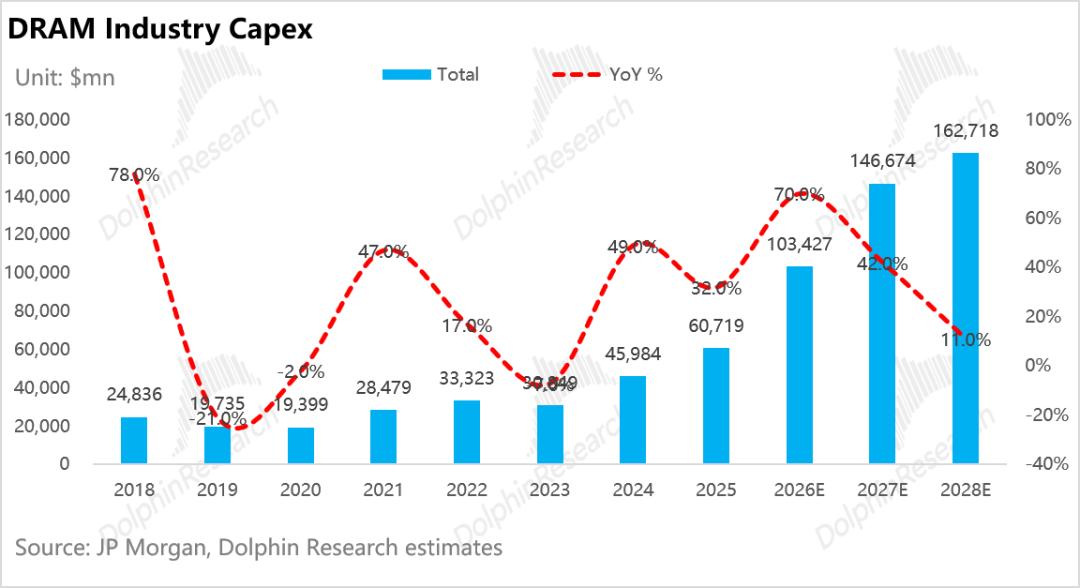
Despite the certain explosion of AI demand, the NAND industry still maintains restrained capital expenditure after the last round of deep losses. The comparison in the figure below is very obvious:
Although storage manufacturers are increasing capital expenditure, it is mainly allocated to DRAM/HBM - the estimated total will reach 162.7 billion USD in 2028 (3-year CAGR of 39%); while NAND's investment is already low, it will only grow to 38 billion USD by 2028, with a 3-year CAGR of only 25%, and its proportion in global storage capital expenditure has dropped from 25% in 2025 to 19%.
② Shift of Capital Expenditure: "Squeeze" capacity through technology upgrades
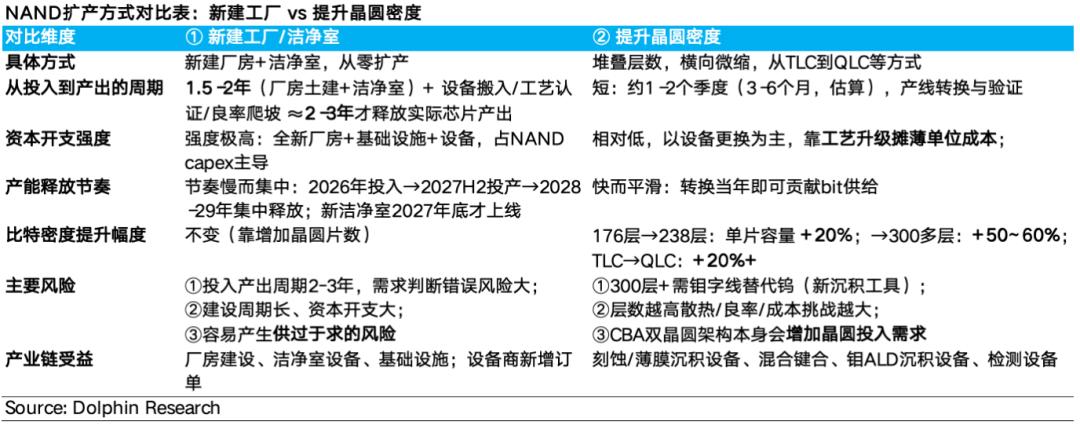
The capacity expansion strategy of overseas original manufacturers has fundamentally changed: from 2026 to 2027, restricted by cleanroom space, large-scale new capacity cannot be built, and capital expenditure is mainly used for the upgrade of existing production lines - the core is to increase the number of 3D stacking layers (migrating to 200+/300+ layers), supplemented by increasing the number of storage bits per cell and optimizing the architecture, to improve the bit output per wafer.
New wafer fabs will be put into concentrated operation from 2028, and the new capacity will still be dominated by DRAM/HBM. The large-scale release of NAND capacity will not happen until after 2029.
Compared with building new factories, increasing wafer density requires less investment and takes effect faster: large-scale equipment replacement usually takes 3-6 months (with a temporary drop in output during the period), which is much faster than the 2-3 years required for building a new factory.
③ Capacity Release Rhythm: Rely on Chinese expansion lines from 2026 to 2028, new lines of global players are released centrally after 2029
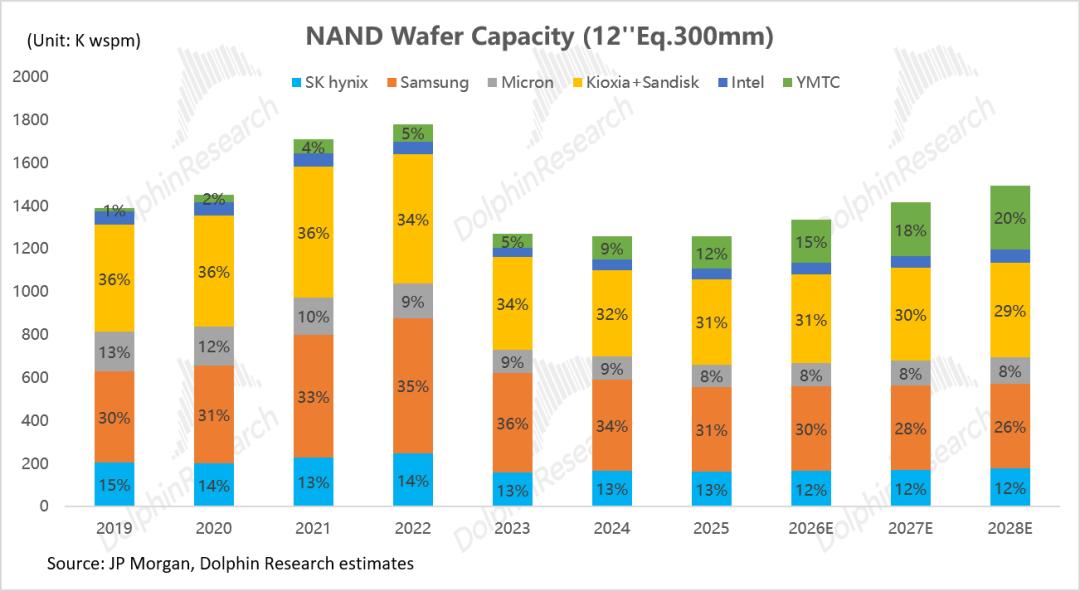
From the perspective of wafer starts, the global monthly NAND capacity in 2025 is about 1.26 million wafers, which is expected to increase to only 1.5 million wafers in 2028, with a 3-year CAGR of only 6%. Among the additional 240,000 wafers, YMTC contributes about 150,000 wafers, and its share rises from 12% to 20%; Samsung's physical capacity has zero growth, and its share passively drops from 31% to 26%.
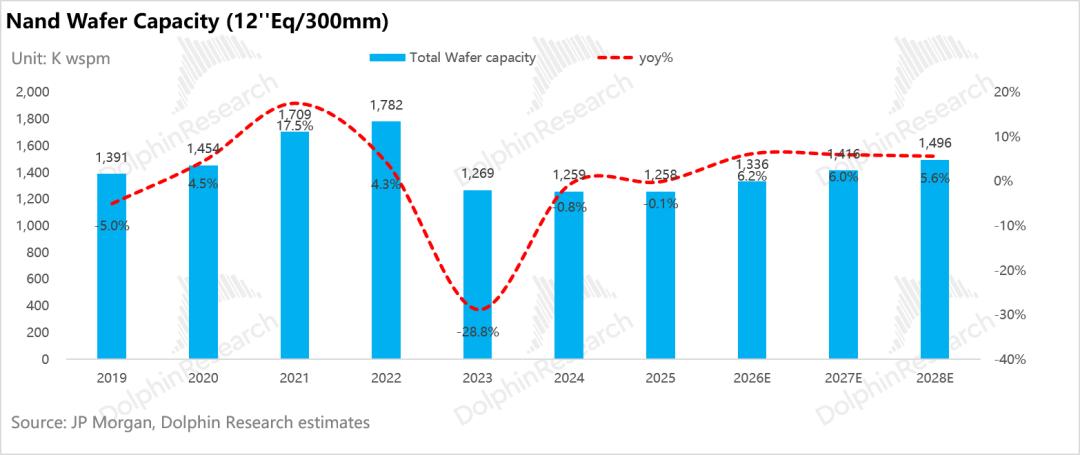
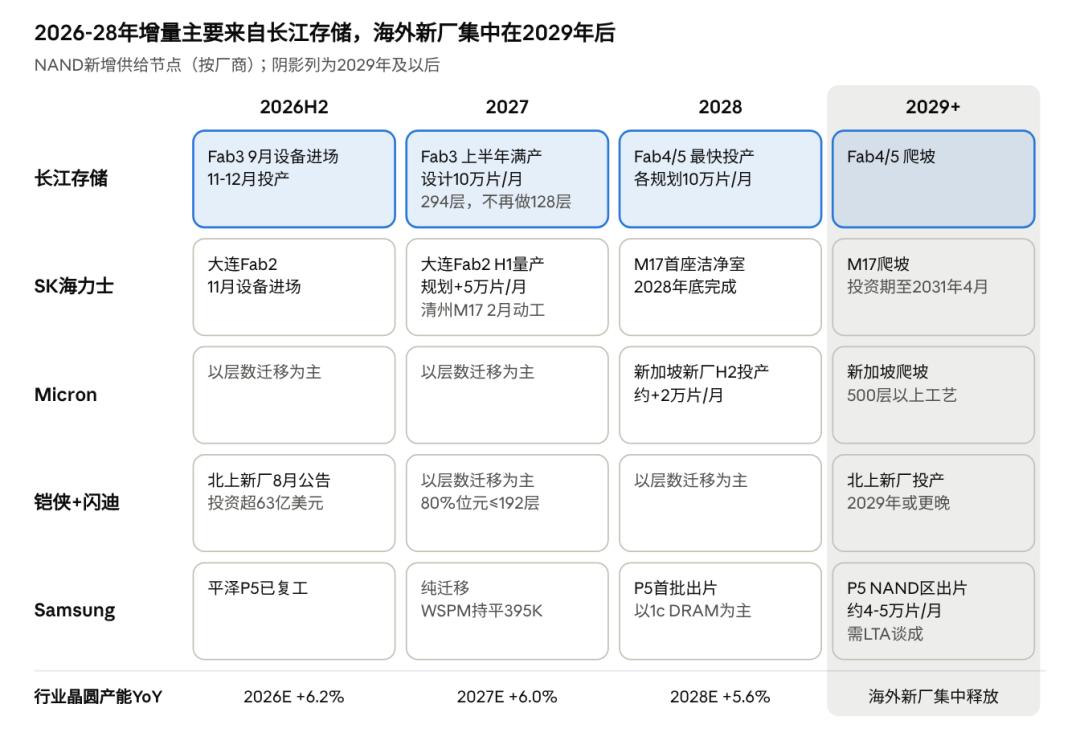
New production lines are clearly staggered in region and time: supply has not been released on a large scale from 2027 to 2028, and there is a jump risk in 2029:
2026H2-2028 (dominated by Chinese capacity expansion): New fabs mainly come from YMTC (Fab 3) and SK Hynix (Dalian Fab 2). There are almost no large new fabs put into operation overseas (only a small amount of capacity is released at Micron's Singapore fab at the end of 2028), 2027-2028 is the stage with the weakest supply elasticity of overseas manufacturers, and bit growth is highly dependent on layer migration.
2029 and later (overseas new fabs are put into operation centrally): Large-scale capacity of Samsung P5, Kioxia/Western Digital's new northern fab, and SK Hynix M17 will be released centrally, and the supply growth rate may increase significantly, requiring tracking of project progress and long-term agreement signing status.
a. YMTC: Double-driven capacity expansion by stacking layers and adding production lines in the next three years
YMTC's capacity will expand from 200,000 wafers/month in 2026E to 300,000 wafers/month in 2028E.
Currently, Fab1/Fab2 are already at full capacity (about 200,000 wafers/month). The key incremental Fab 3 (designed monthly output of 100,000 wafers) is expected to be put into operation at the end of 2026, with monthly capacity reaching 50,000 wafers in 2027.
Its new-generation Xtacking 4.0 architecture can launch 1Tb TLC and 2Tb QLC products to cover enterprise-level and consumer-level demands.
Fab 3 will directly introduce 294-layer products, with the target of enterprise-level SSD proportion reaching 60%.
The land for Fab 4/Fab 5 has been approved (designed capacity of 100,000 wafers/month each), if construction starts in advance, there is still room for upward revision of supply in 2028.
