The renaming of the Baijiahao App signifies that it no longer occupies a position in Baidu's development blueprint.
Back in early 2019, an article titled "The Search Engine Baidu Is Dead" went viral across the Chinese internet, pointing directly to the fact that search results on Baidu's search engine were occupied by its "Baijiahao", while high-quality external websites were pushed to the back pages, so Baidu Search could be renamed as "Baijiahao In-site Search". Seven years later, Baijiahao, which once plunged Baidu into a public opinion crisis, has also become a thing of the past. Baidu recently announced that its Baijiahao App will be renamed "Baidu Live Mate" on September 22, focusing on providing users with live streaming-related functions.
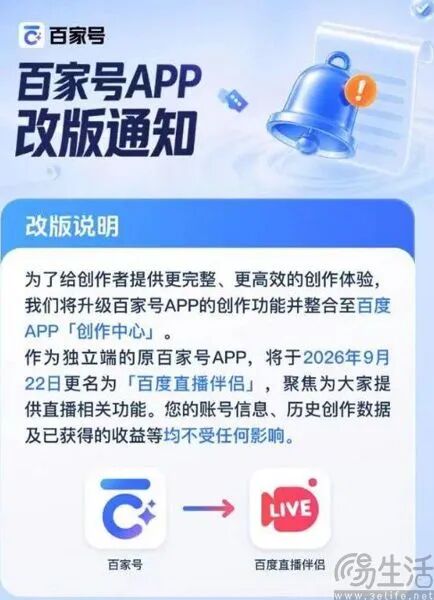
Baidu stated that non-live creators can go to Baidu App - Mine - Creator Center to continue creating and managing content, while live creators can continue to use the "Baidu Live Mate" App. To be precise, Baidu is not abandoning Baijiahao: articles and videos published by creators will still be included in Baidu's search and recommendation systems, but the company no longer wants to maintain a separate App for it.
In fact, Baijiahao has shown an "unwilling" temperament from start to finish, and it was not something Baidu originally intended to build. Back in the PC internet era, the internet ecosystem was decentralized, and information on the web flowed fully. After search engines took control of the channels through which people accessed information, Baidu naturally became the biggest winner.
However, the very things that once made you strong will turn into resistance to transformation when the new era arrives. In the mobile internet era, everything changed. Websites became a thing of the past, and emerging Apps were like isolated islands that cut off the flow of information, making it impossible for search engines to obtain information effectively. The old saying "ask Baidu whenever you are unsure" soon no longer worked.
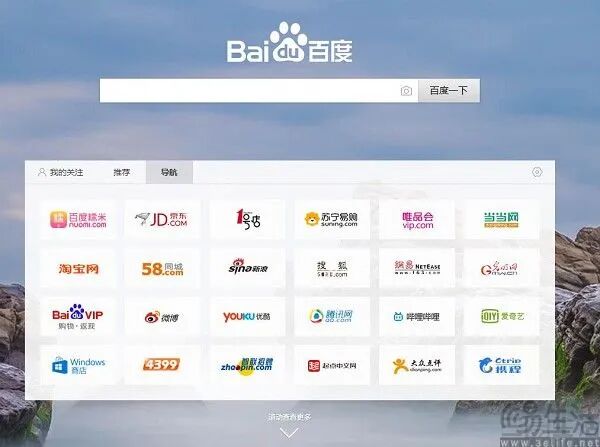
Once, as long as you knew how to use Baidu, you could find most of the information you needed on the internet. The HTTP protocol allowed search engines to access every website that did not block them. However, after entering the mobile internet era, all daily life scenarios were fully divided up: for news and information, there are Weibo and Toutiao; for in-depth content, there are Zhihu and WeChat Official Accounts; for entertainment, there are Douyin and Kuaishou; for local life services, there are Meituan and Taobao Flash Shopping; for software distribution, there are app stores from various mobile phone manufacturers.
At this point, although Baidu still had an entry point, it found that all major scenarios of the consumer internet were occupied by competitors, and the presence of search engines was gradually replaced by various Apps. Although Baidu could reach users at this time, it could not retain them. In 2016, Baidu prescribed a "prescription" for itself: Baijiahao, that is, to build its own information flow platform based on the search engine, hoping to use content to occupy users' time.
Ten years ago, building an information flow platform was the trend, and Baidu did not enter the market too late. But the problem was that Baidu was running Baijiahao in the way it ran a search engine. At that time, in order to attract creators, all major platforms offered quite generous incentive measures, and Baijiahao was no exception. Since there was profit to be made, reward hunters naturally flocked to it. Views like "There are really subsidies, it's really profitable" and "Baijiahao really pays, and pays on time" also show that Baijiahao's generosity at that time was obvious to all.
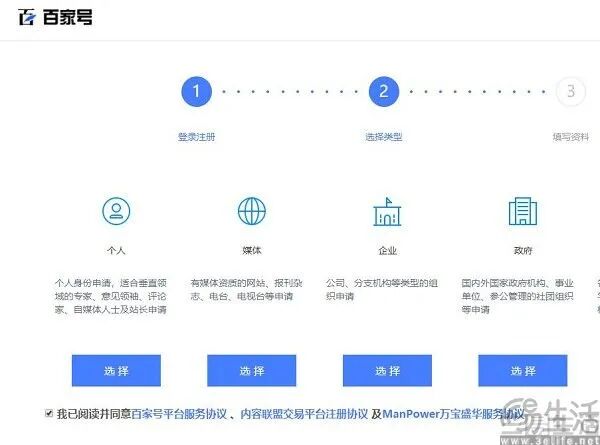
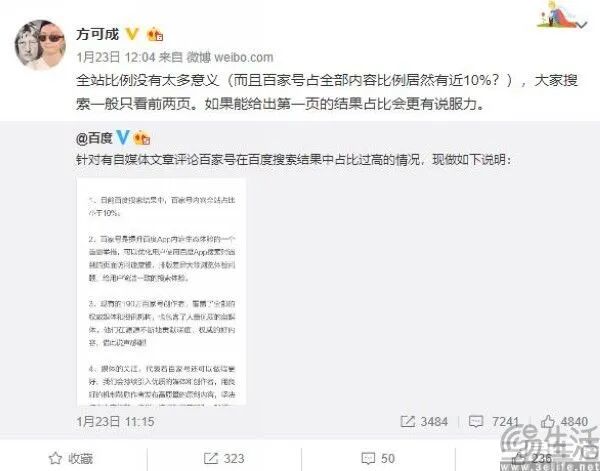
However, compared with Weibo, WeChat Official Accounts, Xiaohongshu and Zhihu, the content review of Baijiahao can only be described as barely existent. Back then, the premise of the article "The Search Engine Baidu Is Dead" going viral was that the content on Baijiahao was of extremely poor quality. Although Baidu claimed at that time that the increase of Baijiahao's search weight was "sorted according to high-quality content", what users saw on Baijiahao was full of low-quality content that was rephrased from others' works, plagiarized, or even completely fabricated out of nothing.
The model of search engines is highly user-autonomous: users decide which link to click on, while the operation mechanism of information flow platforms is algorithm recommendation, and the content users see is what the algorithm thinks they may be interested in. When seeing low-quality content, users will consider themselves unlucky when they actively obtain information, but when they passively receive information, they will blame the platform.
Failure to stop the impact of reward hunters and content farming accounts on the content ecosystem made Baijiahao lose users' favor. In a sense, Baijiahao was already "half dead" after the publication of the article "The Search Engine Baidu Is Dead". The emergence of AI large model technology has made the supply of low-quality content unprecedentedly abundant. In a scenario where Zhihu provides in-depth thinking, Weibo provides gossip and entertainment, Xiaohongshu provides product recommendation and sales, and WeChat Official Accounts provide sharp viewpoints, what unique content on Baijiahao can make users linger?
When Baidu launched the "Smart Box" at its AI Day last year, it announced the largest-scale innovation to its search in ten years, with comprehensive upgrades from the search box to the result page and the entire ecosystem. After Li Yanhong said, "When you search 10 questions now, 7 of the answers are rich media, not a string of text links, but a picture, a video, a live stream, or even a digital human", the position of Baijiahao in Baidu's ecosystem became rather awkward.
In contrast, live streaming has not yet fallen into the "clutches" of AI for the time being. For digital human live streaming, current application scenarios are limited to live streaming e-commerce and news broadcasting, both of which share a common feature: the host is not at the center of the stage. Among them, the core of the former is price, and the key of the latter is news. In game live streaming and show live streaming, the status of real people cannot be shaken for the time being.
In fact, live streaming is a product based on the content consumption needs of the mobile internet era. Even though the boom has passed, the demand for pan-entertainment live streaming has always existed. Hosts provide emotional value to the audience through performances such as singing, dancing, and chatting, in the way of "breaking a big stone on the chest in the cyber world". This has hardly changed from the old 6.cn and YY Live to today's Douyin and Kuaishou.
This business, just like telling cross-talk or acting, emphasizes "being born with the talent for it", and the so-called "diligence can make up for one's lack of talent" does not account for a very large proportion. For example, the words Li Jiaqi used when selling lipsticks are not difficult to learn, but only he can arouse the audience's emotions and attract young ladies to place orders constantly. Others can only copy him blindly and become a laughing stock. The core reason is that his charisma and ability to create atmosphere are hard to imitate.
Under the circumstance that live streaming cannot be replaced by AI for the time being, it has entered Baidu's field of vision. In addition, YY Live, which Baidu bought for 3.6 billion US dollars back then, cannot be allowed to lie idle all the time. Baidu seems to have never given up the idea of revitalizing its own mobile ecosystem with the help of live streaming.
This article is from the WeChat Official Account "Three E Life" (ID: IT-3eLife), written by San Yijun, and published with authorization from 36Kr.