Apart from ticket revenue, what else do scenic spots rely on to make money?
During the National Day holiday, when you visit a scenic spot, you may spend money far more frequently than you expected.
You first buy an admission ticket to enter the scenic area. If the attractions are on a mountain, you also need to purchase a shuttle bus ticket or a cable car ticket. When you get tired walking, you find a restaurant for a meal, participate in an intangible cultural heritage handicraft experience in the afternoon, interact with NPCs and check in at popular spots, and watch a performance in the evening. If the scenic area is large enough, you may even stay overnight and continue your tour the next day.
For tourists, this is an increasingly rich travel experience. For scenic spots, every extra consumption link is an income opportunity.
These scattered consumption items across the whole trip are the result of the transformation of scenic spots from the "ticket economy", a transformation that has been ongoing for many years. As early as eight years ago, relevant authorities issued documents, proposing to reduce the excessively high ticket prices of key state-owned scenic spots, solve the problem of over-reliance on the "ticket economy" in some regions, and explicitly promote the transformation of the tourism industry from the "ticket economy" to the "industrial economy". The document also specifically required that the price of other sightseeing services such as transportation within scenic spots should not be raised while ticket prices are lowered, to avoid increasing the burden on tourists in disguised form.
A very clear problem is placed in front of scenic spots: where to find income other than ticket revenue?
We have reviewed the financial reports of six typical listed scenic spot companies over the past eight years, and the conclusion has emerged: the first business that has been greatly expanded is transportation services such as cable cars, ropeways and sightseeing buses; retaining tourists for longer to increase secondary consumption is another solution for revenue growth; in the past two years, new experiences such as viral NPCs and sports events have become a new trend.
The "second growth curve" is hidden on the way up the mountain
Beyond ticket revenue, transportation is the first business to be scaled up.
According to the financial reports of listed companies including Huangshan Tourism Development Co., Ltd. (hereinafter referred to as Huangshan Tourism), Lijiang Yulong Tourism Co., Ltd. (hereinafter referred to as Lijiang Co., Ltd.), and Changbaishan Tourism Co., Ltd. (hereinafter referred to as Changbaishan) over the past eight years, a distinct common point is that transportation-related businesses have become a critical part of the scenic spot's revenue structure, and are often more stable than other non-ticket businesses.
Huangshan Tourism is a typical example among them.
In 2018, the revenue of Huangshan Tourism's ropeway and cable car business was 496 million yuan, accounting for 31% of the total operating revenue of that year. By 2025, this figure rose to 842 million yuan, with its proportion increasing to 40%, making it the largest single source of revenue for the company. In the same period, the revenue of the company's disclosed "garden development business" (renamed as "scenic spot business" since 2021) increased from 230 million yuan to 293 million yuan, and its proportion remained between 11% and 14% all the time.
The "garden development business / scenic spot business" here mainly corresponds to the shared income related to Huangshan Scenic Area tickets, which is not equivalent to the total ticket amount actually paid by tourists. However, it can be seen at least from the revenue structure that the scale of ticket-related income has not changed much for many years, while transportation-related income has continued to expand.
What is more noteworthy is the profitability of transportation-related businesses. In 2018, the gross profit margin of Huangshan Tourism's ropeway and cable car business reached 86.74%, and still remained at 75.2% by 2025.
Lijiang Co., Ltd. also presents a similar structure. In 2018, the revenue of Lijiang Co., Ltd.'s ropeway transportation business was 390 million yuan, accounting for 58% of the operating revenue, with a gross profit margin of 84.24%. In September of that year, the Yunnan Provincial Price Bureau announced a price cut for the tourist passenger ropeway at Jade Dragon Snow Mountain. The company mentioned in its financial report that the price adjustment had a great impact on the operating performance in the fourth quarter of that year.
However, the price drop did not reduce the importance of transportation-related businesses in the scenic spot's revenue structure. In 2025, the revenue of Lijiang Co., Ltd.'s ropeway transportation business still reached 407 million yuan, accounting for 47% of the operating revenue, with a gross profit margin of 84.72%. Over the past eight years, it has always been one of the company's most important sources of revenue.
Changbaishan's transportation-related businesses are more prominent. In 2018, the company's tourist operation business (later renamed as "tourism passenger transport business") generated a revenue of 323 million yuan, accounting for 70% of the operating revenue. In 2025, the figure reached 520 million yuan, accounting for 66% of the total. According to the explanation in the financial report, tourism passenger transport is Changbaishan's core business, which mainly involves tourist transportation within the three scenic spots of Changbaishan, tourism vehicle leasing, and parking lot management.
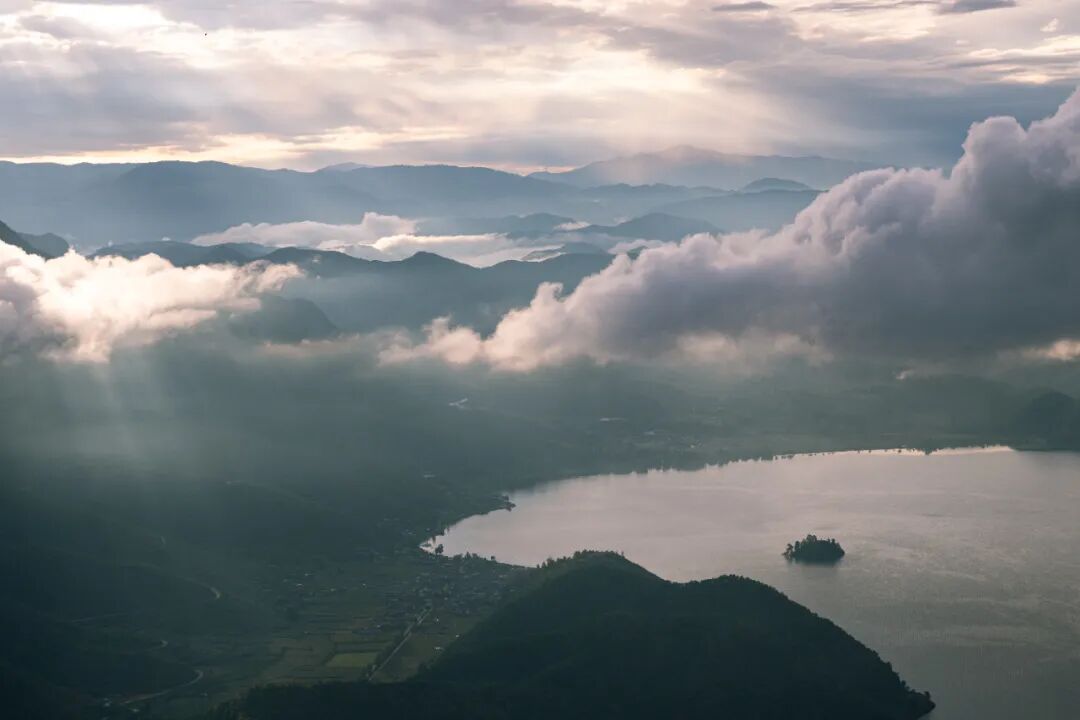
● The Goddess Mountain of Gemu, Lijiang. Photo by Huang Yiting
From these cases, there is a very practical reason why transportation-related businesses have become the "second growth curve" — among all kinds of businesses in scenic spots, transportation projects such as ropeways, cable cars and sightseeing buses usually have strong rigid demand, as well as relatively high operating efficiency.
The core landscapes of mountain-type scenic spots such as Huangshan, Jade Dragon Snow Mountain and Changbaishan are not located in places that tourists can reach at will. Ropeways, cable cars, scenic area buses and sightseeing buses are themselves infrastructure in the tour chain, which tourists can hardly completely avoid after entering the scenic area.
This business model will even affect the spatial design of scenic spots. Some scenic spots set up tourist distribution centers and parking lots outside the core scenic area, and some even expand their boundaries by more than ten or even dozens of kilometers, just to block private cars outside, and complete internal connection through shuttle buses, ropeways or sightseeing buses. This also makes "the entrance of scenic spots being built farther and farther away" one of the topics that have been discussed from time to time in recent years.
In 2023, the Sixiang Studio of Sohu News paid attention to the phenomenon that "the entrance of scenic spots is built farther and farther away, and small transportation services harvest tourists in various ways", taking the Chaka Salt Lake Scenic Spot in Qinghai as an example. The ticket price of Chaka Salt Lake Scenic Spot is only 60 yuan, but if you follow the official recommended tour route, the actual total cost of tickets plus small transportation services is nearly 200 yuan per person. Even if you choose the relatively cheaper train to enter and exit, each person still needs to spend 170 yuan to complete the tour.
On this basis, after conversion, the Sixiang Studio found that the price of the small train in the salt lake scenic spot is as high as 15.63 yuan per kilometer, while the ticket price of China's G-series high-speed railway is only 0.46 yuan per kilometer, with a 30-fold price gap between the two.
For another example, in 2024, China News Weekly once reported the controversy over transportation charges in the Yellow River Stone Forest Scenic Spot in Gansu. After tourists enter the scenic spot, private cars are not allowed to go further, and tourists need to purchase transportation services including shuttle buses and sightseeing buses. The reasons given by the scenic spot management include the increasing number of tourists, limited parking capacity and safety management requirements.
This is the other side of the "second growth curve" of transportation. It can indeed bring stable income to scenic spots, but it does not mean that all transportation charges are acceptable to tourists. Especially when transportation becomes a necessary link to enter the core attractions, the price, service and charging method will easily affect tourists' perception of the overall price of the scenic spot.
For scenic spots, transportation is a relatively mature and stable business, but it is not the end point. What really determines whether a scenic spot can transform from the "ticket economy" to the "industrial economy" is whether tourists can stay for a few more hours or one more night after arriving at the scenic spot, and how much they are willing to pay for more services and experiences during this period.
Find ways to make tourists stay longer
In the past, the tour logic of scenic spots was relatively simple: buy tickets, view the scenery, take photos, and leave after a few hours. Tourists' staying time is limited, so it is difficult to generate more consumption beyond tickets and transportation. Under this logic, scenarios such as dining, shopping, accommodation and entertainment experiences have become the revenue growth solutions found by scenic spots.
Wang Binshan, Deputy Secretary-General of the Planning Committee of China Tourist Attractions Association and Deputy Chief Planner of Tsinghua Tongheng Urban Planning & Design Institute, refers to this type of income as secondary consumption.
Among the five listed companies that separately disclose the revenue of hotel business, four of them have seen a significant increase in the proportion of hotel business revenue in the past eight years.
For example, Jiangsu Tianmu Lake Tourism Co., Ltd. (hereinafter referred to as Tianmu Lake) generated 95 million yuan of hotel revenue in 2018, accounting for 19% of its operating revenue. In 2025, the hotel revenue reached 154 million yuan, and its proportion rose to 30%. In the same period, the proportion of scenic spot business revenue dropped from 74% to 51%. Lijiang Co., Ltd., Changbaishan and Xi'an Qujiang Cultural Tourism Co., Ltd. (hereinafter referred to as Qujiang Cultural Tourism) also showed a similar upward trend in the proportion of their hotel business revenue.
When a scenic spot's hotel rents out a room, it is not just selling a one-night stay. If tourists stay for one more night, it means they will have one more meal, enjoy one more hot spring bath or watch one more performance. The original several-hour sightseeing trip is extended to a two-day, one-night arrangement, so that the scenic spot has more opportunities to keep consumption within its business scope. Therefore, hotels have become a link connecting tickets and other consumption.
However, more secondary consumption does not mean that the scenic spot earns more. In 2025, the hotel and catering business revenue of Qujiang Cultural Tourism was about 240 million yuan, accounting for 25% of the operating revenue, but its gross profit margin was only 4.9%.
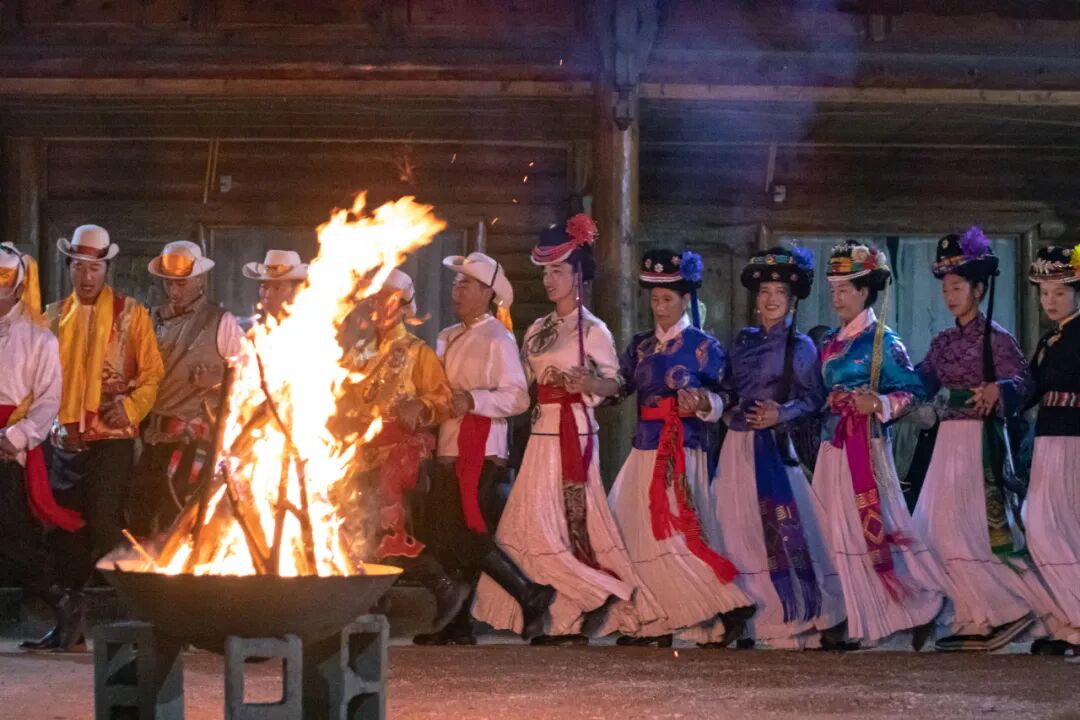
● A performance in the Lugu Lake Scenic Area. Photo by Huang Yiting
Therefore, to make tourists willing to stay and spend more, scenic spots need to find consumption scenarios that are worth paying for tourists and also worth investing for the scenic spot management.
The Wuzhen scenic spot operated by CYTS made such an attempt at an early stage. In 2019, Wuzhen received 9.1826 million tourists, with a year-on-year growth of only 0.35%, but its annual operating revenue reached 2.179 billion yuan, a year-on-year increase of 14.39%, and its net profit was 807 million yuan, a year-on-year increase of 9.97%. This means that each tourist unit generates more consumption.
Under the industry environment of intensified competition and ticket price cuts, it did not simply rely on tickets and traditional sightseeing, but built the scenic spot into a place that can continuously generate public topics.
For example, the conference facilities and service capabilities brought by the World Internet Conference continue to be used to host various conferences and events; the Wuzhen Theatre Festival has become an independent cultural IP, and the Mu Xin Art Museum continuously holds art activities; Wucun Village has added leisure products such as parent-child activities, summer camps, rice field swimming pools and folk music classes. Tourists can come to Wuzhen for a conference, or come again for the theatre festival; they can stay in the scenic spot and spend a whole vacation in Wucun Village with their children.
Under this trend, scenic spots are no longer just operating a single attraction, but a complete period of time belonging to tourists.
However, hotels, hot springs, and traditional performances such as *Impression · Lijiang* and the *Song of the Eternal Series* are essentially relatively fixed products. How to provide tourists with immersive experiences has become a new trend in the past two years.
"The current demand is for immersive experiences, which change tourists' behavior from 'just looking around' to 'staying for longer'. Through interactive projects, immersive performances, cultural exhibitions and other forms, tourists can feel, participate, deeply understand the local culture, and truly integrate into the environment," said Wang Binshan.
Viral NPCs are a typical example of this trend.
According to the financial report of Qujiang Cultural Tourism, in 2024, the revenue of the company's tourism scenic spot operation and management business accounted for about 52%. The scenic spots it manages, including Tang Paradise, Giant Wild Goose Pagoda and Tang Dynasty Ever-bright City, already have mature performance products such as *Dream Back to Tang Dynasty*, *Tang Dynasty Dream* and *Dream of Chang'an*. At the same time, the company is constantly adding "interactive entertainment" content, among which the "non-falling girl" and "Tang Secret Box" are the two most popular IPs that have gone viral online.
The "non-falling girl" who became popular in 2019 did not change the architecture, historical relics or block length of Tang Dynasty Ever-bright City, but gave tourists a specific reason to visit — to hold hands with the "non-falling girl". At that time, the topic of "non-falling performance" in Tang Dynasty Ever-bright City gained massive exposure on social platforms, and a large number of tourists often gathered in the performance area during the show time.
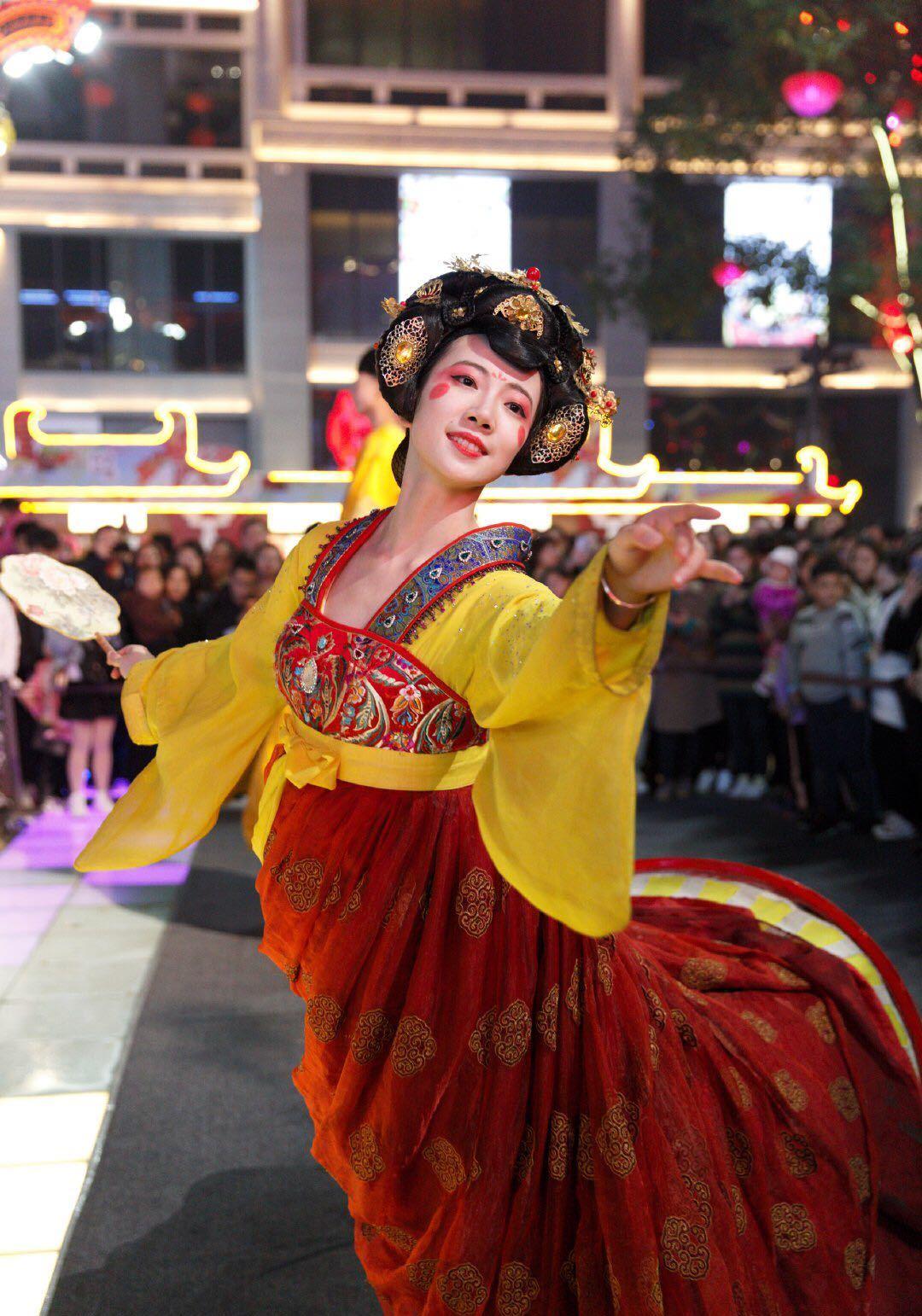
● The "non-falling" performance in Tang Dynasty Ever-bright City. Photo by the official account of Tang Dynasty Ever-bright City
In addition to "shaking hands" with viral NPCs, when you enter the Wanshan Martial Arts City in Kaifeng, you can experience more immersive content. The waiters on the street will take the initiative to talk to tourists, and tourists can play finger-guessing games and receive tasks; characters from different backgrounds keep appearing in different areas, and performances and interactions are interspersed along the tour route. The scenic spot has more than 2000 performers, and more than 3000 performances and interactive activities can be held every day. On social platforms, the total play volume of the single topic "Wanshan NPC" has exceeded 520 million views.
Immersive sightseeing extends tourists' staying time and enriches consumption scenarios. In the first half of 2025, Wanshan Martial Arts City received 10.242 million tourists, and achieved a total revenue of 604 million yuan, a year-on-year increase of 162%.
Sports events follow a similar logic. In 2021, Qujiang Cultural Tourism incorporated sports events into its main business scope, including large-scale road running and cross-country running events, as well as business travel services, online malls and event technical services. By 2025, the revenue of this business was about 176 million yuan, accounting for about 18% of the company's total revenue.
A marathon event brings far more than just registration fees. Participants need to arrive in advance, and have clear demands for accommodation, catering and transportation