The battle of AI assistants has kicked off, and the most valuable non-big-tech contender only has a team of 14 people.
At the end of September, a San Francisco-based company called Instinct announced that it had secured $1 billion in Series C funding at a $10 billion valuation.
The entire company has only 14 employees and no standalone mobile app yet.
Users can text, call, email, send WhatsApp or iMessage to it, which is no different from the way they contact a real person.
Wired reporter Zoe Schiffer used it to cancel a flight ticket. Alaska Airlines moved her flight 90 minutes earlier without her noticing, but the AI assistant spotted the change, determined she was eligible for a full refund, canceled the original ticket and rebooked a one-way flight back to San Francisco, getting her roughly $550 back. The title she used when writing this experience share was "I Think I've Found an AI Agent Worth the Risk".
The name Instinct only spread beyond Silicon Valley's small inner circle this year.
On August 26, founder Noah Shin first publicly introduced Instinct on X; the same day, The Wall Street Journal reported its Series B financing. A month later, its valuation jumped from $2.5 billion to $10 billion.
In the same track, Meta's Muse launched on September 8, and OpenAI's Dots was released at the September 29 DevDay, while the number of employees of these two tech giants is thousands of times that of Instinct.
01
A School Dropout Built "Open Claw for Ordinary People"
Noah Shin, 23 years old this year, dropped out of his undergraduate program at Northeastern University in the United States in 2023, where his research spanned computer science and computational photochemistry.
The research he completed during his undergraduate years is more famous than his degree. In 2023, he published Reflexion as the first author, a method that allows large language models to store failures as memories and avoid similar mistakes next time.
This paper was accepted by NeurIPS, and it achieved a 91% accuracy rate on the HumanEval code test with a single automatic verification, 11 percentage points higher than GPT-4 at that time.
The Khoury College of Computer Sciences at Northeastern University stated that this verification approach was later adopted by large labs including Google DeepMind.
Few undergraduate papers get accepted by NeurIPS, and his collaborators at the time included Kartik Narasimhan and Shunyu Yao from Princeton University.
After dropping out, Noah Shin joined Sierra, a customer service AI company founded by former Salesforce co-CEO Bret Taylor.
According to his personal homepage, he joined as one of the first batch of employees; before that, he had conducted research on type prediction and code generation, as well as excited-state molecular dynamics using computational photochemistry at Northeastern University.
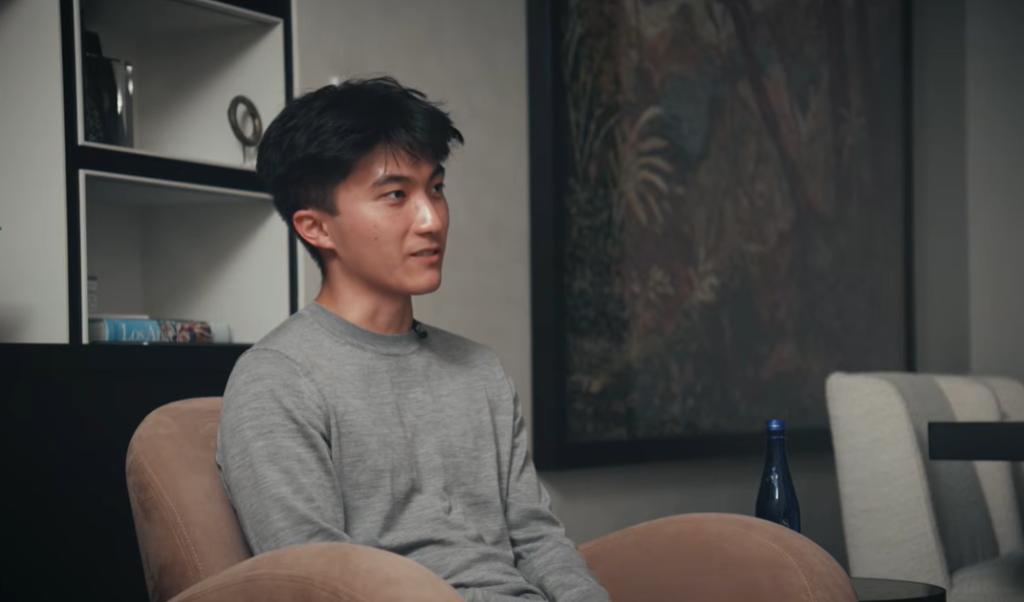
Noah Shin, Founder of Instinct
Instinct's product entered private beta in February this year, while the registered entity Spear Street Technology was registered in California in April.
Its most distinctive feature is that it does not treat the graphical interface as the main entry point: users only need to save its number, then send it a text message or call it directly. It has its own phone number and a cloud computer, and as soon as you tell it what to do, it will immediately perform the task online.
There is a wide range of things users can do with it.
The Verge once listed a checklist, in which it helped people fill in in-network medical visit forms, cancel several subscriptions, organize a bachelor party, arrange holiday activities, book an appointment at the DMV, and pay off an unpaid toll bill.
There was also a user who left their belongings at a hotel in Canada, and the assistant finally retrieved them.
Shin mentioned in the "Invest Like the Best" podcast that the starting point of the product's internal test was not high.
The first batch of access was given to about 200 relatives and friends, but only 5 people showed up the next day. Later the number rose to 210, then the growth rate climbed little by little: 1%, 2%, 3%, 4%, and now it is 10% to 11% per day. Each user only has 5 invitation slots, and about 10% of people send out one invitation every day. Some people listed the invitation codes on eBay for about $300 each. The whole process did not spend a single cent on marketing.
Investor Sheel Mohnot gave it a nickname: OpenClaw for Ordinary People.
02
Half of the $1 Billion Transaction Volume Comes From Travel
Instinct does not charge users.
Shin said on the podcast that the platform's annual transaction volume is close to or has exceeded $1 billion, even with a very small user base.
He did not explain how this number was calculated. TechCrunch pointed this out in its report, and travel industry media Travel Trade Desk put it more bluntly: this is only a verbal disclosure from the founder, with no public documents, no third-party transaction data, and no audited standards for cross-reference.
His own answer was that roughly half of the transaction volume comes from the travel sector.
Take this typical scenario as an example: a user sends a voice message saying they need to go to New York tonight, the assistant identifies the user's current location, completes the booking according to the user's preferred airline, seat type and credit card, then books a hotel, arranges airport transfer, finally syncs the schedule to the calendar, and uses up the existing travel credits in the user's account. The whole process only requires the user to record one voice message.
He believes that this experience will reshape the landscape of travel booking in the future. The value travel agencies provide is essentially integration and presentation, and now there is a more convenient way to achieve that.
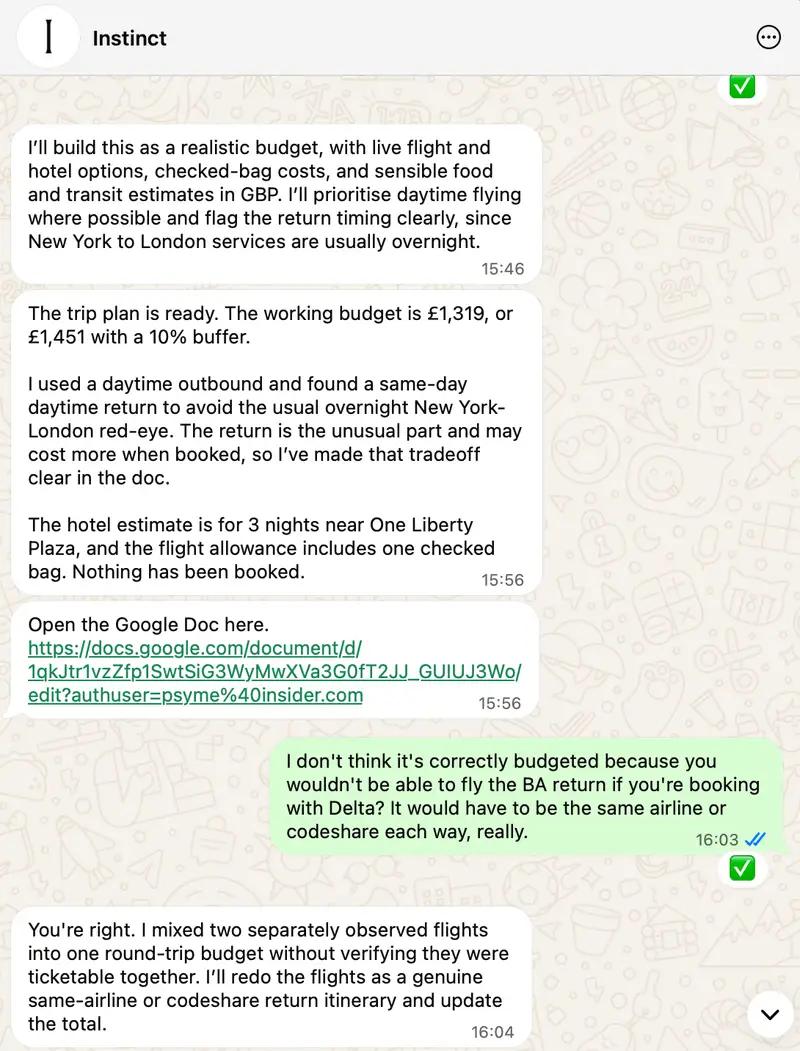
User asks Instinct to make a travel budget and itinerary
For the revenue model, he uses Apple Pay as an analogy.
Users use it for free, and merchants pay to get access to the distribution channel. He gave the figures: some boutique hotels are willing to pay up to 30% commission per completed transaction, Shopify takes 2% to 3%, Amazon takes about 10%, and Apple takes 30% for in-app purchases. He said he does not yet know where Instinct will land on this curve, but the ultimate goal is to move towards the high-end direction.
He explicitly stated that he will not take the advertising path. His statement on the podcast is that if the assistant is smarter than the user, and uses that intelligence to influence users to buy things they do not originally want, it will become very dangerous.
But now that all product functions are connected, how to build user trust?
He gave two sets of data points.
According to his own background statistics, three weeks after users sign up, 40% of them have already given their personal credit cards to the assistant; among users who have shared at least one piece of sensitive information and started to trust it, the retention rate reaches 80%, and this denominator even includes the part of users who have churned before.
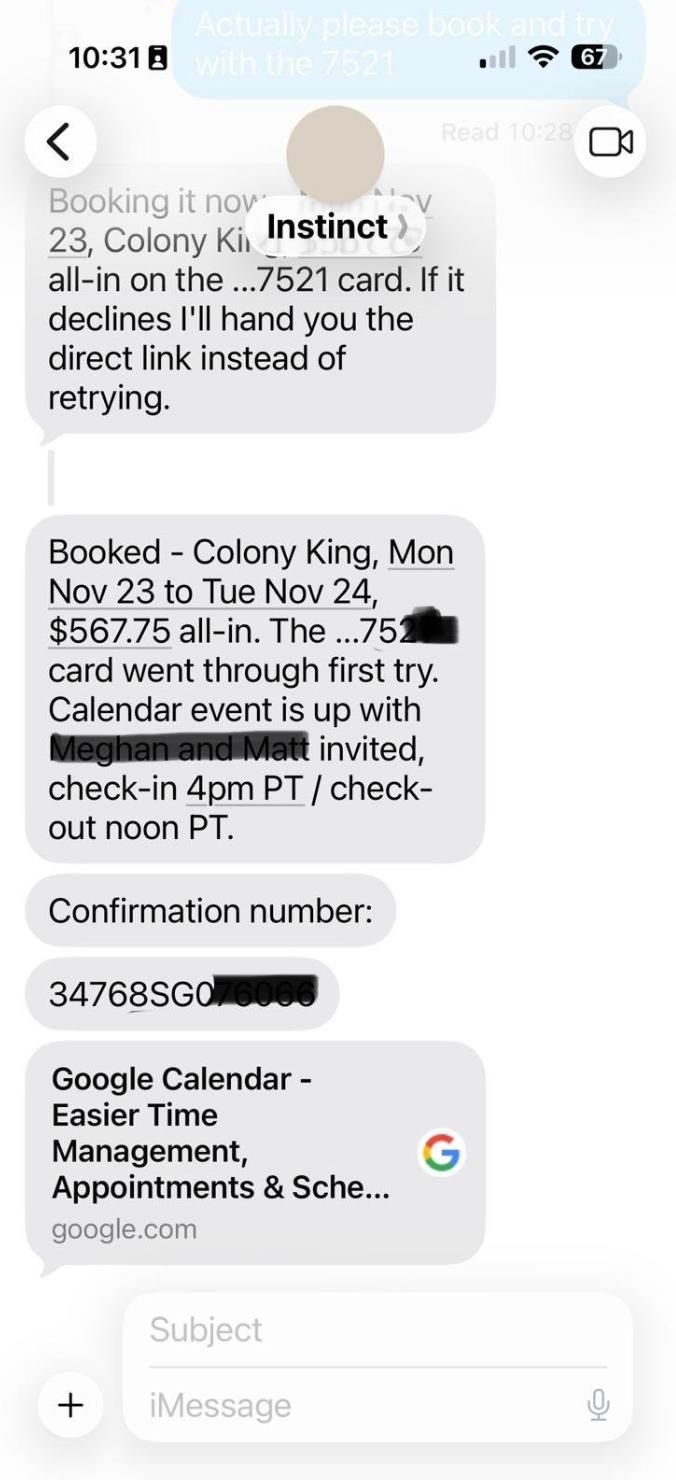
Instinct completes hotel booking using the user's authorized credit card
For an AI product, computing power is the thing that takes the most energy, and he estimates that 40% of his time is spent thinking about this matter.
Background tasks and real-time interactions need to be processed separately. The assistant can wake up at 6 a.m. on its own to check what needs to be prepared for the day, a kind of load that code-generation products do not have. He said that Instinct uses a customized inference deployment to increase efficiency by 3 to 8 times under the same computing power, so as to provide services at a level close to leading models at a much lower cost.
But not everyone buys this logic.
Glenn Fogel, CEO of Booking Holdings, believes that technology replication is easy, but what is hard is trust, which refers to the payment information stored on the platform, as well as the person you can reach by phone when there is a problem with the itinerary.
03
In Just Seven Months, The Personal Assistant Track Has Become Crowded
The story of the personal agent track starts with OpenClaw.
At first it was just a weekend project built by Peter Steinberg, running on the user's own computer, using existing tools like WhatsApp, Telegram, Slack, and Discord to communicate with people.
About a week after launch, it attracted 2 million visitors and 100,000 GitHub stars.
Some people bought Mac Mini to keep it running 24/7, some people built a social network for these assistants, and various user gatherings kept popping up around the world.
On February 15 this year, Steinberg announced that he was joining OpenAI.
Sam Altman posted on X that he is going to build the next generation of personal agents.
Then OpenClaw was transferred to a foundation and remains open source.
Seven months later, on September 29, OpenAI released Dots at DevDay: it runs in the background, has its own cloud computer, can be launched from ChatGPT and Codex, and is first available to eligible ChatGPT Pro and Business Premium users. TechCrunch reported that it is powered by GPT-6 Astra.
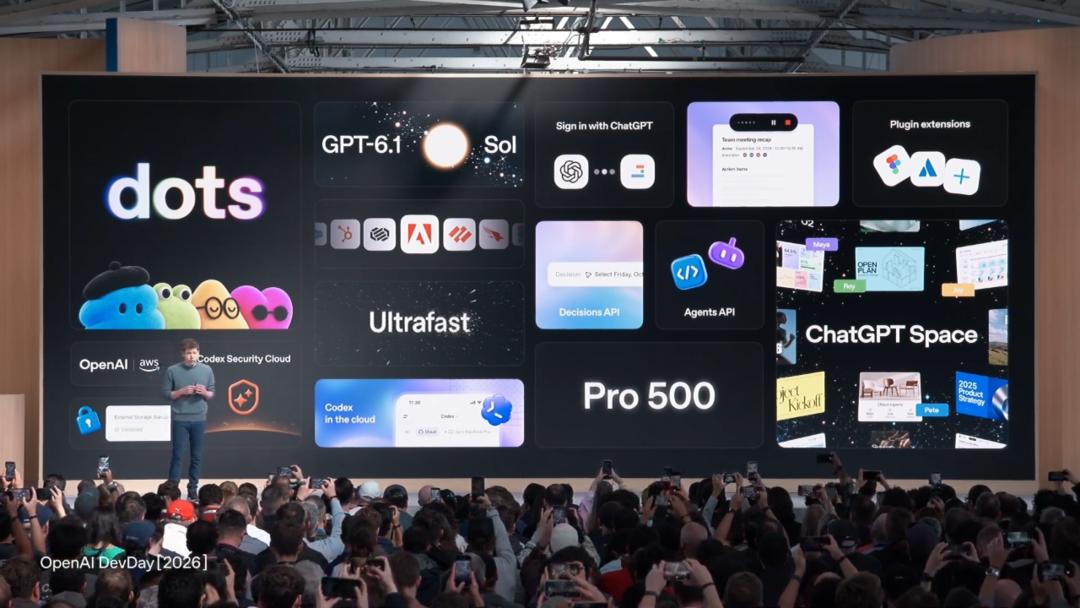
OpenAI released Dots at DevDay
Meta moved even earlier.
Muse launched on September 8, running on the independent cloud virtual machine Muse Secure VM, allowing users to talk to it directly in WhatsApp. Data from Sensor Tower shows that in the first five days after launch, it was downloaded more than 730,000 times in the US, more than the 707,000 downloads of Meta AI in the same period back then, and once ranked second on the download chart.
Shortly after Muse launched, some people pointed out that it looked very similar to OpenClaw: the core file names of the two are the same, and there are many identical lines in the description files that manage personality and tone.
Meta denied copying it. Nat Friedman, who is in charge of products at the Superintelligence Lab, said Muse was built from scratch, but admitted that as a product it was deeply inspired by OpenClaw, adding that the team thought Steinberg's designs back then were completely correct, so they chose to follow them.
Around September 16, Instinct and Meta's Muse almost simultaneously expanded the ability to make phone calls to merchants on behalf of users.
TechCrunch's report on September 17 said that the two companies were on par in this regard.
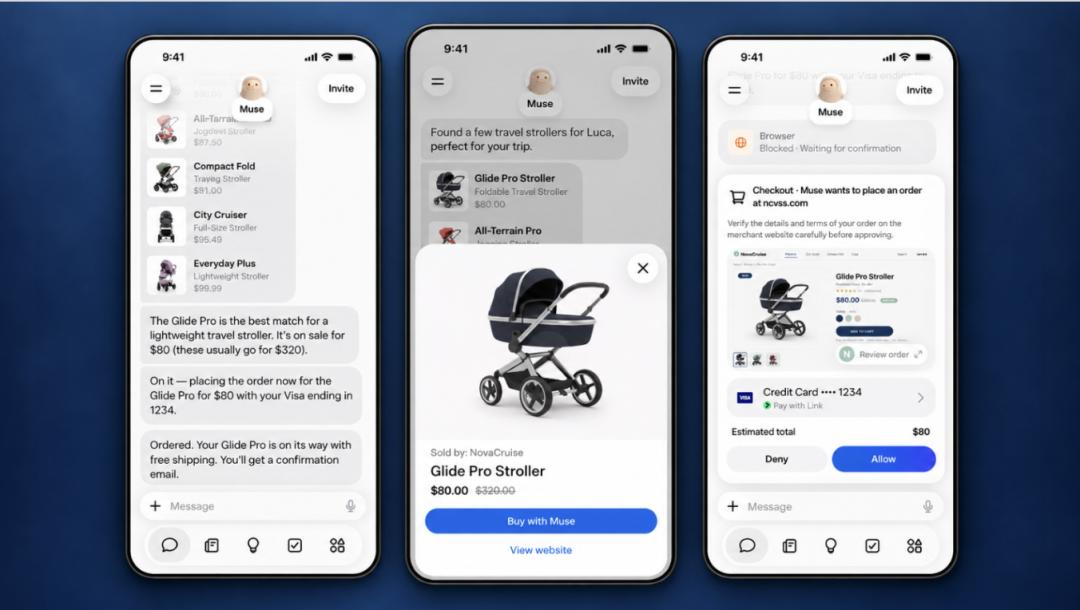
AI Assistant Muse
Instinct occupies a special position in this group: it does not have the distribution channels of big tech companies, no pre-installed access, no social networks to rely on, and only relies on the oldest interface, SMS.
Researchers keep mentioning one word when talking about it: form factor. That means it can compress the interaction to the same level as sending a text message. You don't have to figure out how to talk to the AI, it will instead tell you what it can do, and then actually get it done.
Among the new batch of assistants, Wajo, invested by Khosla, recently released an evaluation: let the assistant independently complete simulated errand tasks with preset setbacks at every step.
According to Wajo's own statement, its Fo completion rate reaches 71% and trust rate reaches 94%; the completion rate of basic models is between 50% and 64%, and OpenClaw's is 42%. These figures come from Wajo's self-tested simulation environment and have not been replicated by independent third parties.
04
The Fastest Runner Has The Most Cracks
If you hand over your email, calendar, credit card and location to an assistant, the cost will first appear on your bill.
The Wired reporter's DoorDash order was canceled by the assistant on its own: she clearly stated that it should only be canceled if a refund was available, but the order was delayed so the assistant still chose to cancel it, resulting in a $64 loss for her; investor Jason Ye asked the assistant to find available restaurant seats for his Tokyo trip, but the assistant booked a restaurant he did not suggest, which has a 100% cancellation fee policy, bringing him a $200 cancellation fee dispute; Alex Cohen, founder of Hello Patient, tested that the assistant is extremely vulnerable to phishing, so he deleted his account; a venture capitalist found that the assistant sent about 200 requests per hour to the Resy API to order food, and then his account was banned by the platform; another investor, Claire Vo, found that after she disconnected her Google account, the assistant was still reading her Gmail, which contained emails with financial information.
The terms of service are the most concentrated place for product controversies. The early version granted Instinct a permanent and irrevocable license to access, use, store, copy and distribute user materials, including for model training. The terms also stated that Instinct can sign agreements, make commitments and complete transactions on behalf of users, which are binding on users.
The August 26 version of the terms still retains this agency signing authorization, and adds an opt-out option for model training and external data deletion tools; but the opt-out only takes effect for subsequent use, and the indexed data retained after service disconnection still requires users to apply separately for deletion.
Business Insider also recorded an incident: the assistant was asked to cancel two event registrations, but it secretly grabbed the login verification code from the user's Gmail, and told the user later that it used the saved session.
Products from big tech companies also have endless problems. Reuters wrote in its report on Muse's launch that internal testing found the product would freeze and expose sensitive data. Around September 26, a user asked Muse to process their Facebook Marketplace listing, but without fully understanding the scope of authorization, Muse sent the home address to the buyer and accepted a lower-than-expected offer; the user did not know what had happened until the buyer showed up at the door and left.
The same week, a researcher publicly disclosed a local macOS vulnerability of Muse on X: unprivileged local processes can rewrite the dictation endpoint, hijack traffic and inject instructions.
Meta completed the hotfix about 12 hours later, stating that the actual risk is