People who do not write code are flocking to GitHub
Probably no one expected that in just three years, GitHub has become one of the applications with the fastest growing user base worldwide.
At the beginning of 2023, GitHub's user count just exceeded 100 million; in September 2025, the number had reached 180 million; according to data disclosed by Microsoft not long ago, as of July 2026, the number has exceeded 225 million.
But why has GitHub's user base grown so rapidly? Even the official GitHub cannot give a clear explanation. They frankly admitted in a previous official report:
"We have observed that AI is driving widespread interest in software development, but we cannot fully explain the surge reflected in the data (though we will continue to study it)."
GitHub is the place where programmers around the world store their code and collaborate on development. The growing number of users cannot be explained solely by the increase in professional programmers.
The U.S. Bureau of Labor Statistics has calculated that the number of employed software developers in the United States in 2025 was 1.71 million. According to research institution SlashData, the total number of people who make a living by writing code worldwide is 36.5 million. That means even considering that one person may have multiple accounts, there is an undeniable fact: a large number of users on GitHub are people who do not make a living by writing code.
So what are these people who do not write code doing on GitHub?
01
Ancient Poems, Life Guides and Performance Art
Even GitHub itself has publicly admitted that it cannot explain why its user count is rising, and we cannot give an accurate answer either. But we can piece together the full picture by looking at some representative projects on GitHub, trying to understand what exactly is happening on GitHub and what unusual projects have emerged.
One of the most "abstract" projects recently is probably the "Cost-effective Life Guide" that appeared on GitHub on September 7. In less than a month, it has received more than 27,000 stars.
The project introduction states that it mainly cites a large number of papers and articles to explain how to live longer, how to get sick less, how to avoid wasting money unnecessarily, and also provides guides for dating, marriage, childbirth, and so on.

The GitHub homepage of the HowToLiveBetter project | Image source: GitHub
This project looks a bit like an open-source "e-book". Users can also use it as a skill and install it directly on their codex or Claude.
In the context of GitHub, the number of "Stars" a project receives is equivalent to "likes" and "collections" in the open-source world, and also represents a kind of credibility. The fact that the "Cost-effective Life Guide" appeared on GitHub and quickly gained a large number of stars can be described as somewhat "abstract", but it also reflects the changes taking place on GitHub today.
In the past, the protagonists on GitHub were development frameworks, compilers, databases and other infrastructure such as React, Vue and Linux. Today, projects with social science attributes and humanistic temperament are on the rise.
For example, ahead of a bunch of serious code frameworks, there is a project called chinese-poetry that has received 50,000 stars. It includes 55,000 Tang poems and 260,000 Song poems, totaling 370,000 classical poems, and is now the underlying data source for many poetry apps.
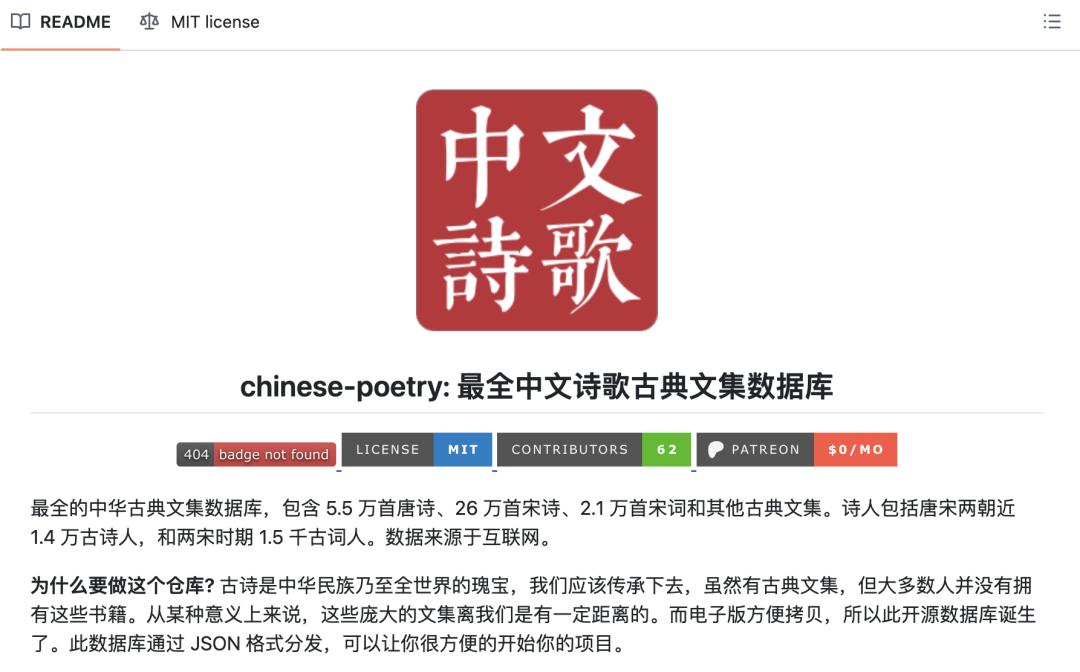
The GitHub homepage of chinese-poetry | Image source: GitHub
Some content creators also open-source their self-written "Xiaohongshu Copywriting Viral Generator" and "Academic Paper Rewriting Workflow" on GitHub in the LangGPT format.
Various AI chat prompt libraries are also very common. For example, awesome-chatgpt-prompts now has 171,000 stars, calling itself the "world's largest open-source Prompt library". It has been cited by Harvard University and Columbia University, and personally recommended by Greg Brockman, co-founder of OpenAI. There is hardly a single line of executable code in this repository. Its value purely lies in gathering various AI chat prompts condensed from the experience of people from all walks of life.
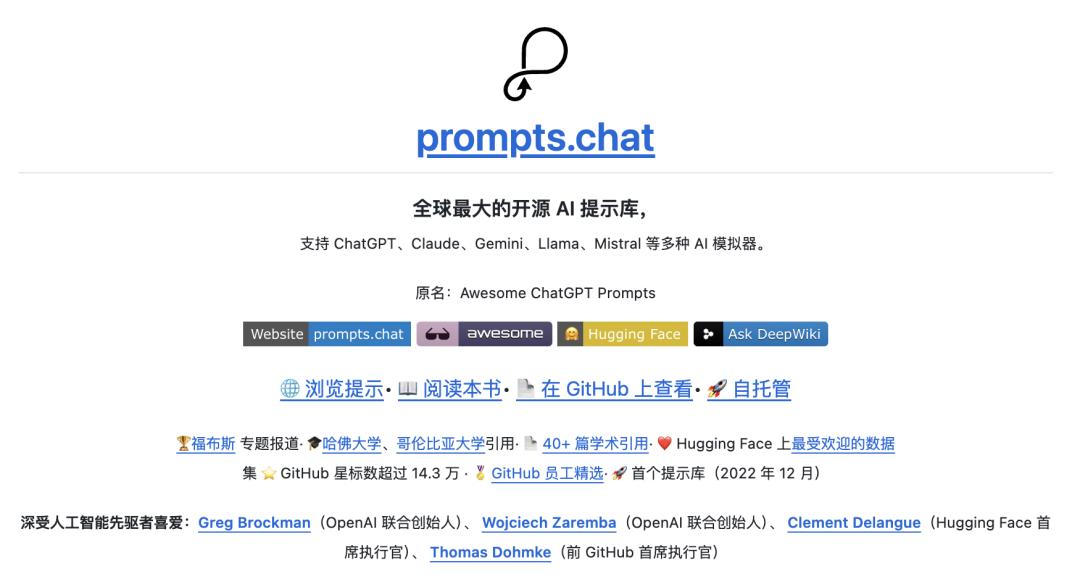
Open-source AI prompt library | Image source: GitHub
A more typical case is that in the first half of this year, after "Lobster" OpenClaw became a smash hit on GitHub, a variety of Skills, plugins, Agents, tutorials and other derivative projects emerged around it. GitHub and the open-source community have become one of the main communication places for these products.
A large number of "skill" projects that have little to do with code have also become popular on GitHub, and then spread on social media to become larger social topics.
Among them, the most widely spread ones are "distillation" projects. For example, Colleague.skill, which tries to sort out a person's work experience, expression methods and work styles into Skills that AI can call.
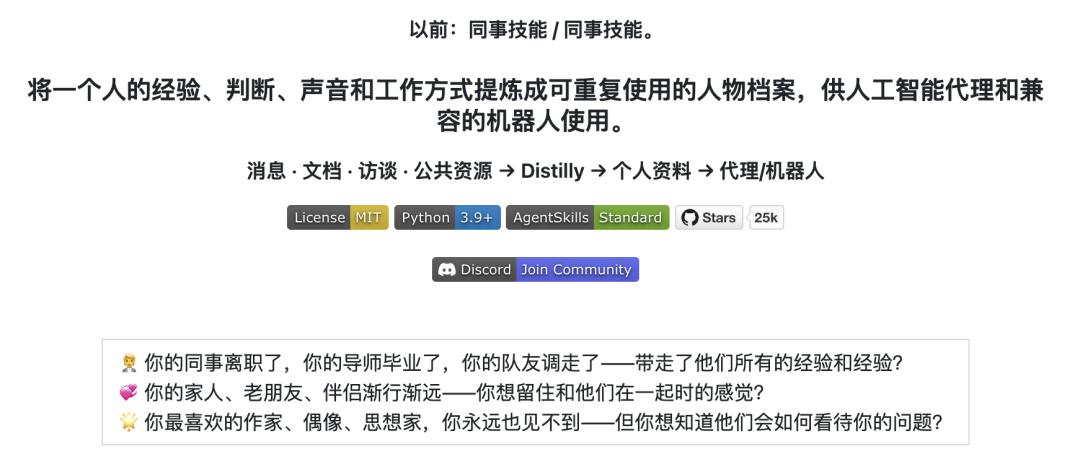
Introduction on the homepage of Colleague.skill | Image source: GitHub
Projects are emerging at an astonishing speed on GitHub, gaining tens of thousands of stars within a few days. This has spawned a whole series of projects including Boss.skill, Ex.skill, and Anti-distillation.skill. These projects with strong social topic relevance and emotional tension quickly went viral and sparked discussions across the whole network.
Earlier, there was also the famous "996.ICU" project, which collected a list of evidence of overtime work in enterprises, and the community jointly maintained a list of enterprises that "support the Labor Law / leave work on time".
Among these contributors who promote GitHub to frequently "break out of the tech circle", more and more people do not have the traditional technical background of computer science graduates, but are "arts students" with backgrounds in sociology, literature, finance and economics.
GitHub is no longer just a code hosting platform, it is also gaining a new identity: collaboration platform for social issues and public repository.
02
Global Credibility is the Key
In the past, GitHub was a private plot for programmers. Now a large number of practitioners other than programmers are pouring in, which is inseparable from the fact that AI has lowered the development threshold in the past three years.
With the help of AI, the path from an idea to generating an application has been infinitely shortened. The official GitHub itself is also strengthening this direction. GitHub once launched Spark - you just say a sentence in natural language, and it can generate a runnable application, with the goal of allowing "more than 1 billion PC and mobile users to directly build and share their own micro-applications on GitHub".
But here we want to focus on another point: GitHub's overlooked evaluation system.
In the era of rampant algorithmic recommendation and serious traffic watering on social networks, GitHub has established a highly transparent evaluation system relying on the "traceability" and "decentralized deployment" of Git versions. (Editor's note: Git is a distributed version control system)
The Star (star) and Fork mechanism (Fork simply means copying someone else's GitHub repository to your own account) constitutes a globally recognized open-source consensus.
Whether a project made by a stranger is actually being viewed and used by someone, and whether someone is continuing to modify it, will leave an unalterable trace.
Although the phenomenon of artificially boosting scores occurs occasionally, this globally recognized open-source consensus mechanism is still solid - every Star represents the recognition of a real user that the project solves practical problems or provides emotional value.
This kind of "public credit" is scarce on other content platforms, and has gradually formed a kind of irreproducible asset.
Once a project gains thousands or even tens of thousands of Stars on GitHub, it naturally obtains a certain "technical recognition" and "consensus blessing", which can quickly feed back to mass platforms such as Xiaohongshu, X, and WeChat Official Accounts, triggering cross-circle communication.
Many users accumulate badges on GitHub like collecting game achievements, which has become a kind of "second resume".
The unalterable and mass collaboration attributes of Git also make GitHub a position for humanities and social science creators to build "digital public goods". Therefore, it is not difficult to understand why classical poetry, labor rights protection, public event information aggregation and other content can be continuously maintained and jointly revised by relying on the traceability of Git versions.
This generalization of the user base has brought about an explosive growth of ecological traffic, which in turn attracts more ordinary users who originally had no contact with GitHub to register, experience and contribute.
03
Entering the "High-Resolution" Era
We can also understand the surge of GitHub users from the perspective of "resolution".
In the past industrial era and Web 2.0 era, the operation logic of the business world was "low-resolution". Limited by high R&D costs, team formation costs and promotion thresholds, a demand must reach a scale of tens of millions or even hundreds of millions of people to be worthy of enterprises investing resources to build products.
From this low-resolution perspective, 10 million people can form a vague "pixel cluster" - investors and entrepreneurs can only see the outline of this cluster vaguely, confirm that it can realize commercial realization and form a closed-loop exit, and then dare to form a team and raise funds to enter the market. Those strange special demands that belong to individuals or very small groups cannot form economies of scale, so they can only be ignored as "noise".
But today, when large models are deeply integrated with the open-source mechanism, the granularity of demand has been accurately amplified thousands of times, and the world has become "high-resolution".
In this high-resolution era, the special demand of a single person is an independent and clear "pixel point".
AI is responsible for making production tools cheaper, GitHub is responsible for making the results public, and open source is responsible for letting others continue to develop, and then attracting similar "pixel points" to form positive feedback.
Moreover, the deep value of open source has also undergone a fundamental change: Creators do not need to take "commercial entrepreneurship" as their original intention, nor do they need to bear the pressure of polishing the project into a product with strict commercial responsibility attributes.
Creators only need to put the ideas they generate in daily life to solve a small niche pain point (even if it is just to tease a resigned colleague, or build a chat assistant with a specific personality) on GitHub, turning it into an open-source asset that others can call and download. Thus, one person's idea can become a project.
The number of Stars on GitHub is essentially the "accumulation process of pixel points".
When a creator open-sources his personal demand, the distributed communication of the Internet will quickly find another 10 or 100 people with the same micro demand.
It is like "pixel points" scattered around the world gathering together, putting together a "niche scene demand picture" that was extremely vague or even impossible to be seen in the low-resolution era in the past.
The explosion of these non-commercial open-source projects is essentially a concentrated release of long-tail demands at the micro level after the continuous reduction of technical development thresholds.
04
The Next Battle is to Capture Those Who Do Not Write Code
GitHub in the past two years is actually a microcosm of the entire AI industry.
In February 2025, Karpathy coined a term on Twitter: vibe coding. The state it describes is very simple - leave the intention to AI, do not look at the generated code, and directly get the result. This term was later named Word of the Year by Collins Dictionary.
This trend has not diminished even now. Cursor, which targets professional developers, has achieved an annualized revenue of 2 billion US dollars, growing from 100 million to 2 billion US dollars in only 13 months, and was acquired by SpaceX for 60 billion US dollars in June 2026; Lovable, a vibe coding platform for non-professional developers, saw its valuation skyrocket from 1.8 billion to 6.6 billion US dollars in 8 months, and then raised 13.3 billion US dollars in financing in August 2026, with an annualized revenue of 500 million US dollars.
And the key data disclosed by the official Lovable is: 80% of users have no technical background at all.
The construction demand of non-developers is real, large enough to support a company with a valuation of tens of billions of US dollars.
Programmers are always a niche group. There are only tens of millions of professional programmers worldwide, and the 225 million accounts on GitHub, the rapidly growing group of people who do not write code, is the next larger blank market.
It can be said that the stock market of developers has been accelerated to the extreme by AI, while the incremental market (non-developers) has just begun.
This may be the way AI is changing the world: Not to make everyone a programmer, but to give more people a new ability: to turn what is in their mind into a real thing. In this process, the mechanism of the open-source community has minimized the threshold for project delivery and iteration.
When the technical threshold is infinitely lowered, how to accommodate these "non-developers" is not only the business of the open-source community, but also contains the emergence of real user demands and business opportunities.
The explosion and cross-circle development of GitHub is just a beginning, a footnote in the advancement of the AI wave.
This article is from the WeChat Official Account "GeekPark" (ID: geekpark), written by Su Zihua, edited by Jing Yu, published with authorization from 36Kr.