The real business of BI has only just begun.
This year, the cost of querying data with large language models has been driven extremely low.
By connecting AI to data sources like spreadsheets, a business department can build a dialog box in just one afternoon; billed by the number of calls, it costs very little.
Theoretically, enterprises should have saved this expense. But after reviewing public bidding records from the past two years, I found that the saved money did not remain on the books, instead, a new category of procurement has started to be established as independent projects.
Let's start with one of these projects:
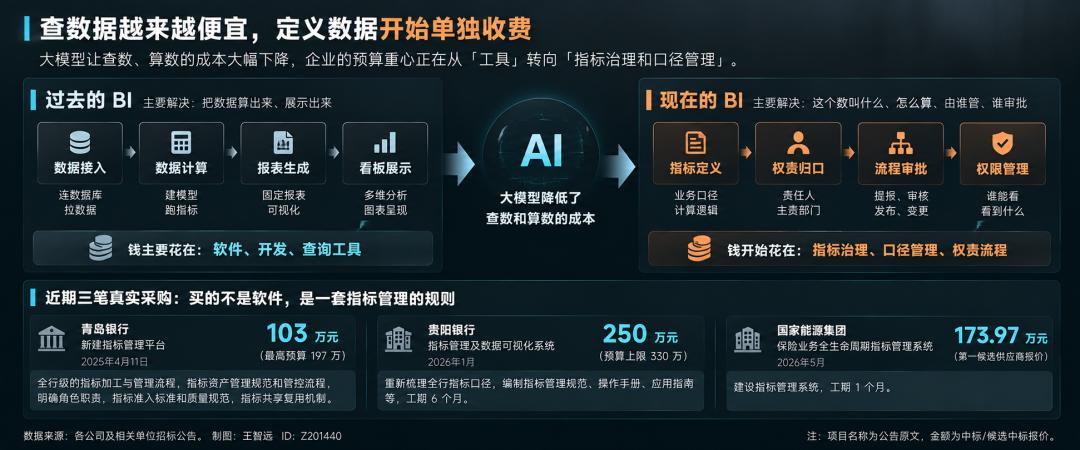
On April 11, 2025, Bank of Qingdao released a competitive consultation project named "New Construction of Indicator Management Platform". The maximum budget was 1.97 million yuan, but the final transaction price was only 1.03 million yuan, less than 60% of the budget.
What exactly did they buy for this 1.03 million yuan? From the requirement section of the announcement, I pick out several key points:
Bank-wide indicator processing and management procedures, indicator asset management specifications and control processes, clear role responsibilities, indicator access standards and quality specifications, indicator sharing and reuse mechanisms, and process-based control.
Reading through the whole document, there is barely any mention of the software itself. What this money actually buys is a set of processes with signed approvals, and this practice is far from unique to this enterprise.
Bank of Guiyang also launched a bidding in January this year for a project named "Indicator Management and Data Visualization System", with a maximum budget of 3.3 million yuan, and the final transaction price was 2.5 million yuan, won by Digital China Rongxin, with a construction period of 6 months.
China Energy Investment Corporation also had a procurement in May, with the project named "Full Life Cycle Indicator Management System for Insurance Business". The first candidate supplier quoted 1.7397 million yuan, with a construction period of only 1 month.
The announcement from Qingdao did not mention the term "caliber" at all, while the one from China Energy Investment only mentioned it once, in the background section of the project overview. For the exact same matter, the three parties have not even aligned their naming conventions.
The expensive 2.5 million yuan project takes half a year to complete, the cheap 1.03 million yuan project has no specified construction period, and the 1.7397 million yuan project in the middle only takes one month. All are called "indicator management", but what these companies purchased are completely different things.
The huge price difference comes from the fact that these companies are not buying the same product.
The one that can be delivered in 1 month is just a set of system development; the 6-month project requires rechecking all bank-wide calibers, and compiling the indicator management specifications, operation manuals, and application guidelines together.
The value of this latter part does not depend on the software, but on how long the internal stakeholders of the client need to negotiate and align.
To be honest, I was stunned when I saw such a large price gap. This business segment has not yet taken shape, which is why the prices are so chaotic. It is being split out from other budget items and gradually becoming an independently established expense.
In the project of Bank of Qingdao, the maximum monthly cost for technical personnel does not exceed 40,000 yuan; after the free maintenance period expires, the annual service fee cannot exceed 10% of the transaction amount.
The same rule applies to Bank of Guiyang: subsequent maintenance renewal fees cannot exceed 10% of the winning bid price, and payment is made in three installments: 30% paid first, then 60%, and the final 10% is retained as the remaining payment.
Calculated by person-month, and with annual service fees to be paid, this sum of money is not spent all at once. So why can't it be directly included in the BI budget, but must be established as an independent project?
The sellers themselves have given the answer.
Guanyuan has summarized five major reasons for the failure of intelligent data query projects: the business side does not know what to ask, the caliber of the queried indicators does not match the daily reports, the permission configuration prevents users from accessing the corresponding themes, the knowledge base does not cover business jargon, and feedback on issues does not enter the optimization closed loop.
All five points show that the most critical factors are completely outside the model, and none of them point to the insufficient capability of the large language model itself.
And the hardest core part among them is the number itself: what this number refers to, who defines it, and who has the right to modify it.
There is also a sentence in the same batch of articles: more than 60% of enterprises that have launched decision-making cockpits will not rely on the data from the cockpit when senior executives actually make decisions.
In most cases, they still ask the business department to resubmit the data offline for cross-verification, or even make decisions directly based on experience. This statement comes from the sellers themselves.
There are also developments overseas.
On July 22 this year, Domo announced that it sold almost all its assets and employees to Progress Software for 400 million US dollars in cash. The transaction was completed on September 22, and the remaining shell company was renamed Huckleberry.
In that quarter, Domo's revenue dropped by 4% year-on-year, and the company itself stated in its financial report that there was doubt about its ability to continue as a going concern.
The interesting part of this transaction is that the 900 million US dollars of tax losses were retained in its own company for tax deduction, and there is still about 246 million US dollars in cash left on the books, while the business and employees were sold out.
Earlier, in March 2024, Alteryx completed privatization at a price of 48.25 US dollars per share in cash, with an overall valuation of 4.4 billion US dollars, led by two private equity firms Clearlake and Insight.
None of the articles interpreting these two acquisitions mentioned the word "caliber". There is a professional term in the industry called metric drift, which means that the meaning of the same indicator deviates gradually during calculation.
There is also a term called decision gap, which refers to a layer of barrier between executives and real data.
None of the explanations for these two transactions mentioned "customers cannot figure out whose data to listen to internally". In overseas industry terminology, this is not called caliber.
It is true that using AI to query data has become cheaper, but this sum of money has only been moved to another account, included in the "indicator management platform" item.
However, only having signatures is not enough. How a number is calculated and which number it refers to has little to do with whether the large language model can calculate it correctly. The real difficulty lies here: who finally approves this number.
......
Moving further down, we come to the rules and regulations. There are regulatory provisions externally, and enterprises also need to build their own set of internal rules.
Let's first talk about a scenario that happens every day in enterprises.
For the same indicator, three departments calculate three different numbers. The risk control department calculates the proportion of bad debts according to regulatory rules, the finance department follows national accounting rules, and the business department uses the caliber for internal assessment and rewards. None of the three parties made calculation errors, but conflicts arise as soon as the three sets of numbers are put on the same table.
Why is it so difficult for everyone to sit down and unify the rules?
"Some management teams are afraid of the changes in the power structure brought by transparency", this statement is made by Wu Mufeng, Information Director of Jiangshi Holdings.
Note his wording: fear. Fear is more critical than refusal. Refusal means unwillingness to cooperate, while fear means worrying about losing something for their own side. Whoever gives up their department's own calculation rule first will hand over the right of interpretation to others.
When focusing on indicators, the number itself becomes the object of management. As Zhu Xingming from Inovance said at the beginning of this year, "you are managing this number".
Enterprises themselves know that they cannot control this situation. In a 154-page bidding document of Bank of Guiyang, it is admitted at the beginning that there is no unified management for various indicators inside the bank, and the same indicator cannot be reused repeatedly.
Conversely, each department calculates its own numbers, the same number cannot be aligned, and no one's data can be used. This is exactly written in the bidding document by the bank itself.
Therefore, the bidding requirements explicitly stipulate that each indicator must register five items: indicator name, business caliber, calculation logic, responsible person, and responsible department; among the five columns, business caliber and calculation logic are definitions, while responsible person and responsible department are for ownership. How a number is calculated and who is in charge of it are written on the same form.
An eight-step process has also been established.
From submitting requirements, defining indicator rules, approving and releasing, to launching for use, daily monitoring, and finally modification or deactivation. In the approval and release step, both the business leader and the technical leader must give their consent. If one of them is missing, this indicator cannot be launched.
Permissions are also finely divided: the head office can view bank-wide data, and branches can only view their own part, so the two levels see different numbers for the same indicator.
This bidding document manages only one thing throughout the whole process: who has handled this number from the moment it is proposed to the moment it is presented at the meeting.
There have long been external rules governing this matter. Article 15 of the "Regulations on Financial Statistics Management" issued by the central bank stipulates that the name, calculation method, and classification of indicators are uniformly formulated by the People's Bank of China. No bank can interpret them on its own.
Article 13 leaves a small gap: branches can add necessary statistical items and statistical indicators, on the premise that they are under the items and indicators uniformly stipulated by the head office.
In September 2023, the U.S. Securities and Exchange Commission penalized Newell Brands: the company was fined 12.5 million US dollars, and the former CEO personally paid another 110,000 US dollars.
They created a term called "core sales growth" to bring in sales from subsequent quarters in advance. For the same quarter, the internal judgment was disappointing, but the external statement was strong and robust.
There is no sentence in the case file saying that they made calculation errors. This penalty is imposed on the right of interpretation: the company cannot arbitrarily decide the meaning of an indicator.
The Shanghai Stock Exchange has drawn a line for controlling shareholders selling stocks: if the stock price falls below the issue price or net asset value per share, or the total dividends in the latest three years are less than 30% of the average annual net profit, they are not allowed to reduce their holdings in the secondary market.
The 30% is written in the regulation, and who can sell and who cannot depends on this number. This line was drawn on September 26, 2023, and was upgraded to a regulation of the China Securities Regulatory Commission the next year, only three days apart from the SEC case.
The People's Bank of China, the U.S. Securities and Exchange Commission, and the Shanghai Stock Exchange each manage a part of the scope, but what they are essentially managing is the same thing.
In terms of system, there are originally two sets of accounts. Article 2 of the "Guidelines for the Application of Management Accounting No. 801" issued by the Ministry of Finance states that management accounting reports are for internal use of enterprises.
The Q&A from the Accounting Department further clarifies the boundary: management accounting belongs to internal reporting accounting, which is completely separate from the set of reports for investors.
Article 33 of the "Regulations on the Financial and Accounting Reports of Enterprises" issued by the State Council adds another rule: when relevant departments request financial data from enterprises according to law, they cannot force enterprises to modify their calibers. Even the parties requesting the data are not allowed to force you to change the calculation rules.
In July this year, the Ministry of Finance revised the "Accounting Standards for Enterprises No. 30", adding a new rule: if an enterprise publicly uses self-defined performance indicators outside the financial report, it must disclose them in the notes, and prepare a reconciliation form that adjusts these indicators back to the standard caliber.
This rule will be implemented step by step from 2027. Although it has not taken effect yet, the direction has been clearly defined.
All these rules are converging to one point: who has the right to define this number will eventually be handed over to a higher level. From the regulation issued by the central bank in 2002 to the standard issued by the Ministry of Finance in July this year, more than 20 years have passed, and this principle has never changed.
The meaning of an indicator is no longer determined solely by the person who calculates the number, but must be signed and confirmed by the party that sets the rules.
Rules and regulations can do things that technology cannot do. For disputes that could have been argued for a year, a formal rule sets a clear standard, and the cost is directly cleared. Technology is only responsible for "whether the number can be calculated correctly", while rules are responsible for "whether this number is recognized", which are two completely different matters.
......
These rules and regulations themselves have not changed much. What AI has changed is on the other side.
It has brought the matter of "whether this number is correct" from the private wrangling in small internal groups of various departments directly to the public.
In the past, this matter was hidden in private, and whoever had the loudest voice had the final say. Now, after opening the dialog box, if you ask the same question twice, two answers will pop up on the screen next to each other, and no one can pretend not to see it.
Postal Savings Bank of China has a project called "PostWin Insight", which was selected as one of the top 10 big data management innovation cases in 2025 by the China Electronic Information Industry Federation. The whole system is find data, query data, calculate data, use data.
In the compilation of Dune Think Tank, the sequence of the Fujian Branch is very clear: first, uniformly register the statistical rules of the indicators, and then open AI data query services.
At the same time, there are five words in the report of the Shenzhen Audit Bureau: "idle immediately after completion".
The provincial government large language model launched in Sichuan has 382 registered users, but only 79 of them are actually using it. Shandong reported that some modules were repeatedly developed or had low usage after completion, involving an amount of 420 million yuan.
There is also an old saying in the industry:
Among ten newly launched intelligent data query systems, only three can be truly implemented and put into use. No one can verify who first said this sentence, but as long as you travel between the client side and the supplier side, you can hear it seven or eight times a day.
FanRuan's revenue in 2024 was 1.57 billion yuan, and the company itself stated that it has ranked first in China's BI market share for 8 consecutive years. This business has not collapsed.
The paper numbered WP 25148 from the National Bureau of Economic Research in the United States talks about the J-curve of productivity: in the first few years after new technologies are introduced, the output will drop instead, because enterprises need to invest money in supporting transformation.
This downward concave section is the time difference. The tools have been installed, but the supporting rules have not kept up, and this stage cannot be bypassed.
Enterprises spending money to establish projects for procuring indicator management platforms are going through this concave stage. The concave section starts to be filled only when someone pays, signs, and registers each caliber clearly one by one.
The sample of Postal Savings Bank of China takes this path: unify the calibers first and then open data query, actively filling this concave section; the 382 accounts in Shenzhen Audit and S