SteamOS will be compatible with Android, and Valve aims to become the godfather of handheld game consoles.
Valve is about to launch a "unification war" in the handheld console market.
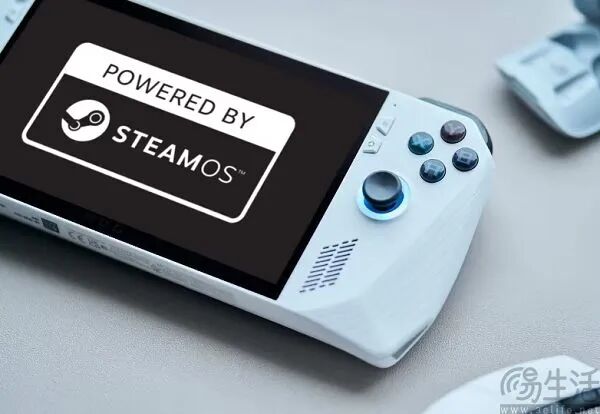
Back in the spring of 2025, Valve confirmed that third-party handheld gaming consoles other than the Steam Deck can also be equipped with SteamOS, forcing Microsoft to roll out the "Xbox UI" as a response. A year and a half later, SteamOS seems to have set its sights on the Arm ecosystem. Information recently exposed by overseas tech media Ars Technica shows that in addition to the existing Proton compatibility layer, SteamOS has added two new compatibility layers: FEX and Lepton.
As is known to all, SteamOS is an operating system built on Linux. To enable a large number of Windows games on Steam to run on SteamOS, Valve launched the Steam Play project, among which Proton is a translation layer specifically designed for running Windows applications on Linux systems. It should be noted that Android is also based on Linux, so the FEX-Emu project that realizes conversion from Linux to Android naturally came into Valve's sight.
The core function of the FEX-Emu project is to enable chips with Arm architecture (aarch64 instruction set) to execute x64 instructions through dynamic binary translation. Combined with the Proton compatibility layer, it can run x86 architecture PC games on Arm devices.
In fact, as early as this spring, Pierre-Loup Griffais, Valve's architect, revealed in an interview that they had successfully run Hollow Knight: Silksong on Samsung Galaxy series phones. At the beginning of this year, the realme Neo8 equipped with a PC handheld mode successfully ran 51 Steam games including Hades 2 on mobile phones with the help of this combination.
As for Lepton, it is an expansion based on the existing open-source Android emulator Waydroid project, which runs a complete Android environment through container technology, so as to run standard Android APK programs on SteamOS.
Although all the "translation" operations with the help of the compatibility layer will bring performance loss, the APU of Steam Deck is powerful enough. The CPU with Zen2 architecture and the GPU with RDNA2 architecture deliver ultra-low power consumption while maintaining strong performance. When SteamOS expanded its ecosystem in the past, the most tricky part was none other than Android handheld consoles.
The current situation of Android handheld consoles and PC handheld consoles can almost be described as "belonging to the same family but different genera". Although the two have similar appearances, there are huge differences in their ecosystems and underlying logic. Among them, PC handheld consoles are a simplified version of consoles and computers, with the core purpose of meeting players' demand for a "portable PC" that allows them to open Steam and play games in their libraries anytime during commutes or business trips.
However, Android handheld consoles are an additive product, whose target audience is heavy mobile game players. With the popularization of FPS and MOBA games on mobile terminals, touch operation has become completely incompatible with these games, so many players complain that playing games on mobile phones is like "rubbing on glass". As a result, handheld consoles, a type of mobile device specially designed for games, have become the new favorite of many hardcore players.
Indeed, since the handheld console industry recovered, it has actually served two completely different groups of consumers. So, can SteamOS's plan to make handheld consoles serve both groups of people win the recognition of consumers?
Absolutely yes. With the help of the two compatibility layers FEX and Lepton, Steam Deck users can take a break from playing Elden Ring and Black Myth: Wukong to play games like Egg Party and Animal Restaurant, and even watch short videos to relax.
In a sense, the days ahead for Android handheld consoles are likely to be very tough. In fact, Android handheld consoles have long been in a niche state. It is not that manufacturers do not want to make big profits, but that their positioning is really awkward. Android handheld consoles simply cannot answer the soul-searching question of why users need to carry an extra device when going out, so they can only take the low-price route.
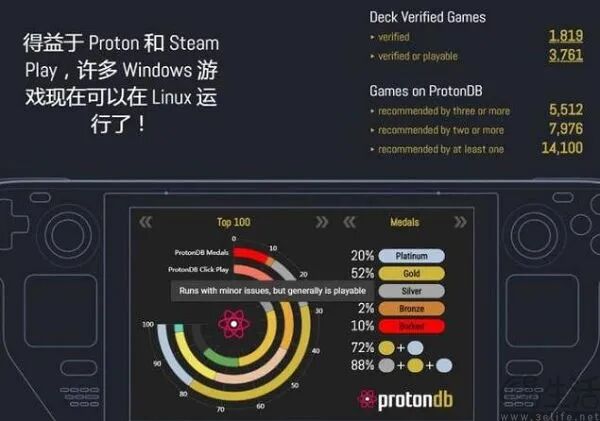
In contrast, the answer for PC handheld consoles is much more straightforward. After all, even thin and light laptops cannot deliver a better gaming experience in mobile scenarios than them. It is too weird to spread a laptop on your lap to play games on the subway, but holding a handheld console with both hands to play games is very normal. Being able to play both PC games and mobile games, and even use Android applications, is Valve's long-term strategy.
Facing Windows-powered handheld consoles, SteamOS says it can also run mobile games. Facing Android handheld consoles, SteamOS can run AAA PC titles. In short, Valve is trying to build SteamOS into a long-term sustainably evolving platform, so as to attract more third-party manufacturers to switch from the Windows and Android camps to its own ecosystem.
[All images in this article are from the Internet]
This article is from the WeChat Official Account "3eLife" (ID: IT-3eLife), written by San Yijun, and authorized for release by 36Kr.