Can AI glasses handle tasks such as translation, food ordering and route finding properly? I tested them overseas for 6 days.
In front of a mural full of mythological stories at the Grand Palace in Bangkok, I was "made to stand in place" for an hour by the AI glasses on my nose.
I didn't pay for a Chinese-speaking guide at the entrance. After all, according to the product launch event, the device should be able to perceive the world in front of it and fluently explain everything the user sees. In fact, it could indeed recite the historical significance of the Grand Palace, albeit in general terms, but very fluently. However, when I asked it which mythological story the mural depicted, it could not give a valid answer.
Recalling the enthusiastic guides who solicited business along the way and spoke fluent Chinese, I felt a little regretful. It was too late to turn back to find a Chinese guide now, as the scenic spot ticket costs 103 yuan and becomes invalid once you exit.

Photography: Lin Qiuyi
Sweat dripped down from my forehead, and my travel companion and I finally made up our minds to shamelessly catch up with two girls who had hired a Chinese guide, and asked if we could pay to join their group. The kind-hearted girls agreed, and the final tour experience was quite satisfactory.
The core features that AI glasses promote, including menu translation, scenic navigation and guide commentary, and first-person perspective shooting, almost all hit the rigid needs of outbound travel. This holiday, many people stuffed them into their suitcases, expecting them to be useful in foreign countries. But this is just one of the episodes where I "struggled" with AI glasses during my 6-day, 5-night stay in Thailand.
6 Days, I Took Out My Phone Countless Times
This time, I brought two pairs of glasses to Thailand, one Rokid, and one Alibaba Qwen S1, both equipped with display screens. Their official selling prices are around 3000 yuan. One ranks first in domestic retail sales in the first quarter of this year, and the other ranks first in omni-channel sales in the first 5 months of this year.
After landing in Bangkok, I went out at 8 a.m. every day, and the first thing I did was to put the glasses on my nose. The moment I put them on, the display lit up, giving me a vague feeling that the future had arrived.
I am a typical "P person" in the MBTI test who does not like to act according to plans. Before using these two pairs of glasses, I almost did no preparation, only installed the domestic version of the app, and planned to "use it blindly" directly in Thailand - which is a little less rigorous, but it is the real usage scenario of most ordinary users.
The first time I used it, the AI glasses gave me a big surprise. At the hotel buffet area in the morning, there was a small Thai sign under each dish. I asked the Rokid to take a photo and translate it, and in about 2 to 3 seconds, the Chinese dish names would appear neatly in front of my eyes. According to the official introduction of Rokid, its translation supports 89 languages and covers more than 100 countries.

Source: Screenshot of Rokid App
At 12 noon, I took the public boat on the Chao Phraya River to Iconsiam shopping mall. Rokid received the instruction to introduce the scenic spots along the way. It described the Grand Palace and Wat Arun in great detail. At that moment, I felt that the profession of tour guide was in danger of being replaced.
But soon, I found that battery life and weight were indeed insurmountable obstacles. During the whole morning of visiting the Grand Palace alone, I charged it three times. The bridge of my nose also bore an unbearable weight: both pairs of glasses weighed more than regular frame glasses, and my nose began to protest after wearing them for an hour. After a whole morning, two obvious red marks appeared on my nose. In addition, I do not have a high bridge of the nose, so I adjusted my glasses more often than usual.
The real problem emerged when my needs became urgent.
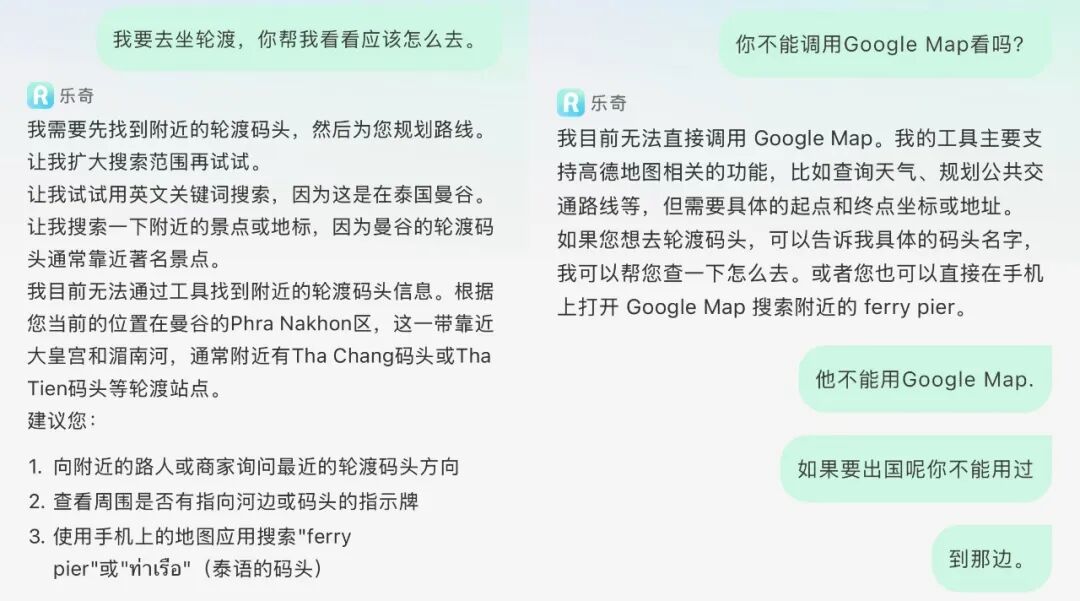
After leaving the Grand Palace, I wanted to take a boat, and asked the glasses to find the nearby ferry terminal. It replied: It is impossible to find the information of nearby terminals through tools. When I asked if it could access Google Maps, it said no, and could only use Amap.
The same Amap has completely different performances at home and abroad. For commuters using Qwen for navigation, the guidance can be directly projected in front of their eyes, and the arrow adjusts the direction as the head turns, so there is no need to look down at the mobile phone. But this highlight scenario failed to work after going abroad. In the end, I took out my mobile phone and navigated to the terminal by myself.
After reviewing the incident afterwards, half of the responsibility for this "failure" lies in the version issue.
Rokid glasses are divided into domestic version and overseas version. The domestic version is bound to Amap, and only the overseas version is connected to Google Maps. The two versions correspond to two separate apps, which cannot be installed at the same time. To switch versions, you need to delete the Bluetooth pairing and reconnect. The one I took abroad was the domestic version, and the paired mobile phone was an iPhone. Some users reported that the functions of the iOS app are weaker than those of the Android version. It was almost destined that the map function would fail.
The situation of Qwen is similar, it is deeply bound to Amap. The official says the adaptation to international ecosystems such as Google Maps and PayPal will be completed within 2026. But I was not aware of these details before departure.
Source: Screenshot of Rokid App
At the hardware level, AI glasses are also restricted by a large number of scenarios. In bright outdoor conditions, I often had to cover my eyes with a dark sleeve to see what was written on the screen.
In the translation scenario with the most rigid demand, slow translation is a major problem. After a foreign friend finishes a sentence, the AI glasses usually take 10 to 20 seconds to start translating, and the other party is already speaking the next sentence - in the end, I can't hear clearly either part.
On the ferry, the broadcast announced the stops in Thai, English and Chinese. The Chinese announcement was fast and had a strong accent. I wanted the glasses to listen to the Thai broadcast and translate it into Chinese. But on the open water, coupled with the noise of the cruise ship, it could neither hear the broadcast clearly nor capture the conversation of foreign tourists next to it. It could only hear the Chinese dialogue between me and my travel companion, so it dutifully translated Chinese into Chinese.
In the shopping mall, I came across a milk tea shop operated by a local Chinese brand that expanded overseas, and the menu was only in Thai and English. I asked the glasses to translate it. After it took a photo, it did not translate, but read all the contents aloud in the form of a broadcast. After reading a long list, it even asked me back whether I preferred a stronger tea flavor or a stronger milk flavor.
It probably "kindly" wanted to give consumption advice, but I just wanted to know the corresponding Chinese names of the menu items. After struggling for a long time, I gave up and placed an order in broken English. When I went back to the hotel to review the incident, I found that the translation was synchronously displayed in the dialog box of the mobile app, not on the glasses screen.
Relatively speaking, the shooting function is the biggest highlight of this trip.
When we went out to sea on Koh Lan in Pattaya, my travel companion and I both booked the parasailing project. When my travel companion was towed into the sky by the speedboat, I was wearing the Qwen AI glasses S1, trying to capture the whole process of her taking off from the deck to landing. But after shooting a short segment, the glasses automatically stopped recording. I then realized that Qwen AI glasses can only shoot 1-minute videos at a time.
At this time, it was my turn to put on the parasailing equipment. The situation was urgent, so I could only fly into the sky first. In the air, I held the umbrella rope tightly with both hands and shouted "Quark assistant, help me shoot a video", but the wind noise at high altitude was too loud, and the Qwen glasses did not respond. I could only turn my head to the right side, free my hand to press the shooting button, and captured a 1-minute "bird's-eye view" video.

High-altitude parasailing footage shot with Qwen S1 glasses Photography: Lin Qiuyi
However, in any case, the shooting function is currently the most recognized feature by users. When your hands are occupied, the camera mounted on the bridge of your nose makes sense. Scenarios like cycling, cooking, and holding children are all places where it can give full play to its capabilities. A cycling enthusiast praised it, saying that the first-person immersive feeling when turning a corner cannot be achieved by mobile phones and action cameras.
But at this stage, AI glasses still cannot well meet the demand in terms of battery life. When watching Khon performances, for a 20 to 30-minute show, the Rokid AI glasses can only record for a maximum of 10 minutes.
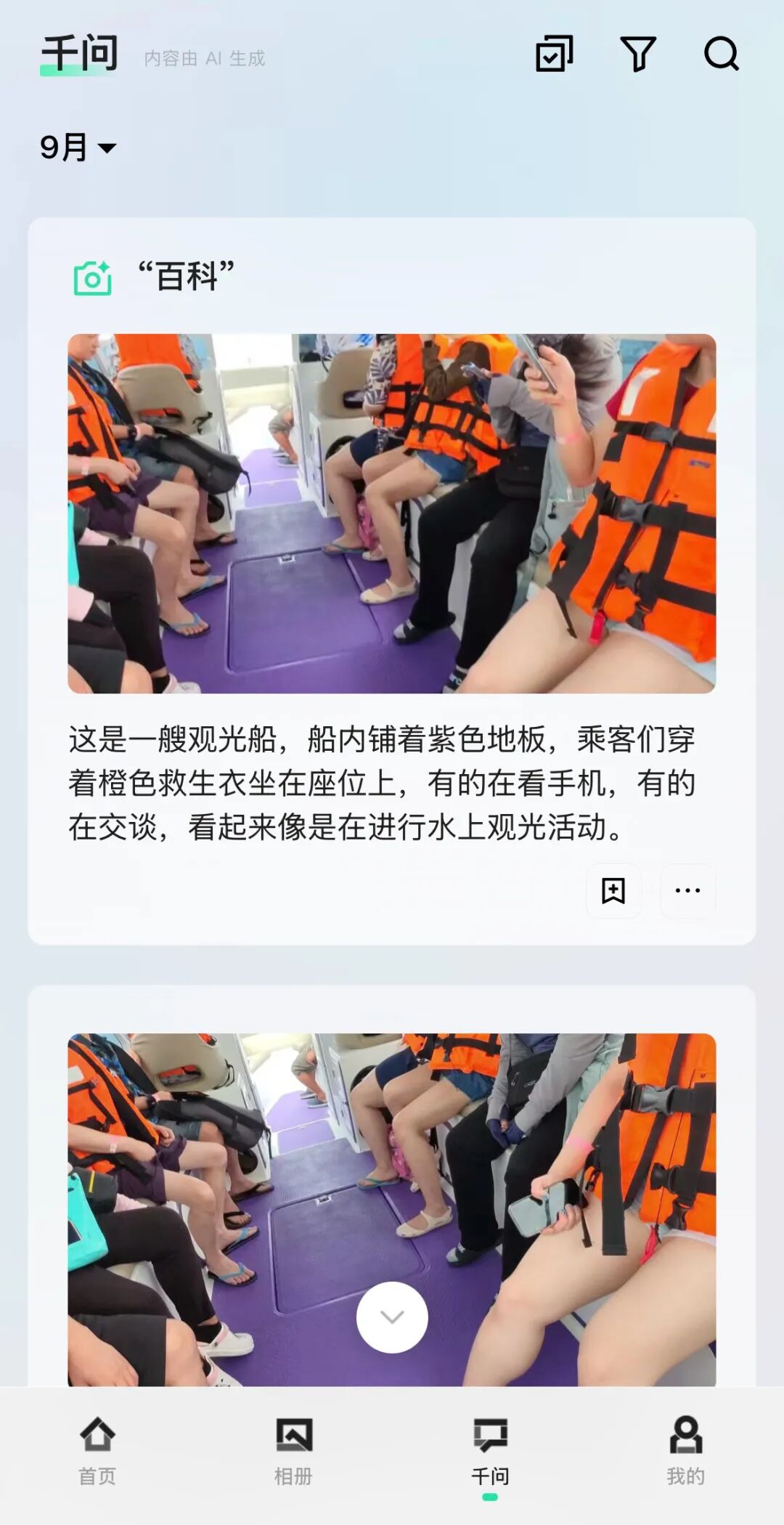
In order to prove that it is "smart", AI glasses often "act on its own". On the speedboat going out to sea, the boat shook slightly, and the glasses suddenly took a picture of the scene in front of me, telling me that this was a speedboat with a certain number of people on it all wearing life jackets. It took the initiative to do this many times, which drained the battery very quickly.
Source: Screenshot of Qwen App
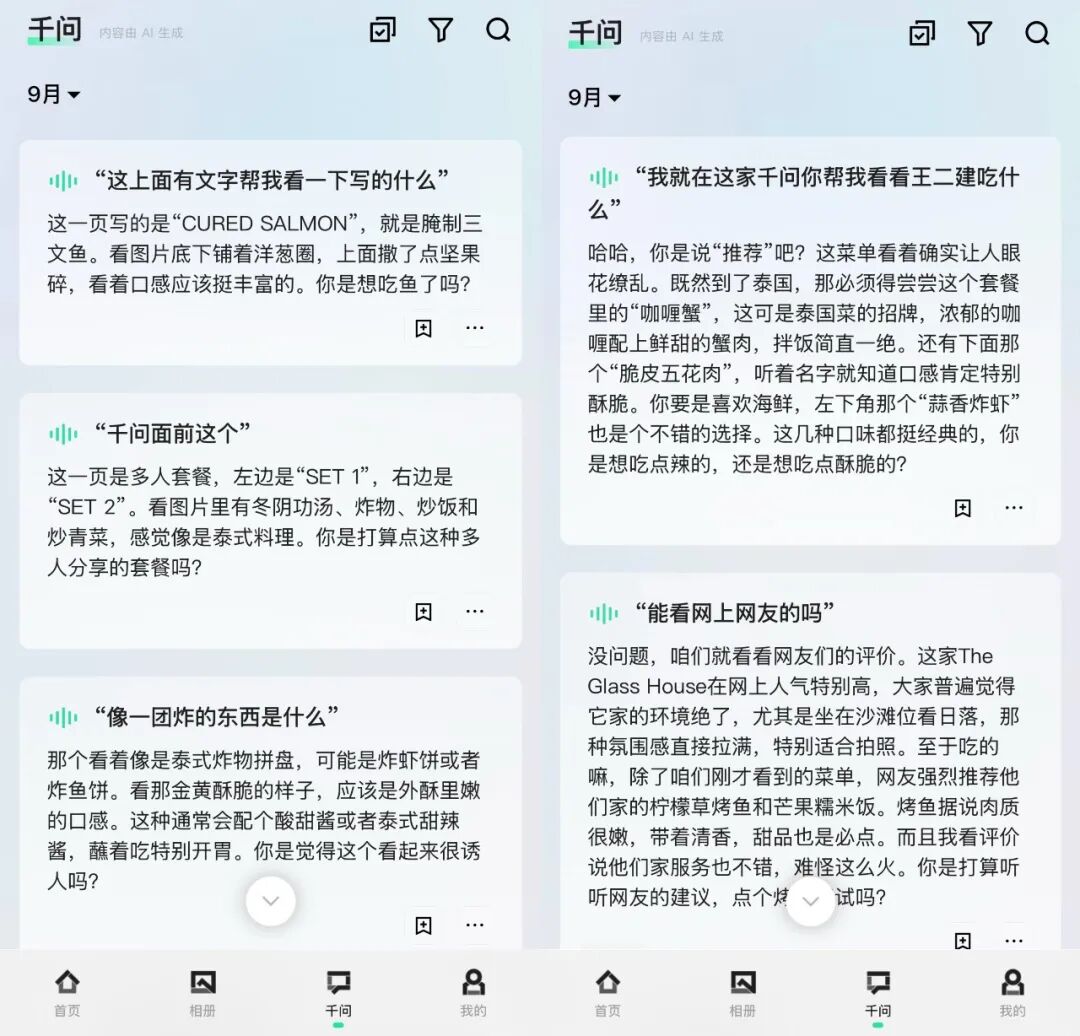
On the third night, I arrived in Pattaya and had dinner at a famous local internet-famous restaurant. The menu was only in Thai. I asked the glasses what the dish in front of me was. It described the appearance of the dish, but could not name it. For the four Tom Yum Goong soups on the menu, it uniformly replied: This is Tom Yum Goong soup, and even confidently mistook the fried shrimp cake for a fried fish cake.
But it is not completely useless. After I entered the name of the restaurant, it could search for the recommended dishes from netizens online, and tried to ask about my taste preferences, whether I liked seafood and what kind of sauce I preferred. Unfortunately, it still could not read all the dishes of the restaurant through the Internet. In the end, I still took out my mobile phone, used the camera to select the text, and translated the entire menu.
Source: Screenshot of Qwen S1 Glasses App
Recently, there have been some discussions in China about the ethics of taking photos with AI glasses. But in the actual use process, the expected embarrassment did not appear. No passerby took a second look at the glasses, even when the camera light was on during shooting. The real obstacle may not exist in the eyes of others.
I also tried the payment scenario, and neither of the two pairs of glasses had unblocked the restrictions with overseas payment methods. In China, I shouted: "Rokid, help me pay 10 yuan." The glasses screen will display: "Please confirm to pay 10 yuan", and I need to answer "Confirm payment". For introverted "I people", this is a bit similar to "public execution".
Who Is Buying and Wearing Them?
After 6 days of use, the number of times I actually used AI glasses for translation can be counted on one hand, and most translations still rely on mobile phones. I also quickly went through the process of wearing it every day to stuffing it at the bottom of my bag.
According to Omdia data, the retail volume of domestic smart glasses in the first half of 2026 was 1.012 million units, a year-on-year increase of 106%.
But there are also a lot of returned products. According to statistics from the industry monitoring agency XR Vision, the average return rate of AI glasses on e-commerce platforms has reached 30%, and on the Douyin channel dominated by live streaming sales, this figure even reaches 40% to 50%. The reasons for return are surprisingly consistent: too heavy, pressing the nose, clamping the head, top-heavy. The orders placed on impulse in the live broadcast room turned into a real burden on the bridge of the nose.
Weight, performance, and battery life are still regarded as the "impossible triangle" that the AI glasses industry cannot balance. At present, the weight of mainstream products on the market is close to 50 grams, more than twice that of ordinary glasses, and the continuous shooting battery life is mostly only one hour.
Every time the glasses answer a question, they have to go through the whole process of sound collection, speech recognition, large model reasoning, and reply generation, and each link will bring delay. At this stage, large models cannot respond immediately when called, and it is not uncommon for them to give irrelevant answers.
Li Hongwei, CEO of Thunderbird Innovation, once admitted in a public interview that the industry has launched more than 200 new features in the past two years, but the long-term usage rate of users is less than 6%, and 94% of people who bought it will only use it to check the weather and read news. But this kind of thing can be done easily with a mobile phone, there is no need to spend thousands of extra yuan to put a pair of glasses on the bridge of your nose.
More people's glasses have been hung on the second-hand market. I opened Xianyu and saw that consumers' attitudes towards AI glasses are very distinct.
At the end of November last year, after the Quark AI Glasses S1 went on sale, the delivery schedule was once extended to 45 days. The resale price on Xianyu was generally maintained at around 4000 yuan, and the spot price was once called for more than 5000 yuan. Now the price of 99% new products has dropped to around 2000 yuan.
The Xiaomi AI glasses, which were released at a price of 1999 yuan in June last year, are now priced at only about 626 yuan on Xianyu, falling by nearly 70% in just over a year.