Is the current automotive industry too depressing? The feedback from the front line is rather disheartening.
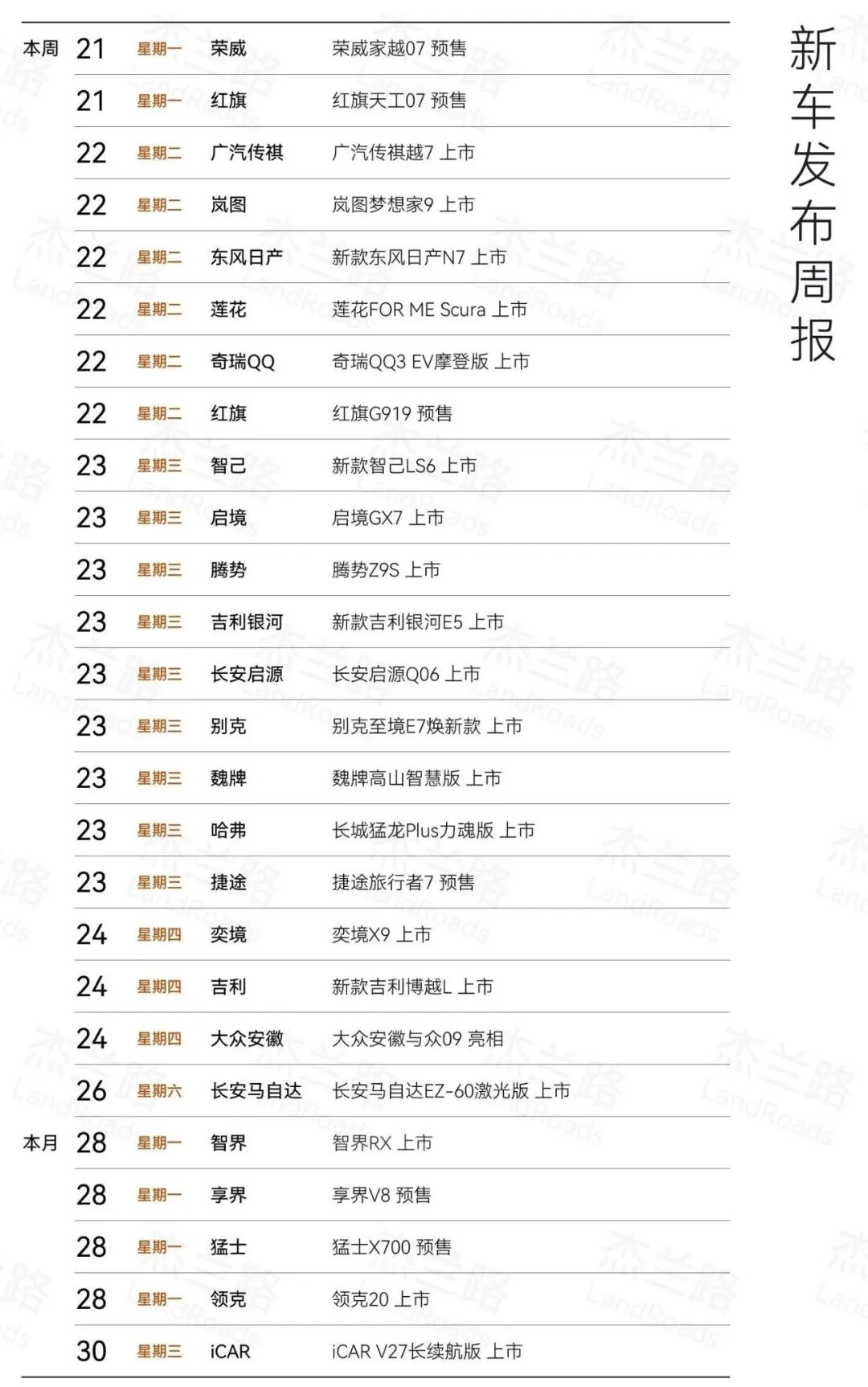
Before the Mid-Autumn Festival and National Day holidays, China's domestic auto market staged a very lively sprint of new car launches.
On September 23, nearly ten new car launch events were held intensively, and in this whole week, a total of 20 launch ceremonies appeared in turn. Sedans, SUVs, MPVs, boxy off-road models, pure electric vehicles, plug-in hybrids, and full hybrids, all kinds of new products made intensive public appearances. Statistics show that the number of new cars launched in the whole September reached as many as 50.
From the external perspective, new products are emerging in endlessly, export data continues to rise, and the penetration rate of new energy vehicles climbed steadily in the first half of September, reaching a peak of 70%, making the whole industry a scene of full swing.
However, on the other side of this bustle, there is real exhaustion and depression for people inside the industry.
Behind the scenes of multiple launch events, there are countless late nights for countless brands, vehicle models and public relations practitioners, with dark circles and tiredness covering their eyes. Further up, the sales end is pushing new cars to the market in a rush, so the development nodes on the R&D end have to be continuously moved forward, making the 007 work regime a norm.
This pressure and sense of suffocation are also spreading continuously to the supply chain, whose living space is being continuously compressed.
Do you think this is just a short-term state? That's not the case. Two recent heavyweight industry signals have further laid this contradiction bare to everyone.
The *15th Five-Year Plan for the Development of the Intelligent Connected New Energy Automobile Industry* clearly puts forward that the full-labor productivity of the automobile industry will increase by 15% by 2030 compared with 2025. The original intention of the policy is to achieve high-quality industrial development relying on technological upgrading, automation transformation, process optimization and development of high value-added products.
But when it comes to the mouths of industry practitioners, a layer of realistic concern arises: will this 15% efficiency increase eventually be transformed into more overtime, higher KPI requirements and staff reduction, making the remaining employees take on more workload?
If we simply squeeze human resources without optimizing technology and processes, the degree of industry involution in five years will be equivalent to rising another 15 percentage points.
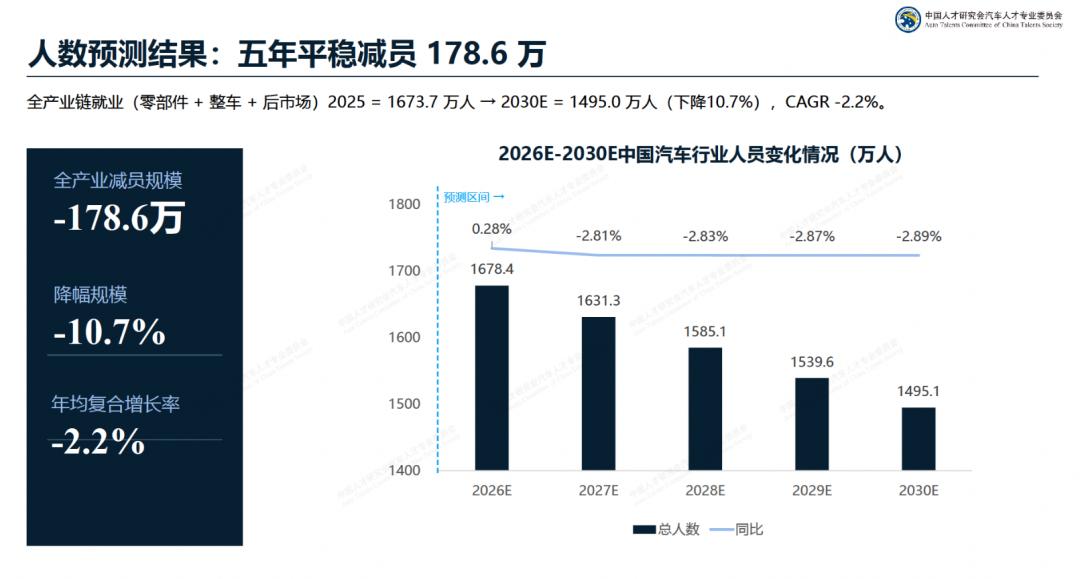
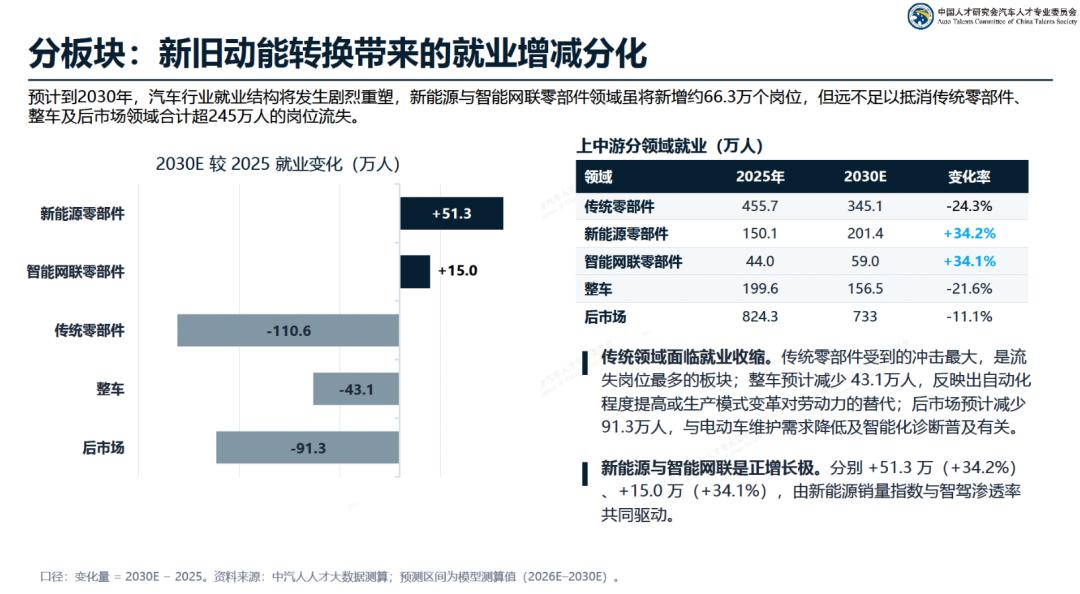
Another set of calculation data from the Automotive Talents Special Committee of China Talents Research Association is also thought-provoking. By the end of 2025, the total number of employees in China's entire automotive industry was about 16.74 million, down 26.3% compared with 2022; the model predicts that by 2030, the whole industry will see a net reduction of 1.786 million employees, and 1.53 million jobs will disappear in traditional parts, complete vehicle manufacturing and aftermarket, with the succession rate of new and old jobs even less than 50%.
On one hand, there is endless new product launch, and the pace of technological iteration is getting faster and faster; on the other hand, the total number of jobs in the industry is shrinking, and the remaining people have to bear greater pressure. Under the superficial bustling of the industry, depression has penetrated into every link of vehicle factories, parts enterprises and R&D engineers.
Recently, Auto Community collected voices and feedback from automotive industry practitioners through offline exchanges and online channels, piecing together the other side of the extremely depressed industry under the shell of rapid growth through multiple channels.
Taking orders means loss, not taking orders also means loss: suppliers fall into a deadlock dilemma
"Doing it is chronic death, not doing it is direct death." This is a sentence often said by many small and medium-sized auto parts business owners.
Nowadays, the auto parts industry has generally fallen into an absurd paradox: when you get an order from an OEM, you face losses for every unit you produce; but if you reject the order, rigid fixed costs such as plant depreciation, equipment amortization, employee salaries and social security fees have no place to be absorbed, and the factory will also find it difficult to survive.
Lao Li, a factory operator who has been deeply engaged in the auto parts industry for more than ten years, told us about his realistic situation: "Our factory is fully compliant, with a standard quality control system, complete reliability tests, and full payment of employees' social security. For the same part, after calculating all costs, we quote 100 yuan, while some small workshops dare to take the order at only 50 yuan."
Being forced to lower prices has become a common dilemma faced by parts enterprises. "They skip the full set of verification, use recycled raw materials, and do not follow the specifications for employment. The OEM purchasers take the low price offered by the workshops, and force us to cut prices accordingly." Lao Li said, a little excited, but more helpless.
"It's not that we can't compete with our opponents in the involution, but that we dare not. If we fight for price with opponents who can default on wages and omit test procedures, even if we win the order, we will lose in the end." Lao Li said.
Even if you don't get eliminated by the low price of opponents, the mandatory annual price reduction in the industry has become the norm. Many OEMs issue rigid cost reduction targets every year, generally requiring suppliers to cut prices by 5%-10% every year. Some projects add VAVE (Value Analysis and Value Engineering) cost reduction, making the comprehensive cost reduction range even larger.
It is said that doing business is win-win cooperation, but in the aspect of parts cost reduction, many dominant OEMs do not carry out business negotiation with suppliers, but issue a notice: accept the price cut, continue cooperation; if you don't accept, new suppliers will be introduced to replace you immediately.
What is more worth mentioning is that with the intensification of industry involution, the life cycle of new cars is getting shorter and shorter, and there is a huge gap between the order commitment given by OEMs to suppliers and the actual shipment volume.
Some suppliers invested millions of yuan to develop molds and build production lines according to the OEM's expectation of 20,000 monthly sales. After mass production, the sales volume of many models could not stay stable for 3 months before plummeting: 13,000 units in the 3rd month, 5,000 units in the 4th month, and directly fell to 1,200 units in the 5th month. The molds and tooling invested in the early stage hardly had the chance to be amortized and recovered.
Lao Li said that some conscientious OEMs can at least give suppliers a guaranteed minimum of development fees, but now many car companies adopt the average allocation mode. Once the model sales are poor, the tooling, molds, fixtures and checking fixtures (the general name of four types of process equipment, which belong to the "infrastructure" to ensure accuracy and quality in automobile manufacturing) will all become non-performing assets of suppliers, occupying a large amount of cash flow.
Sample making is also a bottomless consumption. Lao Zhang, a practitioner in the interior trim cover industry, revealed that his enterprise needs to cooperate with customers to complete more than 50 sample parts a year, consuming a large number of tools and fixtures, but finally only got one small-batch one-time order for two products, with no subsequent mass production demand. The cost generated by sample making has exceeded all the benefits brought by the order.
In Lao Zhang's industry, there is a most realistic saying: among a hundred samples, you will be very lucky if ten of them can finally get stable large orders.
In addition, over the past years, account period and commercial acceptance bills have further amplified the survival crisis of parts enterprises.
Prolonged settlement cycles, high quality guarantee deposits, and a large number of commercial acceptance bills make triangular debts pass down layer by layer along the industrial chain. Many enterprises still have gross profit on their books, but are dragged down directly by cash flow.
"Goods can be supplied continuously, prices can be discussed slowly, invoicing can be postponed, and the actual cash we get in hand is very little." A Kuan, who is engaged in project management in a parts enterprise, described the current situation like this.
He said that now they dare not expand the scale blindly, because expanding the scale is equivalent to continuing to bleed in disguise, and not expanding is a way to stop losses. "The work focus of the whole team is no longer on developing new projects, but all on project acceptance, invoicing and collecting payment. The Party A directly made it clear to us that we should be mentally prepared that every invoice will be overdue." A Kuan said helplessly.
Fortunately, since last year, the state has begun to rectify the account period problem, so small and medium-sized parts enterprises can take a breath, but there are still a considerable number of parts enterprises in the industrial chain in distress.
Infinite compressed cycle, continuously consumed engineers
If the depression of parts comes from the survival crisis, then the depression of R&D engineers from OEMs to parts suppliers comes from the continuously compressed cycle, continuously lowered standards and continuously dissolved personal boundaries.
Automobiles are industrial products with the highest safety level. DV (Design Validation) and PV (Production Validation) are two firewalls to ensure product reliability. But now many OEMs put cost reduction and launch nodes above everything else, and a large number of development processes are arbitrarily cut.
Lao Qin, a veteran engaged in the seat parts industry, can't understand the current rhythm very much. "In the past, the rule was to finish all DV and close the loop before entering the PV stage. It's different now. Before the DV design validation is finished, the OEM's cost reduction index has already been sent over. What's the point of complete DV? Many of our seat projects directly skip DV, and rush forward with PV production validation in a hurry."
In order to seize the market window, "rushed mass production" has become a common phenomenon in the industry. "There are a lot of unresolved problems, unqualified parts are installed on vehicles, we just build the cars and sell them first, and what faults will break out later is a matter for the future." An unnamed parts engineer said.
Some industry practitioners said that in some enterprises, even the basic process material change process has become a dead letter. Even ordinary consumer goods need to go through the complete ECR (Engineering Change Request) and ECN (Engineering Change Notice) for filing, and no one knows when this bad trend emerged. "A verbal notice in the meeting can change materials and processes, there may not even be an email notification, let alone document records."
The TR (Technical) review in some enterprises is also getting more and more suffocating. Da Bing, a practitioner with many years of project management experience in foreign-funded parts enterprises, can't understand why the situation has become like this now.
"Before 2022, 50 pages of PPT were enough for TR review. 20 pages to introduce the company, 30 pages to talk about design, simulation, process, manufacturing and quality inspection. The meeting lasted for one hour, each person spoke for ten minutes, and it could be passed if there was no fatal flaw. Subsequent changes were communicated for half an hour each time, with at most two or three iterations."
"After 2025, everything is completely different. For the same part, TR needs 270 pages of PPT. When the design maturity is less than 80%, we need to work out every process, production beat, equipment selection and production line layout. The team worked overtime for a whole month to make materials, core personnel flew to the site to speak offline for four hours, and a large number of people were on standby online. The same TR was repeated more than three rounds, and the team worked for three or four months. The most ironic thing is that after all the work is done, you may not get the project. As long as your quotation is not the lowest, all your efforts are in vain." Da Bing sighed that this industry is no longer what it used to be.
In such a working environment and atmosphere, the front-line engineers suffer the most.
Recently, the topic of 13 consecutive days off for the Mid-Autumn Festival and National Day hit the hot search, but a few days into the holiday, people who took the consecutive vacation began to regret it. Because in the circle of automotive engineers, there is a very piercing complaint: all holidays for automotive engineers are false propositions. Only when you resign and delete all work records can you have a real vacation.
Even on statutory holidays, meetings, online demands and work calls never stop. Project nodes override everything, personal life keeps giving way to work, and anxiety and internal friction have become the norm.
Engineer Chen, who is engaged in electronic control R&D, said when reviewing past projects with Auto Community that after a complete project is finished, the team is almost half depleted. Some people can't stand the pressure and resign voluntarily, some are forced to leave by the management, and some are directly dismissed as scapegoats after problems occur in the project.
A Kai, a test engineer at a new power car company, is considering changing jobs recently. He said he has been staying at the test site for more than a year, and basically can't get home after 10 p.m. every day, working non-stop as a norm. He said his colleague in the adjacent group basically works until one or two o'clock in the morning every day, and his body can't hold on anymore, so he can only choose to change jobs.
Not only their own employees have high work intensity, OEMs also directly require suppliers' manpower to operate at high intensity. Some parts enterprises received cooperation requirements that suppliers need to work in two shifts to cooperate in development.
Xiao Chen used to be responsible for automotive wiring harness trial production. He said that the complete process of a normal set of samples is 14 days, but this time has been continuously compressed in recent years. Especially after the explosion of domestic cars, this time has been compressed to one week, and previously some salesmen directly asked for delivery within a few days.
"It was really extremely busy. The whole process including type selection, drawing, BOM building, trial production and delivery was compressed to two days. We originally only had one day off a week, but then we had to come to work overtime on Sundays, and I once worked for half a month in a row. Later I couldn't hold on anymore and resigned." Talking about the past, Xiao Chen is glad that he withdrew in time, "If I stayed any longer, I felt I would get depressed."