36 robot companies that have rung the listing bell: there is a massive disparity in profitability, and their commercialization efforts no longer rely on superficial gimmicks.
Robotics enterprises are intensively sprinting for public listing, and the trend is shifting.
The wave of embodied intelligence remains surging at present, and the capital market's enthusiasm for robotics has not faded. Just recently, Unitree was listed on the Sci-Tech Innovation Board, while Mech-Mind and UD Robots were successively listed on the Hong Kong Stock Exchange. At the end of September, Benmo Technology and Huanchuang Technology also went public one after another.
However, sources say the market is growing more prudent over the IPO of embodied intelligent robotics companies.

At the beginning of this month, CLS learned from multiple investment banking sources that regulators are adjusting the IPO pace of some humanoid robotics enterprises.
At present, the regulatory authorities have not yet released special new rules publicly, but public information continuously points to a set of increasingly strict review standards:
Revenue must be real, sustainable and replicable, the loss trend and profit prospect must stand scrutiny, and products must move beyond technical demonstrations to achieve stable customer acquisition and large-scale delivery.
At this point, QbitAI ROBO has re-sorted public data on the A-share and Hong Kong stock markets, compiling a list of at least 36 listed robotics-related companies worth observing together (incomplete statistics).
The list includes not only humanoid robotics companies, but also players that have been operating in industrial, warehousing and household scenarios for many years, as well as component enterprises that have just started supplying robotics clients.
It should be noted that this is not an exhaustive list. The boundary of the robotics industry itself is expanding rapidly, and different companies have varying degrees of involvement. This inventory focuses more on representative enterprises directly related to complete robotics machines, applications, core systems and components, and omissions are inevitable.
They have already opened a clear gap in financial data:
Some companies' humanoid robotics revenue exceeds half of their total revenue, while some companies' new robotics business still only accounts for a few ten-thousandths of their total revenue; some companies earn nearly 300 million yuan a year, while others have not yet achieved profitability even with revenue of about 2 billion yuan.
The first batch of financial reports submitted by these 36 companies already allows us to see how far the commercialization of robotics has actually gone.
36 Companies Have Tapped the Listing Bell, Robotics Has Built a Full Public Listing Lineup
When it comes to listed embodied intelligence companies, Unitree and UBTECH often come to mind first. But if you look further along the perception, control and execution links required by robotics, the list will quickly grow longer:
There are not only enterprises that sell complete machines directly, but also suppliers of reducers, motors, sensors and drive systems hidden inside robotics.
Divided by main products and businesses, among these 36 companies, 18 mainly deliver complete machines and application solutions, and 18 provide systems and components.
A boundary needs to be drawn here first: the list includes industrial robotics, warehousing robotics and household robotics enterprises that have been operating for many years, as well as companies that have recently entered the humanoid and embodied supply chain. Therefore, it cannot be directly interpreted that all 36 companies take the new generation of embodied intelligence as their main business.
Placing them in a table serves a more important purpose, which is to outline a robotics industrial chain that has entered the capital market.
On the complete machine side, the scenarios where products are deployed have been clearly differentiated.
Unitree and UBTECH are known for their humanoid and legged robots; enterprises such as ESTUN, SIASUN and Effort have long served industrial production, while companies such as Dobot, RobCT and Huayan take collaborative robots as their core business.
They are all solving the problem of how robots complete operations, but they differ in task complexity, customer types and deployment conditions.
There is also a group of companies focused on mobility and services.
Geek+, KALMS and Seer Intelligent target scenarios such as warehousing and logistics, Yunji and UD provide commercial service and delivery robots; Woan, Ecovacs and Roborock place their products in households.
Although industrial robots and sweeping robots cannot be directly equated with this new round of new-generation embodied intelligence, these years of procurement, deployment and after-sales services are exactly the most practical reference for new technologies.
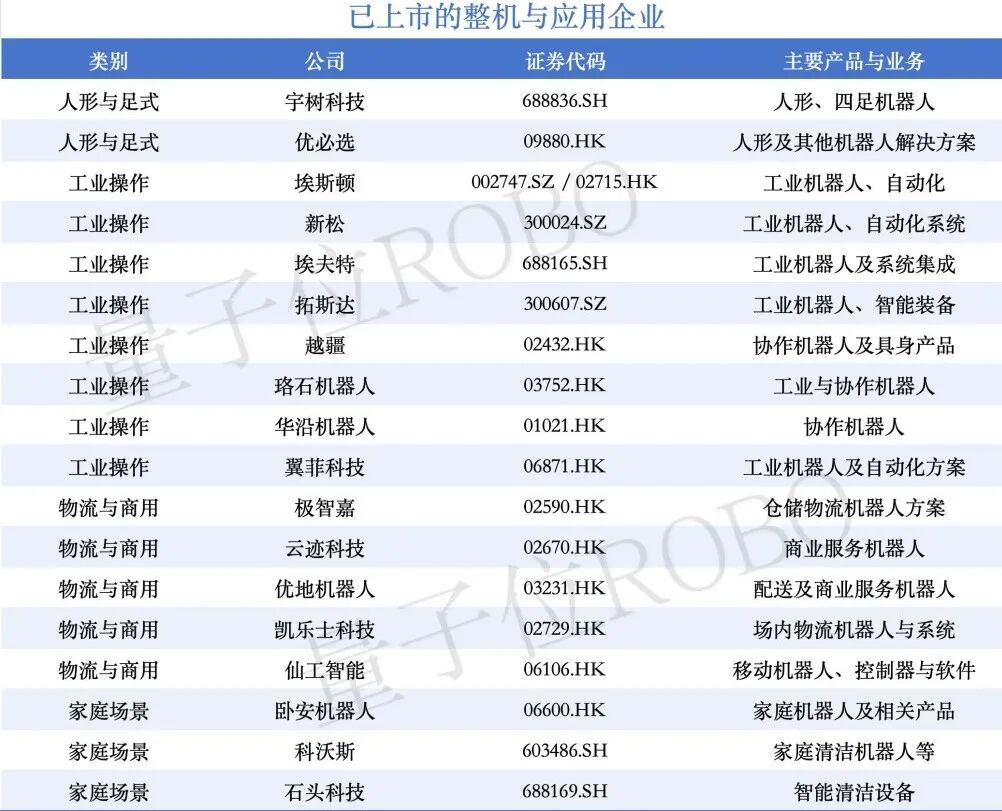
Note: The classification is for observing main businesses; the codes are for identifying entities, not as statistics of all listing locations; the same applies to the following table
Apart from complete machines, a single robot also links a longer supply chain.
Mech-Mind, Lochn Robotics, Orbbec and Huanchuang Technology provide vision and perception related products; Inovance, Kinco, Leadshine and HC Motion are involved in control and drive, while Benmo Technology takes robot power modules as its main product; GreenHarmonic, Shuanghuan Transmission, Zhongda Leader and Zhaowei Electromechanical cover transmission or micro drive. Keli Sensing and Mingzhi Electric Appliance are respectively active in the force sensing and motor segments.
This industrial chain also does not have completely neat boundaries. Seer Intelligent not only sells controllers and software, but also delivers mobile robots; Lochn Robotics has not only perception products, but also layouts for complete robot machines.
A company may appear in multiple segments at the same time, so the table is categorized by main products, which is only for the convenience of observation and does not mean that the enterprise only engages in this type of business.
There is another type of company that needs to be analyzed separately: enterprises such as Tuopu Group, Sanhua Intelligent Control and Joyson Electronics already have large existing businesses, and are extending their manufacturing, supply chain and customer capabilities to the robotics sector.
The large scale of the group and how much revenue the new robotics business has contributed are two separate issues. Entering the supply chain, getting designated, and starting batch supply correspond to different stages before truly forming identifiable revenue.
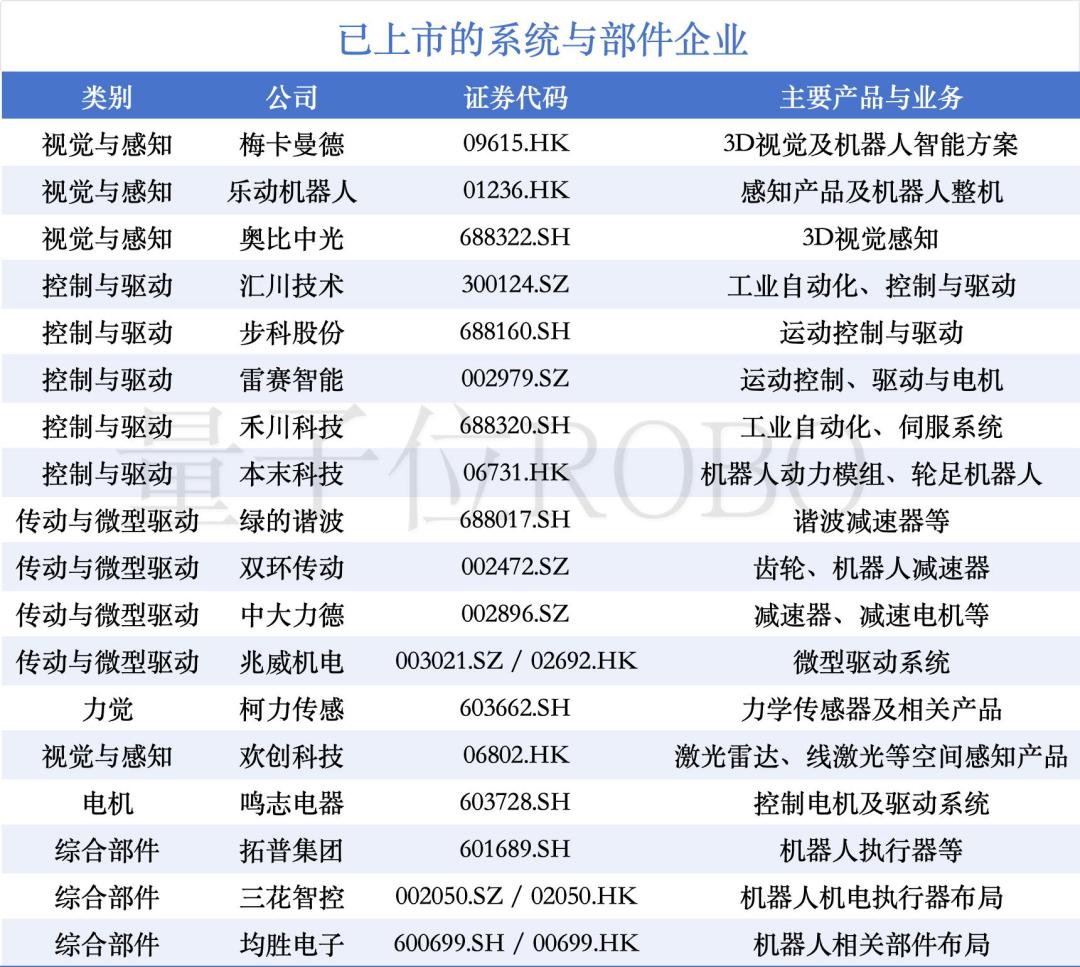
More and more companies are already listed, in the prospectus stage, or waiting in line for listing, but what really matters is how far the robotics business has developed: just getting designated in the supply chain, or having achieved scaled revenue, or becoming the main revenue pillar.
Humanoid Robot Revenue Starts to Be Disclosed Separately
UBTECH took the lead in writing humanoid robot into its revenue structure.
In 2025, UBTECH recorded revenue of about 2.001 billion yuan, of which the revenue from full-size embodied intelligent humanoid robot products and solutions was about 821 million yuan, accounting for about 41.0%. In the first half of 2026, the revenue of this category reached about 590 million yuan, accounting for 46.5% of the total revenue.
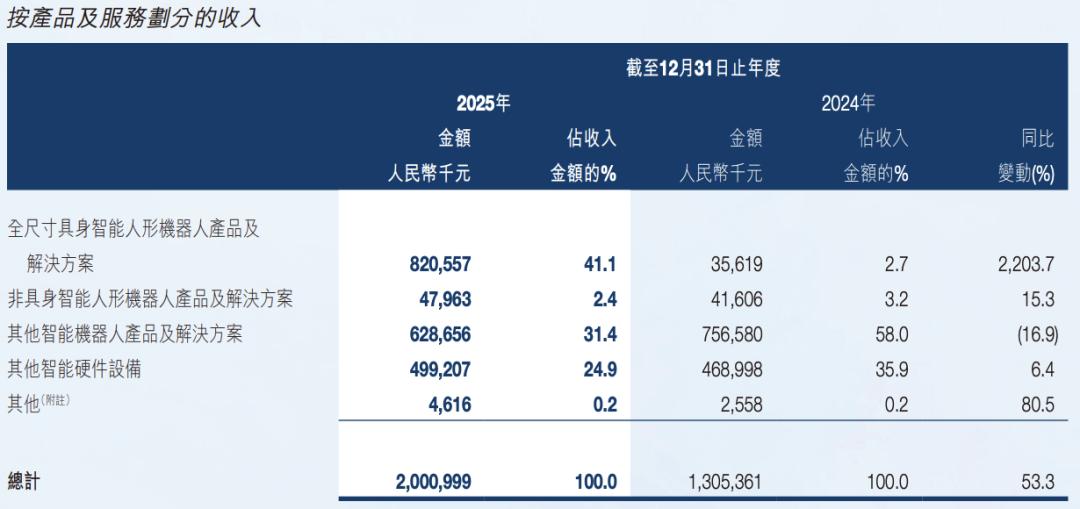
Source: UBTECH 2025 Annual Report
Unitree also announced a similar revenue structure.
In 2025, its operating revenue was about 1.699 billion yuan, of which humanoid robots contributed about 868 million yuan, and quadruped robots contributed about 698 million yuan. Calculated based on total revenue, humanoid robots accounted for about 51.1%, which has exceeded half.
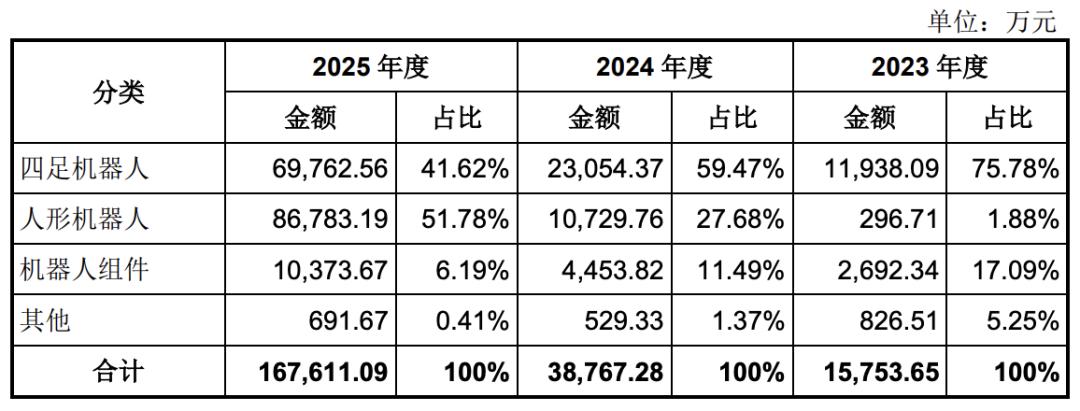
Source: Unitree Technology Prospectus
For these two companies, humanoid robots have evolved from a new product category to a position that can significantly affect the revenue structure.
Dobot is another company that has disclosed humanoid robot revenue.
Among the revenue of about 492 million yuan in 2025, Dobot's embodied intelligent robots contributed about 20.04 million yuan, accounting for 4.1%; in the first half of 2026, this revenue rose to about 45.23 million yuan, accounting for 14.3%. At the same time, its six-axis collaborative robots still contributed about 62.2% of the revenue.
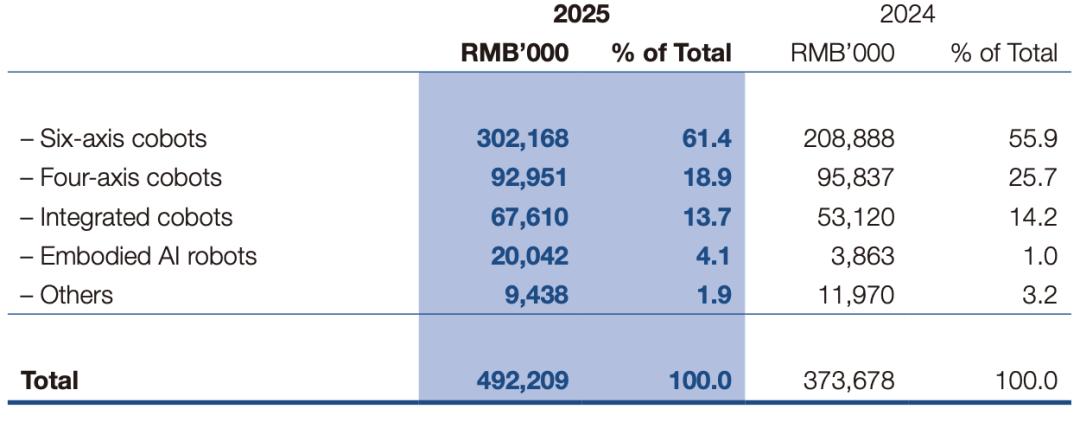
Source: Dobot Technology 2025 Annual Report
The growth rate of the embodied business has emerged, but at present collaborative robots are still the main products supporting the company's operation.
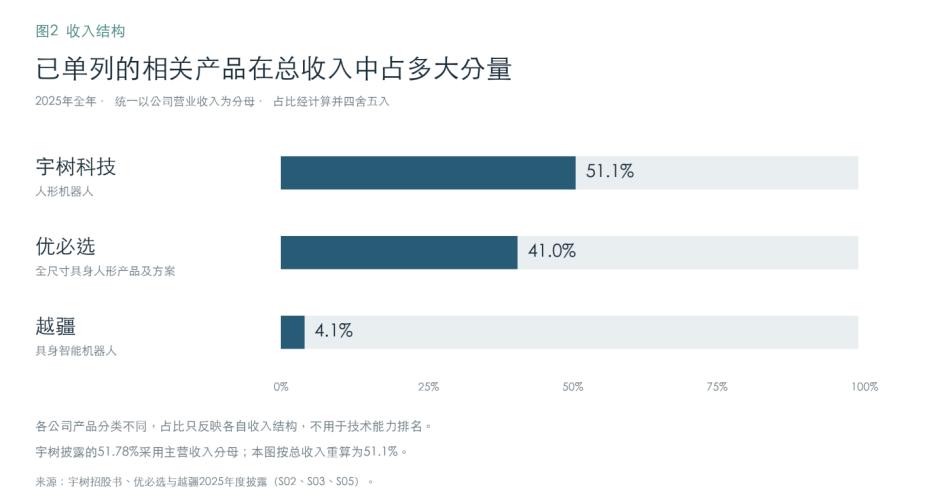
Putting these data together, the first intuitive gap appears: even for robots classified as embodied robots, the proportion of related business in the company's revenue can range from more than half all the way down to single digits.
Of course, simple horizontal ranking is not applicable here. Unitree discloses humanoid robot revenue, UBTECH discloses revenue from full-size embodied intelligent humanoid robot products and solutions, and Dobot lists embodied intelligent robot revenue separately.
The statistical scope of each company is not completely consistent, and the proportion level is more suitable to illustrate the weight of this business within the company, and cannot be directly used to judge technical capabilities.
The key point to emphasize here is that the very act of disclosing humanoid robot revenue separately itself indicates that the trend has changed.
In the past, when talking about robotics commercialization, people focused on what new products were released and how many cooperation agreements were signed. Now we have to look into the financial reports: how many products have actually been sold, what proportion they account for in total revenue, and whether this revenue still exists in the next reporting period.
Intuitively, financial reports have begun to provide a "ruler" with more precise scales for robotics business.
The statements of supply chain companies need to be analyzed more carefully.
Reducers, motors, servo systems and sensors can be sold to customers in multiple industries by nature. The fact that a company enters the humanoid robot supply chain does not mean that all its original revenue comes from humanoid robots; there are different commercial stages between customer verification, designation, order, batch delivery and revenue recognition.
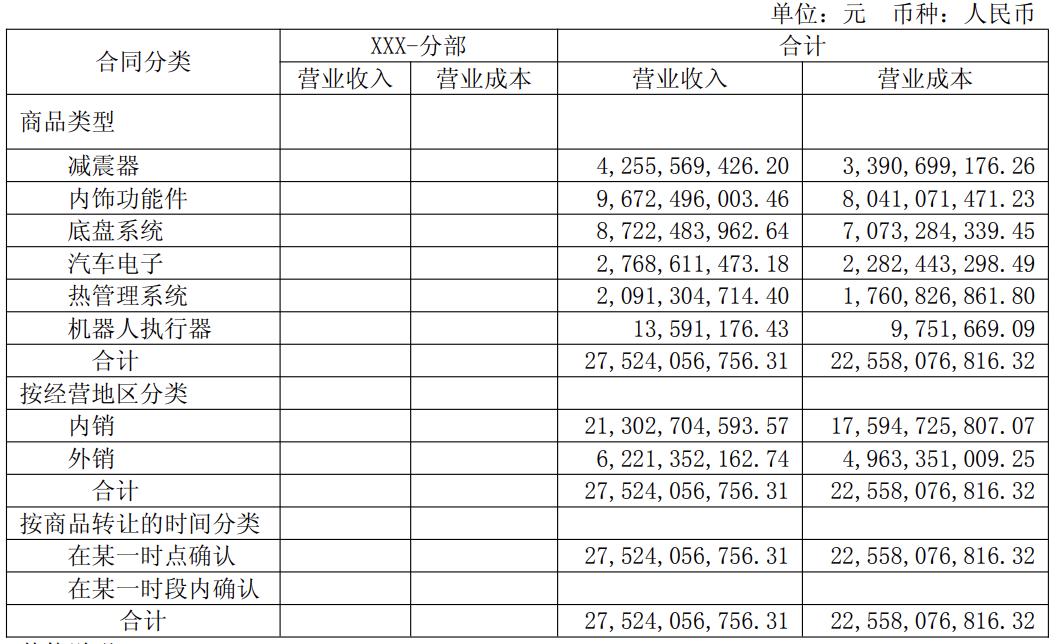
The data of Tuopu Group best illustrates this problem. In 2025, the company's operating revenue was about 29.581 billion yuan, and the revenue from robot actuators was about 13.59 million yuan, accounting for about 0.046% of the total revenue.
Source: Tuopu Group 2025 Annual Report
For a listed company with a revenue scale of nearly 30 billion yuan, the robotics business may still be only a very small new revenue source. Only by separating the relevant business separately can we see clearly how small its starting base is.
With the same robotics label, the situations reflected in the financial reports are significantly different:
Unitree and UBTECH's related products have become important revenue sources; Dobot is cultivating new increments on its original robotics business; some traditional suppliers are still gradually converting new customers, new products and designations into large-scale orders.
Summarizing all these states with a unified term of "commercial implementation" will conceal the real gap.
Entering the supply chain, getting orders, generating revenue, and becoming the main business are four different stages. What the hype around concepts most easily conceals is precisely the distance between these stages.
Robots Are Being Sold, and Profit Statements Are Beginning to Diverge
Regarding profits, Unitree and UBTECH can also be used as a comparison.
In 2025, the two companies recorded operating revenue of about 1.699 billion yuan and 2.001 billion yuan respectively, and their humanoid robots have both generated revenue of a certain scale, but their profit statements and cash flow statements have completely different trends.