Racing toward the trillion-yuan target, the "No.1 Automobile City" has reached a critical juncture.
The restructuring of FAW and GAC has officially taken effect, and the cooperation between Huawei and Seres has been adjusted... Recently, leading automakers have been making continuous moves. Behind this is a shift in the growth logic of China's automotive industry — shifting from scale expansion to quality improvement and efficiency enhancement.
Not long ago, nine government departments including the Ministry of Industry and Information Technology jointly issued the *15th Five-Year Plan for the Development of the Intelligent Connected New Energy Vehicle Industry*, proposing that by 2030, the sales proportion of new energy passenger vehicles will reach 70%, China will join the ranks of world automotive powers, and "production capacity early warning and regulation" will be written into the plan for the first time.
Industry reshuffling is around the corner, and the major automotive city behind it has also stepped into the spotlight. Recently, Chen Xinwu, Deputy Secretary of the Chongqing Municipal Party Committee and Mayor of Chongqing, conducted an inspection at Seres Group, emphasizing the need to focus on the direction of intelligence, greenness and integration, and promote the high-quality development of Seres through government-enterprise collaboration.
In fact, as a major traditional automotive industry hub, both Chongqing and Guangzhou have experienced the impact of electrification, but Chongqing has taken a faster step in transformation. In recent years, the output of new energy vehicles represented by Seres has soared, and its total automobile output has successively surpassed that of Guangzhou and Shenzhen, regaining its title as China's "No.1 Automotive City" in 2025.
At present, the era of high growth in the industry has ended, and it has officially entered a period of in-depth adjustment. Seres itself is also undergoing a round of restructuring. This inspection not only mentioned that "we will do our utmost to help enterprises solve practical difficulties and promote them to seize opportunities for leapfrog development", but also the construction of the capital of intelligent connected new energy vehicles has been mentioned again.
For Chongqing, the "No.1 City in Automobile Output" has reached the moment of value upgrading.
Challenges
As a time-honored major automotive hub, Chongqing has ushered in its highlight moment in the past year.
In 2025, its automobile output reached 2.788 million units, a year-on-year increase of 9.7%, ranking first among all cities nationwide and third among all provinces; the output of new energy vehicles reached 1.296 million units, a year-on-year increase of 36%, and the scale of the industrial cluster exceeded 800 billion yuan.
This is also the first time Chongqing has returned to the title of "No.1 Automotive City" after many years.
Looking back, from 2014 to 2016, Chongqing's automobile output ranked first among all cities nationwide for three consecutive years. In 2016, the output even reached 3.156 million units, making it the only city in the country with an output exceeding 3 million units.
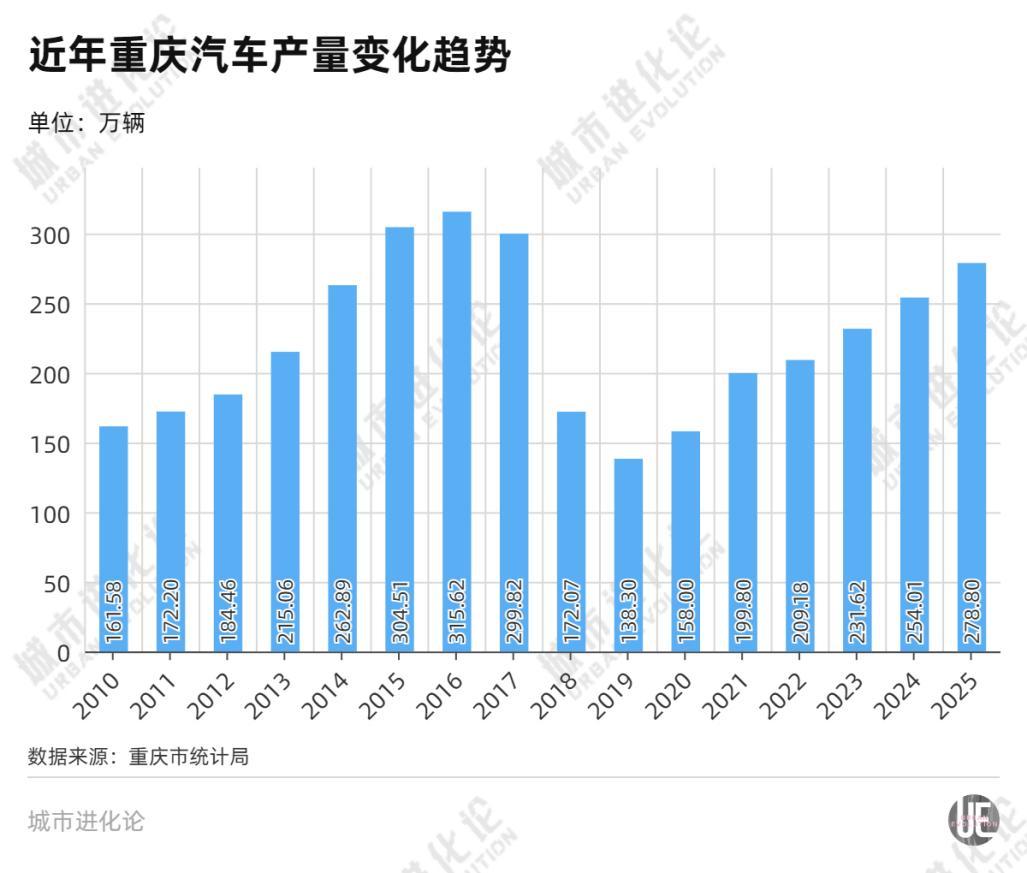
In 2017, Chongqing's automobile output began to decline, dropping to 1.383 million units in 2019, less than half of its peak figure. During the same period, new energy vehicles began to shake up the original pattern of the automotive industry. From 2020 to 2025, Chongqing's new energy vehicle output surged from only 43,000 units to 1.296 million units, an increase of nearly 30 times, contributing an incremental scale of over 1 million units.
However, the situation has changed again at present.
The latest data from the National Bureau of Statistics shows that from January to August this year, Chongqing's automobile output was 1.4495 million units, a year-on-year decrease of 12.6%. Its output was surpassed by Zhejiang and Jiangsu, dropping from the 3rd place nationwide in the same period last year to the 5th place. In August alone, Chongqing's automobile output was only 168,900 units, nearly 30% lower than the 234,800 units in the same period last year.
In the same period, Chongqing's new energy vehicle output was 721,500 units, a year-on-year increase of 4.2%. The growth rate is far lower than the national level, and also significantly slower than its own 13.3% growth rate in 2025.
The decline in output and slowdown in growth rate are the intuitive manifestation of transformation pains. To put it simply, in the process of accelerated production capacity adjustment, the increment of new energy vehicles has not been able to fill the gap left by the decline of traditional fuel vehicles synchronously.
Greater challenges come from the depth of the industrial chain.
According to media reports, the 27th meeting of the 2nd Standing Committee of Chongqing Municipal People's Republic recently heard the report of the municipal government on the development of the city's intelligent connected new energy vehicle industry (hereinafter referred to as the "Report").
According to the industrial chain investigation of Chongqing Municipal Commission of Economy and Information Technology, although Chongqing has realized small-batch local mass production of power devices and basic MCUs, the proportion of local chip supporting is far lower than the national domestic substitution level. The external dependence of key components such as automotive-grade chips and high-precision sensors exceeds 80%, the localization rate of vehicle-mounted operating systems is less than 15%, and core technologies and production capacity are highly dependent on external suppliers.
An undeniable fact is that as the industry moves from the stage of high-speed expansion to a new stage dominated by quality and structural upgrading, the gold content of the "No.1 City in Output" will be continuously diluted. On the contrary, the shortcomings in the core links of the value chain will be sharply amplified, accelerating the industry reshuffling process.
For Chongqing at the current stage, challenges come not only from internal transformation pressure, but also from external industry adjustments, and every step is critical.
Leading Enterprise
Seres, the local leading automotive enterprise in Chongqing, is also under pressure at the same time.
In the first half of this year, Seres turned from profit to loss. Financial reports show that during the reporting period, the company's operating revenue was 57.493 billion yuan, a year-on-year decrease of 7.87%; the net loss attributable to shareholders of listed companies was 1.717 billion yuan. This is the first semi-annual loss of Seres after two consecutive years of profit, and its net profit in the same period last year was 2.94 billion yuan.
Regarding the reason for the decline in performance, Seres stated in the report that the main models in the second quarter were in the transition period of product iteration, and the effect of production capacity and sales scale was not fully released; at the same time, the prices of core components such as batteries and chips rose periodically, superimposed with asset impairment provision, which jointly led to the decline in profitability.
According to Seres' production and sales express in August, the sales volume of new energy vehicles in August was 24,244 units, a year-on-year decrease of 43.96%, and the cumulative sales volume for the year was 227,250 units, a year-on-year decrease of 12.58%; among them, the sales volume of Seres vehicles in August was 20,652 units, a year-on-year decrease of 49.68%, and the cumulative sales volume for the year was 201,902 units, a year-on-year decrease of 14.07%.
On September 15, Harmony Intelligent Mobility Alliance and AITO released statements on the same day, announcing that AITO will explore a new cooperation mode under the framework of Harmony Intelligent Mobility Alliance. AITO's product definition, product design, brand marketing, channel retail and service system will be led by Seres, with Huawei Terminal participating in enabling.
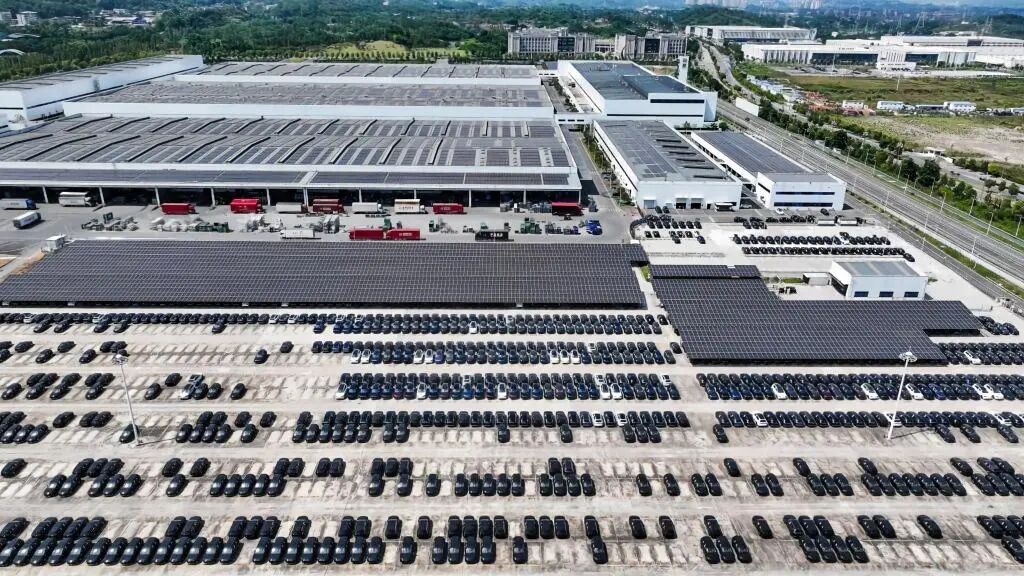
Seres Super Factory (Phoenix) Image source: Xinhua News Agency
Looking back to 2021 when Seres partnered with Huawei, Chen Hong, then chairman of SAIC Motor, once put forward the famous "soul theory" — when asked whether SAIC would consider cooperating with third-party companies such as Huawei in autonomous driving, Chen Hong said: "It is difficult for SAIC to accept a single supplier providing us with overall solutions. Our 'soul' must be in our own hands."
At that time, Chongqing's automotive enterprises, which were in the throes of transformation, chose to temporarily put aside their "prejudices" and seize the initiative. As the first cooperative automotive enterprise under Huawei's Smart Selection model, Zhang Xinghai, chairman of Seres Group, has repeatedly emphasized in public that "cooperation with Huawei is something we must do".
Now, in response to this cooperation mode adjustment, Yu Chengdong, Executive Director of Huawei, Director of Product Investment Review Committee, and Chairman of Terminal BG, responded: "After years of cooperation between Seres and Harmony Intelligent Mobility Alliance, Seres' capabilities have grown by leaps and bounds. Seres proposed that they want to take the lead, and I think we will support them."
In the eyes of the outside world, this will bring two benefits to Seres. First, by taking back the leading right of the above five core business links, Seres is expected to further give play to its advantages in vehicle manufacturing and enterprise operation; second, as the overseas market becomes increasingly important for Chinese automotive enterprises, AITO is expected to accelerate its overseas expansion business after Seres takes the lead.
At the critical transition period of the adjustment of the cooperation mode between Huawei and Seres, the news that the mayor of Chongqing went to the enterprise for inspection came. According to the report of *Chongqing Daily* on September 27, Chen Xinwu, Deputy Secretary of the Chongqing Municipal Party Committee and Mayor of Chongqing, conducted an inspection at Seres Group recently, emphasizing that "government and enterprises collaborate to promote the high-quality development of Seres, and inject new momentum into the construction of the capital of intelligent connected new energy vehicles".
Trillion-level Industry
As for Chongqing, as early as 2018 when it was caught in the "throes" of automobile output, it had issued the *Guiding Opinions on Accelerating the Transformation and Upgrading of the Automobile Industry*, clearly proposing to take the development of new energy and intelligent connected vehicles as the main line, and promote the transformation of the automobile industry from high-speed growth to high-quality development.
By 2024, Chongqing further proposed to build the "Capital of Intelligent Connected New Energy Vehicles". In the eyes of the outside world, Chongqing's driving environment with many mountain roads, bridges, complex interchanges, tunnels and rainy foggy weather is a natural test field for intelligent connected vehicles. By 2025, the city has realized full coverage of 3 major systems, 12 major assemblies and 56 components of intelligent connected new energy vehicle parts.
Up to now, intelligent connected new energy vehicles have been identified as the "primary industry" among the three trillion-level industries. The goal is to achieve an annual output of 2 million new energy vehicles by 2027, build a trillion-level industrial cluster, and build a capital of intelligent connected new energy vehicles with global influence and competitiveness.
It should be pointed out that the key to building the capital of intelligent connected new energy vehicles is not to produce more vehicles, but to change the competition logic: shifting from the scale competition of complete vehicle production capacity to the systematic competition of chips, algorithms, software, data, brands and ecology.
As Zhang Xinghai said earlier, the high-end development of Chongqing's intelligent connected new energy vehicles will continue to drive the upgrading of the automotive industry chain and promote the transformation of the traditional supply chain. Suppliers in the upstream and enterprises in the downstream such as sales and after-sales services will all benefit from it, which will effectively promote the optimization of regional industrial structure and enhance Chongqing's position in the global industrial chain.
Leading enterprises have always been an important fulcrum for Chongqing to achieve the trillion-level industrial goal of intelligent connected new energy vehicles. The above report on the development of Chongqing's intelligent connected new energy vehicle industry proposes to strengthen the leading role of leading enterprises and enhance the control of the industrial chain. We will expand leading chain-owner enterprises such as Changan, Seres and Qianli Technology, and support them to build world-class automotive enterprises.
In this inspection, Seres was positioned as a "technology-oriented innovative enterprise", and three key directions were further clarified —
We should lead development with innovation, gather high-level talents in the industry, increase R&D investment, strengthen key core technology research, and continuously improve technological innovation capabilities and core competitiveness;
Build brands with high quality, strengthen the whole life cycle quality management of products, further improve the product spectrum, enhance the competitive advantages in each market segment, and continuously improve brand value, influence and reputation;
Improve efficiency through management, rely on the industrial brain to enhance operational and management efficiency, promote the digital collaborative upgrading and data sharing of the industrial chain and supply chain, and strive to build a first-class enterprise.
According to data from Chongqing Municipal Commission of Economy and Information Technology, the average price of new energy vehicles produced in Chongqing has risen from 236,000 yuan in 2024 to 240,000 yuan in 2025. Although the product structure has been continuously optimized, the average price of complete vehicles is still lower than the average market price of new energy vehicles in Shenzhen and Shanghai, and there is still room for improvement in the high-end development of Chongqing's new energy vehicle products.
According to Chongqing's plan, 2027 will be a key node for the development of its intelligent connected new energy vehicle industry from "large output" to "strong industry". Not limited to the scale advantage, the "No.1 Automotive City" needs a real "value summit".
This article is from WeChat official account "City Evolution", author: Cheng Xiaoling, published with authorization from 36Kr.