Anthropic's prospectus has been leaked, revealing a massive $518 billion bet on computing power, and its IPO valuation is expected to exceed $2 trillion.
Chasing a $2 trillion IPO valuation, the move is backed by a staggering $5.18 trillion bet on computing power!
On September 28, Reuters disclosed the financial details contained in Anthropic's prospectus documents.

Underpinning this sky-high valuation expectation is a steep growth curve:
In 2025, Anthropic's revenue approached $4.6 billion, roughly 12 times that of the previous year.
Investors are betting that more and more enterprises will continue to pay for Claude, extending this momentum of growth.
However, growth expectations are not equivalent to actual orders, let alone revenue that has already been received in the account.
The volume of future customer orders remains uncertain; meanwhile, Anthropic has already committed to $5.18 trillion in computing power and infrastructure expenditures over the coming years in advance.
Once the speed at which customers pay cannot keep up with the pace of computing power cost burn, the confidence brought by advance layout may turn into heavy capital pressure.
With $4.6 billion in annual revenue, why did it report a "huge loss" of $42 billion?
Looking at Anthropic's 2025 financial books, two sets of figures form a stark contrast:
Its revenue surged to roughly 12 times that of the previous year, approaching $4.6 billion; in the same period, its net loss reached approximately $420 billion.
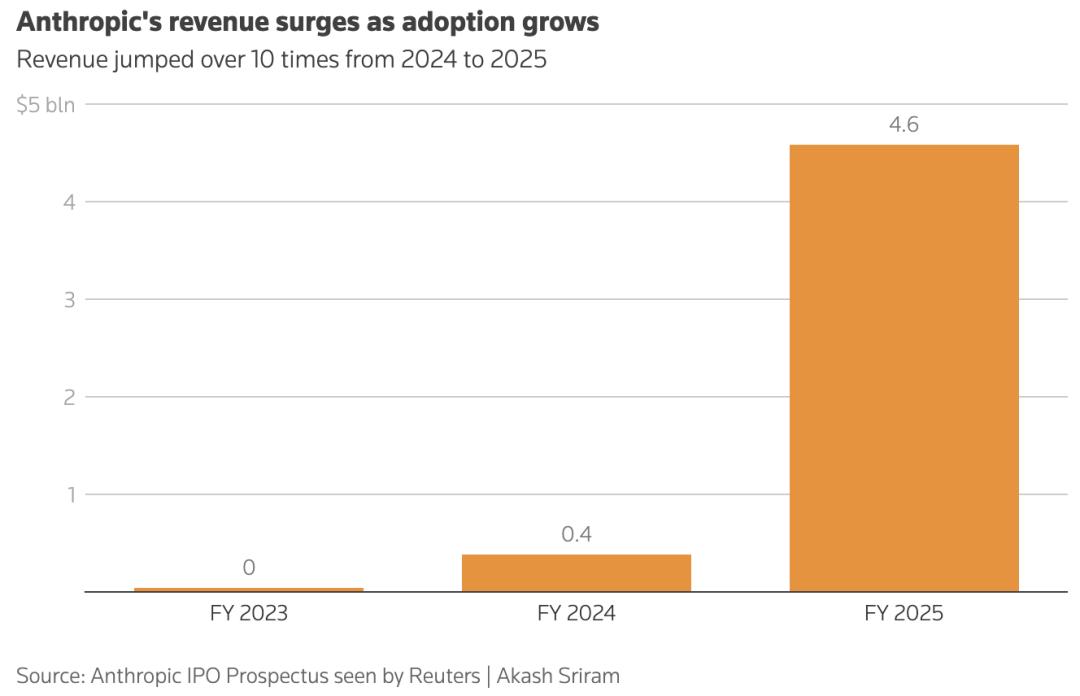
Anthropic's revenue increased from about $400 million in 2024 to nearly $4.6 billion in 2025. (Source: Reuters)
With $4.6 billion in annual revenue and a net loss of $420 billion, the loss is about 9 times its revenue.
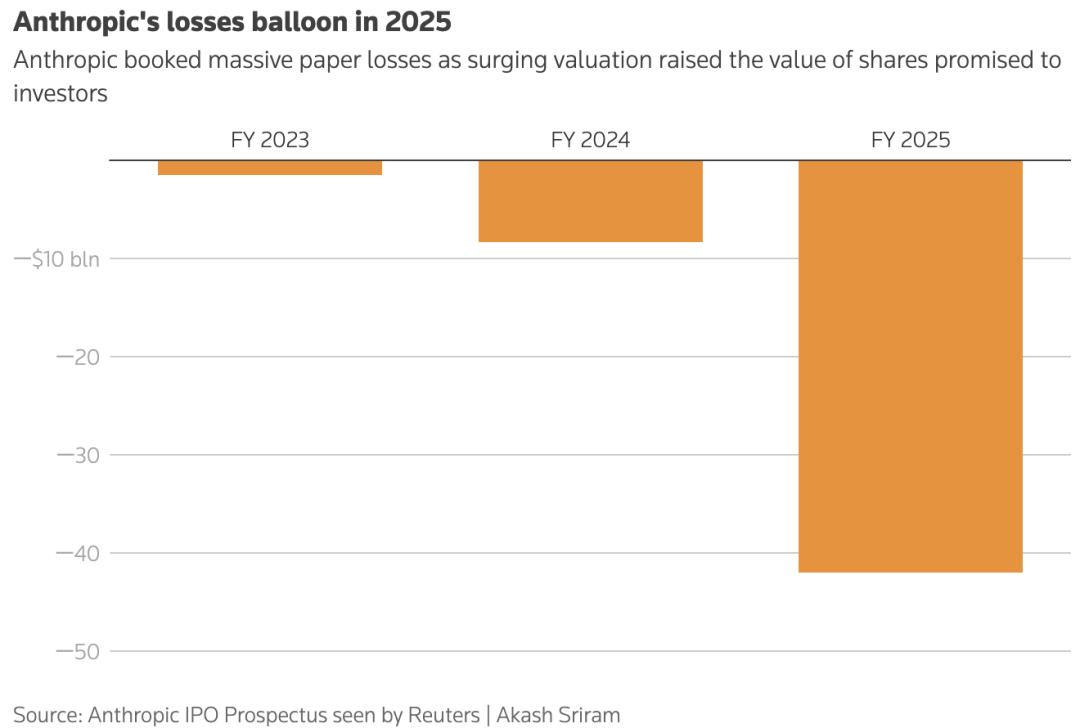
Anthropic's net loss in 2025 was about $420 billion, mainly affected by book expenses generated from financing revaluation. (Source: Reuters)
According to Reuters reports, of the $420 billion net loss, around $340 billion is related to valuation changes of previous financings.
Part of the financing Anthropic obtained in the past may be converted into company shares in the future. As the company's valuation rises, this "share conversion right" held by investors also becomes more valuable.
For the company, the financing obligation it needs to fulfill to investors also increases on the books. According to the accounting rules applicable to this type of financing arrangement, this increased portion of value must be recorded as a current-period loss.
Therefore, this roughly $340 billion is mainly a book expense generated from the revaluation of financing, which does not correspond to an equivalent amount of cash outflow, nor can it be counted as the actual money the company spent on model R&D, computing power procurement or user services that year.
Even after excluding this accounting factor, Anthropic still faces considerable operational pressure.
Anthropic's operating loss in 2025 reached $8.06 billion.
Among that figure, computing power and infrastructure expenditures alone hit $7.33 billion, accounting for nearly 60% of operating expenses.
As revenue and user scale continue to grow, this computing power bill will keep rising further.
Take Claude Code as an example: Anthropic disclosed on February 12 this year that its weekly active user count had doubled compared to the start of the year.
This means greater demand for computing power.
If there is insufficient computing power when customer demand surges, even the most advanced model may fail to handle the flood of incoming business.
But the more computing power you prepare, the higher the corresponding costs will rise.
For Anthropic, the real test is not whether to expand, but whether revenue can grow faster than costs.
In the next stage, whether revenue growth can gradually outpace cost growth will determine if this high-speed expansion can eventually generate profits.
$5.18 Trillion: The huge bet on computing power for the future
The $7.33 billion is only the computing power and infrastructure investment Anthropic has already spent in 2025.
The far larger bet lies in the future.
Prospectus documents show that Anthropic has taken on long-term expenditure commitments of up to $5.18 trillion over the coming years, covering cloud services, computing resources and infrastructure.
To deploy computing power in advance, Anthropic disclosed in May this year that it has signed new computing power agreements with Amazon, Google and Broadcom, and reached GPU computing power cooperation with SpaceX.
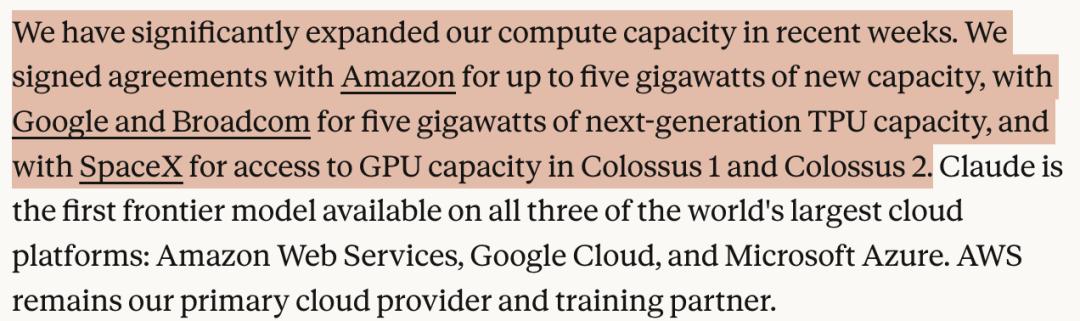
Anthropic has signed computing power agreements with Amazon, Google, Broadcom and SpaceX.
These agreements are the chips Anthropic prepared in advance for future growth.
While computing power can be locked in ahead of time, customer demand cannot be guaranteed in advance.
Once enterprise customers cut their budgets, competitors launch price wars, or product usage falls short of expectations, these long-term computing power commitments may turn from growth enablers into heavy financial pressure.
The $5.18 trillion has already been written into the future expenditure plan, and the real question that follows is:
Will future orders be able to support this huge computing power bill?
Nearly a quarter of revenue comes from just two clients
A figure disclosed in the prospectus adds another layer of suspense to this huge bet.
In 2025, nearly a quarter of Anthropic's revenue came from two customers.
Reuters' recent report did not disclose the specific names of these two clients.
Big customers can quickly boost revenue, but they also make the company more dependent on their orders. Once one of them drastically reduces procurement, the company may lose a large portion of its revenue.
Another risk lies in how long customer orders can be locked in for.
According to Reuters reports, Anthropic warned in its risk factors that many of its largest group of customers have not signed long-term contracts, and may reduce or even stop their expenditures.
Computing power needs to be prepared in advance, but the volume of future purchases from customers is not necessarily guaranteed by long-term contracts.
Whether customers are willing to continue paying also depends on whether using AI is cost-effective for them.
Going forward, the ability to get customers to keep purchasing and expand their usage is the key to supporting the $5.18 trillion long-term computing power investment.
$2 trillion valuation: The market is already betting on the year 2028
Given that the risks are clearly visible, why are supporters still calling for a $2 trillion IPO valuation?
The answer can be found by looking at Anthropic's growth rate.
In 2024, the company's revenue was about $400 million; by 2025, this figure had approached $4.6 billion, roughly 12 times that of the previous year.
In May this year, the company announced the completion of a $650 billion financing, with a post-money valuation reaching $965 billion. It also stated that its annualized revenue run rate for that month had exceeded $470 billion, which is equivalent to converting the revenue rate at the time into a full-year scale.
Investors' sights have even been set on the year 2028.
Reuters cited people familiar with the matter in an August report that Anthropic forecasts its 2028 revenue will be between $1.9 trillion and $2 trillion, and bankers and investors are referring to this future revenue to value the company.

Turning long-term forecasts into reality requires a series of conditions to be continuously met: customer demand keeps expanding, products maintain competitiveness, and revenue growth gradually outpaces the costs that support expansion.
If any of these items falls short of expectations, the valuation may come under pressure.
What will support the $2 trillion valuation expectation?
xAI's parent company SpaceX has already landed on the capital market first.
In June this year, it debuted on the public market with an IPO valuation of $1.77 trillion.

On June 12, 2026, the bell-ringing ceremony of SpaceX was held simultaneously in New York and Texas.
Anthropic is pushing for an IPO valuation that may exceed $2 trillion, but its listing timeline has not yet been finalized.
Reuters said the IPO may be postponed until after the US midterm elections in November. OpenAI has also secretly submitted its listing application, and according to media reports, it may go public in early 2027, with the specific timeline still undetermined.
Trillion-dollar valuations are putting the future of these companies on the scales of the capital market ahead of time.
But going public is only a milestone. Whether a company can sustain its valuation still depends on continuous growth, cost control and reliable products.
For users of Claude and ChatGPT, this competition ultimately boils down to one question:
With the same subscription fee, who can do more work, make fewer mistakes, and let you do less rework and worry less?
The capital market can price in the future in advance, but users are paying for the experience of today.
Whether it is Anthropic or OpenAI, every renewal that supports their sky-high valuations requires a sufficiently practical reason.
References:
https://www.reuters.com/business/finance/anthropics-ipo-prospectus-shows-sweeping-ai-vision-surging-costs-2026-09-28/
This article is from the WeChat official account "AI Era Insight", author: ASI Revelation, published with authorization from 36Kr.