Brand globalization has entered a competition stage of systematic capabilities. The *Insight Report on Accelerated Growth of Brand Globalization* jointly released by Ebrun Think Tank and Pattern analyzes the new growth paths.
As AI reshapes consumers' discovery and decision-making paths, platform rules and compliance requirements are becoming increasingly complex, and the growth rhythm and competition patterns of different regional markets are also accelerating their differentiation. From mature markets to emerging regions, the exploration of globalization continues to deepen, and the stability, efficiency and sustainability of growth are becoming new propositions that brands are facing together.
To find answers, brands, founders, CEOs and service providers are all asking the same core question: when the supply of goods continues to increase but sales growth fails to keep pace, how to obtain more market share through more precise marketing, more efficient operations, more in-depth localized services and landing resources?
On September 17, 2026, the Accelerate26 Cross-border Ecosystem Acceleration Conference founded by Pattern was held for the first time in Shenzhen, China. This annual event in the North American e-commerce industry aims to directly connect Pattern's accumulated resources of head platform players, service providers and brand decision-makers in North America with local brand founders and executives who have the strongest overseas expansion capabilities, helping Chinese brands accelerate their global layout.
At the conference, Ebrun Think Tank and Pattern jointly released the Intelligent Win · Symbiosis: Insight Report on Accelerated Growth of Brand Globalization (hereinafter referred to as the "Report"). Zheng Min, Chairman of Ebrun Power and Dean of Ebrun Think Tank, gave an on-site interpretation, focusing on answering three key questions: Where are the global growth opportunities? What kind of operation system do brands need to build? What kind of cooperation model can continuously convert market opportunities into business results?
01 The global market continues to expand, what changes have taken place in the growth logic?
Insight 1: Global e-commerce is shifting from "scale expansion" to "long-term operation"
The overall global e-commerce market continues to expand. eMarketer data points out that from 2026 to 2028, global retail e-commerce sales are expected to grow from US$6.8 trillion to nearly US$8 trillion, maintaining an annual growth rate of about 7%. Mature markets such as the United States and Europe continue to form an important base, the Asia-Pacific region continues to act as the growth pole of global e-commerce scale, and emerging markets such as Latin America and the Middle East are also further releasing their potential. At the same time, the differences in consumer demand, channel ecology and operation rules in different regions are more significant, and brand competition has shifted from competition for single products and traffic to competition for comprehensive operation capabilities.
Insight 2: Policies support the dual-cycle development of cross-border e-commerce
The policy system continues to support the dual-cycle development of cross-border e-commerce. On the import side, the facilitation of customs clearance and the optimization of the list of imported commodities continue to expand the high-quality domestic supply; on the export side, policies related to export tax rebates, overseas warehouse construction and cross-border e-commerce development continue to be improved. In the first quarter of 2026, China's total import and export of cross-border e-commerce reached 6184.6 billion yuan, of which exports were 4735.5 billion yuan and imports were 1449.1 billion yuan. This policy framework not only helps Chinese brands expand overseas markets, but also creates a more mature operating environment for overseas brands to enter China.
Insight 3: AI and compliance, two core variables, reshape the operation logic of cross-border e-commerce
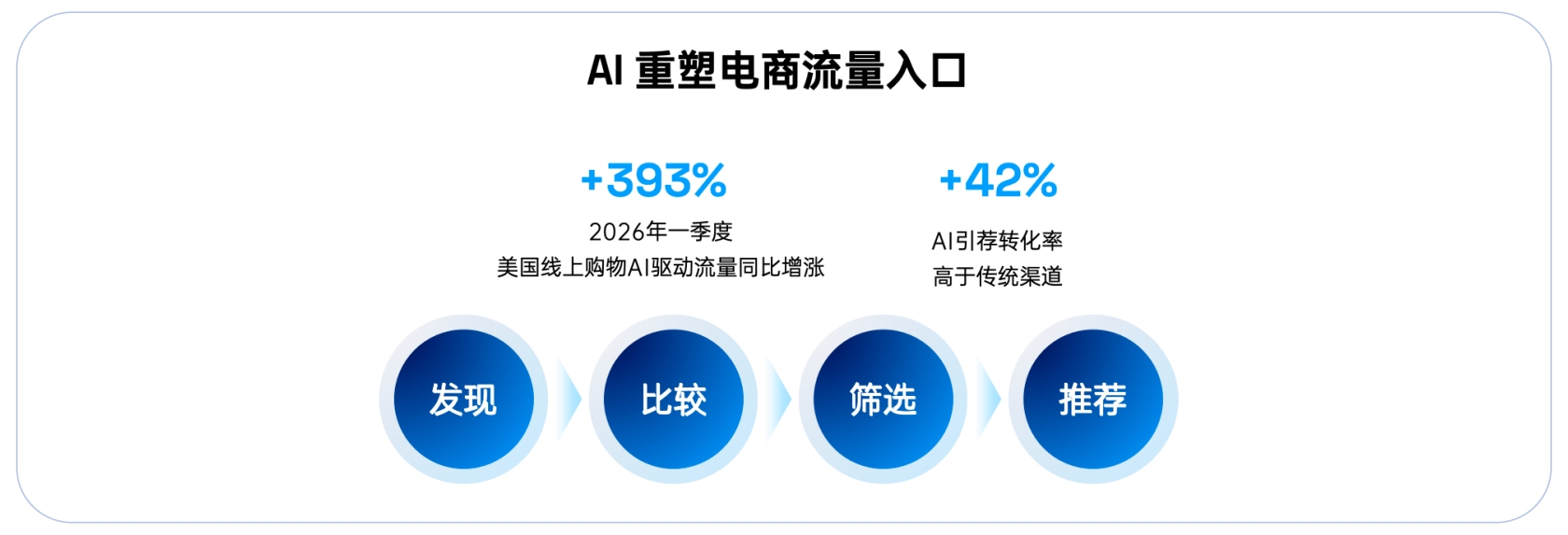
AI reshapes e-commerce traffic entrances. Data from Adobe Analytics shows that in the first quarter of 2026, generative AI-driven U.S. online shopping traffic increased by 393% year-on-year, and its referral conversion rate was 42% higher than that of traditional channels. Consumers' shopping entrances are extending from "active search" to "expressing demands", pushing brand traffic operations to further expand from traditional SEO to GEO (Generative Engine Optimization).
At the same time, global tax, environmental protection and data compliance requirements continue to become stricter. Brands need to move compliance reviews forward to links such as product selection, listing, marketing and logistics, and establish a dynamic monitoring system covering different markets.
AI raises the upper limit of efficiency, and compliance requirements clarify the bottom line of operation. The two together push global e-commerce to pay more attention to long-term operation quality.
02 Opportunities for brand globalization are expanding, and operational complexity is rising simultaneously
Three major opportunities × Three major bottlenecks, forcing the upgrading of global operation capabilities
Opportunity 1: Industry dividends are concentrated in branded enterprises
As the release of traffic dividends slows down and compliance and marketing costs increase, merchants that rely mainly on low-cost supply chains and inventory-stocking models to achieve growth face higher operational pressure, while branded enterprises with technological R&D, product premium and agile supply chain capabilities usher in new development opportunities. Marketplace Pulse data shows that the number of sellers with annual sales exceeding US$1 million on Amazon's global sites increased from 60,000 in 2021 to more than 100,000 in 2025, and the number of large sellers with annual sales exceeding US$100 million also increased from 50 to 235.
Opportunity 2: Omnichannel coverage revitalizes the long-term value of users
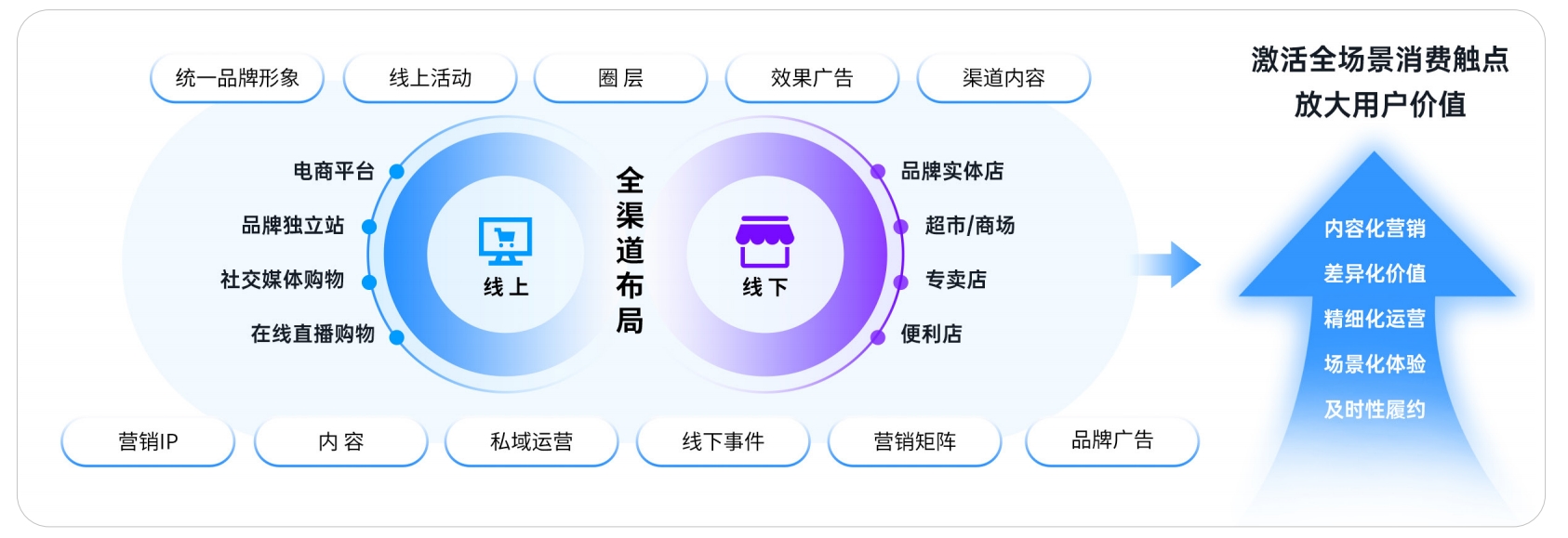
Data shows that 73% of consumers worldwide choose to shop across channels. As consumers' shopping paths become more non-linear, brand operations are no longer limited to a single e-commerce platform, but gradually form a channel matrix composed of third-party platforms, independent sites, social e-commerce and physical retail. Brands identify personalized needs through user behavior and sales data, and continuously deepen consumer connections combined with localized services, which gives them the opportunity to further release the long-term value of users.
Opportunity 3: Upgraded consumer experience opens up the value space of the supply chain
Efficient fulfillment, product quality and personalized services are increasingly significantly affecting consumers' purchasing decisions. Brands not only need to continuously improve product innovation and quality capabilities on the manufacturing side, but also need to respond to consumers' higher requirements for speed and experience with more efficient, safe and convenient logistics, payment and related services on the delivery side.
While the three major opportunities are accelerating their release, global operations are also facing three major bottlenecks.
Bottleneck 1: The traditional direct sales model is under pressure of capital cost
Building self-operated teams for operations, marketing and customer service not only requires brands to bear continuous manpower and market investment, but also requires them to complete global stock preparation on their own and bear the costs of inventory, logistics and warehousing. Data shows that among the operational costs of cross-border e-commerce supply chains, product costs account for about 20%-30%, advertising and marketing costs account for about 10%-15%, and logistics and warehousing costs account for about 15%-20%. The heavy-investment operation model further increases the pressure on capital turnover.
Bottleneck 2: Multi-management of service providers dilutes the effect of localization
According to a survey by Ebrun Think Tank, 62.5% of brands believe that localization capability is the most necessary capability in the process of globalization. However, in actual operations, brands often need to connect with multiple service providers for marketing, payment, warehousing and compliance across regions. The lack of unified operational goals and data collaboration in all links not only increases management costs, but also extends the decision-making chain and reduces the efficiency of brands in responding to market changes.
Bottleneck 3: Market volatility intensifies the risk of overstocking
The cross-border supply chain has a long cycle. When there is a deviation between sales forecasts and actual demand, in-transit inventory and overseas warehouse inventory are prone to overstocking; the fragmentation of multi-channel inventory and insufficient reverse logistics capabilities further increase the difficulty of inventory digestion. The Ebrun Think Tank survey shows that 61.2% of merchants are worried about the risk of unsalable overstocking.
Full-link growth partner empowerment becomes the key to breaking the situation
The three major opportunities and three major bottlenecks together show that what brands need is not just more service providers, but growth partners who can unify operational goals, integrate global resources and share results together. The Report believes that such partners need four core capabilities: risk sharing, full-link integration, data-driven and localized operation. To judge its value, we should not only look at its single service capability, but also see whether it can truly connect the benefit mechanism, operational goals, data system and market execution.
Based on this, the Report takes Pattern's global e-commerce platform accelerator as a research sample to observe how this model can be transformed into specific business results.
03 How does Pattern build a brand globalization growth system?
A systematic methodology runs through the entire growth link
What brands need for globalization is not just scattered capability modules, but a continuously operable business system.
Focusing on this judgment, the Report summarizes the growth methodology of Pattern's global e-commerce platform accelerator into four levels:
The first level is to clarify the responsibility and benefit mechanism with the brand global general distribution model;
The second level is to disassemble the core operational leverage with the e-commerce business growth equation;
The third level is to drive the intelligence and automation of operational decisions with two AI engines;
The fourth level is to connect China and the global market with a two-way growth channel.
The four levels respectively answer "who is responsible", "what to operate", "how to execute" and "how to enter different markets", and together form a replicable and continuously evolving brand globalization growth system.
First level: Clarify responsibility and benefit mechanism with the general distribution model
In the traditional service procurement relationship, service providers usually charge according to projects or service contents, and brands bear the main risks of inventory, market and operation. Although the two sides have a cooperative relationship, their operational goals may not be completely consistent.
Pattern undertakes the responsibilities of distribution and operation within the scope of brand authorization, and upgrades the traditional service relationship to in-depth collaboration focused on business results through integrated procurement and sales, risk sharing, full-link integration and localized execution.
This model mainly includes three mechanisms.
Mechanism 1: Role collaboration, focus on advantages
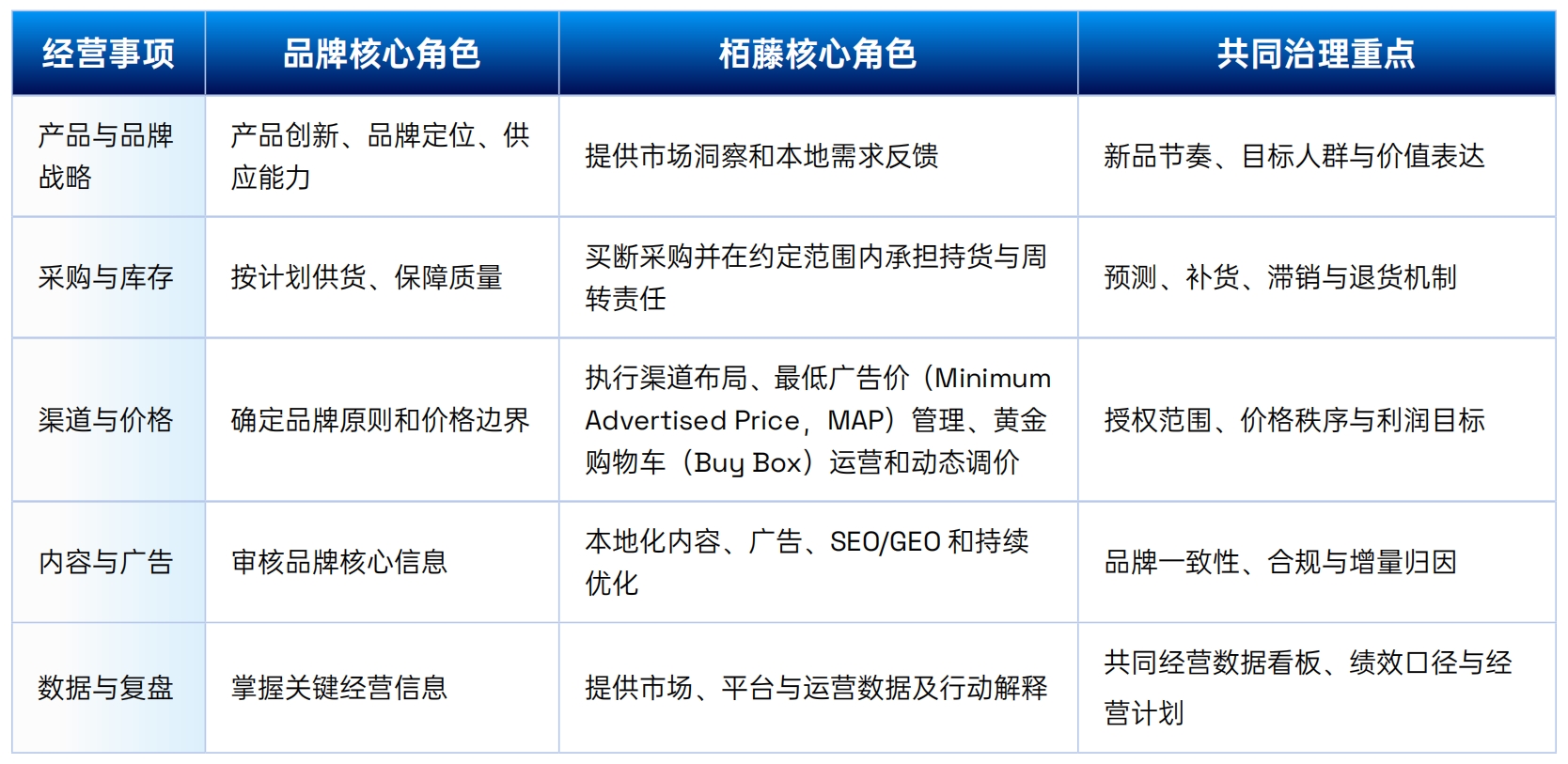
Brands focus on product innovation, supply chain construction and brand asset precipitation; Pattern is responsible for market execution, compliance, customer service and fulfillment within the authorized scope, and continuously feeds back local market insights to brands. The two sides have shifted from a simple service procurement relationship to professional division of labor around the same operational goal.
Mechanism 2: Integrated procurement and sales, risk sharing
Under the traditional agency operation model, the risks of inventory, returns and market fluctuations are mainly borne by brands; Pattern assumes the responsibilities of procurement, stock holding and inventory turnover within the agreed scope through buy-out procurement and sales, alleviating the pressure of capital occupation and trial and error in the process of global brand expansion. The two sides form a more consistent benefit mechanism around indicators such as sales, inventory turnover and profit performance.
Mechanism 3: Co-governance, clear rights and responsibilities
Brands retain core strategic decision-making power, and Pattern is responsible for specific operation execution within the authorized scope; the two sides establish a co-governance mechanism for key matters such as price, channels, advertising and inventory, clarify decision-making boundaries, information sharing and effect attribution, and improve market response efficiency while maintaining the long-term value of the brand.
The general distribution model first solves the problem of "who is responsible". Only when responsibilities, benefits and decision-making boundaries are clarified can brands free themselves from scattered daily operations and focus their core energy on product innovation and brand building.
Second level: Disassemble the core operational leverage with the e-commerce business growth equation
The cooperation mechanism clarifies who is responsible, and the e-commerce business growth equation further answers what the two sides should manage.
Based on the panoramic operation thinking, Pattern summarizes the core variables that affect revenue growth as:
Revenue = Traffic × Conversion × Price × Supply

Traffic determines how many consumers see the product, conversion determines how many of these demands form orders, price determines the value that each order can realize, and supply determines whether the product can remain available for sale and be delivered on time. The supply here not only refers to the inventory quantity, but also includes the capabilities of stock preparation, inventory turnover and fulfillment guarantee.
The four levers together form a complete growth link. If any link has shortcomings, it will affect the final revenue. Insufficient traffic makes it difficult for brands to obtain effective demand; insufficient conversion makes it impossible for traffic to form orders; mismatch between price and market will affect conversion and value acquisition; insufficient supply may lead to stockouts, delivery delays and sales losses.
Through the e-commerce business growth equation, brands can judge which link the problem comes from when revenue changes, and determine resource input and optimization priorities accordingly. Growth management is thus transformed from a general performance goal into a measurable, executable and continuously improvable operational task.
Third level: Drive intelligent and automated operational decisions with two AI engines
After clarifying the cooperation mechanism and growth path, brands also need to implement it in daily operations, continuously identify growth opportunities, optimize operational decisions through data and AI, and automatically execute specific tasks.
As of September 2026, Pattern has accumulated more than 91 trillion data points and holds 44 patents (including granted and pending ones). Relying on this data and technology base, the company deeply applies artificial intelligence to every link of brand growth, and builds the AI autonomous e-commerce execution engine Pattern Intelligence (Pi) and the intelligent advertising engine Destiny through self-developed models and full-stack technology system, helping brands achieve global growth with higher efficiency and stronger predictability.
The Pi AI autonomous e-commerce execution engine builds an intelligent operation closed loop of "Perception - Decision - Execution - Feedback". Pi continuously monitors product quotations, advertisements, content, pricing and inventory, and automatically executes optimization or repair operations after identifying opportunities or risks; when brand judgment is required, it pushes decision items to manual approval. Since its deployment, Pi has performed millions of automatic operations in its brand portfolio, including restoring product recommendation positions, adjusting prices and repairing content, and can run 24/7 non-stop.
The Destiny intelligent advertising engine focuses on the real incremental value of advertising. It integrates data of advertising, consumer behavior and product performance, optimizes resource allocation through automatic bidding and budget adjustment, helping brands shift from focusing on exposure and advertising sales to measuring the contribution of advertising to actual growth.
Fourth level: Connect China and the global market with a two-way growth channel
The AI engine provides brands with decision-making and execution capabilities, and Pattern's channel network and