Five-year assessment of the international consumption center city: Beijing has turned in its answer sheet!
"At midday, the market is held, gathering people from all over the world and bringing in goods from every corner of the globe." This ancient proverb from the *I Ching* is solemnly included in the preface of the "Special Plan for the Layout of Commercial and Consumption Spaces in Beijing (2022-2035)."
This is far more than a decorative phrase. It represents policymakers' in-depth understanding of the logic of urban commerce. The vitality of the "market" lies in aggregation, circulation, and the ability to attract people's hearts.
In July 2021, with the approval of the State Council, five cities including Beijing, Shanghai, Guangzhou, Tianjin and Chongqing took the lead in standing on the starting line of fostering and building international consumption center cities. Five years on, before we review the performance of Beijing's construction, we must first clarify the core proposition of this task. Why build an international consumption center city? What exactly is it? What kind of mission do the first batch of pilot cities shoulder?
Let's first look at a global shift. After entering the post-industrial society, urban functions are shifting from production-led to consumption-led. From Weber's "consumer city" in the 1920s to Glaeser's *The Consumer City* in 2001, academic judgments have become increasingly clear: Consumption is replacing production and becoming the primary driving force for urban development.
Then let's look at why China is pursuing this task. The two engines of investment and export are showing signs of fatigue. Although China is already a major global production country, it cannot yet be called a strong consumption country. The production side has reached a high point, while the consumption side remains underdeveloped. From the "focus on expanding domestic demand" put forward in the report of the 20th National Congress of the Communist Party of China, to the Central Economic Work Conference listing boosting consumption as an annual key task, making up for the shortcomings in consumption has become an unavoidable priority.
The international consumption center city is exactly the official solution to this problem.
Beijing, Shanghai, Guangzhou, Tianjin, Chongqing — they are not only the core engines of the Beijing-Tianjin-Hebei region, the Yangtze River Delta, the Guangdong-Hong Kong-Macao Greater Bay Area, and the Chengdu-Chongqing twin-city economic circle, but also the cities with the largest domestic consumer market scale, the highest level of internationalization, and the strongest policy willingness. Letting them carry out pilot initiatives first and then radiate and drive the surrounding urban agglomerations is a classic reproduction of the Chinese-style "pilot diffusion" policy logic in the consumption field.
Academics have deconstructed the concept of "international consumption center city". The term "international" refers to focusing on the global scope, gathering global consumption resources and attracting global consumers, rather than only gathering local stock; "consumption" is not a simple transaction of goods, but the sum of scenarios, fashion, culture and social experience, and sometimes consuming a scenario is more important than consuming a physical product; "center" points to the hub status and radiation driving capacity in the global network system.
The final measurement of it is never just the single indicator of total retail sales of consumer goods, but the comprehensive level jointly formed by international popularity, consumption prosperity, commercial activity, accessibility, and consumption comfort.
Beijing, which has spent five years on this pilot, is now handing in its report card.
01.
Performance Sheet: The Redefined Concept of "Consumption"
Five years is long enough to see the overall outline of a systematic reconstruction of urban commercial functions. We look at the total volume for consumption scale, the quality for consumption structure, the attractiveness for the number of first stores, the vitality for online retail, and the supply for commercial space. Combining these dimensions gives a full picture of a city's consumption ecosystem. Over the past five years in Beijing, data from each year tells a story of "change".
Pilot Cities' Consumption Scale Fluctuates at a High Level, and the Resilience of the Overall Market Foundation Is Highlighted
2021 to 2025 marks the complete five-year cycle for the first batch of international consumption center city cultivation and construction. During this period, the total retail sales of social consumer goods of the five pilot cities have remained at a high level, with the total volume rising from about 6.08 trillion yuan in 2021 to about 6.21 trillion yuan in 2025, continuously occupying the core weight of the national consumer market.
By tier, Shanghai has always been firmly in the first echelon of national consumption scale, Chongqing continues to release high growth momentum, Guangzhou makes steady progress, Tianjin expands steadily, and Beijing enters the advanced stage of structural adjustment.
What is particularly noteworthy is Beijing's performance. As the capital sample among the first batch of pilots, Beijing's total retail sales of consumer goods have remained stable in the high range of 1.3-1.5 trillion yuan over the past five years, reaching 1,486.77 billion yuan in 2021, the peak of the five years; later, affected by factors such as the consumption shift of traditional fuel vehicles and the adjustment of durable goods consumption cycle, the total volume showed a high fluctuation trend, reaching 1,367.7 billion yuan in 2025.
Entering 2026, the trend of structural adjustment of total retail sales of consumer goods continues. According to official data from the Beijing Municipal Bureau of Statistics, the city achieved a total retail sales of consumer goods of 658.78 billion yuan in the first half of the year, down 2.2% year on year; after excluding automobile-related commodities, the decline in retail sales of consumer goods narrowed to 0.1%, and the overall consumption foundation remained resilient.
Behind these data, however, is the active shift of Beijing's consumption growth drivers. Service consumption and experience consumption are taking over as the main growth engines. The slowdown in the growth rate of total retail sales of consumer goods precisely reflects that Beijing is advancing from a "large commodity consumption city" to a "strong service consumption city", which is also a typical feature of the international consumption center city upgrading to the stage of high-quality development.
Consumption Structure Continues to Adjust, and the Proportion of Service Consumption in Total Household Consumption Rises Year by Year
The historical experience of developed countries shows that there is a close correlation between the upgrading of consumption structure and the level of economic and social development of a country or region. It is worth noting that the gradual increase in the proportion of service consumption has become a significant feature of consumption structure upgrading.
From 2021 to 2025, the per capita consumption expenditure of Beijing residents rose steadily from 43,640 yuan to 50,667 yuan, with a cumulative increase of 16.1% in five years and an average annual growth of about 3.8%. Behind this total growth, the resident consumption structure is undergoing continuous optimization and upgrading.
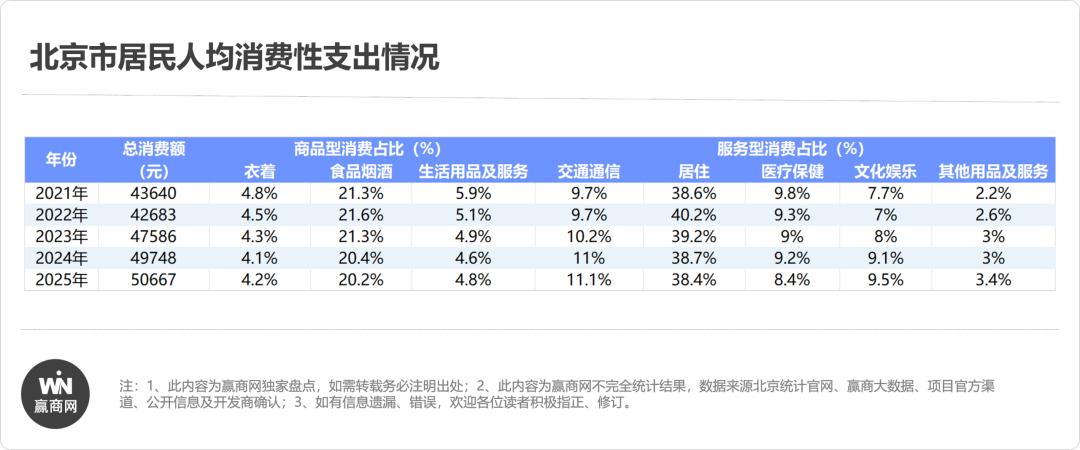
The proportion of Beijing residents' housing consumption has always remained in the high range of 38% to 40%. The persistently high proportion of housing consumption not only reflects the high housing cost in Beijing as a megacity, but also squeezes the expenditure space of other consumption fields to a certain extent.
Overall, in 2025, the proportion of Beijing residents' service consumption expenditure in per capita consumption expenditure has approached 70%, the highest level in the same period since 2015. This proportion is close to the average level of 60% in Western developed countries, marking that qualitative changes have taken place in the consumption habits and demand structure of Beijing residents.
High-quality First Store Pattern of the Five Cities: Hierarchical Total Volume and Differentiated Structural Focus
Cities have formed a first-store brand structure with their own priorities, which also reflects the differentiated paths of the five cities in the construction of international consumption centers.
According to the 2025 high-quality first store statistics from Winshang Data, in terms of total volume, Shanghai ranks firmly in the first echelon with 521 high-quality first stores, leading comprehensively in the thickness and breadth of the first store ecosystem; Chongqing ranks second with 435 stores, with dense layout of regional and mass first stores; Beijing ranks third with 350 stores, and the overall first store structure tends to medium and high levels; Tianjin and Guangzhou have 339 and 321 stores respectively, in the third echelon.
The structure of 350 high-quality first stores in Beijing precisely fits the positioning of the capital's international consumption center city. There are 4 top-level S-class first stores, second only to Shanghai, maintaining strong agglomeration of top luxury brands and consolidating the benchmark positioning of international high-end consumption. On the whole, the core advantage of Beijing's first-store economy does not lie in the total scale, but in brand energy level and consumption driving force. The proportion of high-quality first stores is higher, and the leading force for high-end consumption and trend consumption is stronger, which highly matches the consumption positioning and customer group structure of Beijing as the capital.
Consumption Scenarios Continue to Iterate and Innovate, Three New Initiatives Are Implemented in Depth
During the five-year cultivation period, Beijing takes new formats, new models and new scenarios as the core starting point, promotes the in-depth integration of digital technology, cultural and sports resources and physical consumption, continuously expands the time and space boundary of consumption, and builds a multi-level consumption innovation ecosystem.
Digital consumption continues to lead, with the proportion of instant retail rising from 15.5% in 2020 to 31.5% in 2025; a total of 35 municipal-level characteristic live-streaming e-commerce bases have been recognized, and 24 of the national TOP100 MCN institutions are located in Beijing, ranking first in quantity; benchmark projects such as the Sanlitun Smart Business District and Taikoo Li South District Smart Store have been launched, and digital technology has been deeply integrated into physical commercial operations from online tools.
Different from the statistical caliber of high-quality first stores, according to data from the Beijing Municipal Bureau of Commerce, from 2021 to 2025, Beijing introduced more than 4,600 first stores in total. The debut economic model has advanced, with more than 500 high-quality first stores launched in total and 12 global debut centers cultivated; in the first half of 2025, 520 events including debuts, first shows and first exhibitions were held, and the first-store economy has been upgraded from a single "brand landing" to a full-chain operation traffic engine. The in-depth integration of culture, business, tourism, sports and exhibitions, the night economy has been iterated to version 3.0, and 14 national-level night cultural tourism consumption agglomeration areas have been launched; both events and performances have grown, the 2025 China Open box office hit a record high, and the annual performance box office doubled compared with 2020, highlighting the linkage effect of the "ticket root economy".
Consumption spaces are diversified and innovative, with characteristic scenarios such as Shougang Sixihui and Tangu launched, and 850 15-minute convenient living circles fully covered. In 2025, Beijing was approved as a "Three New" pilot by the Ministry of Commerce, and consumption innovation entered a new stage of systematic promotion.
02.
The Depth of Commercial Scene: Points, Lines and Surfaces
As industry observers, Winshang Network pays more attention to the evolution of physical commerce behind the numbers.
Over the past five years, Beijing's commercial consumption space is not a scattered pile of projects, but follows the three-level progressive logic of points, lines and surfaces: taking a single commercial project as a "point" to realize commercial upgrading; taking format integration as a "line" to extend the consumption chain; taking space networking as a "surface" to expand the radiation range, and finally build a full-coverage commercial consumption ecosystem.
Point: The Emergence of New Landmarks and the Rebirth of Old Landmarks
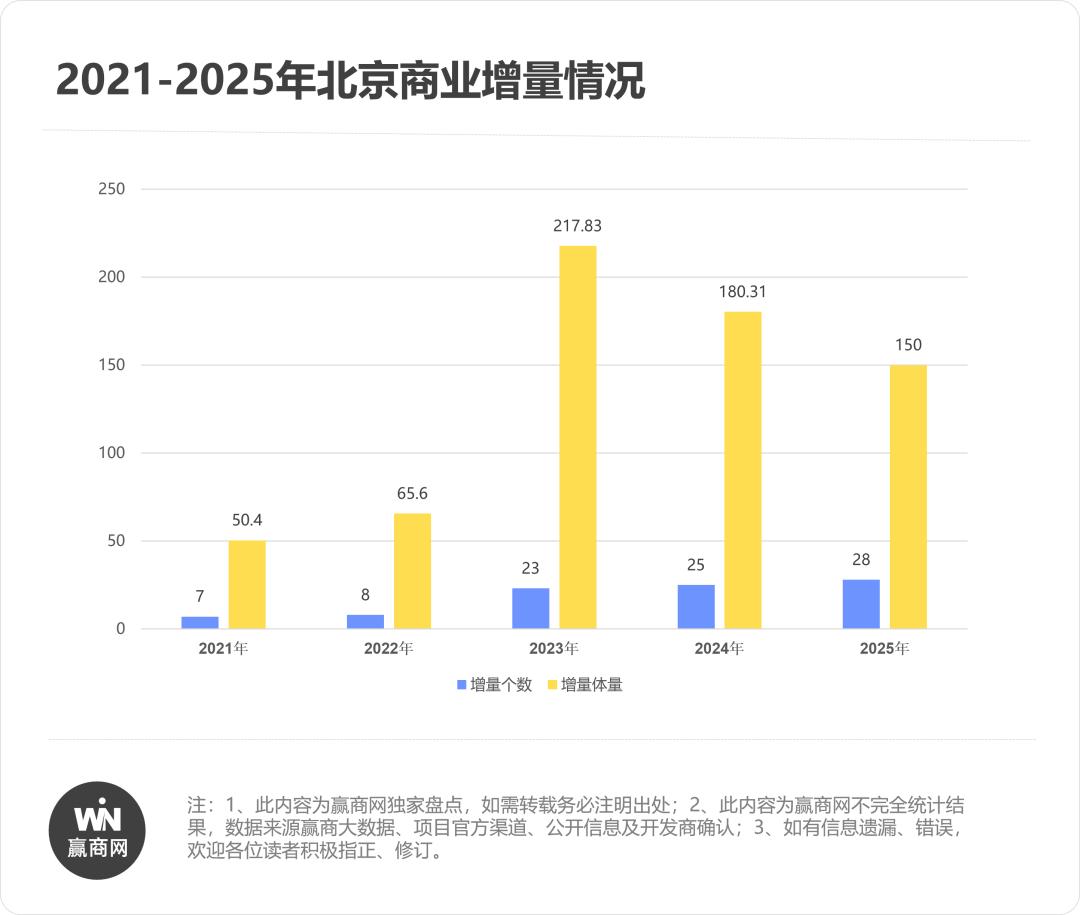
According to incomplete statistics from Winshang Data, from 2021 to 2025, Beijing added more than 6.6414 million square meters of commercial space and 91 new commercial projects, with 2023 being the peak period of new commercial supply in Beijing. The market advances along two main lines: new supply accurately complements the context of urban development, fills the gaps in different districts, and explores the boundary of scenarios; stock assets are deeply activated and upgraded, evolving from hardware renovation to content reconstruction and value revaluation. The two types of projects together constitute the core growth pole of Beijing's commercial consumption.
■ New Supply: Precise Complementation, Scenario Breakthrough
The new commercial projects launched in the past five years have completely broken away from the old path of traditional Beijing commerce featuring "core agglomeration, layout along the ring road, and all-customer positioning", and have been fully iterated in location logic, format structure and content core, forming a new commercial force differentiated from traditional core business districts, and reconstructing the spatial territory and track boundary of urban commerce.
One type is new city complementary commerce, which accurately undertakes the demographic dividend of urban function decentralization and industrial spillover, and no longer pursues the traditional shopping mall paradigm of "large and comprehensive" in format configuration, but targets the needs of regional customer groups. Longfor Lize Paradise Walk, Longfor Yizhuang Paradise Walk, and Yinghai UniFUN are anchored in industrial agglomeration areas such as Lize Financial District, Yizhuang Economic Development Zone, and Daxing New City, while Xisanqi MixC, Xibeiwang MixC, and Changping Shahe Wanda Plaza make up for the shortcomings of commercial supporting facilities in densely populated working and living areas such as northern Haidian and Changping New City.
The core value of such projects lies in filling the gap of high-quality commerce in the region, digesting the consumption demand of industrial population locally, promoting the integration of work, residence and consumption, improving the overall livability and commercial level of the region, making Beijing's commerce evolve from "single-center agglomeration" to "multi-center balance", and enhancing the overall livability and commercial level of the region.
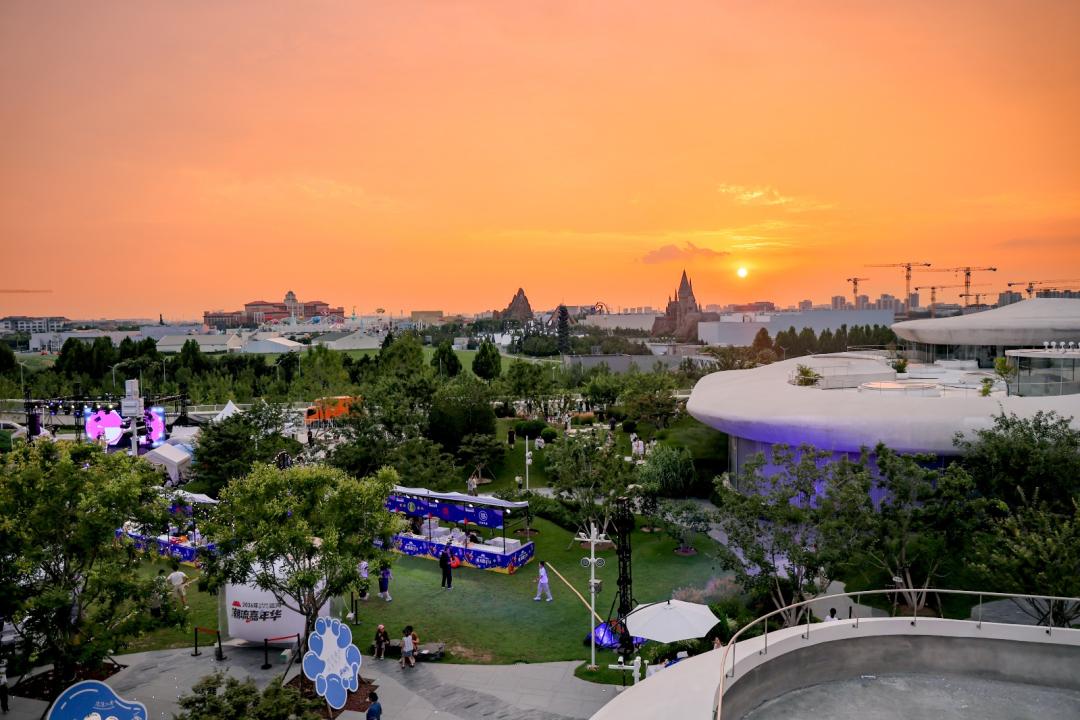
Wanli, Source: Official project materials
The other type is scenario breakthrough commerce, which breaks through the boundary of traditional central urban business districts, explores new consumption tracks, takes content as the core, and makes commerce a supporting facility for scenarios rather than the main body. The most representative one is Tangu Slow Flash Park, which extends the commercial scene to the shallow mountain area of western Beijing, takes "near-mountain mini-vacation" as its core positioning, integrates multiple formats such as outdoor, nature, art and commerce, and opens up a new track of destination-oriented commerce in Beijing; Wanli relies on the Universal Resort IP, through Wangfujing Welltown, Tingyun Town and Nuolan Hotel, to create an integrated consumption cluster of culture, business and tourism, converting the tourist flow from all over the country into commercial increment, breaking the traditional boundary that urban commerce only serves local customers.
■ Stock Revitalization: Asset Reconstruction, Value Revaluation
In the past five years, the renewal of Beijing's stock commerce has fully entered the deep-water area, no longer staying in the 1.0 stage of facade renovation and hardware upgrading, but fully shifting to the 2.0 stage of positioning reconstruction, content operation and customer group reset. Different types of stock assets are iterating along a clear direction, promoting traditional commercial forces to complete self-evolution and maintain the basic commercial base of the central urban area.
The transformation of traditional department stores is deepening in the direction of